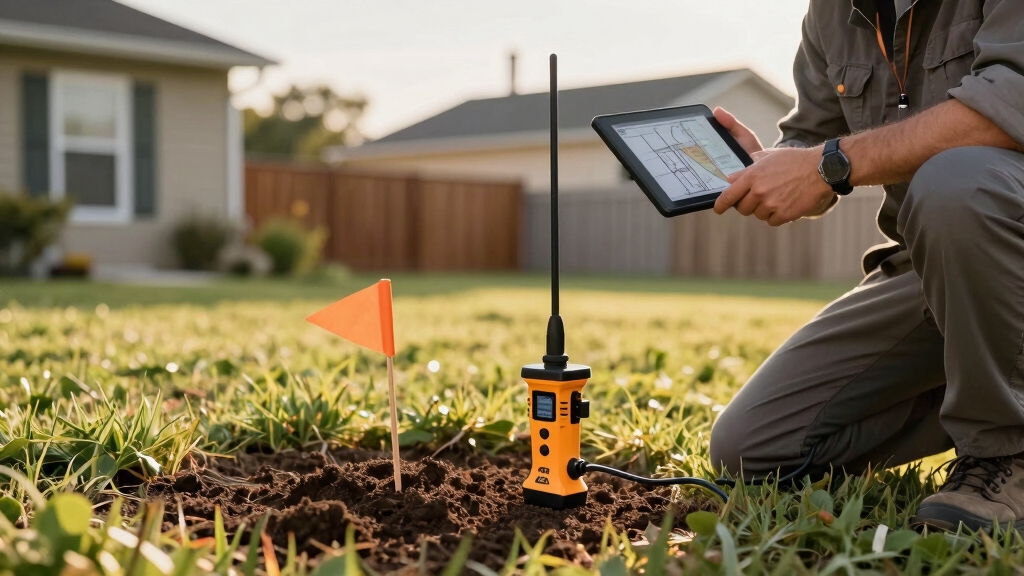

You can find your septic tank location by first checking property deeds, building permits, or site plans for system details.
Look for yard signs like lush grass patches or inspection risers near your house’s sewer cleanout to trace pipes. Using a soil probe in a grid pattern helps map the tank’s outline underground.
Electronic tools like transmitters or ground-penetrating radar provide precise detection. If you need detailed guidance on each method, keep exploring these proven techniques.
Key Takeaways
- Check property records, building permits, and health department files for septic system location and installation details.
- Look for yard indicators like lush grass, soil depressions, or inspection caps signaling septic tank placement.
- Locate the main sewer cleanout near the house foundation to trace the pipe direction toward the septic tank.
- Use a soil probe in a grid pattern around the house to detect firmer resistance indicating the tank’s edges and lid.
- Employ electronic tools like flushable transmitters, ground-penetrating radar, or magnetic locators for precise septic tank locating.
Reviewing Property Records and Septic System Documentation

When you start looking for your septic tank, the best place to turn to is your property records and septic system documentation. Your property deed often indicates whether a septic system exists, while building permits detail installation dates and precise locations.
Begin your septic tank search with property records and building permits for installation details and locations.
Design plans and site maps clarify the original tank placement, usually 10 to 20 feet from your foundation. You can access these records at the local county recorder’s or municipal building department.
Septic permits and as-built drawings provide exact system layouts and specify setbacks, generally no less than 10 feet from structures. Health departments maintain permit copies linked to soil properties.
Additionally, home purchase documents like surveys and inspection reports may include compliance certificates confirming septic tank details. Keep in mind that record availability varies by jurisdiction, so persistence in searching local offices or online portals is essential.
Remember, proper tank sizing and system design are critical for avoiding septic system failure and ensuring long-term functionality.
Identifying Visual Signs in Your Yard
You’ll often find important clues about your septic tank’s location by carefully inspecting your yard’s vegetation and soil conditions. Look for patches of lush grass or vigorous shrubs that suggest nutrient-rich effluent presence.
Conversely, dead or stressed vegetation may indicate soil saturation or leakage. Surface contours can also help; slight depressions or mounds often mark buried components.
Additionally, persistent damp spots or sewage odors might point to failing areas. Key visual indicators include:
- Enhanced plant growth or greener grass over tank or drainfield areas
- Depressions or raised soil features indicating tank settling or drainfield lines
- Damp, spongy ground or pooling water signaling effluent surfacing
- Visible inspection caps, risers, or vent pipes marking access points
These signs collectively assist in pinpointing your septic tank’s location. For added security, similar to how peepholes provide privacy considerations for homeowners, identifying your septic tank location can help prevent accidental damage during yard work or construction.
Tracing Sewer Lines From the House

Start by locating the main sewer cleanout near your house foundation. This provides direct access to the sewer line. Remove its cap to determine the line’s direction and mark the location.
Next, consult your property records for as-built drawings and permits that outline pipe paths and depths. Contact 811 to have underground utilities marked safely before digging.
Use a pipe locator tool by feeding the transmitter line into the cleanout and tracing signals above ground, marking key points. If needed, verify with professional tools like camera inspections or ground-penetrating radar.
For added security during any digging, consider installing a peephole on your metal access doors to monitor activity nearby.
| Step | Action |
|---|---|
| Locate cleanout | Find capped pipe near foundation |
| Check records | Review surveys, permits, zoning data |
| Call 811 | Request underground utility markings |
| Use locator tool | Trace sewer signals from cleanout |
| Verify professionally | Employ camera or radar as needed |
Using Probing Techniques for Tank Detection
After tracing the sewer line from your house, probing techniques offer a practical method to pinpoint the septic tank’s exact location underground.
Tracing the sewer line helps accurately locate your septic tank underground using effective probing methods.
Use a long, narrow soil probe with a T-handle to reach depths of 6 to 30 inches or more. Insert the probe vertically and steadily, noting firmer resistance that marks the tank top or baffle.
Map the tank perimeter by probing in a grid pattern every 18–24 inches. Mark probe hits to outline the tank and identify likely lid locations near the center.
Key points to follow:
- Use solid steel or tapered probe tips to penetrate soil without damaging components.
- Mark known underground utilities before probing to avoid hazards.
- Avoid probing over soft drainfield areas or thin-walled pipes.
- Record probe depths and distances relative to house features for accuracy and future reference.
For improved detection accuracy, consider how electromagnetic interference from surrounding infrastructure might affect your probing results.
Employing Electronic Tools and Professional Services
To zero in on your septic tank’s location with greater accuracy, electronic tools and professional services can substantially streamline the process. Devices like flushable transmitters emit signals tracked by receivers, while ground-penetrating radar (GPR) images subsurface features.
Magnetic locators detect metal lids quickly. Professionals often combine these techniques for superior results, minimizing unnecessary digging.
| Tool Type | Strengths | Limitations |
|---|---|---|
| Flushable Transmitters | Precise tracking within pipes | Blocked pipes stop signals |
| GPR | Non-invasive depth and footprint | Affected by soil conductivity |
| Magnetic Locators | Quick metal lid detection | Ineffective on plastic tanks |
Engage certified locators for expert interpretation and hybrid tool use, ensuring efficient, reliable tank identification. Using engineered barriers such as reinforced frames and professional-grade equipment enhances the accuracy and security of the locating process.
Frequently Asked Questions
How Often Should a Septic Tank Be Inspected or Pumped?
You should have your septic tank inspected every one to two years by a licensed contractor, especially if your household has five or more people or uses an alternative system with mechanical parts.
Pumping is generally needed every three to five years, depending on tank size and usage. If you notice slow drains, odors, or wet spots, schedule an immediate inspection to prevent costly repairs and maintain system efficiency.
What Are Common Septic Tank Maintenance Mistakes to Avoid?
Common septic tank maintenance mistakes you should avoid include skipping regular pumping and inspections, which leads to sludge buildup and system failure.
Don’t overload your system with excessive water use or allow roof drains to saturate the drainfield. Avoid flushing non-biodegradable items or harsh chemicals that kill beneficial bacteria.
Also, never drive or plant invasive roots near your drainfield, and always make certain proper, professional repairs to maintain tank integrity and prevent costly damage.
Can Landscaping Affect Septic System Performance?
Absolutely, landscaping can make or break your septic system’s performance! If you plant deep-rooted trees or shrubs nearby, their roots will invade and clog pipes, causing costly damage.
Overwatering or poor soil grading can flood the drain field, halting proper wastewater dispersal. You must choose shallow-rooted, drought-resistant plants and maintain proper sloping to guarantee your system functions efficiently and lasts longer without expensive repairs.
Are There Any Health Risks Associated With Septic Tank Leaks?
Yes, septic tank leaks pose serious health risks.
You’ll face exposure to pathogens like bacteria, viruses, and parasites that cause diseases such as dysentery, hepatitis, and typhoid fever.
Leaks contaminate groundwater, increasing infection risks.
Additionally, toxic gases like hydrogen sulfide can cause respiratory issues or even death at high concentrations.
Nutrient pollution from leaks also threatens infants, causing conditions like “blue baby” syndrome.
You must address leaks promptly to protect health.
How Do Weather Conditions Impact Septic Tank Functionality?
Like the shifting tides in a stormy sea, weather profoundly affects your septic system.
Heavy rains saturate soil, causing backups and flooding, while freezing temperatures freeze pipes and stress structures.
Drought hardens soil, impairing effluent dispersal, and severe storms can damage components or disrupt power, halting pumps.
You must monitor conditions closely, perform timely maintenance, and apply protective measures to prevent failures and maintain system functionality year-round.
Raid the Records: Old Documents Hold New Answers
So, unless you enjoy playing hide-and-seek with your septic tank, start by checking those dusty property records and that mysterious folder labeled “septic system.”
If that fails, become a backyard detective; trace pipes or poke around with a probe. When all else fails, call in the pros with their fancy electronic gadgets.
Remember, finding your septic tank isn’t just about avoiding surprises; it’s about mastering the art of subterranean navigation with precision and minimal backyard excavation.