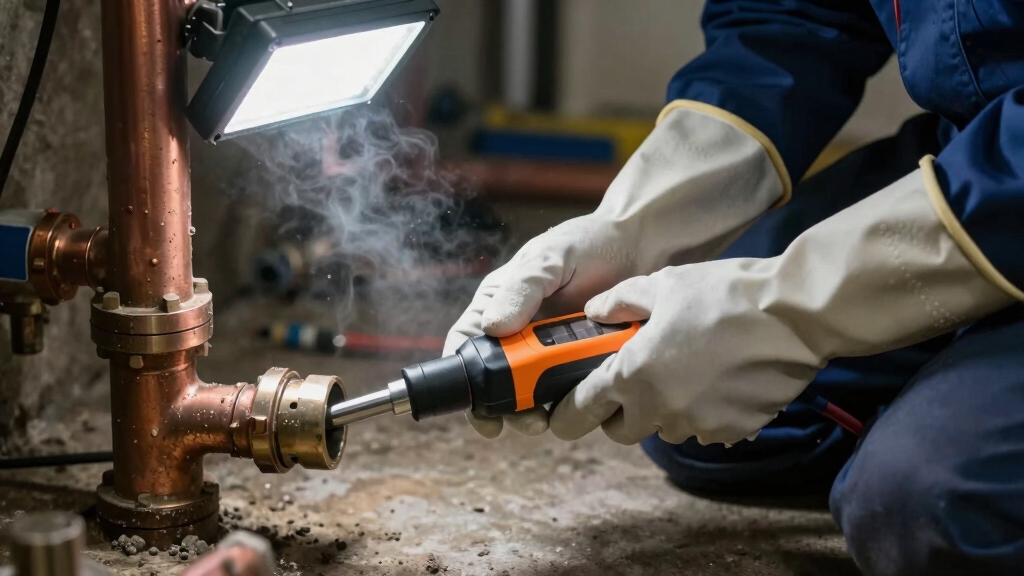

You detect leaks by monitoring escaping fluids through changes in pressure, acoustic signals, tracer gases, or visible evidence like bubbles.
Pressure methods analyze drops or profiles dynamically. Acoustic sensors capture ultrasonic sounds from leaks, even in noisy settings.
Tracer gases reveal hard-to-find leaks using precise detection tools. Visual tests spot gross breaches via bubble formation.
Each technique balances sensitivity with application needs. This offers targeted detection from pipelines to confined systems. Explore these methods further to optimize your leak detection strategy.
Key Takeaways
- Leak detection identifies escaping test mediums by monitoring pressure, flow, or temperature changes in pressurized systems or components.
- Acoustic and ultrasonic sensors detect high-frequency sounds from leaks, converting them to electrical signals for precise leak localization.
- Pressure-based methods detect minute leaks by analyzing pressure drops or profiles dynamically, compensating for temperature and operational changes.
- Tracer gases like helium or hydrogen reveal leaks through mass spectrometry or sniffers, enabling highly sensitive and accurate leak localization.
- Visual methods use soap solutions or submersion to create bubbles at leak sites, providing immediate but less sensitive detection of gross leaks.
Principles of Leak Detection: How Escaping Fluids Are Found
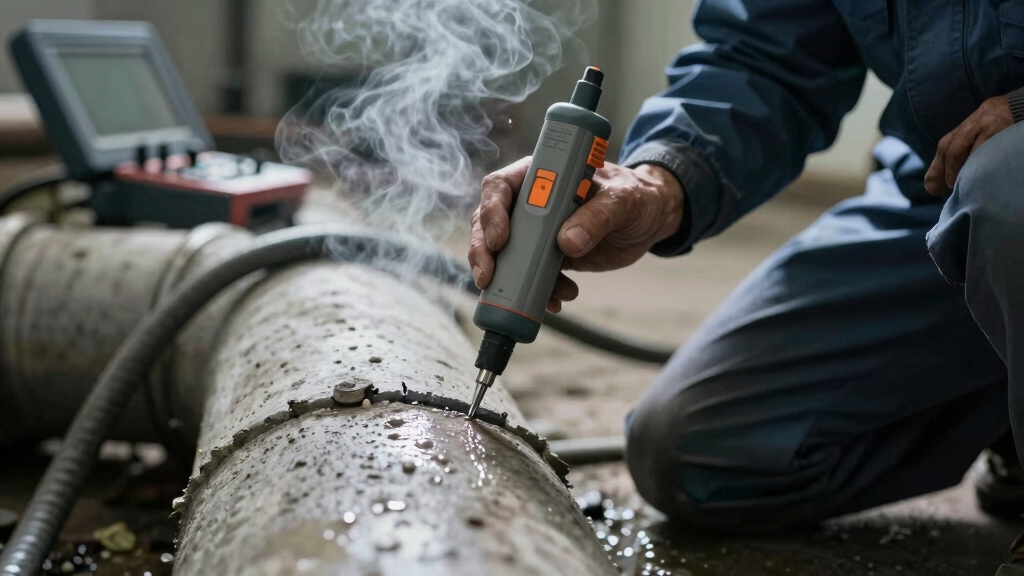
Although leak detection involves various specialized methods, its core principle centers on identifying escaping test mediums from pressurized systems or components.
Leak detection fundamentally focuses on identifying escaping test mediums from pressurized systems or components.
You monitor parameters like flow rate, pressure, and temperature changes to pinpoint leaks accurately.
By pressurizing the system above its normal operating pressure, you create conditions that amplify any leakage, making detection feasible.
Static systems rely on observing constant pressure drops, while dynamic systems interpret real-time data adjustments to detect anomalies.
Your primary tasks involve detecting leakage presence, measuring leak rates, and locating the leak source precisely.
Effective leak detection demands understanding system behavior under pressure variations and correlating parameter deviations with potential breach points.
This guarantees you can isolate leaks swiftly, minimizing operational disruptions and safety risks.
Proper circuit safety protocols are essential when integrating leak detection equipment with electrical systems to avoid hazards.
Acoustic Leak Detection Methods: Hearing and Locating Leaks
You’ll be detecting leaks by listening for those telltale sounds they make, like hissing or gurgling. This is where sensitive acoustic sensors come into play. They really help pick up those sounds.
And here’s an interesting twist: ultrasonic energy, often created by escaping tracer gases, boosts our ability to detect leaks even beyond what we can hear.
Now, it gets even better! By analyzing how long it takes for sound to travel between multiple sensors, you can accurately pinpoint where the leak is hiding within a pipeline or system. This makes it much easier to tackle the problem head-on!
Distinct hissing or whistling sounds near gas lines or appliances often indicate small openings and should prompt immediate inspection with sound-based leak indicators.
Detecting Leak Sounds
When you monitor pipelines or pressurized systems, detecting leak sounds provides a direct way to identify escaping fluids through the acoustic energy they generate.
You rely on sensitive microphones and acoustic sensors to capture characteristic hissing or gurgling noises caused by fluid turbulence at leak points.
These devices amplify signals even amid background noise, enabling detection in complex environments.
By deploying correlation technology, you measure the time difference of sound arrival between sensors, pinpointing leak locations precisely.
This technique effectively identifies leaks as small as 10^-3 mbar·l/s in both small and large pipelines.
Accurate sound analysis helps you differentiate leak-induced acoustic signatures from ambient noise, ensuring reliable identification.
Detecting leak sounds remains a critical, non-invasive method for early leak localization and system integrity assessment.
Ultrasonic detectors are commonly used to capture inaudible sound waves from pressurized leaks, enhancing detection capabilities for pressurized gas leaks.
Ultrasonic Energy Use
Harness ultrasonic energy to detect leaks by capturing high-frequency sound waves generated as pressurized gas or liquid escapes through small openings.
You’ll use specialized ultrasonic sensors that detect frequencies beyond human hearing, typically above 20 kHz. This enables identification of leaks even in noisy environments.
These sensors convert ultrasonic waves into electrical signals, which you analyze to distinguish leak signatures from background noise.
The method is sensitive to leak rates as low as 10^-3 mbar·l/s, making it suitable for both small and large systems.
Ultrasonic detection doesn’t rely on audible sounds, allowing you to monitor pressurized pipelines or components without direct access.
Combining ultrasonic detection with magnetic sensors can improve accuracy in locating leaks and other hidden defects.
Precise Leak Localization
Although detecting leak sounds is essential, precisely locating their source requires advanced acoustic techniques that analyze sound travel times and signal characteristics.
You use correlation devices that measure the time difference between sound arrivals at multiple sensors along a pipeline. This time delay helps pinpoint the leak location with high accuracy.
Additionally, sophisticated signal processing isolates leak noises from background interference, improving detection in noisy environments.
By interpreting acoustic energy patterns, you can distinguish leak severity and exact points. Key components of precise leak localization include:
- Using pairs of microphones to correlate sound signals and calculate leak position
- Analyzing frequency and amplitude variations to differentiate leak types
- Employing real-time data processing to track dynamic acoustic changes
These methods enable you to locate leaks efficiently in both small and large pipeline systems.
To ensure reliable detection, it is crucial to minimize electromagnetic interference that can distort acoustic signals and lead to false readings.
Pressure-Based Leak Detection Techniques Explained
Since pressure variations directly reflect system integrity, pressure-based leak detection techniques offer a reliable means to identify leaks by analyzing pressure drops or profiles at specific points.
You monitor static systems for pressure decay, where a drop signals a leak. Dynamic approaches adjust measurements in real time, accounting for operational changes.
Methods like pressure point analysis evaluate localized pressure data, pinpointing leak zones. The pressure decay method uses compressors and barometers to detect minute leaks, with sensitivity down to 10^-4 mbar·l/s.
However, be mindful that temperature fluctuations can skew results, demanding compensation. Advanced techniques incorporate mass/volume balance or statistical models to refine detection accuracy.
For reliable system performance, it is essential to use cables with appropriate insulation ratings to minimize electrical interference during pressure monitoring.
Using Tracer Gases to Detect Hard-to-Find Leaks
When you need to locate leaks in confined or complex systems where traditional methods fall short, tracer gas detection offers a highly sensitive solution.
By injecting a harmless gas like helium or hydrogen into the system under pressure, you can detect even minute leaks using specialized sensors.
These sensors, mass spectrometers or sniffer probes, identify escaping tracer gases, allowing precise localization in areas inaccessible to acoustic or pressure-based techniques.
Key advantages include:
- High sensitivity suitable for vacuum systems and aerospace applications
- Rapid detection in pressurized, confined environments
- Ability to quantify leak rates through gas concentration measurements
Using tracer gases, you gain analytical accuracy critical for maintaining the integrity of refrigeration, aerospace, and other high-stakes systems where leaks are otherwise difficult to find.
This method complements other approaches such as electronic locating tools for comprehensive leak detection and system integrity verification.
Visual and Bubble Tests for Detecting Gross Leaks
You can easily detect gross leaks by pressurizing the object and watching for bubbles at potential leak points. It’s pretty straightforward—just apply a soap solution, and you’ll see escaping air forming bubbles.
Those bubbles are your clues, showing you exactly where the leaks are.
Now, when you’re looking at those bubbles, pay attention to their size and how often they appear. This gives you a good idea of how severe the leak might be.
It’s a simple method, but it’s really effective for finding out what you need to fix! Moisture increases conductivity between contacts, creating unintended current paths that cause sparks in electrical outlets.
Bubble Formation Process
In performing bubble and visual tests, the bubble formation process plays a pivotal role in identifying gross leaks. It reveals escaping gas through visible bubbles.
When you pressurize a system submerged in liquid or apply a soap solution, gas escaping from leaks nucleates at surface irregularities or weak points, forming bubbles. The size and frequency of bubbles correlate with leak magnitude, allowing you to approximate leak rates.
Key factors influencing bubble formation include:
- Surface tension and viscosity of the liquid, affecting bubble size and detachment rate.
- Pressure differential driving gas flow through leaks, dictating bubble generation speed.
- Duration of observation, impacting detection sensitivity based on smallest detectable bubble.
Understanding these parameters helps you accurately detect and quantify gross leaks using bubble formation techniques. For safety, it is crucial to follow precautions and safety tips during leak detection to prevent accidents and ensure proper handling of equipment.
Visual Leak Identification
Building on how bubble formation reveals escaping gas, visual leak identification harnesses this observable phenomenon to detect gross leaks rapidly and effectively.
You pressurize the test object and either submerge it in water or apply a soap solution to suspect areas. Escaping gas forms bubbles at leak sites, providing immediate visual confirmation.
This method detects leaks with rates typically above 300 units, making it ideal for identifying significant breaches rather than fine leaks.
The leak rate (Q) calculation depends on pressure (p), volume (V), and time (t), with sensitivity limited by bubble size and observation duration.
Visual tests offer a straightforward, cost-effective approach, requiring minimal instrumentation. However, they demand vigilant inspection to avoid missing transient or small bubble formations during the test interval.
Unlike smoke detectors that sense airborne particles early, visual leak identification focuses solely on detecting physical gas escape through visible bubbles, emphasizing the importance of early warning systems in fire safety.
Pipeline Inspection Technologies for Leak Detection
Detecting leaks within pipelines demands advanced inspection technologies that combine accuracy with efficiency.
You rely on smart pigs equipped with ultrasonic or magnetic flux leakage sensors that scan pipe walls for anomalies. These sensors pinpoint corrosion or cracks that indicate leaks.
These devices gather precise data as they traverse the pipeline, enabling early detection and reducing downtime. Acoustic methods complement this by capturing ultrasonic signals produced by escaping fluids. This allows you to locate leaks even in noisy environments with high sensitivity.
Additionally, pressure-based techniques monitor pressure drops and profiles dynamically. They offer real-time insights into leak presence and severity.
- Smart pigs: ultrasonic and magnetic flux leakage scanning
- Acoustic sensors: ultrasonic signal detection and correlation
- Pressure analysis: static and dynamic pressure monitoring
Comparing Leak Detection Methods: Sensitivity and Use Cases
Although each leak detection method offers unique advantages, you must evaluate their sensitivity and application contexts to select the best approach.
Acoustic methods excel in detecting small leaks down to 10^-3 mbar.l/s, suitable for noisy environments and large pipelines.
Pressure-based techniques achieve higher sensitivity (up to 10^-4 mbar.l/s) but can be affected by temperature fluctuations, making them ideal for static or controlled systems.
Tracer gas methods deliver superior precision in confined or vacuum systems, especially aerospace or refrigeration, detecting minute leaks with helium or hydrogen.
Visual and bubble tests are straightforward but limited to gross leaks, effective for initial assessments.
Pipeline-specific smart pigs combine magnetic flux and ultrasonic data, providing detailed structural insights and leak localization. They’re optimum for all-encompassing pipeline integrity monitoring.
Match sensitivity requirements and operational environment carefully to optimize detection efficiency.
Frequently Asked Questions
How Often Should Leak Detection Inspections Be Performed?
You should perform leak detection inspections based on system criticality, usage intensity, and regulatory requirements, typically semiannually or annually.
High-risk or aging infrastructure demands more frequent checks, sometimes quarterly.
Dynamic systems with real-time monitoring can reduce manual inspections but still require periodic validation.
Also, after repairs or modifications, conduct immediate testing.
Tailoring intervals to your operational conditions guarantees early leak identification, preventing costly damage and maintaining system integrity efficiently.
What Safety Precautions Are Needed During Leak Detection?
You must balance vigilance with caution during leak detection. Always wear personal protective equipment, like gloves and goggles, to guard against hazardous substances.
Make certain proper ventilation when working with tracer gases to avoid inhalation risks. Isolate and depressurize systems before testing to prevent accidents.
Use intrinsically safe instruments in explosive environments. Constantly monitor pressure and temperature changes, and never bypass safety protocols.
Even minor oversights can escalate into serious hazards.
How Do Environmental Factors Affect Leak Detection Accuracy?
Environmental factors like temperature fluctuations, noise, and humidity directly impact your leak detection accuracy.
Temperature changes can alter pressure readings, causing false positives or masking leaks.
Background noise interferes with acoustic methods, reducing sensitivity.
High humidity or moisture may affect sensor performance, especially in tracer gas detection.
You must calibrate equipment for local conditions and apply compensatory algorithms to maintain precision during detection tasks.
Can Leak Detection Systems Be Integrated With Smart Home Technology?
You can definitely integrate leak detection systems with smart home technology. For example, a homeowner installed acoustic sensors linked to their smart hub, enabling real-time alerts on their phone when a leak sound was detected.
This integration uses precise acoustic data, correlating sound waves with location, enhancing early leak identification. By connecting pressure or tracer gas sensors to home automation, you gain proactive control.
This minimizes water damage and optimizes maintenance through seamless monitoring.
What Are the Costs Associated With Different Leak Detection Methods?
You’ll find costs vary widely: acoustic methods range from moderate to high due to sensitive sensors and correlation devices.
Pressure-based systems tend to be cost-effective but may require frequent calibration.
Tracer gas techniques are expensive, needing specialized gases and detection equipment.
Bubble and visual tests are the cheapest but suit only gross leaks.
Pipeline smart pigs are costly upfront but provide thorough data, justifying investment in large-scale infrastructure.
Choose based on accuracy and budget.
Transforming Hidden Vulnerabilities into Operational Strength
By understanding these nuanced leak detection methods, you’re well-equipped to uncover even the most discreet fluid escapes.
Each technique offers a subtle yet effective way to maintain system integrity, ensuring minor imperfections don’t evolve into major concerns.
Whether using acoustic signals, pressure shifts, or tracer gases, your vigilance transforms potential vulnerabilities into manageable insights.
This approach preserves operational excellence with precision and care.