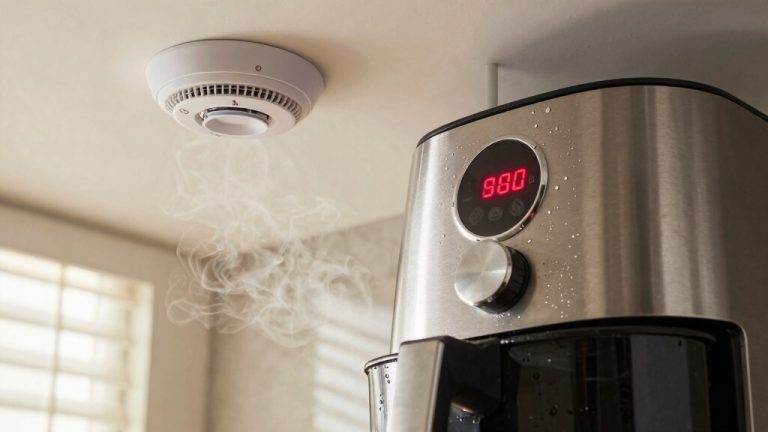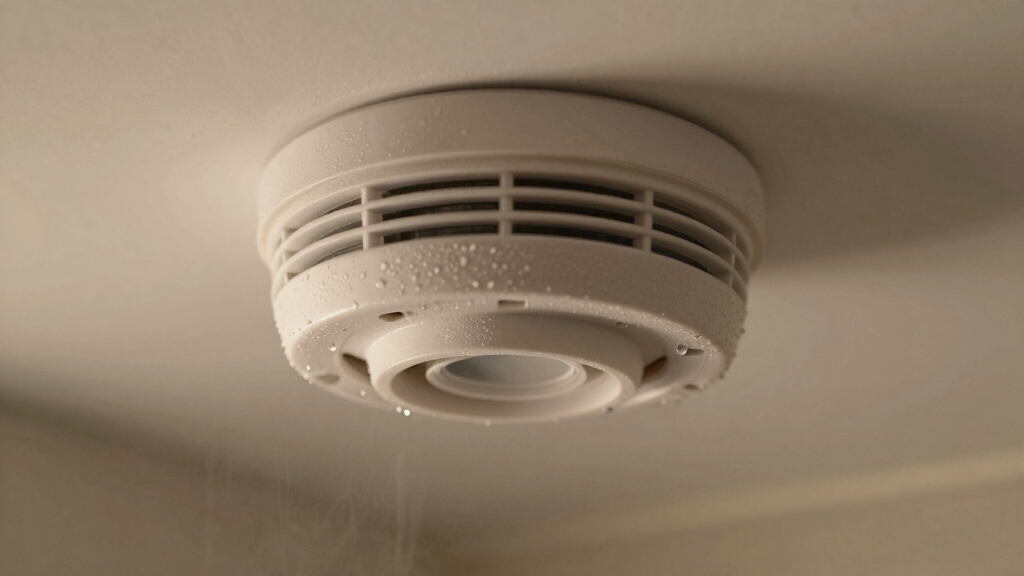

Yes, humidity can trigger your smoke alarm by causing moisture particles and condensation to mimic smoke inside the sensor chamber.
This is especially common when relative humidity rises above 70%. Ionization detectors are more sensitive and prone to false alarms above 85% humidity.
Photoelectric and dual-sensor alarms generally handle moisture better but can still react to heavy steam. Proper placement and maintenance are key to minimizing these false triggers.
Learn how different technologies and setup strategies can help you avoid these issues.
Key Takeaways
- High humidity, especially above 70%, can cause false smoke alarms by confusing sensors with moisture droplets and condensation.
- Ionization smoke detectors are more prone to false alarms from moisture due to charged ion neutralization by water vapor.
- Photoelectric alarms are less affected by humidity but can still trigger false alarms from dense steam or condensation inside the chamber.
- False alarms increase near windows, exterior walls, or humid areas like bathrooms due to condensation forming inside or around alarms.
- Proper alarm placement away from humidity sources and regular maintenance help reduce false alarms caused by moisture.
Why Does Humidity Cause False Smoke Alarms?
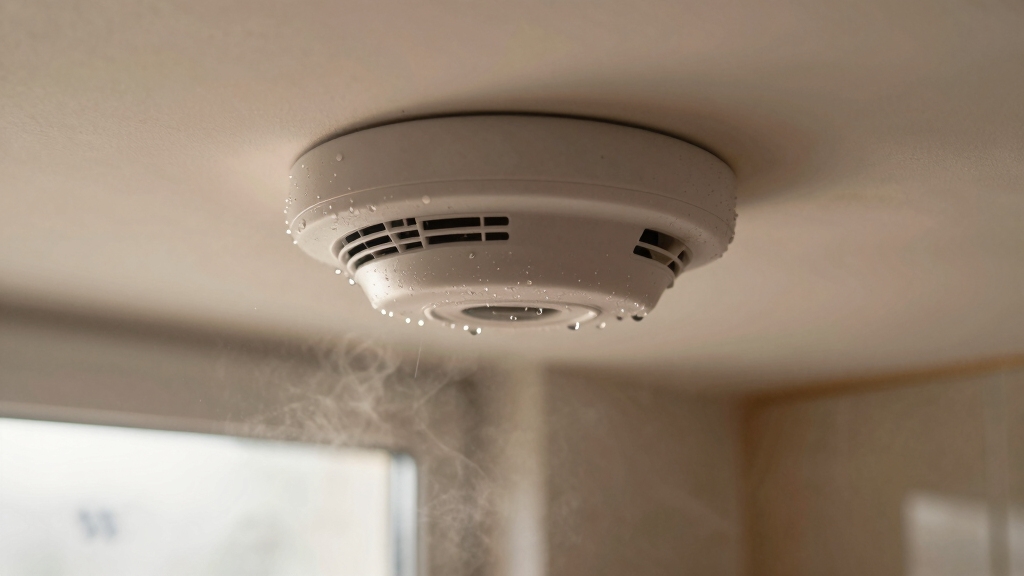
Humidity frequently triggers false smoke alarms because moisture particles interfere with the sensors designed to detect smoke.
Moisture particles often cause false smoke alarms by disrupting the sensors meant to detect smoke.
In ionization detectors, moisture mimics smoke particles by neutralizing charged ions inside the chamber, causing the alarm to activate erroneously.
You’ll notice that when humidity climbs, especially above 85%, these detectors become more sensitive to water vapor.
Photoelectric detectors, which rely on light scattering, are less affected by humidity but can still misinterpret steam droplets as smoke.
Additionally, condensation forming inside the alarm can disrupt sensor readings.
If humidity levels rise, weak batteries exacerbate the problem by reducing sensor efficiency.
Understanding these mechanisms helps you pinpoint how moisture compromises your smoke alarm’s accuracy.
Maintaining proper positioning and environmental control is essential to minimize false alarms caused by humidity.
For more reliable fire safety, it is important to remember that smoke detectors provide early alerts by sensing airborne particles, unlike sprinklers which activate only at high temperatures.
At What Humidity Levels Do Smoke Alarms False Alarm?
When moisture levels rise beyond certain points, smoke alarms are more prone to false activations. Specifically, relative humidity above 85% markedly increases the risk of false alarms, particularly in ionization detectors.
These alarms mistake humid air particles for smoke since water vapor interferes with charged particle detection.
In regions like Florida with humidity exceeding 70%, ionization alarms frequently trigger falsely.
Photoelectric alarms are less sensitive but can still be affected by steam and condensation.
High humidity causes water droplets to scatter light or condense within the sensor chamber, confusing detection mechanisms.
Condensation forming when air cools to dew point exacerbates this issue.
Maintaining humidity below 85% near alarms reduces false triggers, ensuring reliable fire detection and minimizing unnecessary disruptions.
Proper placement of detectors away from kitchens, bathrooms, and other high-humidity areas is essential to reduce false alarm triggers caused by moisture.
How Do Ionization and Photoelectric Alarms React to Humidity?
Ionization alarms are pretty sensitive to humidity. Why? Because water vapor can actually look a lot like smoke particles, which often leads to false alarms when the humidity goes above 85%. That can be quite frustrating, right?
On the flip side, we’ve photoelectric alarms. These work by detecting light that gets scattered by dense particles. They’re generally less affected by humidity, but it’s worth noting that they can still react to steam from showers. Regular maintenance, such as cleaning sensors, can help reduce false or erratic beeping caused by environmental factors like humidity.
Ionization Alarm Sensitivity
Although both ionization and photoelectric smoke alarms detect particles in the air, they react differently to humidity levels.
Ionization alarms are more sensitive to moisture because water vapor mimics smoke particles. This disrupts the ionization chamber’s charged particles. When humidity surpasses 85%, you risk false alarms.
Photoelectric alarms, however, rely on light scattering and are less affected by humidity. They may still react to dense steam.
| Feature | Ionization Alarm |
|---|---|
| Sensitivity to Humidity | High; false alarms above 85% RH |
| False Alarm Causes | Cooking steam, tobacco smoke, moisture |
| Battery Impact | Weak batteries increase false alarms |
You should position ionization alarms away from humid areas to minimize false triggers. For reliable performance, it is also important to avoid placing alarms in humid, dusty, or obstructed locations that can impair their function.
Photoelectric Alarm Response
Photoelectric smoke alarms detect particles by measuring light scattering, making them less prone to false alarms from humidity compared to ionization detectors.
When humidity rises, dense water vapor droplets scatter the light beam, potentially triggering a false alarm, especially near bathrooms or kitchens where steam is common.
Unlike ionization alarms, which mistake charged water vapor for smoke particles, photoelectric sensors respond primarily to larger particles. Moderate humidity rarely causes issues, but heavy steam can still mimic smoke density, briefly activating the alarm.
You should position photoelectric alarms away from humidity sources and maintain proper ventilation to minimize false triggers. While they respond faster to smoldering fires, photoelectric alarms still require regular cleaning to prevent dust or insects from obstructing the sensor, which could falsely activate the device.
The design of the optical chamber, including its controlled airflow and insect-resistant vents, helps reduce false alarms caused by environmental factors like humidity.
Where Should You Install Smoke Alarms to Avoid Humidity False Alarms?
When installing smoke alarms, placing them at least 10 feet away from bathrooms, laundry rooms, and kitchens helps prevent humidity-induced false alarms. These areas generate high moisture levels, which can trigger ionization and photoelectric sensors.
Position smoke alarms at least 10 feet from moisture-heavy areas to reduce humidity-triggered false alarms.
Avoid installing alarms near humidifiers, steam vents, or cooking appliances where water vapor concentration spikes. Position devices in well-ventilated spaces to minimize condensation buildup inside detectors, especially in climates with frequent dew point fluctuations.
Keep alarms off exterior walls prone to temperature swings that cause moisture accumulation within the unit. Ceiling placement is preferred but make certain they’re not adjacent to ceiling fans or ducts pushing humid air.
Following these guidelines optimizes sensor accuracy by reducing interference from airborne moisture. This decreases false alarms and maintains reliable fire detection performance. Additionally, hardwired smoke detectors should always have a battery backup to ensure continuous operation even during power outages.
How Can You Prevent False Smoke Alarms Caused by Humidity?
To keep false smoke alarms from going off because of humidity, it’s a good idea to place your smoke alarms at least 10 feet away from wet areas like bathrooms and laundry rooms. This distance helps prevent any steam or moisture from interfering with their operation.
Also, don’t forget to maintain your alarms! Regularly clean the sensors, check the batteries, and make sure there aren’t any insects or dust blocking the detection chamber. By combining proper placement with routine upkeep, you can significantly reduce the chances of those annoying humidity-triggered malfunctions.
Using sealed 10-year lithium batteries can also help minimize false beeps caused by low battery warnings related to humidity effects.
Optimal Alarm Placement
Although smoke alarms are essential for safety, placing them improperly can increase false alarms caused by humidity. You should install alarms at least 10 feet away from high-humidity sources like bathrooms, kitchens, and laundry rooms to minimize moisture exposure.
Avoid placing detectors near windows or exterior walls where condensation frequently forms. Ensure good air circulation by positioning alarms away from stagnant air pockets and using fans to reduce humidity buildup.
Opt for locations with stable temperature and humidity levels, ideally between 40°F and 100°F. If you live in a humid climate, consider using photoelectric or dual-sensor alarms, which are less prone to false triggers from steam and moisture.
Proper placement reduces sensor confusion from airborne droplets, making certain alarms only activate during genuine smoke events.
Regular maintenance and inspection of alarms are also important to prevent malfunction due to moisture buildup or dust accumulation.
Regular Maintenance Practices
Regularly inspecting and maintaining your smoke alarms markedly reduces false alarms caused by humidity.
Begin by cleaning the unit’s sensor chamber to remove dust and insects that can mimic smoke or moisture particles, using a vacuum or compressed air.
Check and replace batteries promptly, as weak power increases sensitivity to humidity.
Test alarms monthly to verify proper function and silence false triggers with the hush button.
Avoid placing alarms near high-humidity sources like bathrooms or kitchens to minimize moisture interference.
If false alarms persist, consider switching to photoelectric or dual-sensor detectors, which better tolerate humidity.
Additionally, dry the alarm interior gently with a low-heat hair dryer if condensation forms.
Consistent maintenance prevents sensor confusion caused by humidity, enhancing reliability and reducing nuisance alerts.
For enhanced safety, consider upgrading to a monitored system to ensure automatic notification of emergency services in case of an actual fire.
How Do You Troubleshoot Smoke Alarms Triggered by Moisture?
When your smoke alarm goes off due to moisture, start by silencing it with the hush button to prevent unnecessary disturbance.
Next, dry the interior using a low-heat hair dryer to remove condensation.
Clean the sensor area to eliminate dust and insects, which can worsen false alarms.
Check battery levels and wiring to avoid power-related triggers.
If issues persist, consider relocating the alarm away from humid zones.
Using high-quality 9V batteries can help reduce false alarms caused by unstable voltage in humid environments.
| Step | Action | Purpose |
|---|---|---|
| Silence & Dry | Use hush button, dry interior | Stop alarm, remove moisture |
| Clean & Inspect | Dust, insects, wiring, batteries | Eliminate sensor interference |
| Relocate or Replace | Move away from humidity sources | Prevent future false alarms |
Why Are Dual-Sensor Alarms Better for Humid Environments?
After troubleshooting moisture-triggered false alarms by silencing, drying, and inspecting your smoke detector, you might consider upgrading to dual-sensor alarms for improved performance in humid environments.
Dual-sensor alarms combine ionization and photoelectric technologies, leveraging the strengths of both.
Dual-sensor alarms merge ionization and photoelectric technologies for enhanced and balanced fire detection.
Ionization sensors are sensitive to fast-flaming fires but prone to false alarms from high humidity.
Photoelectric sensors better detect smoldering fires and resist some moisture interference.
By integrating these sensors, dual-sensor alarms reduce false alarms caused by steam or humidity above 70%, common in coastal or tropical areas.
This synergy provides more reliable detection, minimizing the impact of humidity-triggered false alarms.
You’ll benefit from enhanced fire safety without frequent nuisance alerts, especially in bathrooms, kitchens, or laundry rooms where moisture levels fluctuate regularly.
Frequently Asked Questions
Can Humidity Damage the Internal Components of Smoke Alarms?
Yes, humidity can damage the internal components of smoke alarms. Excess moisture leads to condensation inside the device, which can corrode sensitive electronics and sensors.
Over time, this corrosion degrades performance and may cause false alarms or complete failure. To protect your alarm, install it away from high-humidity areas.
Maintain proper ventilation and regularly inspect and clean the unit to prevent moisture buildup that compromises its functionality.
How Often Should Smoke Alarms Be Replaced in Humid Climates?
You should replace smoke alarms every 7 to 10 years, but in humid climates, consider doing it closer to 7 years.
High moisture accelerates sensor degradation and increases false alarms, especially in ionization detectors prone to humidity above 85%.
Regular replacement guarantees reliable performance. Additionally, inspect and replace batteries annually.
Opt for photoelectric or dual-sensor alarms designed to handle humidity better, minimizing maintenance and false alarm issues.
Do Wireless Smoke Alarms Have Higher Humidity Sensitivity Than Wired Ones?
Yes, wireless smoke alarms often have higher humidity sensitivity than wired ones.
Since they’re interlinked wirelessly, moisture affecting one unit can trigger alarms across the network, amplifying false alarms.
Wired alarms typically operate independently, reducing this risk.
To minimize humidity-related issues, you should use dual-technology alarms, position them away from moisture sources, and maintain proper ventilation to keep humidity levels below critical thresholds.
Can Air Purifiers Reduce Humidity-Related False Alarms?
Think of an air purifier as a gatekeeper controlling your indoor air’s composition.
While it can reduce airborne particles and some moisture, it doesn’t directly lower relative humidity enough to prevent false alarms caused by high moisture levels.
You’ll still need dehumidifiers or proper ventilation to tackle humidity.
However, air purifiers can help minimize dust and allergens that might exacerbate sensor confusion, indirectly supporting your smoke alarm’s accuracy.
Are There Specific Brands Better Suited for High-Humidity Areas?
Yes, you’ll want to choose brands like Nest Protect, First Alert, or Kidde that offer photoelectric or dual-sensor alarms designed for high humidity.
These models better resist false alarms caused by steam or moisture. Avoid ionization-only detectors in humid environments.
Look for units with sealed sensors and humidity tolerance above 85%. Regular maintenance and proper placement away from bathrooms or kitchens also improve reliability in moist areas.
Humidity and Smoke Alarms: What Every Homeowner Should Remember
So, can humidity really trigger your smoke alarm? Absolutely. It can cause false alarms by interfering with sensor accuracy, especially in ionization models.
You’ll want to install alarms away from damp areas and consider dual-sensor alarms for better reliability. Regular maintenance and troubleshooting are key to minimizing moisture-related issues.
Don’t let humidity compromise your safety. Are you taking the right steps to keep your smoke alarms precise and dependable?