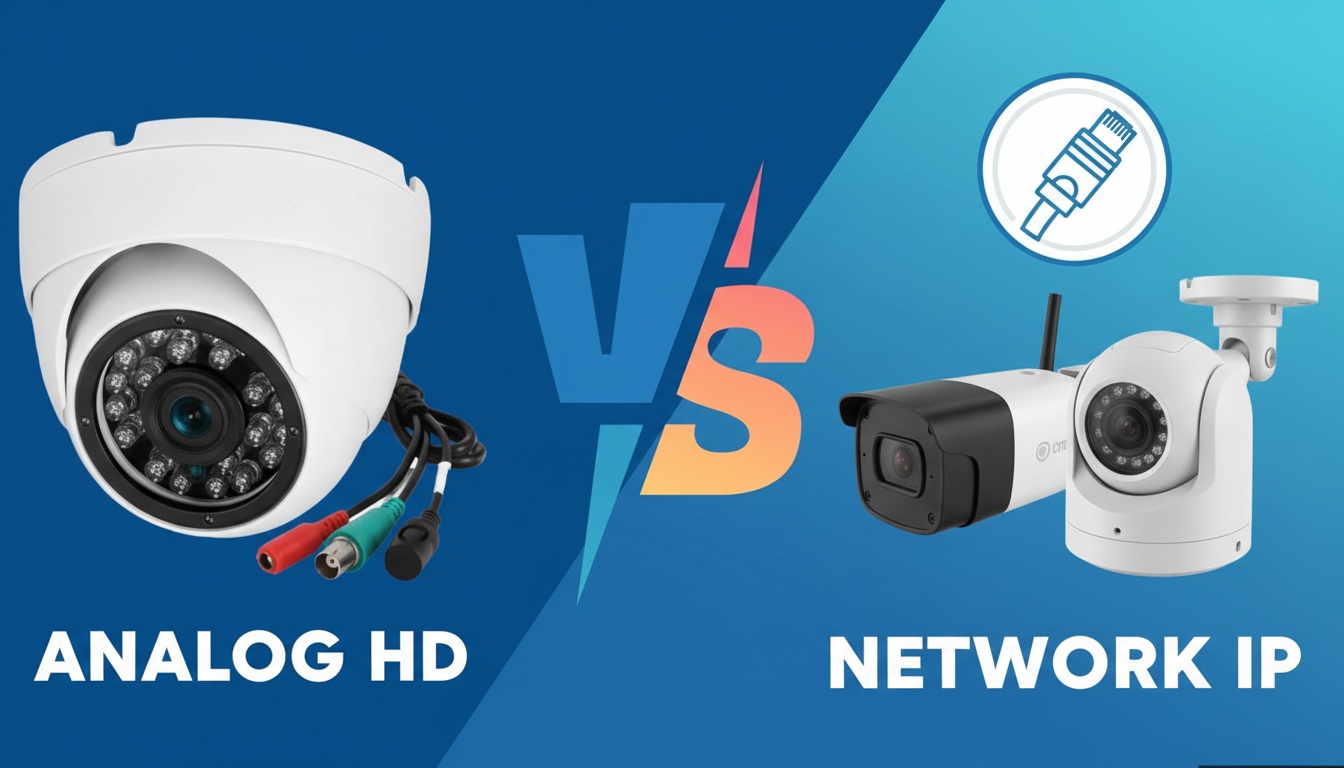

When choosing between CCTV and IP cameras, consider your surveillance needs carefully.
CCTV uses analog signals over coaxial cables with lower resolution, ideal for basic monitoring and low-light settings. IP cameras offer high-definition 4K video, encrypted digital transmission, and advanced features like AI analytics and remote access.
They support PoE for simpler installation and scalability but require robust network setup. Your choice hinges on budget, image quality, and future expansion. Explore their detailed differences to decide smartly.
Key Takeaways
- CCTV cameras transmit analog signals via coaxial cables to DVRs, offering basic monitoring but limited scalability and no encryption.
- IP cameras send encrypted digital video over Ethernet or Wi-Fi, supporting remote access, firmware updates, and advanced analytics.
- IP cameras provide higher resolution up to 4K, wider field of view, and better image quality over long distances than CCTV.
- IP systems use Power over Ethernet (PoE) for simpler wiring and easier expansion, while CCTV requires separate power and coaxial cables.
- CCTV suits low-light environments and small setups with lower upfront cost, whereas IP cameras offer more features and future-proof scalability.
IP Camera vs CCTV: Key Differences Explained
| Feature | CCTV Camera | IP Camera |
|---|---|---|
| Signal Type | Analog signal | Digital signal (encrypted) |
| Transmission Medium | Coaxial cable | Ethernet, Wi-Fi, or LAN |
| Recording Device | DVR (Digital Video Recorder) | NVR or Cloud Storage |
| Max Resolution | Standard Definition (SD) | Up to 4K Ultra HD (16MP) |
| Image Detail | Limited, grainy | High clarity, sharp details |
| Distance Impact | Quality degrades over long cables | Maintains quality over network |
| Field of View | Narrow | Wider, reduces camera count |
| Low-Light Performance | Strong analog sensitivity | Digital enhancement + IR LEDs |
| Night Vision | Consistent, grain-free | Detailed but may cause IR glare |
| Video Processing | Handled by DVR | Processed internally by camera |
| Advanced Features | Basic monitoring only | AI analytics, facial recognition, alerts |
| Remote Access | Limited or none | Full remote access via apps/browser |
| Storage Options | Local DVR only | Local NVR + Cloud storage |
| Security | No encryption | Encrypted data transmission |
| Bandwidth Usage | Low | High (15–20 Mbps for 4K) |
| Installation | Separate power + coaxial cable | Single cable via PoE |
| Scalability | Limited, hardware-dependent | Easy expansion over network |
| Maintenance | Minimal updates | Regular firmware updates required |
| Upfront Cost | Lower | Higher |
| Best Use Case | Small setups, low-light monitoring | Large areas, smart & scalable security |
Technology Differences Between CCTV and IP Cameras
While both CCTV and IP cameras serve the purpose of video surveillance, they operate on fundamentally different technologies.
You’ll find CCTV cameras transmit analog signals through coaxial cables to a DVR, relying on separate power sources.
In contrast, IP cameras send digital video over Ethernet, Wi-Fi, or LAN to an NVR or cloud platform, often using Power over Ethernet (PoE) to combine power and data in a single cable.
CCTV processes video at the DVR, whereas IP cameras handle processing internally before transmission.
This difference means IP cameras can integrate advanced functions and network connectivity inherently, while CCTV systems depend heavily on the DVR for processing and recording.
Understanding these foundational distinctions helps you evaluate system capabilities and infrastructure requirements accurately.
Additionally, IP cameras benefit from regular firmware/software updates that maintain security, functionality, and performance, helping to prevent vulnerabilities and ensure reliable operation.
Video Quality: CCTV vs IP Cameras Compared
You’ll notice that IP cameras really stand out when it comes to resolution and detail. They can deliver up to 4K clarity, which is fantastic for capturing faces and license plates with precision.
On the flip side, CCTV cameras usually stick to standard definition. But here’s the thing: they often perform better in low-light conditions and don’t necessarily need infrared support to do so.
When you compare their night vision capabilities, you’ll see there’s a bit of a trade-off. IP cameras rely more on digital enhancement, while CCTV cameras have that analog sensitivity that can be pretty impressive in the dark. It’s all about what you value more in your surveillance setup!
Additionally, combining infrared detection techniques can help identify hidden devices that may compromise your camera system’s security.
Resolution And Detail
Because video clarity plays a critical role in surveillance effectiveness, understanding the resolution and detail differences between CCTV and IP cameras is essential.
IP cameras capture high-definition images up to 4K resolution, delivering precise facial and license plate details. In contrast, CCTV cameras typically provide standard definition, resulting in grainier images with limited detail.
Additionally, IP cameras maintain image quality over longer distances without degradation, unlike CCTV systems whose quality diminishes with cable length.
Security doors with multi-point locking systems use reinforced components that similarly emphasize distributing force and resisting tampering, a principle reflected in the mechanical design of advanced IP cameras.
| Feature | CCTV Camera | IP Camera |
|---|---|---|
| Max Resolution | Standard Definition (SD) | Up to 4K Ultra HD (16MP) |
| Image Detail | Limited, grainy | High precision, sharp |
| Distance Impact | Quality degrades over coaxial | Maintains quality over network |
| Field of View | Narrow | Wider, reducing camera count |
Night Vision Performance
Image clarity during nighttime conditions demands a different set of capabilities compared to daytime resolution.
CCTV cameras excel in low-light environments by utilizing larger image sensors and enhanced infrared (IR) illumination. This delivers clearer monochrome images without zoom, making them reliable for basic night surveillance where ambient light is minimal.
Conversely, IP cameras rely heavily on IR LEDs to capture detailed video in darkness. They often provide higher resolution night footage due to superior sensor technology. However, IR illumination can cause glare or overexposure if improperly configured.
Additionally, IP cameras can integrate advanced image processing algorithms, such as noise reduction and dynamic range enhancement. This improves visibility in varying lighting.
When choosing, consider that CCTV offers consistent, grain-free night vision. IP cameras provide more detailed, digitally enhanced night images suited for complex security needs.
Many models include additional features such as night vision to increase usefulness in low-light conditions.
Key Features of IP Cameras vs CCTV
While both IP and CCTV cameras serve surveillance purposes, their key features differ substantially, impacting performance and usability.
IP cameras process video internally, transmitting high-definition digital signals over Ethernet or Wi-Fi, supporting PoE for streamlined power and data delivery.
IP cameras internally process video and deliver high-definition digital streams via Ethernet or Wi-Fi with PoE support.
They offer advanced functionalities like motion detection, facial recognition, AI analytics, two-way audio, and smart alerts, plus remote access via apps or browsers.
Conversely, CCTV cameras transmit analog video to DVRs, with limited processing and basic real-time monitoring.
CCTV setups require separate power sources and coaxial cabling, restricting scalability.
IP cameras provide wider fields of view, maintain image quality over distance, and integrate with cloud storage and unified dashboards.
CCTV excels in simple, low-light surveillance without advanced features but lacks the flexible, feature-rich ecosystem IP systems deliver.
Similar to how photoelectric smoke alarms use an optical chamber to detect scattered light from smoke particles, IP cameras leverage digital image processing and sensor technology to enhance detection and analysis capabilities in modern surveillance systems, offering more reliable and early detection of events through advanced sensor integration.
Storage and Security: Options for CCTV and IP Cameras
When securing your surveillance footage, the choice between CCTV and IP cameras materially affects storage methods and security measures.
CCTV systems store analog video locally on DVRs, limiting scalability and remote accessibility. These analog signals are physically secure but susceptible to interference and lack encryption, which could expose footage to tampering.
Conversely, IP cameras transmit encrypted digital video over networks to NVRs or cloud storage, enhancing remote access and scalability. However, you must configure IP systems correctly to safeguard against cyber threats due to their network connectivity.
Additionally, IP cameras demand higher bandwidth—up to 15-20 Mbps per 4K stream—necessitating robust network infrastructure.
Ultimately, your storage needs and security priorities will guide whether the simplicity and physical security of CCTV or the flexible, encrypted digital solutions of IP cameras suit your surveillance setup.
Proper load wire identification is crucial in ensuring the safety and reliability of any electrical installation supporting your camera systems.
Installation and Scalability of CCTV vs IP Cameras
When you install CCTV cameras, you’ll find yourself dealing with some pretty rigid wiring and separate power sources. This can really ramp up the complexity, especially if you plan to add more units down the line.
On the other hand, IP cameras make things a lot easier when it comes to expansion. Thanks to Power over Ethernet and network integration, you can scale up your system without having to run extra cabling.
Additionally, just as peepholes provide a secure and clear viewing mechanism from inside, IP cameras offer enhanced image clarity and flexible installation options compared to traditional CCTV setups.
Installation Complexity Comparison
Because IP camera systems leverage network integration and Power over Ethernet (PoE), they offer a markedly streamlined installation process compared to traditional CCTV setups.
You only need a single Ethernet cable per camera to handle both power and data, which notably reduces wiring complexity and labor time.
In contrast, CCTV cameras require separate coaxial cables for video and distinct power lines, increasing installation difficulty and material costs.
Additionally, IP cameras support wireless options, giving you greater flexibility in placement without extensive cabling.
CCTV’s rigid wired infrastructure demands precise planning and often necessitates additional hardware, such as DVRs and power adapters, complicating the setup.
Overall, IP systems simplify deployment through centralized network management and fewer physical connections.
This makes IP installations less prone to errors and easier to troubleshoot than the more fragmented CCTV wiring scheme.
However, when working with any wired security system, it is critical to practice safe handling techniques to prevent damage and ensure system reliability.
Scalability and Expansion Options
Although both CCTV and IP camera systems serve surveillance purposes, their scalability and expansion capabilities differ markedly, impacting long-term adaptability.
When you expand a CCTV system, you must run additional coaxial cables and power lines to each new camera, plus upgrade or add DVR channels. This increases hardware complexity and labor costs.
In contrast, IP cameras leverage existing network infrastructure; you simply add cameras to your Ethernet switch or Wi-Fi network. Power over Ethernet (PoE) further simplifies expansion by delivering power and data via a single cable.
This network-based architecture allows you to integrate access control, cloud storage, and centralized management easily. Consequently, IP systems offer superior scalability for growing surveillance needs, while CCTV systems impose rigid limits due to physical wiring and hardware constraints.
Proper installation and maintenance are crucial to avoid issues similar to those faced by sensor systems, where wiring problems and power supply issues can compromise system performance and reliability.
Cost and Use Cases for CCTV vs IP Cameras
Since cost efficiency and specific application needs often dictate surveillance choices, understanding the financial and functional distinctions between CCTV and IP cameras is essential.
CCTV systems offer a lower upfront cost, making them suitable for small to medium setups requiring basic, consistent frame rates and low bandwidth. They excel in low-light environments without advanced features, ideal for simple monitoring.
Conversely, IP cameras demand a higher initial investment but provide long-term value through scalability, advanced analytics, and integration capabilities.
You’ll find IP cameras ideal for expansive areas, multifamily properties, and businesses needing detailed imagery, remote access, and intelligent alerts.
Wired IP setups guarantee reliability and future-proofing, whereas CCTV’s analog infrastructure limits expansion and feature upgrades. Choose based on your budget constraints and the complexity of your surveillance needs.
Additionally, integrating IP cameras with smart-home hubs can enhance automation and remote management options for surveillance systems.
Frequently Asked Questions
Can IP Cameras Work With Existing CCTV Infrastructure?
You can integrate IP cameras with existing CCTV infrastructure, but it requires careful planning.
Since CCTV uses analog signals and coaxial cables, you’ll need encoders or hybrid DVRs that support both analog and IP inputs.
Power over Ethernet (PoE) won’t work on standard coax cables, so you’ll need separate power sources for IP cameras.
Upgrading wiring to Ethernet or using media converters can simplify integration and future scalability.
How Do Weather Conditions Affect CCTV Vs IP Camera Performance?
You might think storms could fry both cameras instantly, but IP cameras handle weather better due to sealed, weatherproof casings and digital signal resilience.
While CCTV’s analog signals degrade with moisture and interference, IP’s digital data transmits reliably even in heavy rain or fog.
However, extreme cold or heat can impact both; you’ll want cameras with rated temperature ranges.
IP’s remote diagnostics help you monitor performance under harsh conditions, unlike basic CCTV setups.
Are There Privacy Concerns Unique to IP Cameras?
Yes, you should be cautious about privacy with IP cameras.
Because they transmit digital video over networks and often connect to the internet, they’re vulnerable to hacking if not properly secured.
You’ll need to configure strong passwords, enable encryption, and update firmware regularly to prevent unauthorized access.
Unlike analog CCTV, IP cameras can expose sensitive footage remotely, so safeguarding your network and using secure cloud storage are vital to protecting privacy.
What Maintenance Is Required for CCTV and IP Cameras?
You’ll need to regularly clean lenses and housings on both CCTV and IP cameras to assure clear images.
Check connections and cables for wear or damage, especially with CCTV’s coaxial wiring.
For IP cameras, update firmware to maintain security and functionality.
Monitor power supplies; CCTV often requires separate sources, so inspect adapters.
Also, verify storage devices like DVRs or NVRs aren’t full and test remote access to confirm continuous operation.
Can IP Cameras Operate Without Internet Connectivity?
Yes, your IP cameras can operate without internet connectivity.
They still capture and process video internally and transmit data over your local network to an NVR or storage device.
However, without internet, you won’t access remote viewing or cloud storage features.
Your system remains functional for local monitoring and recording, but remote alerts, app access, or cloud backups require internet connectivity to function properly and securely.
Clear Vision Ahead: Making the Right Surveillance Choice
Choosing between CCTV and IP cameras is like picking the right lens to capture your world’s safety. CCTV offers reliability with analog simplicity, while IP cameras open doors to detailed, scalable, and secure surveillance.
Understanding their core differences lets you focus your vision sharply—balancing quality, installation ease, and cost. By grasping these technical nuances, you make certain your security system becomes a steadfast guardian, not just a silent observer.