
Yes, security cameras deter crime effectively by making offenders think twice.
Visible cameras reduce crime rates by 15% to 20%, with monitored areas reporting drops up to 51%. Burglars avoid places with obvious surveillance because they risk identification, cutting break-ins by as much as 67%.
Cameras placed at entry points work best, while real-time monitoring speeds response. They also provide clear evidence for investigations, improving safety outcomes.
Exploring their usage reveals even greater impact and mechanisms.
Key Takeaways
- Security cameras reduce crime rates by 15% to 20%, with monitored areas reporting up to a 51% decrease.
- Visible cameras deter about 60% of burglars by increasing the perceived risk of identification.
- Placement at entry points maximizes deterrence, causing offenders to avoid surveilled locations.
- Real-time monitoring and alerts enable faster responses, further discouraging criminal activity.
- Recorded footage provides clear evidence, aiding investigations and supporting successful prosecutions.
How Security Cameras Reduce Crime: Evidence and Impact?
Frequently, security cameras play a crucial role in reducing crime by deterring potential offenders and enabling faster law enforcement response.
Security cameras are vital for deterring crime and accelerating law enforcement interventions.
Research shows public surveillance cuts crime rates by 15% to 20%, with monitored areas reporting up to 51% reductions according to the U.S. Department of Justice.
In residential settings, homes with visible cameras face 300% lower burglary risk, while break-ins can drop by as much as 67%.
These statistics suggest cameras shift offenders toward less risky targets, reducing overall crime rather than displacing it.
Additionally, continuous monitoring provides high-quality video evidence, increasing arrest rates and speeding investigations.
This combination of deterrence and improved law enforcement response establishes cameras as a measurable, impactful tool in crime reduction strategies across various environments.
Enhanced features such as motion detection algorithms further optimize camera effectiveness by triggering alerts and recording only when necessary, improving response times and evidence collection.
Why Visible Security Cameras Stop Burglars in Their Tracks?
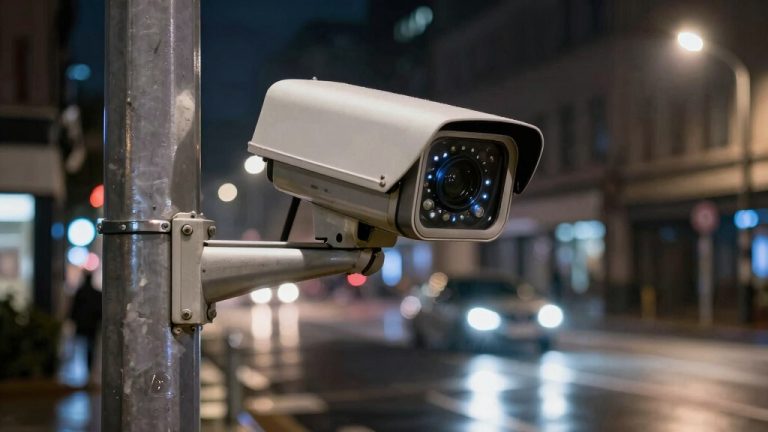
Visible security cameras consistently stop burglars in their tracks by creating a strong psychological barrier that signals high risk and low reward.
When you install visible cameras, you increase the perceived chance of being identified and caught, which deters about 60% of burglars from targeting your property.
Studies show homes with visible cameras face 300% lower burglary risk, emphasizing the power of visual deterrence.
Burglars actively avoid locations where surveillance is obvious, opting for easier targets.
This behavior aligns with evidence from UNC Charlotte, where 60% of convicted burglars admitted to changing their plans due to cameras.
By making your security measures clear, you influence offenders’ risk assessments, reducing break-ins by up to 67%.
This deterrent effect is strongest when cameras are visibly positioned at entry points and driveways.
Additionally, cameras that offer real-time alerts enhance deterrence by enabling immediate response to suspicious activity.
Where Public Security Cameras Cut Crime the Most?
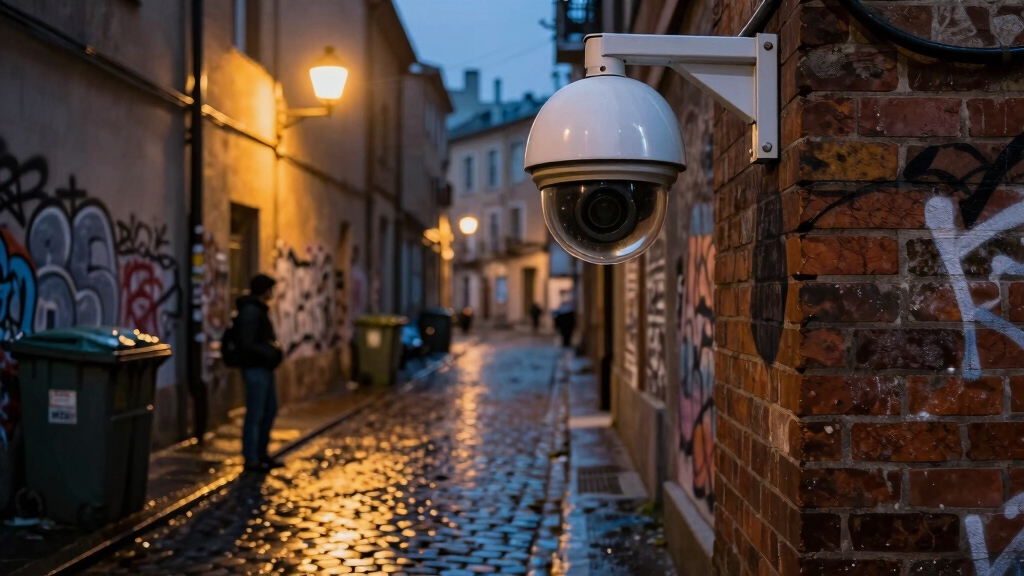
Beyond private properties, public security cameras have a notable impact on reducing crime in communal spaces.
Studies consistently show crime rates drop between 15% and 20% in monitored public zones. You’ll find these reductions most pronounced in areas with high pedestrian traffic and vulnerable targets.
Public cameras cut crime markedly in parks and recreational areas, where visibility deters assaults and thefts.
They also reduce violent and property crimes in streets and urban centers.
In public transportation hubs, cameras lower incidents like vandalism and pickpocketing.
Residential neighborhoods see decreased burglary and trespassing rates as well.
For example, a multi-city evaluation revealed a 20% crime decrease, while Orange County, NJ saw a 50% drop in all crime types.
These findings underscore how strategically placed cameras enhance public safety without simply shifting crime elsewhere.
The increasing use of digital video transmission in modern public cameras allows for remote monitoring and faster response times, further improving their effectiveness.
Key Features That Make Security Cameras Effective Deterrents
Enhancing crime prevention hinges on specific camera features that maximize deterrence. You’ll want cameras that are visible, as 60% of burglars avoid properties with noticeable devices.
Active monitoring also increases effectiveness by enabling prompt responses and psychological risk for criminals. Combining cameras with alarms and lighting further discourages crime.
High-quality video resolution improves identification, boosting the chance of arrest.
| Feature | Impact on Crime Deterrence | Emotional Effect |
|---|---|---|
| Visibility | 60% burglars avoid visible cams | Feeling of being watched |
| Active Monitoring | 51% crime reduction reported | Assurance of immediate action |
| High Resolution | Higher arrest likelihood | Confidence in justice |
Selecting these features guarantees your security system works as a powerful deterrent. Additionally, ensuring stable connections and minimal interference in your camera system enhances continuous monitoring and reliability.
How Recorded Footage Helps Investigations and Boosts Safety?
Recorded footage plays an essential role in criminal investigations by providing clear, objective evidence that can verify events and identify suspects.
When you review recorded video, you gain vital insights that support law enforcement and judicial processes. This footage strengthens cases by reducing reliance on eyewitness accounts, which can be unreliable.
Key benefits include:
Enhancing suspect identification with high-quality visuals.
Enabling prompt law enforcement response through real-time monitoring.
Supporting prosecution with indisputable evidence in court.
Lowering liability and assisting insurance claims through documented proof.
Security cameras utilize a unique device identifier called a UID to ensure secure and reliable remote access to footage without compromising privacy.
Frequently Asked Questions
How Do Security Cameras Affect Homeowners’ Insurance Premiums?
Security cameras can lower your homeowners’ insurance premiums by reducing risk.
Insurers recognize that visible, monitored cameras decrease burglary likelihood, which cuts claims.
Studies show properties with cameras face up to 300% less burglary risk, translating into fewer payouts.
This risk reduction encourages insurers to offer discounts.
Can AI Integration Improve Real-Time Crime Detection?
Yes, AI integration can improve real-time crime detection by analyzing video feeds instantly. This helps you identify suspicious activities faster and more accurately.
This boosts your ability to respond promptly, increasing arrest rates and deterring criminals effectively. Studies show AI-enhanced systems enhance monitoring quality and reduce false alarms.
They also support strategic camera placement. By using AI, you gain a more proactive, reliable security setup that strengthens overall crime prevention and community safety.
What Additional Security Measures Work Best With Cameras?
Think of your security system as a layered fortress. Pair cameras with alarms and strategic lighting to create multiple barriers, increasing deterrence by up to 67%.
Visible cameras combined with signs deter 25% more burglars, while AI-enhanced monitoring boosts real-time response.
This multi-faceted approach not only lowers crime rates but also improves evidence quality and community safety. It makes your property a much harder target for criminals.
Do Signs Without Cameras Effectively Deter Burglars?
Signs alone can deter about 25% of burglars by suggesting surveillance. However, they aren’t as effective as actual cameras.
Without cameras, you miss out on visual evidence and real-time monitoring, which reduces deterrence power.
To maximize protection, you should combine signs with visible, actively monitored cameras and other measures like alarms and lighting.
This layered approach greatly lowers burglary risk and improves overall security effectiveness.
How Does Camera Density Influence Neighborhood Safety?
Think of camera density as a safety net: the more cameras you install in your neighborhood, the stronger that net becomes.
Studies show dense camera setups lower crime markedly by covering multiple angles and entry points, making it harder for criminals to find blind spots.
This layered surveillance boosts detection and deterrence, creating a safer environment. You’ll see up to a 20% crime drop in well-monitored areas, reducing risks for everyone.
Watchful Eyes, Safer Spaces: The True Power of Security Cameras
When you spot a security camera’s unblinking eye watching over a neighborhood or storefront, you’re witnessing a powerful crime deterrent in action.
Research shows these visible cameras create a psychological barrier, making criminals think twice. Their strategic placement in high-risk areas and clear recording capabilities don’t just prevent crime; they provide essential evidence when incidents occur.
By combining presence and proof, security cameras play a critical, evidence-backed role in enhancing public safety.