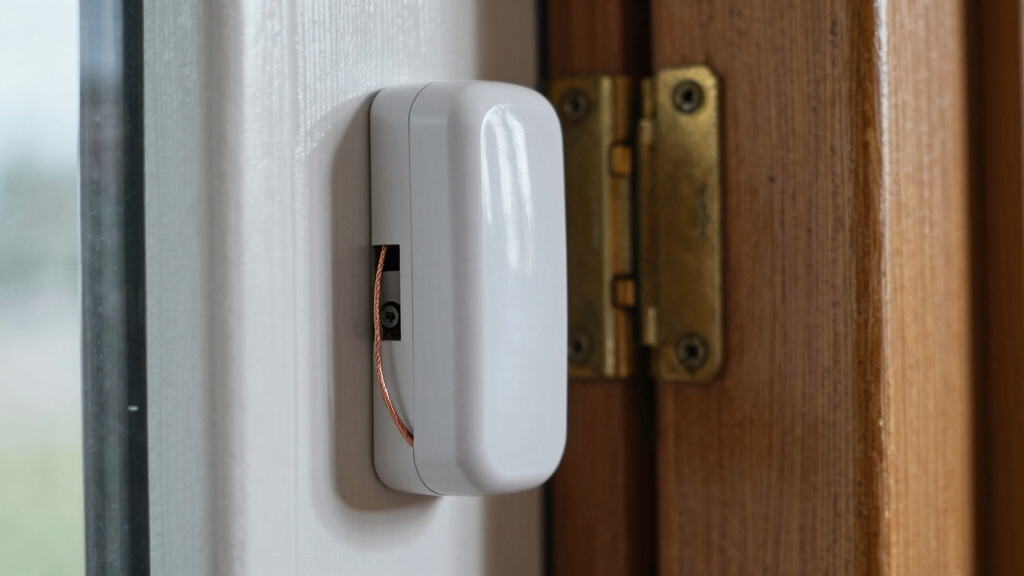

You’ll find wired door alarm sensors reliable and interference-free, using mechanical reed switches triggered by magnet alignment. They work without power draw or batteries, making them highly durable.
You can choose normally open or normally closed configurations to suit your monitoring needs and enhance tamper detection. Installation involves maintaining a precise magnet gap, usually under 0.5 inches, for consistent signaling.
These sensors integrate easily with most alarm panels and microcontrollers, offering flexible, low-maintenance security. More details cover installation tips, compatibility, and sensor types.
Key Takeaways
- Wired door alarm sensors use reed switches activated by magnet alignment to detect door open/close status without external power.
- They support normally open (NO) and normally closed (NC) configurations for customizable security and tamper detection.
- Installation requires mounting sensors and magnets within 10–25 mm, ensuring proper alignment to prevent false alarms.
- Two-wire, non-polar wiring simplifies connection and compatibility with any hardwired alarm panel or microcontroller.
- Wired sensors provide reliable, interference-free monitoring with no power draw, suitable for diverse door types and environments.
How Do Wired Door Sensors Work?
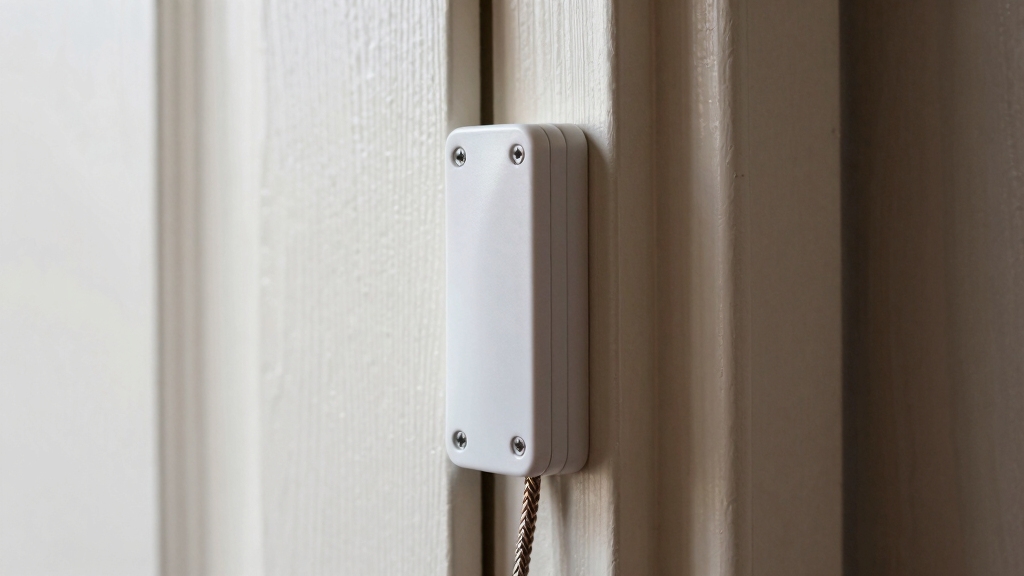
Although wired door sensors may seem simple, they operate through a precise mechanism involving a reed switch and a magnet.
When the magnet aligns with the reed switch, it holds the circuit in a normally closed state, indicating the door or window is shut.
As soon as the magnet separates from the sensor, typically beyond a 10-25mm sensing distance, the reed switch opens, triggering an alert signal.
The sensor’s non-polar design lets you connect wires in any order without affecting functionality.
It requires no power from the security panel since the mechanical contact acts as the switch itself.
Installation involves surface mounting with screws, ensuring the sensor stays within 0.5 inches of the magnet when closed.
This setup enables accurate detection of open or closed status through a simple two-wire connection.
For optimal security, it is critical to maintain the sensor gap at no more than 1/4 inch for doors to ensure reliable detection and prevent false alarms.
Top Benefits of Wired Door Sensors
When you choose wired door sensors, you benefit from a system that eliminates the need for battery replacements. This ensures continuous operation without maintenance interruptions.
Choosing wired door sensors means no battery changes, ensuring uninterrupted and hassle-free security monitoring.
These sensors use a mechanical reed switch, which requires no power draw. This enhances reliability and reduces system complexity.
You’ll appreciate their universal compatibility with any hardwired alarm panel. This avoids frequency conflicts common in wireless models.
Installation involves a simple two-wire connection and surface mounting with screws, making setup straightforward and secure.
The durable PVC housing resists rust and environmental damage, extending sensor lifespan.
Additionally, wired sensors provide consistent signal transmission without interference, which is vital for critical security applications.
With precise sensing distances of 10-25mm and flexible NO/NC switch options, you can tailor performance to your specific security needs efficiently.
Their integration into layered defense systems further strengthens overall security by complementing other protective measures.
Why Wired Sensors Beat Wireless Alternatives?
You’ll love how wired door sensors work completely without batteries. This means no more worrying about maintenance or unexpected power interruptions. Isn’t that a relief?
Also, they’re universally compatible, so you can easily integrate them with any hardwired system, no matter the brand or frequency. That’s just one less thing to think about!
And let’s not forget about their mechanical reed switch design. It ensures consistent performance without interference every single time. Pretty impressive, right?
Plus, their reliability supports integration with motion sensors and obstacle detection to enhance overall security.
Battery-Free Operation
Wired door alarm sensors run entirely without batteries, drawing no power from the security panel thanks to their mechanical reed switch design. You won’t worry about battery replacements or power failures since the sensor’s mechanical contact triggers signals when the magnet separates.
This design guarantees continuous operation, making it ideal for long-term security needs. The sensor’s non-polar reed switch connects easily in any wire order, enhancing installation flexibility.
| Feature | Benefit |
|---|---|
| Mechanical reed switch | No power drain or battery use |
| Non-polar wiring | Simplifies installation |
| Durable PVC housing | Resists rust, guarantees longevity |
| Two-wire connection | Reliable data transmission |
This battery-free setup guarantees you a maintenance-free, dependable security system. Additionally, proper identification and handling of load wires in the wiring ensures safe and reliable operation of the connected circuits.
Universal System Compatibility
Many security systems benefit from sensors that guarantee universal compatibility. Door alarm sensors wired for hardwired connections fit this need perfectly.
These sensors operate within a broad voltage range (100V to 200VDC) and support standard two-wire connections. This ensures seamless integration with virtually any hardwired alarm panel regardless of brand.
You won’t have to worry about frequency conflicts or pairing issues common with wireless alternatives. Their non-polar wiring design lets you connect cables in any order, simplifying installation.
Whether you’re working with wood, glass, or metal doors, these sensors maintain consistent communication through a straightforward mechanical reed switch. This universality makes them ideal for diverse environments, from homes to warehouses.
You get a reliable, hassle-free solution compatible with existing and custom security systems. Additionally, using cables with appropriate current limitations ensures enhanced safety and compliance with electrical standards.
Consistent Mechanical Reliability
Building on their universal compatibility, these door alarm sensors deliver unmatched mechanical reliability that wireless alternatives can’t match.
You’ll appreciate that their reed switch mechanism operates purely through magnet separation, requiring no power draw and eliminating signal interference common in wireless models.
The normally closed or normally open switch configurations guarantee consistent contact closure or opening, providing precise detection of door status.
Since the sensor’s mechanical contact is housed in durable PVC and mounted securely with screws, you avoid issues like battery failure or wireless signal loss.
The two-wire connection offers straightforward data transmission without interruptions.
Additionally, their design ensures safety by requiring power to be disconnected before maintenance, aligning with power cut procedures to prevent electrical hazards.
Compatibility of Wired Door Sensors With Alarm Systems and Microcontrollers
Wired door sensors are pretty much a safe bet when it comes to compatibility—they work with just about any hardwired alarm system, no matter the brand or model. That’s a huge plus if you’re looking for something straightforward.
And here’s the best part: they’ve this simple two-wire connection. This feature means you can easily hook them up to microcontrollers like Arduino. So, if you’re into custom monitoring or want to automate things a bit, you’re in luck!
However, when working with wired sensors, it’s important to follow safe wire handling procedures to prevent damage and ensure reliable operation.
Universal Alarm System Compatibility
Wired door alarm sensors offer seamless integration with a wide range of hardwired alarm systems and microcontrollers, ensuring universal compatibility regardless of brand or platform.
These sensors support normally open (NO) and normally closed (NC) switch configurations, aligning effortlessly with various input requirements. Their non-polar wiring lets you connect without worrying about polarity.
Mechanical reed switches require no power from the panel, simplifying integration. Whether you use security panels or microcontroller boards, these sensors transmit reliable signals over two-wire connections.
| Feature | Specification | Benefit |
|---|---|---|
| Voltage Range | 100V to 200V DC | Wide system compatibility |
| Switch Type | NO/NC | Flexible input configurations |
| Wiring | Two-wire, non-polar | Easy installation |
| Signal Type | Mechanical reed switch | No power draw, reliable |
For enhanced reliability, it is important to consider potential signal interference from nearby electronics that can affect wireless components in alarm systems.
Microcontroller Integration Options
Integrate door alarm sensors seamlessly with microcontrollers like Arduino by leveraging their simple two-wire connection and non-polar design. The sensor’s reed switch outputs a binary signal when the magnet separates, making it easy to read open or closed states via a digital input pin.
Because the sensor requires no power source, it reduces wiring complexity and power consumption on your microcontroller. You can connect the sensor in either wire order, simplifying installation. Use pull-up or pull-down resistors to guarantee stable readings.
These sensors support normally open (NO) or normally closed (NC) configurations, so you can tailor logic to your application. This compatibility makes wired door sensors ideal for custom security projects and automations integrating with various microcontroller platforms.
For optimal performance, ensure proper frame alignment to prevent false alarms caused by door misalignment.
How to Choose Normally Open vs. Normally Closed Wired Sensors?
Selecting between normally open (NO) and normally closed (NC) door alarm sensors hinges on understanding their operational states and how they interact with your security system.
NO sensors remain open until the door closes, completing the circuit. NC sensors maintain a closed circuit until the door opens, breaking the circuit. Your choice depends on security needs and fault tolerance.
| Feature | Normally Open (NO) | Normally Closed (NC) |
|---|---|---|
| Circuit State | Open when door open | Closed when door closed |
| Fault Detection | Less sensitive to faults | Detects wire cuts |
| Use Case | Simple alarm triggers | Enhanced tamper detection |
Choose NC for higher security. NO suits basic monitoring. Regular monitoring and baseline comparisons help detect new or unexplained signals appearing at specific times or locations, which can be critical for identifying tampering attempts.
What Voltage, Current & Power Ratings Mean for Your Sensor?
Although door alarm sensors appear simple, their voltage, current, and power ratings critically influence performance and compatibility.
You must guarantee your sensor’s working voltage, typically between 100V and 200VDC, matches the control panel’s supply to prevent malfunction or damage.
The working current, ranging from 0.3A to 100mA, affects how much electrical load the sensor can handle without overheating.
Power ratings, commonly 3W or 10W, define the maximum energy the sensor can dissipate safely.
Exceeding these values risks sensor failure or reduced lifespan.
Understanding these parameters guarantees you select a sensor that operates reliably within your system’s electrical limits.
This ensures signal integrity and mechanical contact function without causing electrical stress or interference in your wired alarm setup.
Installation Tips for Surface-Mounted Wired Door Sensors
When installing surface-mounted wired door sensors, you need to make certain the sensor and magnet align correctly with a gap no greater than 0.5 inches to maintain proper signal detection.
Start by cleaning the mounting surface to guarantee secure adhesion and prevent movement. Use the provided screws to firmly attach both the sensor and magnet to their respective positions on the door frame and door.
Route the two-wire cable carefully, avoiding sharp bends and potential pinch points to preserve signal integrity. Confirm the sensor’s NO or NC switch configuration matches your security panel requirements before wiring.
Test the sensor’s mechanical contact operation by opening and closing the door, ensuring consistent triggering without false alarms. Finally, verify the durable PVC housing remains intact and properly sealed against moisture and dust.
Maintaining the Right Magnet-to-Sensor Distance
To ensure reliable triggering, it’s important to keep a gap of 10 to 25mm between the magnet and the sensor. If you stray from this range, you might run into issues like false alarms or not detecting whether the door is open or closed.
Optimal Gap Measurement
In maintaining the ideal gap measurement between the magnet and the sensor, you guarantee reliable activation of the door alarm system.
The most favorable gap typically ranges between 10 to 25 millimeters, with a recommended maximum of 0.5 inches (about 12.7 mm) for most wired reed switch sensors.
If the magnet is too far, the reed switch won’t engage, causing false alarms or failure to detect door status.
Conversely, placing the magnet too close can stress the sensor or cause constant activation.
During installation, position the magnet directly opposite the sensor’s reed switch, ensuring alignment and consistent spacing.
Use precise measuring tools or spacers to maintain this distance.
Proper gap calibration enhances system responsiveness while preventing mechanical wear, ensuring long-term reliability.
Effects of Distance Variance
Although maintaining the correct magnet-to-sensor distance may seem straightforward, even slight deviations can substantially impact the door alarm sensor’s performance.
The sensor’s reed switch activates reliably only within its specified action distance of 10-25mm. If the gap widens beyond this range, the magnetic field weakens, preventing the switch from closing properly. This can cause false alarms or failure to detect door status changes.
Conversely, placing the magnet too close or pressing firmly against the sensor risks mechanical wear or permanent contact. This reduces sensitivity over time.
You should make certain the magnet stays consistently within the prime gap—typically under 0.5 inches—to maintain reliable signal transmission without stressing the switch mechanism.
Accurate distance control is vital for dependable wired door alarm operation.
Installation Best Practices
Maintaining the correct magnet-to-sensor distance during installation directly impacts the reliability of your wired door alarm sensor. You should make sure the gap stays within the sensor’s specified action distance, typically 10-25mm (about 0.5 inch).
This proximity guarantees the reed switch accurately detects door or window status changes without false triggers. When mounting, position the magnet and sensor flush on opposing surfaces with screws, avoiding misalignment or excessive spacing.
Use a calibrated gauge or spacer during installation to maintain consistent spacing. Remember, too large a gap results in missed signals, while too close may cause constant activation.
Properly securing the sensor’s durable PVC housing also prevents movement that could alter the gap over time. Following these best practices optimizes performance and extends sensor longevity.
Different Styles and Sizes of Wired Door Sensors
Wired door sensors come in a variety of styles and sizes to fit different installation needs and aesthetic preferences. You’ll find options designed for discreet mounting, robust durability, or space-saving applications. Understanding these variations guarantees you choose the right sensor for your setup.
Key styles and sizes include:
- Mini and Slim Strip Profiles: Compact dimensions (around 2×0.38×0.29 inches) for hidden or sleek installations.
- Recessed Sensors: Installed within door or frame cavities, offering a flush, tamper-resistant design.
- Surface Mount Sensors: Larger housings (up to 56x14x13mm) with PVC casing, ideal for visible mounting on various door types.
Each style supports either normally open or normally closed reed switches, with cable lengths near 30cm.
This ensures compatibility with most wiring configurations and security panels.
Common Applications for Wired Door Sensors
When you install door sensors, you’ll find they serve a wide range of applications across residential, commercial, and industrial settings. You can use wired door sensors on entry doors, windows, garage doors, and office access points to monitor open or closed status accurately.
Their compatibility with any hardwired alarm system and microcontrollers like Arduino enables custom security or automation setups. In warehouses and shops, these sensors help secure inventory by detecting unauthorized access. Hotels and apartments benefit from reliable, low-maintenance monitoring without battery replacements.
Because they handle various door types, including wood, glass, sliding, and casement, wired door sensors provide versatile protection. Their mechanical reed switch operation guarantees signal integrity, making them ideal for environments demanding consistent, interference-free security monitoring.
Frequently Asked Questions
Can Wired Door Sensors Be Used Outdoors in Extreme Weather Conditions?
Yes, you can use wired door sensors outdoors in extreme weather, but you’ll need to make certain they’ve durable PVC housing to resist rust and moisture.
Also, maintain the best gap within 0.5 inches between the sensor and magnet for accurate detection despite temperature changes.
Proper surface mounting with screws helps secure them against harsh conditions.
Choose sensors rated for your voltage and current specs to guarantee reliable operation under varying environmental stresses.
How Do Wired Door Sensors Handle Power Outages or Electrical Surges?
Over 60% of power outages cause security system failures, but wired door sensors handle these events efficiently.
They rely on a mechanical reed switch that requires no external power, so during outages, they continue detecting open or closed states.
However, electrical surges can damage connected panels, so you should install surge protectors.
Their non-polar design and durable PVC housing also help maintain reliable operation despite voltage fluctuations, ensuring your security remains intact.
Are Wired Door Sensors Compatible With Smart Home Automation Systems?
Yes, you can integrate wired door sensors with smart home automation systems. They work seamlessly when connected to compatible security panels or microcontrollers like Arduino.
These sensors provide reliable mechanical signals via reed switches, which your smart hub can interpret for automation triggers. Just make sure your system supports hardwired inputs.
You’ll benefit from stable, interference-free operation without worrying about battery life or wireless frequency issues.
What Troubleshooting Steps Exist if a Wired Door Sensor Stops Working?
When your wired door sensor stops working, the first step is to check the wiring connections. Make sure nothing’s loose or corroded.
Next, verify the magnet aligns properly within the specified sensing distance. Test the reed switch for continuity with a multimeter.
Inspect the sensor housing for physical damage or dirt. If all else fails, swap the sensor with a known good unit to isolate the issue.
Don’t overlook power supply voltage and panel compatibility.
Can Wired Door Sensors Be Integrated With CCTV or Video Monitoring Systems?
Yes, you can integrate wired door sensors with CCTV or video monitoring systems. By connecting the sensor’s two-wire output to a security panel or microcontroller, you can trigger video recording or alerts when the door opens or closes.
This setup enhances surveillance by synchronizing sensor events with video footage. It allows real-time monitoring and evidence capture without wireless signal interference, ensuring reliable and continuous operation within your security infrastructure.
Building an Unbreakable Security System with Wired Door Sensors
When you install wired door sensors, you’re not just adding security. You’re creating an impenetrable fortress.
These sensors work with pinpoint precision, ensuring no unauthorized entry goes unnoticed. Compared to wireless options, wired sensors offer unmatched reliability and seamless integration with alarm systems and microcontrollers.
By choosing the right type and maintaining proper magnet distance, you guarantee peak performance. In short, wired door sensors turn your property into a fortress of flawless security technology.