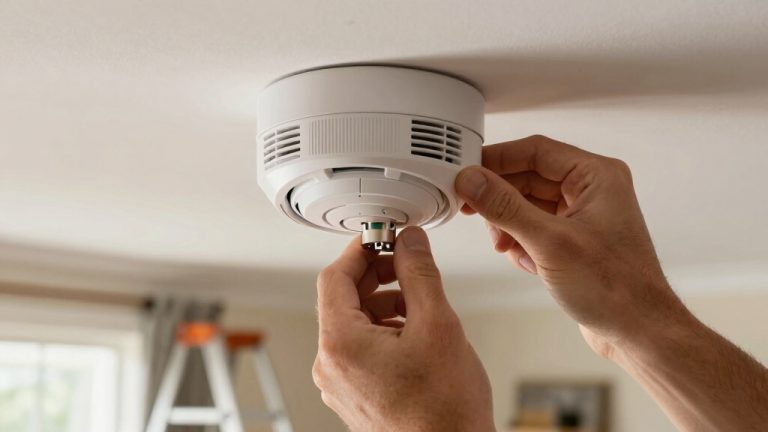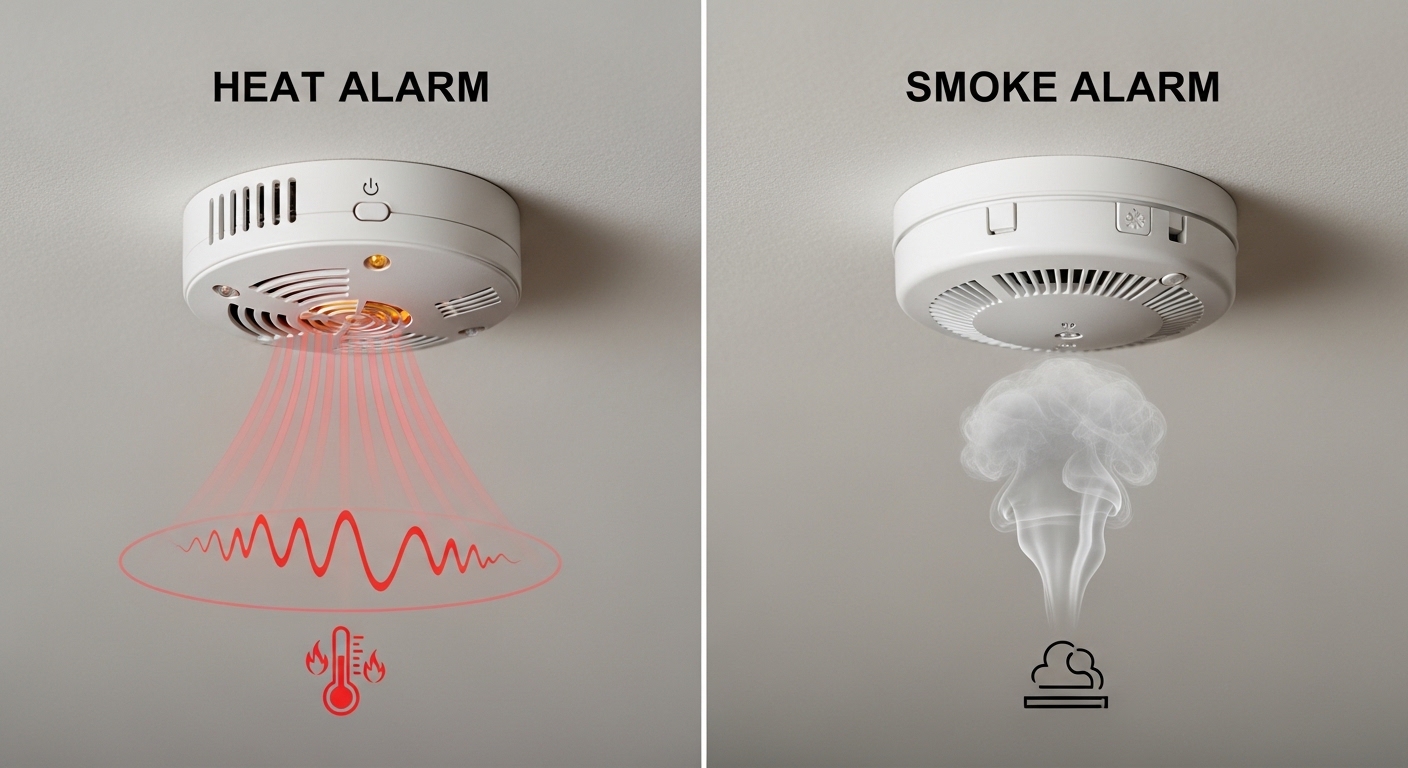

You’ll want smoke alarms to detect early-stage, smoldering fires by sensing smoke particles. This makes them ideal for bedrooms and living areas.
Heat alarms respond to temperature changes and suit kitchens, garages, or dusty spots. These areas might cause false alarms for smoke alarms due to steam or contaminants.
Combining both offers broader protection against varied fires and false alerts. Understanding their distinct functions and best placements helps optimize your home’s safety.
Explore further how each type performs in different fire scenarios.
Key Takeaways
- Smoke alarms detect smoke particles early, offering faster alerts during smoldering fires, while heat alarms respond to temperature changes.
- Heat alarms resist false alarms from steam, dust, and cooking fumes better than smoke alarms, making them ideal for kitchens and garages.
- Photoelectric smoke alarms excel at detecting thick smoke with fewer false alarms, while heat alarms focus on rapid temperature rises in fast fires.
- Fixed-temperature heat detectors activate at set high temperatures, whereas rate-of-rise detectors respond to sudden heat spikes for faster detection.
- Combination detectors integrate smoke and heat sensing, providing broader fire detection coverage and improved false-alarm resistance.
Comparison Table Between Heat Alarms & Smoke Alarms
| Feature | Smoke Alarms | Heat Alarms |
|---|---|---|
| Detection Method | Detect smoke particles using photoelectric sensors | Detect temperature changes or rapid heat rise |
| Best For | Bedrooms, living rooms, hallways | Kitchens, garages, bathrooms, dusty areas |
| Fire Type Sensitivity | Best for smoldering, slow-burning fires | Best for fast-flaming, high-heat fires |
| Response Time | Faster in early-stage fires | Faster in rapid temperature rise situations |
| False Alarm Risk | Higher (steam, dust, cooking fumes) | Lower (resistant to contaminants) |
| Types Available | Mainly photoelectric (modern standard) | Fixed-temperature & rate-of-rise detectors |
| Activation Trigger | Smoke particles in the air | Set temperature (e.g., 57°C) or sudden heat spike |
| Installation Areas to Avoid | Kitchens, bathrooms, garages | Areas with frequent temperature fluctuations |
| Maintenance Needs | Regular cleaning to avoid dust/insects | Less sensitive but still needs periodic checks |
| Performance in Humid Areas | Can be affected by steam/humidity | Performs reliably in humid environments |
| Early Warning Capability | Excellent (detects fire before heat builds) | Limited (triggers after heat increases) |
| False Alarm Prevention | Needs careful placement and cleaning | Naturally resistant to nuisance triggers |
| Combination Option | Can be integrated with heat sensors | Available as part of combo detectors |
| Overall Role | Early detection and life safety | Reliable detection in harsh environments |
Choosing Between Heat and Smoke Alarms: What You Need to Know
When choosing between heat and smoke alarms, you need to take into account the environment and the specific type of fire risks present in your space.
Smoke alarms detect smoke particles early using photoelectric sensors, providing rapid warnings in areas prone to smoldering fires, such as bedrooms and living rooms.
Conversely, heat alarms activate based on temperature thresholds or rapid rises, making them suitable for kitchens, garages, and dusty or steamy locations where smoke alarms might trigger false alarms.
You should consider that smoke generally precedes heat in most fires, favoring smoke alarms for early detection.
However, heat alarms offer reliability against false activations in contaminant-rich environments.
Your choice must balance early warning needs with environmental conditions to optimize fire detection and minimize nuisance alarms effectively.
Integrated systems that combine smoke detectors with sprinklers provide early warning and direct suppression for enhanced fire safety.
Key Types of Heat and Smoke Detectors and Their Advantages
Explore the key types of heat and smoke detectors to understand their distinct advantages and appropriate applications.
Smoke alarms primarily use photoelectric sensors to detect smoke particles, offering early warnings during smoldering fires.
Heat detectors come in fixed-temperature and rate-of-rise types. Fixed-temperature units activate at a specific threshold, while rate-of-rise models respond to rapid temperature increases, ideal for fast-burning fires.
Photoelectric smoke alarms excel in detecting thick smoke with minimal false alarms. Fixed-temperature heat detectors provide stable activation at preset temperatures.
Rate-of-rise heat detectors respond quickly to sudden heat spikes but may false alarm in variable environments. Combination detectors integrate smoke and heat sensing for all-encompassing detection and faster response.
Choosing the right detector depends on your environment and desired balance between early warning and false alarm resistance.
Photoelectric smoke alarms are especially sensitive to large smoke particles from smoldering fires, providing earlier alerts with fewer false alarms due to their light scattering detection method.
Where to Install Heat Detectors and Smoke Alarms in Your Home?
Selecting the appropriate detector type is only part of effective fire safety; proper placement within your home greatly influences performance. Install smoke alarms in bedrooms, hallways, and living rooms where early smoke detection maximizes occupant safety.
Position them on ceilings or high on walls, away from drafts or vents. Use heat detectors in kitchens, garages, bathrooms, and roof cavities to avoid false alarms caused by steam, cooking fumes, or dust.
Fixed-temperature and rate-of-rise heat detectors suit these environments, resisting nuisance triggers common in high-contaminant areas.
Avoid placing smoke alarms in dusty or steamy zones to reduce false positives. By strategically combining smoke alarms for early warning and heat detectors for harsh environments, you guarantee thorough and reliable fire detection tailored to each space’s conditions.
For optimal safety, install detectors inside each bedroom and outside sleeping areas such as hallways to ensure early warning coverage throughout your home.
How Heat and Smoke Alarms Detect Fires Differently?
Although both heat and smoke alarms serve the critical function of fire detection, they operate using distinct mechanisms tailored to different fire indicators.
Heat and smoke alarms detect fires through different mechanisms designed for specific fire indicators.
Smoke alarms use photoelectric sensors to detect smoke particles disrupting a light beam, enabling early warning during smoldering fires. Heat alarms respond to temperature changes, activating at fixed thresholds (e.g., 57°C) or upon rapid heat rises.
When you rely on these devices, keep in mind:
- Smoke alarms detect particles, offering faster alerts in early-stage fires.
- Fixed-temperature heat alarms trigger once the set heat level is reached.
- Rate-of-rise heat detectors activate on sudden temperature increases.
- Heat alarms resist false alarms from dust or steam common in kitchens and garages.
Photoelectric smoke alarms are generally less affected by humidity, making them a better choice in areas prone to moisture exposure due to their humidity tolerance.
This distinction ensures you choose the right alarm for specific environments and fire types.
Common Causes and Prevention of False Alarms in Heat and Smoke Detectors
Because false alarms can undermine the reliability of fire detection systems, understanding their common causes in heat and smoke detectors is essential for effective prevention.
Smoke alarms often trigger falsely due to steam, cooking fumes, dust, or insects disrupting the photoelectric sensor. Heat alarms, while more resistant, can still false alarm in environments with rapid temperature fluctuations or improper placement near heat sources.
To prevent false alarms, install smoke detectors away from kitchens, bathrooms, and garages, where airborne particulates and steam prevail. Use heat alarms in these high-contaminant areas instead.
Regularly clean detectors to remove dust and insects. For heat detectors, make certain they’re rated for the environment and avoid locations with frequent temperature swings.
Employ multi-sensor detectors to improve accuracy by analyzing multiple fire indicators simultaneously.
Proper ventilation and placing detectors at least 10 feet from steam sources can also help reduce false alarms caused by steam.
How Heat and Smoke Detectors Respond in Different Fire Situations?
You know, it’s pretty interesting how smoke and heat detectors work differently in various fire situations. For instance, smoke detectors tend to respond faster during smoldering fires because they can pick up on that early smoke. It’s like they’re always on the lookout for those telltale signs.
On the flip side, heat detectors mainly kick in when certain temperature thresholds are met or when there’s a rapid rise in temperature. So, depending on the type of fire, one alarm might trigger before the other.
Typically, smoke shows up before there’s a lot of heat, which is why understanding how these devices activate is super important. This knowledge can really help you choose the right type of detector for your space.
It’s also important to note that heat combined with high humidity can sometimes cause false alarms in smoke detectors, especially in environments prone to moisture.
Response Times Comparison
How quickly a fire alarm responds can mean the difference between containment and catastrophe.
Smoke alarms generally react faster in early-stage smoldering fires because they detect smoke particles before significant heat builds up.
Heat alarms, however, excel in rapid-flame fires where temperature rises sharply, triggering them quicker than smoke detectors.
The type of heat detector also influences response time; rate-of-rise models activate faster than fixed-temperature units, which have inherent thermal lag.
Smoke alarms detect fires at the incipient stage by sensing airborne particles.
Heat alarms respond chiefly to rapid temperature increases.
Fixed-temperature heat detectors may delay activation during fast fires.
Combination detectors optimize response by sensing both smoke and heat.
Understanding these differences helps you choose the right alarm for specific environments and fire scenarios.
It is important to note that some alarms require a physical reset procedure to restore factory settings after testing or alarms.
Fire Type Sensitivity
Different types of fires produce varying signals that heat and smoke detectors respond to with differing effectiveness.
When a fire smolders, it produces dense smoke particles before significant heat. This allows smoke detectors using photoelectric sensors to detect disruption in their light beams early.
Conversely, rapidly flaming fires generate intense heat quickly, triggering heat detectors through fixed-temperature or rate-of-rise mechanisms.
You’ll find heat alarms less sensitive to smoldering fires since they rely on temperature thresholds.
Meanwhile, smoke alarms may struggle with fast, clean-burning fires that produce minimal smoke.
In environments prone to steam or dust, heat detectors provide reliable detection by focusing on heat changes, reducing false alarms.
Understanding these sensitivities helps you select appropriate alarms for specific fire scenarios.
This optimizes safety across varied conditions.
It is also important to note that in spaces like garages, where temperature extremes and contaminants are common, heat detectors are often preferred over smoke alarms to reduce false alarms and maintain reliability.
Activation Thresholds Differences
Although smoke and heat detectors both alert occupants to fire hazards, their activation thresholds vary markedly based on the fire’s characteristics.
Smoke alarms activate upon detecting airborne particles, usually before significant heat develops. This makes them sensitive to smoldering fires.
Heat alarms trigger when temperatures exceed fixed points (e.g., 57°C) or rise rapidly. They primarily respond to flaming fires with rapid heat increases.
Understanding these differences helps you position detectors effectively for peak safety.
Smoke alarms detect microscopic particles, activating early in slow, smoldering fires.
Fixed-temperature heat alarms activate only at specific high temperatures, avoiding false alarms in normal conditions.
Rate-of-rise heat detectors respond to sudden temperature spikes, useful in fast-burning fires.
Heat alarms are less sensitive to smoke, reducing false alarms in kitchens or dusty areas.
For continuous protection, it is essential that hardwired detectors include a battery backup to ensure operation during power outages.
Frequently Asked Questions
Can Heat Alarms Detect Fires Without Producing Smoke?
You might think heat alarms need smoke to detect fires, but they actually respond to temperature changes alone.
They activate when the heat reaches a set point or rises rapidly, even if no smoke is present.
This makes them effective in smoky or dusty environments where smoke alarms might false-trigger.
So, yes, heat alarms can detect fires without smoke by sensing thermal energy.
They provide reliable alerts, especially in kitchens or garages.
Are Heat Alarms Suitable for Outdoor Use?
Heat alarms generally aren’t designed for outdoor use because environmental factors like wind, rain, and temperature fluctuations can cause false alarms or damage the sensor.
If you need fire detection outdoors, you should choose specialized outdoor-rated heat detectors with weatherproof casings and proper IP ratings.
Standard heat alarms function best indoors, especially in controlled environments like garages or kitchens, where temperature changes are more predictable and protected from the elements.
How Often Should Heat and Smoke Alarms Be Replaced?
You know what they say: “An ounce of prevention is worth a pound of cure.”
You should replace both heat and smoke alarms every 10 years to guarantee reliable operation. Over time, sensors degrade, reducing sensitivity.
Regularly test alarms monthly and replace batteries annually if applicable.
If your alarm shows signs of malfunction or physical damage before 10 years, replace it immediately to maintain peak fire detection and safety in your home.
Do Heat Alarms Require Professional Installation?
You don’t always need a professional to install heat alarms, as many models are designed for DIY installation with clear instructions.
However, if your heat alarm connects to a hardwired system or integrates with a home security setup, it’s best to hire a qualified electrician to guarantee safety and compliance with local codes.
For standalone units in kitchens or garages, you can usually mount and test them yourself without issue.
Can Combination Alarms Connect to Home Security Systems?
Yes, combination alarms can connect to home security systems, enhancing your fire safety strategy. Over 60% of modern smart alarms offer integration via Wi-Fi or proprietary protocols. This enables centralized monitoring and instant alerts on your smartphone.
This connectivity allows you to receive real-time notifications and automate emergency responses. Make certain compatibility with your security system’s communication standards for seamless integration and peak performance in protecting both life and property.
Protect What Matters with the Right Alarm
When it comes to fire safety, choosing the right alarm is vital. Remember, “an ounce of prevention is worth a pound of cure.” Smoke alarms quickly detect smoldering fires, while heat alarms excel in environments prone to dust or steam.
By understanding their differences and proper placement, you guarantee timely alerts and reduce false alarms. Prioritize your home’s unique needs to protect your family effectively with the right detector in the right spot.