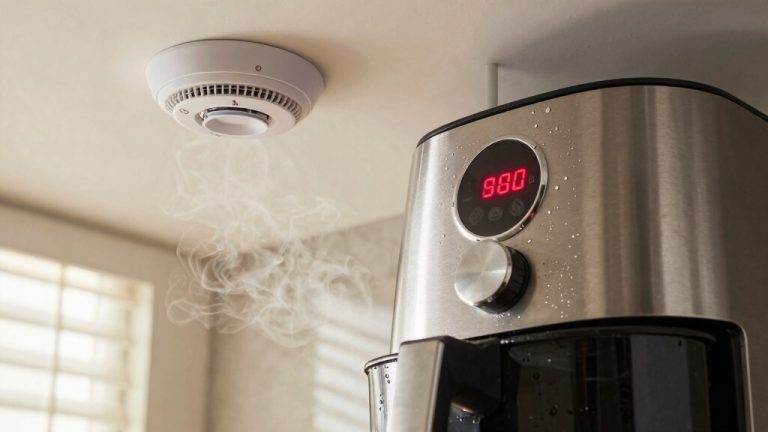
You rely on a photoelectric smoke alarm to detect smoke by sensing light scattered by particles inside a sealed optical chamber.
An LED beam shines through the chamber, but normally no light hits the sensor placed at a right angle.
When smoke enters, it scatters the light toward the photodetector, triggering an electrical signal that alarms you.
This method is especially sensitive to smoldering fires with larger particles. Let’s explore how this technology guarantees early fire warnings and integration with safety systems.
Key Takeaways
- Photoelectric smoke alarms detect smoke by using an LED that emits light inside a dark chamber where smoke particles scatter the beam toward a sensor.
- The sensor, positioned at a right angle to the LED, detects scattered light caused by smoke particles entering the chamber.
- Scattered light intensity increases with smoke concentration, causing the photodetector to generate a stronger electrical signal.
- Signal processing circuitry amplifies and analyzes the photodetector output, triggering an alarm when smoke levels exceed a set threshold.
- These alarms are especially sensitive to large smoke particles from smoldering fires, providing early warnings with fewer false alarms.
Principle of Photoelectric Smoke Detection
Although you mightn’t see it, photoelectric smoke alarms rely on the light scattering principle to detect smoke particles.
Inside a dark optical chamber, an LED emits a steady light beam that travels without directly hitting the sensor under clear air conditions.
Within a dark chamber, an LED beam passes unseen by the sensor when the air is clear.
When smoke enters, particles scatter the light in multiple directions, some reaching the sensor.
This scattered light triggers the sensor, which converts it into an electrical signal, activating the alarm circuit.
The detection leverages the Tyndall Effect, where smoke particles suspended in air scatter light, with sensitivity increasing as smoke density rises.
The device’s chamber design prevents stray light interference, ensuring only scattered light from smoke triggers the sensor.
This provides accurate and early detection of smoldering fires before visible flames appear.
Photoelectric smoke detectors tend to respond quicker to smoke from smoldering fires, making them especially effective in early fire detection.
Key Components of Photoelectric Smoke Alarms
When you examine a photoelectric smoke alarm, you’ll find several key components working together to detect smoke efficiently. Each part plays a critical role in ensuring timely and reliable smoke detection.
Light Source (LED): Emits a steady light beam inside the chamber, designed for longevity and energy efficiency.
Light Sensor (Photodiode/Phototransistor): Detects scattered light caused by smoke particles at a 90-degree angle from the LED.
Optical Chamber: Houses the LED and sensor, allowing smoke in while blocking dust and stray light. This chamber operates on the light-scattering principle known as the Tyndall Effect, which is fundamental to photoelectric detection.
Power Source: Supplies continuous power via battery or mains, often with backup and monitoring features.
Alarm Circuit and Sounder: Processes sensor signals and triggers a loud alert to notify occupants.
Together, these components create a precise system to detect smoke swiftly and reliably.
Design Features of the Optical Chamber
Since the optical chamber forms the core of a photoelectric smoke alarm’s sensing mechanism, its design directly impacts detection accuracy and reliability.
You’ll find the chamber is a sealed, dark space built from dust-, moisture-, and insect-resistant materials to prevent false alarms and contamination.
It incorporates vents with insect screens that allow quick smoke entry yet block debris. These insect screens are a key feature in reducing false alarms.
The chamber geometry optimizes the light beam path, ensuring efficient smoke particle interaction. Regular maintenance, including routine care, helps keep these components functioning optimally.
Inside, an infrared LED emits a focused beam, while a photodiode sensor is positioned at an angle to detect scattered light only when smoke is present.
Reflective surfaces may enhance detection, and housings are designed to shield components from electromagnetic and ambient light interference.
Additionally, airflow is controlled to maintain consistent smoke interaction for reliable sensing.
How Light Scattering Detects Smoke?
The optical chamber is designed to guide the light beam in a specific direction, keeping it away from the photodetector under normal conditions. This setup is somewhat analogous to how a peephole lens controls light direction to create a clear image for the observer inside.
But here’s where it gets interesting: when smoke particles come into play, they start to scatter that light. This scattering redirects some of the light right toward the sensor.
This phenomenon, known as the Tyndall Effect, occurs when the particle size is greater than the wavelength of the incident light.
As a result, the photodetector picks up this extra light, which boosts its signal. Once that signal crosses a certain threshold, the alarm goes off. It’s a pretty clever system, don’t you think?
Light Path Design
Although photoelectric smoke alarms rely on detecting light, they don’t simply measure direct beams; instead, their sensing chambers are precisely engineered to detect light scattered by smoke particles.
The chamber’s geometry and placement of the LED and photodiode guarantee no direct light hits the sensor in clear air, preventing false alarms. When smoke enters, it scatters the light toward the sensor, triggering detection.
Key design aspects include:
- Right-angle light path between source and sensor
- Optical isolation to block direct light
- Reflective surfaces to maximize scattered light capture
- Controlled smoke entry to maintain sensitivity
- Materials minimizing contamination and interference
This precise light path design enables early, reliable smoke detection by focusing on scattered light signals.
Many modern photoelectric alarms, such as the P1210E model, include features like a built-in 10-year lithium battery that provides continuous power without the need for battery replacements.
Installation of these alarms is straightforward and can be performed with basic tools, making them an affordable safety upgrade for any home.
Smoke Particle Interaction
The design of the light path in a photoelectric smoke alarm sets the stage for detecting smoke by exploiting how particles interact with light.
Smoke particles, varying from 0.1 to 10 micrometers, scatter the LED or infrared beam through the Tyndall Effect when they enter the chamber.
This scattering deviates photons from the direct light path, increasing the intensity of diffused light inside.
The optical chamber guarantees scattered light, not direct light, reaches the photodetector, minimizing false alarms.
Larger or denser smoke particle concentrations from smoldering fires enhance scattering, improving sensitivity.
Particle size, shape, and refractive index influence scattering angles and intensity, allowing the detector to differentiate smoke from normal air.
This precise interaction enables the sensor to identify smoke presence reliably and swiftly. The LED and photodiode housed within the chamber work together to detect the scattered light.
Photodetector Signal Response
When smoke particles scatter light inside the detection chamber, they redirect photons toward the photodetector. This device normally receives minimal light from the direct beam. The scattered light increases the photodiode’s electrical current proportionally to smoke concentration.
The device’s circuitry amplifies and digitizes this signal, enabling precise smoke detection. Key factors influencing the photodetector signal response include:
- Scattering intensity depends on smoke particle size and concentration.
- Photodetectors are offset to detect scattered, not direct, light.
- Signal amplitude correlates with smoke optical density.
- Low noise amplifiers enhance the signal-to-noise ratio (SNR).
- Digital processing compares signals against calibrated thresholds to trigger alarms.
This mechanism guarantees timely, reliable response to smoke presence by converting light scattering into measurable electrical signals.
The signal processing circuitry evaluates sensor output continuously to determine when to activate the alarm, ensuring early warning during the smoldering stage of fires.
Sensitivity to Different Types of Fires
Because different fires produce varying smoke particle sizes and densities, photoelectric smoke alarms respond with distinct sensitivity profiles.
Photoelectric smoke alarms detect smoke based on particle size and density, offering tailored sensitivity to different fire types.
They excel at detecting smoldering fires, which emit large, dense smoke particles that effectively scatter light within the sensor chamber.
This provides earlier alerts for slow, smoldering combustion, essential for occupant evacuation and reducing toxic smoke fatalities.
However, photoelectric alarms are less sensitive to flaming fires, which generate smaller, less dense particles that scatter light poorly, delaying detection.
Their design also reduces false alarms by differentiating real smoke particles from cooking smoke or steam, enhancing reliability.
Additionally, their energy-efficient operation reduces power usage and operational costs, making them a dependable choice for long-term fire safety.
For thorough fire safety, you should consider photoelectric alarms in areas prone to smoldering fires, while understanding their limitations with fast-flaming fires is critical for proper system planning.
Comparing Photoelectric and Ionization Smoke Detectors
Did you know that photoelectric and ionization smoke detectors operate using different methods? It’s pretty interesting! Photoelectric sensors work by scattering light when smoke particles enter the detector, while ionization sensors detect changes in ion currents triggered by combustion particles.
Now, each technology has its own set of pros and cons. For instance, photoelectric detectors are really good at picking up on smoldering fires. On the flip side, ionization detectors react more quickly to flaming fires.
However, photoelectric detectors tend to produce fewer false alarms in cooking and steam scenarios, making them a popular choice for apartments and residential high-rises due to their low nuisance rates.
Detection Methods Compared
Although both photoelectric and ionization smoke detectors serve the same essential purpose, they rely on fundamentally different detection methods.
Photoelectric alarms use a light source and sensor arranged to detect scattered light when smoke particles enter the chamber.
The light source is typically an LED chosen for reliability and low power consumption. Installing a photoelectric detector can be part of an overall home safety strategy that includes other security measures.
Ionization detectors employ a radioactive source ionizing air between charged plates, with smoke disrupting the ion current.
Key distinctions include:
Photoelectric alarms detect larger smoke particles from smoldering fires via light scattering.
Ionization alarms sense smaller particles from fast flaming fires by measuring ion current disruption.
Photoelectric chambers contain optical labyrinths to minimize false alarms.
Ionization chambers use radioactive material to maintain air ionization.
Response speeds vary, with photoelectric faster for smoldering and ionization for flaming fires.
Understanding these principles helps you select the right detector for specific fire risks.
Advantages and Limitations
Two primary types of smoke detectors, photoelectric and ionization, offer distinct advantages and limitations based on their detection mechanisms.
Photoelectric alarms excel at detecting smoldering fires by sensing larger smoke particles. They provide earlier warnings in residential settings and reduce false alarms from cooking smoke or steam.
This type of detector is recommended alongside ionization alarms or as combination models to ensure broader fire protection. They often last longer and support smart integrations but respond slower to fast-flaming fires and cost more upfront.
Their operation relies on detecting changes in light caused by smoke particles, akin to how a photoelectric sensor functions in various security devices.
Conversely, ionization detectors react quickly to smaller particles from flaming fires and are generally less expensive.
However, they produce more false alarms, have shorter lifespans, and detect smoldering fires less effectively. Choosing between these depends on your environment and fire risk profile.
Photoelectric units suit living spaces, while ionization detectors may better serve commercial areas with fast-flaming fire hazards.
Advantages of Photoelectric Technology
Frequently, the advantages of photoelectric smoke alarms stem from their superior ability to detect smoldering fires early, providing you with critical additional minutes to respond before flames develop.
This early detection is vital because smoldering fires produce larger smoke particles that photoelectric sensors identify more reliably than ionization types.
Photoelectric alarms excel at early detection of smoldering fires, giving you crucial extra minutes to act.
Here are key advantages you gain from photoelectric technology:
- Early warning for slow, smoldering fires common in homes
- Reduced false alarms from cooking fumes and steam
- Lower energy consumption, extending battery life
- Compatibility with smart and integrated fire safety systems
- Consistent, reliable performance in varied household environments, making them less prone to false alarms from everyday household activities like cooking or shower steam.
Typical Applications and Installation Settings
Building on the advantages of photoelectric smoke alarms, understanding where and how to install them optimizes their effectiveness.
Install detectors inside each bedroom and outside sleeping areas, plus on every home level, including basements and attics, for extensive coverage.
Keep them at least 20 feet from cooking appliances and 10 feet from humid areas like bathrooms to minimize false alarms.
In commercial and institutional settings, photoelectric detectors are placed in high-occupancy spaces, integrated into hardwired systems with battery backups, and zoned for centralized monitoring.
They must also be interconnected so that activation in one detector alerts occupants throughout the building.
Position detectors on ceilings or high walls, away from windows, doors, or vents, ensuring unobstructed smoke access.
Regular maintenance and adherence to codes like NFPA 72 guarantee reliability.
Following these installation protocols enhances early smoldering fire detection and occupant safety.
Integration With Fire Alarm and Smart Systems
Photoelectric smoke alarms are pretty cool because they can connect easily with fire alarm systems that are compatible.
Just keep in mind that it’s usually best to use devices from the same manufacturer to ensure everything communicates reliably.
Plus, many of these models can integrate with smart home platforms.
This means you can monitor and control them remotely through centralized interfaces.
How great is that?
This kind of connectivity really boosts safety by automating alerts and coordinating responses across various devices in your building.
For example, the 7010B model supports hardwired interconnectivity with up to 18 compatible detectors and six compatible devices, enhancing coordinated fire response.
System Compatibility Features
Photoelectric smoke alarms hook up seamlessly with various fire alarm and smart systems, enhancing your property’s safety infrastructure. They integrate directly with your home’s electrical system, ensuring reliable power and continuous operation with battery backup. Most smoke alarms feature a manufacturer date printed on the back for age verification, helping users know when replacements are needed.
You can interconnect multiple units to provide whole-building coverage, while also linking to auxiliary devices like strobes and voice evacuation systems. These alarms are designed to interface with fire alarm control panels and building management systems, enabling centralized monitoring and automated safety responses.
Key system compatibility features include:
- Hardwired connection with battery backup for uninterrupted power
- Networked interconnectivity activating all alarms simultaneously
- Integration with control panels for centralized monitoring
- Compatibility with auxiliary alert devices for enhanced warnings
- Compliance with UL 217 and local fire codes for assured reliability
Smart Home Connectivity
When integrated with your smart home ecosystem, smoke alarms provide real-time mobile alerts and remote monitoring capabilities that keep you informed of potential fire or carbon monoxide threats from anywhere.
You can receive detailed notifications, test devices remotely, and coordinate alarms to trigger safety actions like disengaging smart locks or shutting down HVAC systems. First Alert smart alarms, equipped with Precision Detection Technology, reduce false alarms while maintaining accurate detection.
These alarms communicate via protocols like Wi-Fi or Zigbee, ensuring reliable interconnectivity throughout your home.
| Feature | Benefit |
|---|---|
| Real-Time Mobile Alerts | Immediate notifications on smoke/CO |
| Remote Monitoring | Verify alarm status remotely |
| Wireless Interconnection | All alarms sound when one detects smoke |
| Smart System Integration | Triggers coordinated safety responses |
This integration enhances situational awareness and optimizes your home’s fire safety management.
Enhancing Fire Safety With Early Smoke Detection
By detecting smoke at the earliest stages of smoldering fires, you gain critical extra minutes to evacuate safely and reduce smoke inhalation risks.
Photoelectric smoke alarms utilize light scattering to sense smoke particles, triggering alarms before flames appear. This early detection is essential, as smoke inhalation causes most fire fatalities.
Photoelectric alarms detect smoke through light scattering, alerting you early before flames develop to save lives.
To enhance fire safety with early smoke detection, consider these factors:
- Install detectors in high-risk areas like living rooms and bedrooms.
- Choose photoelectric sensors for sensitivity to larger smoke particles.
- Maintain units regularly to ensure sensor accuracy.
- Integrate alarms with smart home systems for real-time alerts.
- Combine photoelectric and ionization detectors for comprehensive coverage.
Implementing these strategies greatly improves occupant warning times and reduces fire-related injuries.
Frequently Asked Questions
How Often Should Photoelectric Smoke Alarms Be Tested and Maintained?
You should test your photoelectric smoke alarms monthly by pressing the test button to make certain they sound properly.
Perform weekly visual inspections to check for damage or obstructions.
Replace batteries at least annually or when low-battery chirps occur, and clean units regularly to prevent dust buildup.
Conduct professional inspections yearly, including sensitivity tests.
Replace the entire alarm every 8–10 years to maintain sensor effectiveness and comply with safety standards.
Can Photoelectric Smoke Alarms Be Interconnected With Other Alarms?
Yes, you can interconnect photoelectric smoke alarms with other compatible alarms, typically from the same system.
Interconnection may be wired or wireless, depending on your model, allowing all alarms to sound simultaneously when smoke is detected.
Some systems even support combination smoke and carbon monoxide alarms.
Make sure you use compatible units and follow the manufacturer’s guidelines to maintain proper functionality and meet installation requirements.
What Is the Typical Lifespan of a Photoelectric Smoke Alarm?
Think of your photoelectric smoke alarm as a vigilant guardian whose watch lasts about 10 years.
After that, its senses dull due to aging components and environmental wear.
To keep your home safe, you should replace it every decade, even if it seems fine.
Regular testing and maintenance help, but they can’t stop inevitable sensor degradation.
Don’t let time dull your alarm’s protection; replace it promptly for reliable fire detection.
Are Photoelectric Smoke Alarms Battery-Powered or Hardwired?
You can find photoelectric smoke alarms in both battery-powered and hardwired versions. Battery-powered models offer installation flexibility without wiring but require periodic battery changes unless they’ve sealed 10-year batteries.
Hardwired alarms connect to your home’s electrical system, usually with battery backup to guarantee function during outages. They often support interconnection for simultaneous alerts.
Choosing between them depends on your home’s wiring and safety preferences.
How Do Environmental Factors Affect Photoelectric Smoke Alarm Performance?
Environmental factors markedly impact your photoelectric smoke alarm’s accuracy.
High humidity or moisture can cause condensation inside, triggering false alarms by mimicking smoke particles.
Dust and small insects scatter the sensor’s light beam, leading to errors.
Extreme temperatures and rapid fluctuations stress electronic components, degrading performance.
Chemical vapors from cleaners or industrial pollutants can resemble smoke, causing false alarms.
Proper placement, regular cleaning, and ventilation help maintain reliable sensor function.
Improve Home Safety by Choosing the Right Smoke Alarm
So, you want to rely on smoke alarms that only freak out when flames throw a smoky party?
Photoelectric detectors precisely spot those slow, smoldering fires before they turn your home into a bonfire. They use clever light scattering, not guesswork, to keep you safe.
Sure, they’re smarter than that old “see smoke, scream loud” approach.
Because when it comes to fire safety, you deserve technology that’s sharp, not just loud.