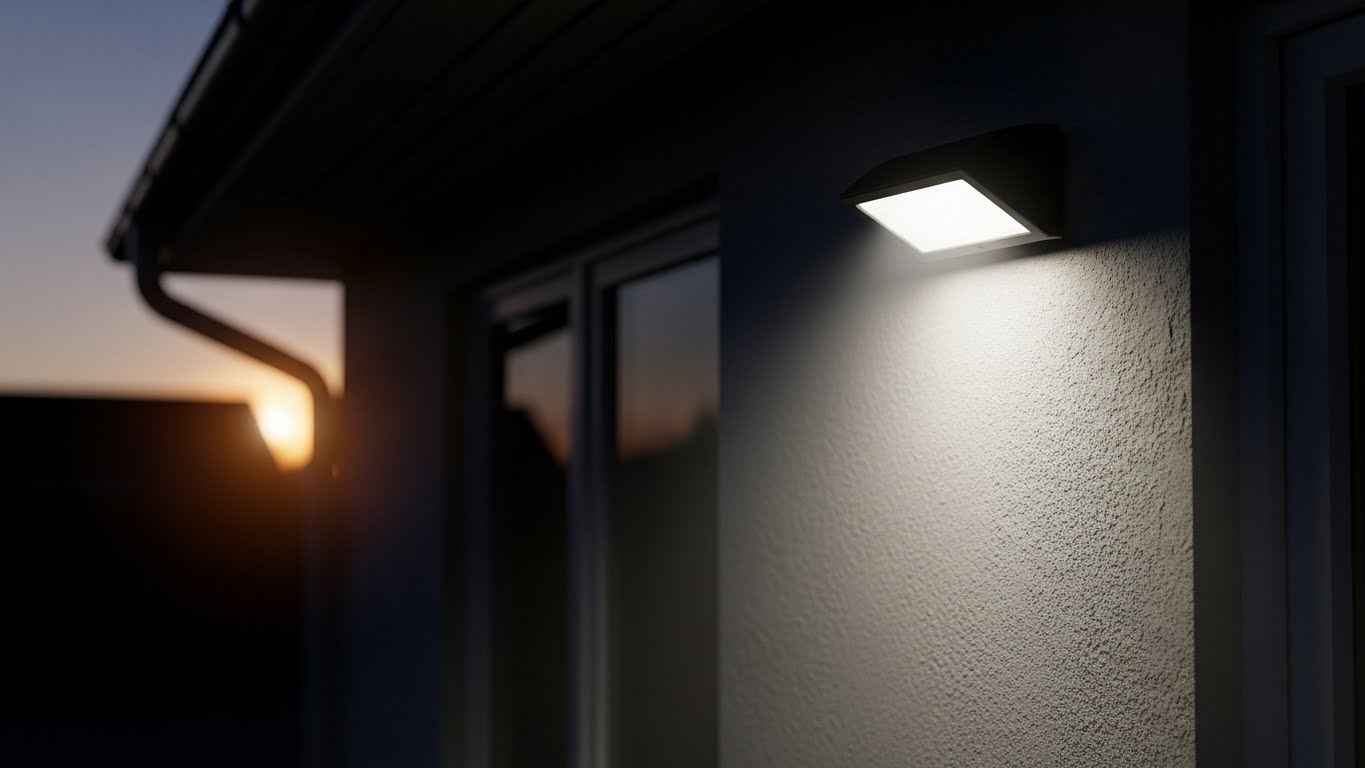

Dusk to dawn lights work by using a photocell sensor that detects ambient light levels through a light-dependent resistor (LDR).
When light dims at sunset, the sensor’s resistance changes, triggering the light to turn on automatically.
At sunrise, increased light reverses this process, switching the light off.
This automation optimizes energy use and enhances security without manual control.
Understanding the sensor mechanics and environmental factors can reveal why dusk to dawn lighting is ideal for reliable outdoor illumination.
Key Takeaways
- Dusk to dawn lights use photocell sensors that detect ambient light levels to activate lights automatically at sunset and deactivate them at sunrise.
- Photocells change electrical resistance based on light intensity, lowering resistance in darkness to trigger the light switch on.
- Light-dependent resistors (LDRs) inside the sensor decrease resistance with increasing light, controlling current flow and light activation.
- The control circuit interprets sensor signals and switches the lighting fixture on or off without manual intervention.
- These systems improve energy efficiency by operating only during low light, reducing electricity use compared to manual or timer controls.
Definition and Purpose of Dusk to Dawn Lighting
Although you mightn’t notice them, dusk to dawn lighting systems automatically activate at sunset and deactivate at sunrise by sensing ambient light levels.
These systems, also called photocell or D2D lights, operate passively during daylight and reactivate in darkness, ensuring illumination aligns with natural day-night cycles.
Their core function is to enhance outdoor safety and security by lighting pathways, entryways, and perimeters after dark. Many installations consider the importance of proper placement to maximize effectiveness.
By providing consistent nighttime visibility, they deter intruders and prevent hazards like trips or falls.
Additionally, they contribute aesthetically by accentuating architectural and landscape features. Outside lights with sensors detect motion or adjust light levels for safety and security.
You’ll find these systems in residential and commercial settings, where automatic operation eliminates manual control, improves energy efficiency, and reduces operational costs.
Consequently, they serve a critical role in outdoor illumination management.
Key Components of Dusk to Dawn Lights
The photocell sensor really is the heart of dusk to dawn lights. It detects the ambient light levels using light-dependent resistors. These resistors adjust their electrical resistance based on how much light is around. Pretty neat, right? This sensing mechanism is somewhat similar to how photoelectric smoke alarms use a photodetector to respond to changes in light caused by smoke.
When it gets dark, the sensor sends signals to the control circuit, which is responsible for turning the light fixture on and off automatically. This automatic operation between sunset and sunrise allows for hands-free control without manual switching. So, you can see how all these parts work together seamlessly. Understanding their interactions is key to grasping how dusk to dawn lighting operates. It’s fascinating to think about how technology like this makes our lives easier, isn’t it?
Photocell Sensor Role
How does a dusk to dawn light know exactly when to turn on or off? It relies on a photocell sensor, a light-sensitive semiconductor device that detects ambient illumination levels.
The photocell converts light energy into an electrical current, adjusting its resistance based on brightness. In low light, its high resistance closes an internal switch, allowing current flow to activate the light.
Conversely, in bright conditions, low resistance opens the switch, deactivating the light. This sensor differentiates gradual changes like sunset from transient fluctuations via built-in delay circuits, preventing false triggers. Most dusk-to-dawn sensors include adjustable sensitivity settings to fine-tune the on/off timing for specific environments.
Housed in weatherproof casing with a three-wire connection—hot, neutral, and load—the photocell guarantees reliable outdoor operation. Proper maintenance and inspection of such components ensure continued efficient operation and prevent premature failure. By precisely sensing ambient light thresholds, it automates lighting control, reduces energy use, and enhances security without manual intervention.
Light-Dependent Resistors
Light-dependent resistors (LDRs), also known as photoresistors or photocells, form the core sensing element in dusk to dawn lights by responding directly to ambient light intensity.
These passive components use semiconductor materials, typically cadmium sulfide, whose resistance decreases as light intensity rises.
In darkness, their resistance spikes to megaohms, limiting current flow and triggering the light to turn on. This principle of operation is similar to how devices use light sensors to detect environmental conditions.
Conversely, bright light lowers resistance to hundreds of ohms, allowing current that keeps the light off.
You’ll find LDRs integrated into simple, low-power circuits, often arranged in voltage dividers to provide an output voltage proportional to light levels.
- Semiconductor material detects photons, altering resistance.
- High resistance in darkness prevents current flow.
- Resistance inversely proportional to ambient light intensity.
- Encased for protection but exposed to light.
- Enables automatic on/off switching without external input.
For proper operation, the sensor surface must be free of obstructions and placed away from other light sources to avoid false triggering.
Control Circuit Functions
Although dusk to dawn lights rely heavily on photosensitive sensors to detect ambient light, the control circuit functions as the critical intermediary that interprets these signals and manages the lamp’s switching operations.
It completes or opens the electrical pathway by responding to sensor input, ensuring lights activate at dusk and deactivate at dawn. This prevents false triggers from artificial light and conserves energy during daylight. Proper sensor placement is essential to avoid false readings caused by street lights or obstructions. The integration of precise control circuits enhances the reliability and efficiency of automatic lighting systems.
| Function | Description |
|---|---|
| Circuit Completion | Closes circuit at night to energize the light fixture |
| Signal Interpretation | Processes sensor data to distinguish dusk and dawn states |
| Relay Operation | Uses coil mechanism to switch contacts on/off |
| Wiring Configuration | Connects sensor, fixture, and house wiring safely |
You depend on this precise control for reliable, automatic lighting.
How Photocells Detect Ambient Light?
You know, photocell sensors are pretty fascinating when it comes to detecting ambient light. They play a crucial role in making sure those dusk-to-dawn lights work just right.
Basically, these sensors take radiant energy and turn it into an electrical signal. They do this by using something called the photoconductivity principle. Photocell sensors operate based on the photoelectric effects using photosensitive cells, typically made of silicon.
It’s really important to understand how this detection process works, especially if you want to optimize the control of automatic lights. After all, having them turn on and off at the right times can make a big difference!
Photocell Sensor Basics
Photocell sensors detect ambient light by converting photons into electrical signals through a photosensitive semiconductor element, typically silicon.
When light photons hit this element, they generate an electric current proportional to the light intensity.
This process hinges on photoconductivity: light exposure decreases the sensor’s electrical resistance, allowing current to flow more easily.
In darkness, resistance rises, reducing current flow and signaling the absence of ambient light.
This electrical behavior enables the photocell to act as a switch, controlling circuits based on light conditions.
The automatic control provided by photocells helps optimize energy usage and supports sustainability by ensuring lights operate only when needed (automatic control).
Using sensors like photocells can reduce overall energy consumption by adjusting lighting based on ambient light levels.
- Semiconductor material alters conductivity with light exposure
- Electric current magnitude varies with photon intensity
- Resistance drops as light levels increase
- Sensor continuously monitors ambient light fluctuations
- Electrical signals trigger relay switches for lighting control
Light Intensity Detection
Building on how photocell sensors convert light into electrical signals, understanding how they detect varying light intensities involves examining changes in electrical resistance within the semiconductor material.
As ambient light increases, the semiconductor’s resistance rises, reducing current flow. Conversely, in low light, the material becomes more conductive, allowing greater current. Photoconductive cells like the Light Dependent Resistor (LDR) typically use materials such as cadmium sulphide that exhibit this property of resistance change with light intensity (photoconductive sensors). This resistance modulation is similar in concept to how dry chemical fire extinguishers use chemical reactions to interrupt processes—in this case, electrical instead of combustion interruption mechanisms.
This resistance modulation directly correlates with light intensity, enabling the sensor to generate an electric current proportional to the incident photons via the photoelectric effect.
The sensor continuously monitors these changes and compares them against predetermined thresholds, triggering the dusk to dawn light activation or deactivation accordingly.
Environmental factors like shadows or overcast conditions can alter perceived intensity, but signal processing components amplify contrasts to maintain accurate detection.
This ensures reliable operation despite fluctuating natural light levels.
The Role of Light-Dependent Resistors (LDRs)
Utilizing photoconductive properties, Light-Dependent Resistors (LDRs) serve as the crucial sensing element in dusk to dawn lighting systems. They adjust their resistance based on ambient light intensity, enabling precise detection. Photons with energy greater than the semiconductor band gap excite electrons from the valence band to the conduction band, increasing conductivity and reducing resistance (photoconductivity principle).
In daylight, LDR resistance plummets to about 100 Ω, allowing current flow. At night, resistance spikes near 20 MΩ, effectively blocking current. Their construction features photoconductive materials like cadmium sulfide arranged in a zigzag pattern on an insulating substrate to achieve desired resistance and power ratings.
You’ll find two main LDR types: intrinsic and extrinsic, optimized for different light wavelengths.
Key characteristics include:
- Resistance inversely proportional to light intensity
- High dark resistance due to minimal free charge carriers
- Integration in voltage divider circuits for signal conditioning
- Sensitivity tunable via fixed resistor adjustments
- Ohmic contacts ensure minimal resistance and reliable operation
Automatic Activation at Dusk and Deactivation at Dawn
When ambient light diminishes at dusk, sensors detect the change and automatically activate the lighting system by allowing current to flow through the photocell as its resistance falls below a critical threshold.
This drop in resistance signals the fixture to power on without manual intervention. Conversely, at dawn, increasing ambient light raises the photocell’s resistance, disrupting current flow and triggering deactivation. Many dusk to dawn lighting systems include delay settings to prevent activation during brief low-light events like passing clouds.
The sensor continuously measures real-time light levels, ensuring activation and deactivation occur precisely at natural dusk and dawn, independent of clocks or seasonal shifts.
This process relies on photoconductivity principles, providing consistent, reliable operation. Proper sensor placement is essential to avoid external light interference, guaranteeing accurate detection and energy-efficient illumination strictly during nighttime hours.
Sensor Sensitivity and Environmental Considerations
Although dusk to dawn sensors offer automatic operation, their sensitivity and environmental factors critically influence performance. You must adjust sensitivity settings carefully to avoid premature or delayed activation.
Environmental conditions like obstructions and artificial light sources can distort sensor readings, causing false triggers or failures. Additionally, sensor performance can degrade over time due to photocell drift and temperature fluctuations, especially below 30°F. Regular maintenance and inspection are essential to prevent system failure.
Consider these factors for optimal function:
- Adjust sensitivity to suit local light conditions and prevent false activation.
- Guarantee a clear line of sight, avoiding walls, trees, or roof overhangs.
- Position the sensor away from nearby artificial lights to avoid interference.
- Monitor and compensate for photocell drift through regular testing.
- Recognize reduced responsiveness in cold temperatures and plan accordingly.
- Many dusk-to-dawn sensors use photocells containing a small semiconductor that reacts to ambient light to open or close circuits, enabling automatic light control.
Energy Efficiency Advantages of Dusk to Dawn Systems
Dusk to dawn lighting systems consistently deliver significant energy efficiency by combining advanced sensor technology with low-wattage LED bulbs.
Dusk to dawn lighting blends smart sensors with efficient LEDs for superior energy savings.
You’ll reduce electrical load drastically. For example, switching from ten 100-watt incandescent fixtures (1,000 watts total) to ten 15-watt LEDs cuts consumption to 150 watts. Regular routine care of the lighting fixtures ensures optimal performance and longevity.
LEDs consume just 0.18 kWh over 12 hours versus 1.2 kWh for incandescent bulbs, resulting in substantial monthly savings.
The integrated photocell sensor activates lights only from dusk to dawn, eliminating needless energy use during daylight and aligning with IECC and ASHRAE 90.1 standards.
This sensor uses a photodiode or photoresistor to detect ambient light levels and control fixture operation automatically.
Additionally, LEDs’ longevity—exceeding 50,000 hours—lowers maintenance costs and waste.
The system’s IP65-rated fixtures withstand harsh conditions, ensuring reliable, energy-efficient outdoor illumination while reducing environmental impact and meeting energy codes effectively.
Common Outdoor Applications for Dusk to Dawn Lighting
Frequently, dusk to dawn lighting finds its most practical use in outdoor settings where safety, security, and visibility are paramount. You can rely on these systems to provide consistent illumination from sunset to sunrise, enhancing navigation and deterring intruders by using built-in light sensors to activate automatically at dusk.
Common applications include:
- Pathways and walkways: make certain safe passage by preventing trips and falls with steady lighting. Proper lighting also serves as a passive security measure to deter unwanted entry.
- Driveways and garages: support safe vehicle maneuvering and enhance security by illuminating entry points.
- Patios and outdoor living spaces: create inviting atmospheres and improve usability after dark.
- Building perimeters and security zones: deter criminal activity by maintaining visibility around structures.
- Entrances and parking areas: provide broad coverage for guests and minimize potential hiding spots.
These targeted uses maximize the functional benefits of dusk to dawn lighting in both residential and commercial contexts.
Differences Between Dusk to Dawn and Motion Sensor Lights
When choosing outdoor lighting, understanding how dusk to dawn and motion sensor lights operate can help you select the right system for your needs.
Dusk to dawn lights activate via a photocell detecting ambient light. They provide continuous illumination from sunset to sunrise, making them ideal for areas needing steady lighting like gardens and pathways.
In contrast, motion sensor lights use PIR sensors to detect infrared movement within about 100 feet and a 240° angle. They activate light only briefly after detection.
This means dusk to dawn provides steady all-night visibility but consumes more energy. Motion sensors optimize efficiency by limiting runtime.
Security-wise, dusk to dawn eliminates dark spots consistently. Motion sensors startle intruders with sudden brightness.
Your choice depends on application: use dusk to dawn for pathways needing constant light. Use motion sensors for entrances requiring on-demand activation.
For maximum effectiveness, some setups combine mixed lighting strategies using both sensor types to balance ambiance and security.
Frequently Asked Questions
Can Dusk to Dawn Lights Be Used Indoors or Only Outdoors?
About 30% of energy savings come from using dusk-to-dawn lights indoors.
You can use them indoors, but you’ll need fixtures with exposed sensors to detect ambient light properly.
Indoor artificial lighting might cause false activations or constant cycling, so placement matters.
Also, outdoor-rated fixtures may overheat or look out of place inside.
For efficient operation, choose sensor bulbs designed for indoor use, especially in garages or basements where natural light varies.
How Do Weather Conditions Affect Dusk to Dawn Light Performance?
Weather conditions affect your dusk to dawn light by influencing its photocell sensor accuracy. Heavy rain and snow can interfere with sensor function, but waterproof housing and durable materials help maintain operation.
Extreme temperatures impact sensor performance, though heat-dissipating alloys and weatherproof designs sustain efficiency. Cloud cover causes fluctuating light levels, yet adjustable sensitivity and advanced monitoring guarantee reliable shifts.
Proper design lets your light adapt and perform well despite weather challenges.
What Maintenance Is Required for Dusk to Dawn Lighting Fixtures?
You’ll want to embrace a routine of attentive care for your dusk-to-dawn fixtures.
Regularly cleanse lenses and housings with gentle materials to maintain clarity and sensor accuracy.
Inspect wiring and connections for subtle wear or corrosion, securing all components firmly.
Test photocells to guarantee proper response, replacing any errant modules or bulbs promptly.
Establish a preventive schedule, applying weatherproofing measures and documenting maintenance for peak longevity and performance.
Are Dusk to Dawn Lights Compatible With Smart Home Systems?
Yes, dusk to dawn lights often work with smart home systems like Alexa, Google Home, and HomeKit.
If they use Wi-Fi or Zigbee, you can integrate them via manufacturer apps or hubs.
Some models support remote control, dimming, and custom schedules.
Just remember, sensor behavior can be disrupted by smart switches cutting power, so controlling the bulb directly is best.
Check wiring and compatibility carefully for seamless operation.
Can Dusk to Dawn Lights Be Manually Overridden if Needed?
Think of your dusk to dawn light as a reliable sentinel guided by ambient light signals.
Yes, you can manually override it. By toggling the wall switch OFF-ON quickly (within three seconds), you activate manual override, forcing the light to stay on regardless of natural light.
This mode resets automatically after about eight hours, or you can deactivate it manually. Some models include dedicated override switches or app controls for precise manual management.
Master Energy Efficiency With Dusk to Dawn Lighting
As dusk melts into night, your dusk to dawn light springs to life, guided by sensitive photocells and LDRs that read the fading glow.
It smartly conserves energy, activating only when darkness blankets your surroundings and shutting off with dawn’s first light.
Understanding this seamless interplay lets you harness efficient, reliable illumination—perfect for enhancing security and convenience without wasting power.
You’re not just lighting a space; you’re mastering the science of adaptive brightness.