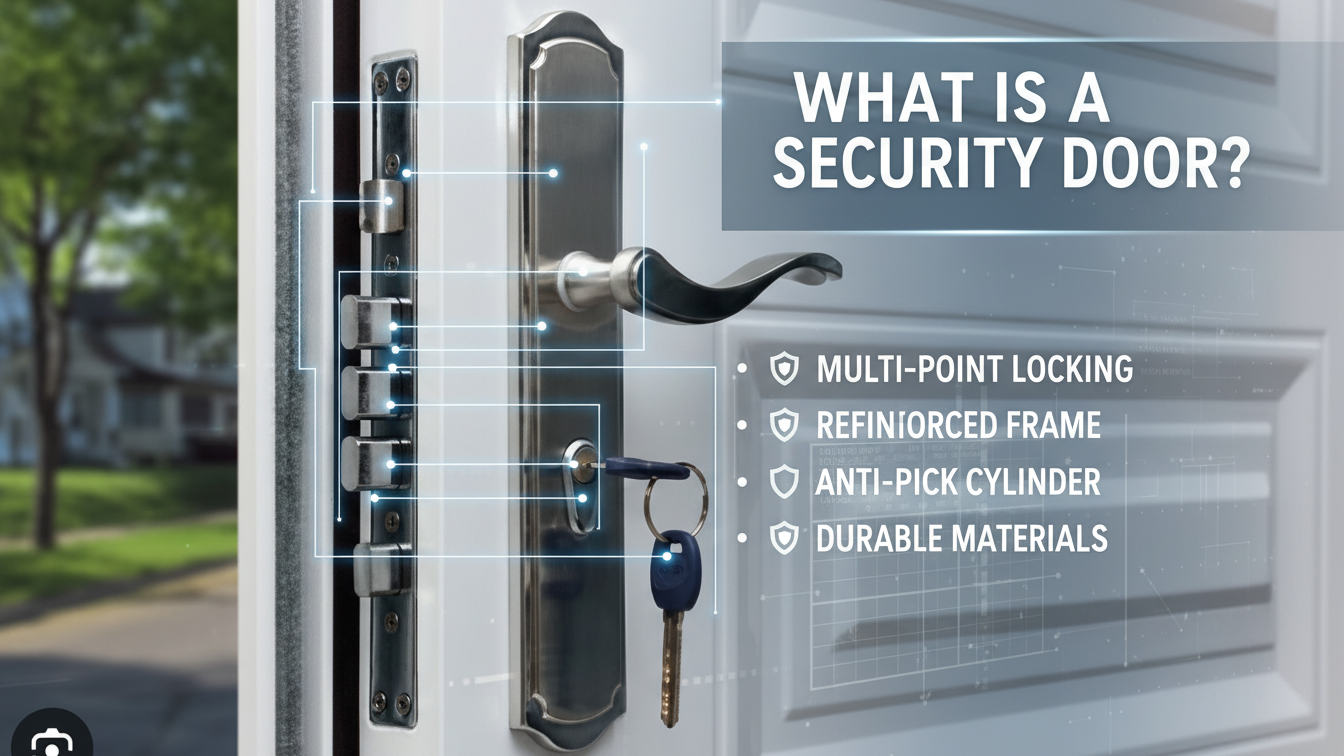

A security door is designed to protect you from forced entry with reinforced materials like steel or composite cores and tamper-resistant hardware, including multi-point locking and heavy-duty hinges.
These doors resist various attack tools and durations, rated from SR1 to SR8 based on threat level. They offer ventilation and visibility without compromising safety, often featuring peephole optics.
Proper installation and maintenance are vital to guarantee full effectiveness. Understanding your specific security needs will help you select the best option.
Key Takeaways
- Security doors are reinforced doors designed to resist forced entry and unauthorized access using tamper-resistant hardware and strong materials.
- They provide visual deterrence and controlled egress with quick-release hardware for emergencies.
- Security doors incorporate reinforced cores, multi-point locking systems, and heavy-duty frames for enhanced protection and structural integrity.
- They offer varying resistance levels (SR1–SR8) against tools from hand tools to power saws, matching different threat profiles.
- Additional features include mesh panels for ventilation, peephole optics for occupant identification, and options for fire and ballistic resistance.
Definition and Purpose of Security Doors
Security doors serve as engineered barriers designed to resist forced entry and unauthorized access through reinforced construction and tamper-resistant hardware.
You rely on these doors to secure main entry points, combining structural strength with certified locking mechanisms and fixed frames to prevent break-ins. TBT Security Doors, a Perth-based expert, ensures these features with rigorous testing and premium materials for strength and durability.
They act as a visual deterrent, signaling increased difficulty to potential intruders, and physically delay forced entry attempts, lowering burglary success rates. Enhancing this security, installing a peephole is a feasible and effective measure for metal doors to add an extra layer of protection.
Beyond crime prevention, security doors enhance occupant safety by allowing controlled egress during emergencies with quick-release hardware. They also provide ventilation and visibility via mesh options, maintaining security while promoting comfort.
Additionally, these doors protect assets, improve privacy, and offer weather resistance, making your property less vulnerable while complementing other security systems to establish a layered defense.
Materials Commonly Used in Security Doors
Choosing the right materials for your doors directly impacts their ability to resist forced entry, environmental damage, and wear over time.
Selecting door materials wisely enhances resistance to break-ins, weather effects, and long-term wear.
Steel offers exceptional strength, often reinforced with plates or bars, and coated to prevent corrosion. This makes it ideal for residential and industrial security doors rated SR1-SR4. Steel frames are commonly used to provide added rigidity to the door structure.
Additionally, steel doors may require precise modifications to install or replace components like peepholes without compromising integrity.
Aluminum provides a lightweight yet strong option, with powder coating for UV and corrosion resistance. It’s suitable for large or luxury doors with ventilation needs. This material can accommodate upgrades such as wide-angle peepholes to improve security viewing.
Stainless steel, especially marine-grade 304 or 316, combines toughness and corrosion resistance. It withstands high-impact forces effectively. Using stainless steel doors can help maintain a functional peephole by resisting corrosion or wear that reduces effectiveness.
Fiberglass delivers durability without warping or rusting, often reinforced with a steel core for added strength. Its stable structure allows for easy replacement of peepholes without damaging the door surface.
Composite materials integrate timber, PVC, steel, and glass fibers. They offer superior insulation, weather resistance, and multi-point locking capability, perfect for ornate and high-security applications.
Construction Techniques for Enhanced Protection
When it comes to enhancing protection in construction, one key area to focus on is the use of reinforced core materials. These materials really boost structural integrity and are designed to resist forced entry. It’s pretty impressive how they can make a difference!
Also, let’s not forget about multi-point locking systems. These systems are great because they distribute the locking force across the door, which really helps with resistance to bending and prying.
It’s like having extra security built right in! For added safety, some security doors even incorporate peephole optics to allow occupants to identify visitors without opening the door.
And, of course, you’ll want to ensure that the frame and hinges are engineered for strength. Heavy-duty components are essential here—they help maintain alignment and prevent failure under attack.
It’s all about creating a robust barrier, right? Proper installation following precise steps is crucial to maximize these features’ effectiveness and ensure improved protection.
Reinforced Core Materials
Durability defines the effectiveness of reinforced core materials in door construction. Advanced engineering techniques enhance protection against forced entry, fire, and ballistic threats. You rely on these materials to ensure your security door withstands impact and environmental stresses without compromising structural integrity.
Key reinforced core materials include:
- Steel Cores: Vertical and horizontal solid steel ribs, cold-rolled or galvanized, resist bending and cutting with 14-18 gauge thickness. Shield Security Doors emphasizes the importance of steel core systems as the primary resistance against forced entry. Their high discharge volume enables quick knockdown, minimizing damage during forced entry attempts.
- Mineral Cores: Non-combustible mineral composites provide up to 90 minutes of fire resistance and structural stability. These cores act similarly to dry chemical powders that smother flames by cutting off oxygen and halting combustion.
- Composite Cores: Engineered wood and fiberglass armor deliver superior impact resistance and UL-listed bullet resistance. The composite materials disrupt fracture propagation akin to how dry chemical agents interrupt fire chemistry to neutralize flames.
- Frame-Reinforced Cores: Steel frames anchored into masonry eliminate weak points and improve rigidity with corrosion-resistant coatings. Customized reinforced doors tailor installation to existing structures for stronger perimeter security and eliminate common hinge-related vulnerabilities, much like proper use and maintenance of fire suppression devices ensure reliable performance during emergencies.
Multi-Point Locking
Reinforced core materials provide the structural backbone for security doors, but the locking mechanism ultimately determines how effectively the door resists forced entry.
Multi-point locking systems engage bolts and hooks at multiple points, typically top, middle, and bottom, when you operate the handle or key. This distributes force evenly across the door height.
It provides a higher level of security and better resistance to forced entry. Some advanced multi-point locks incorporate anti-shear engagement features to enhance resistance.
This reduces hinge-ward deflection and markedly increases resistance to prying or kick-in attacks. Hook-style bolts offer superior anti-shear engagement, while hardened steel components resist drilling and cutting.
You’ll find mechanical, cylinder-operated, and electrified actuation options, each requiring precise door edge routing and frame preparation for secure strike plate installation.
Proper alignment guarantees simultaneous locking point engagement, enhancing security and weather sealing. Multi-point locking not only strengthens security but also improves door durability and thermal performance.
Frame and Hinge Strength
Steel frames form the essential foundation of security doors, delivering the strength and alignment needed to withstand forced entry attempts. Proper maintenance, including periodic cleaning, helps preserve the frame’s structural integrity and appearance.
These frames maintain precise tolerances for deadbolt and pivot points, assuring perfect fit and function. Reinforcement plates bolster lock and hinge areas, increasing resistance to impact.
Regular inspections are recommended to catch issues early and prevent larger problems, ensuring the frame’s continued integrity. Hinge strength is enhanced with heavy-duty screws and hardened metal strips to prevent forced removal or warping.
Key construction techniques include:
- Utilizing steel frames with minimum yield strength of 135,000 psi for structural integrity.
- Installing steel reinforcement plates flush around locks and hinges.
- Hardening hinge zones with 10GA stainless steel strips and 4-inch screws.
- Employing build-out frames to assure proper jamb depth and alignment.
Key Mechanical Features of Security Doors
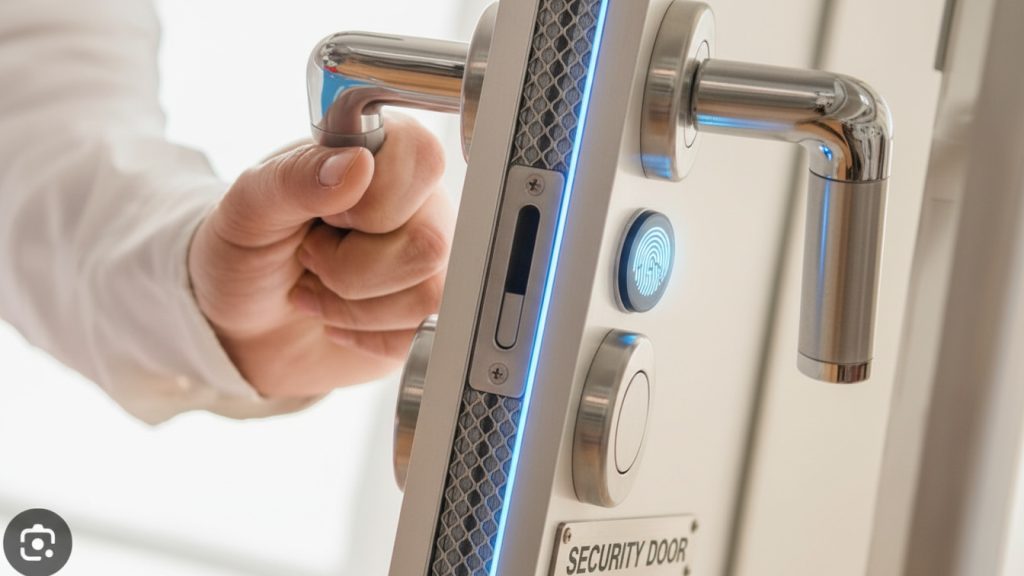
When selecting a security door, you’ll find its mechanical features are engineered to withstand forced entry through strategic material choices and robust construction methods.
High-grade steel panels and reinforced tubular steel frames provide core structural integrity, while welded seams and continuous reinforcements minimize pry points.
Multi-point locking systems engage hardened steel bolts at multiple locations, markedly enhancing resistance to cutting and prying.
Security hinges with non-removable pins and armored anchors secure the door against hinge-side attacks and frame removal.
High-security cylinders incorporate anti-pick and anti-drill technologies, mounted with reinforced escutcheons to prevent tampering. Additionally, thermal cores improve panel stiffness and energy efficiency without compromising strength.
These integrated mechanical features guarantee the door maintains structural rigidity and lock integrity under sophisticated attack scenarios, delivering reliable, standardized security performance. Moreover, the door’s interior is filled with 2″ rock wool to provide sound insulation and enhance privacy.
Specialized Security Door Types and Their Ratings
Although selecting a security door depends on your specific threat environment, understanding specialized door types and their standardized ratings is essential. You’ll find options designed for intrusion resistance, fire protection, ballistic defense, and tailored risk levels.
Key types and ratings include:
- SR1–SR8: Resist increasingly severe tool attacks, from simple hand tools (SR1) to advanced power tools (SR8), with resistance times from 10 to 60 minutes.
- Fire-Rated Doors: Certified up to FD240, combining flame resistance with LPS 1175 security ratings for occupant safety. Many fire-rated steel security doors also feature fire and smoke prevention to enhance building safety.
- Ballistic-Resistant Doors: UL 752 Level 4–8 rated to stop rifles and tactical rounds, customizable for vision panels and configurations.
- RC and PAS24 Ratings: Address residential to commercial security needs, with RC4–RC6 for high security and PAS24 for enhanced certification.
This knowledge guarantees you choose the right door to meet your exact security requirements.
Performance Standards and Testing Methods
To accurately assess a security door’s protective capabilities, it’s essential to understand resistance classifications. You know, these classifications really help in determining how well a door can withstand various threats.
Now, when it comes to testing protocols, there are several important ones to keep in mind. For example, PAS 24, LPS 1175, and ASTM F476 are widely recognized methods that evaluate doors against forced entry and attack scenarios.
UL Solutions provides testing and certification for manufacturers of doors and windows to validate enhanced security performance. Mastering these standards is key!
By doing so, you ensure that the doors you select meet rigorous performance benchmarks for safety and reliability. It’s all about making informed choices for the best protection.
Resistance Classifications Explained
Because security doors must withstand varying levels of forced entry attempts, standardized resistance classifications provide a clear framework to evaluate their performance.
These classifications assign doors to specific grades based on attacker skill, tool types, and resistance duration. You’ll find three major systems:
EN 1627–1629 (RC1–RC6): European classes define resistance from opportunistic hand-tool attacks (RC1–RC2) to power-tool assaults (RC5–RC6), with minimum resistance times from ~3 to 15+ minutes. In particular, the most common production focuses on resistance classes RC2–RC4, while supplementary solutions extend protection up to RC6.
STS202/BR Scale (BR1–BR6): UK/Scandinavian commercial ratings specify progressive resistance against escalating attack complexity, verified through exhaustive component and assembly testing.
ASTM Standards (I–V): US impact-focused ratings assess performance under repeated dynamic strikes, emphasizing perforation resistance.
Application-driven: Higher classes suit commercial, high-risk, or critical infrastructure, ensuring you select a door matching your security needs precisely.
Testing Protocols Overview
When evaluating security doors, standardized testing protocols play an essential role in verifying their ability to withstand various attack methods.
You’ll encounter standards like BS EN 1627–1630, PAS 24, and LPS 1175, which assess resistance to manual attack, impact, cutting, and manipulation.
Tests include static mechanical loading, dynamic impact, cutting/drilling assaults, and lock manipulation within defined timeframes.
PAS 24, for example, is a pass/fail minimum standard that requires rigorous testing by an independent UKAS-accredited house to ensure consistent quality and security performance.
These protocols measure structural integrity, impact resilience, and lock security, assigning resistance classes based on sustained attack duration and tool use rather than force alone.
Testing requires representative samples, complete with frames, fixings, glazing, and hardware, subjected to controlled toolboxes and attack durations.
Pre-conditioning and detailed documentation ensure repeatability and transparency. This rigorous approach guarantees the door assembly’s performance meets specified security levels under realistic attack scenarios.
Installation Best Practices for Security Doors
Make certain every step of installing a security door adheres to rigorous best practices to maximize its protective performance and longevity.
Ensure each installation step follows strict best practices to optimize security door durability and effectiveness.
Begin by selecting corrosion-resistant materials, such as galvanized steel or stainless steel frames and tamper-resistant fasteners. Prepare the site meticulously: measure openings accurately, inspect substrates for defects, and choose anchors suited to the wall type.
Have the security door, frame, and all kit hardware on hand before beginning installation to ensure a smooth process. When fitting, use shims to align the frame plumb and square without bending, guaranteeing uniform reveal for smooth operation.
Secure hardware with heavy-duty screws and verify lock alignment for full engagement. Key practices include:
- Choose UL/BHMA-rated locks and compatible components.
- Inspect and repair surrounding structures before installation.
- Use torque-limited drivers to avoid frame distortion.
- Reinforce hinge sides with bolts or welded tabs for added security.
Following these will guarantee a robust, effective security door installation.
Maintenance Tips to Preserve Security and Function
To keep your security door performing at its best, you should establish a consistent maintenance routine focused on cleaning, lubrication, inspection, and preventative care.
Clean biannually with mild detergent, adjusting frequency by proximity to the coast. Lubricate hinges and locks every 3–6 months using silicone-based lubricants.
Using a soft cloth or sponge is recommended to avoid scratching the surface during cleaning. Proper placement and regular maintenance can also improve HVAC efficiency and indoor air quality.
Inspect hardware and weatherstripping annually, addressing corrosion or wear immediately. Prevent water buildup by clearing drainage holes and promptly removing corrosive substances like bird droppings.
Schedule professional inspections every 2–3 years for thorough diagnostics and warranty compliance.
| Maintenance Aspect | Key Action |
|---|---|
| Cleaning | Biannual deep clean; coastal adjustments |
| Lubrication | Silicone-based lubricant every 3–6 months |
| Inspection & Repair | Annual hardware and seal checks; professional review every 2–3 years |
Matching Security Doors to Threat Profiles
Maintaining your security door guarantees it performs reliably, but selecting the right door starts with understanding the specific threats you face. Match your door’s rating to the expected attack tools and duration for optimal protection.
Consider these threat profiles:
- Domestic medium risk: SR2 rated doors resist bolt cutters and claw hammers for 15 minutes. These doors correspond to the SR2 rating, which is designed for more determined opportunistic attacks using tool category B.
- Low commercial risk: SR3 doors withstand crowbars, drills, and gas torches for 20 minutes. SR3 doors require endurance of a 5-minute attack using tools typical of targeted thieves, reflecting a balance between security and practicality.
- Medium commercial risk: SR4 doors endure sledgehammers and plate shears for 30 minutes. SR4 doors resist 10-minute attacks with tool category D, suitable for premises needing protection from experienced and prepared assailants.
- High commercial or mission-critical sites: SR5 doors resist reciprocating and circular saws for 10 minutes. SR5 doors include tools from category D+ and are used for critical national infrastructure where ultimate security is essential.
Aligning door specifications with these profiles ensures you counteract relevant forced entry attempts effectively, enhancing security without unnecessary cost.
Aesthetic Considerations and Design Options
How do you balance security with curb appeal when selecting a security door?
Start by choosing materials. Steel or aluminium provide slim, durable profiles, while timber and fibreglass offer warmer aesthetics but require more upkeep. Fiberglass doors also bring energy-efficient benefits and resist warping, making them a practical choice for long-term durability.
- Consider finishes: powder-coating, metallic paints, or woodgrain textures can match your home’s architectural style.
- Assess styles. Modern doors favor clean lines and laser-cut patterns; traditional options use ornate wrought iron or raised panels.
- Incorporate glass wisely. Laminated or toughened safety glass maintains security while admitting light; frosted or textured variants preserve privacy.
Don’t overlook hardware finishes in bronze, black, or nickel to harmonize with your exterior. Finally, leverage customization tools and add sidelights or transoms to tailor your door’s visual scale and design, ensuring security integrates seamlessly with your home’s aesthetic.
Frequently Asked Questions
Can Security Doors Be Automated or Integrated With Smart Home Systems?
Yes, you can automate security doors and integrate them with smart home systems. By using compatible smart locks and access control platforms, you can remotely lock or release doors, set access schedules, and trigger automations based on sensors or events.
Make sure you verify compatibility with your smart home ecosystem and choose appropriate hardware. Professional installation helps maintain security ratings, wiring integrity, and seamless integration into your automated environment.
What Is the Average Lifespan of a Security Door Under Normal Use?
You’ll find that the average lifespan of a security door under normal use typically ranges from 15 to 50 years, depending on the material. Steel doors last about 30–50 years, aluminum 30–40 years, and fiberglass up to 70 years with maintenance.
Wood and glass doors tend to last 15–30 years. Proper upkeep, environmental conditions, and mechanical part replacements can materially extend or reduce these averages, so regular maintenance is essential.
Are Security Doors Effective Against Advanced Tools Like Power Saws?
Yes, security doors are effective against advanced power saws when they feature multi-layer steel cores, reinforced edges, and composite materials that slow cutting and wear down blades.
Certified doors with SR5+ ratings withstand timed attacks by mains-powered saws. However, attackers using industrial cutters may eventually breach doors with enough time and noise exposure.
To maximize protection, make certain the entire door set, including frame, locks, and glazing, meets appropriate resistance standards.
How Do Security Doors Impact Home Insurance Premiums?
You’ll slash your home insurance premiums like a pro with security doors in place. Insurers recognize these doors reduce theft and fire risks, offering discounts from 5% up to 20%.
Advanced systems with monitored door sensors amplify savings, while deadbolts alone can cut premiums by up to 10%. These savings reflect your home’s enhanced security profile, demonstrating proactive loss prevention that insurers highly favor.
Can Pets Easily Damage or Bypass Security Doors?
Pets can’t easily damage or bypass properly designed security doors. Reinforced mesh resists clawing and chewing, lasting 15-20 years with maintenance. Security screen doors prevent pets from forcing entry due to dense, durable materials.
Additionally, advanced pet doors use locking technology to restrict unauthorized access. While pets might test boundaries, these doors effectively deter damage and unauthorized bypass, maintaining home security against both pets and potential intruders.
Long-Term Security Starts With Smart Maintenance
When you choose a security door, imagine a steadfast guardian standing firm against threats. Its reinforced frame and robust locks create an unyielding barrier. You’re not just adding an entryway; you’re crafting a shield tailored to your security needs.
By understanding materials, construction, and installation, you guarantee this protective sentinel performs flawlessly. With proper maintenance, your security door remains a reliable fortress. It blends strength with design to safeguard what matters most.