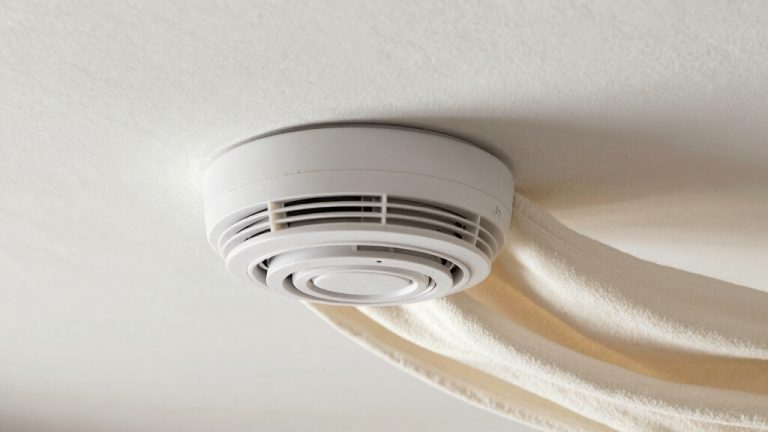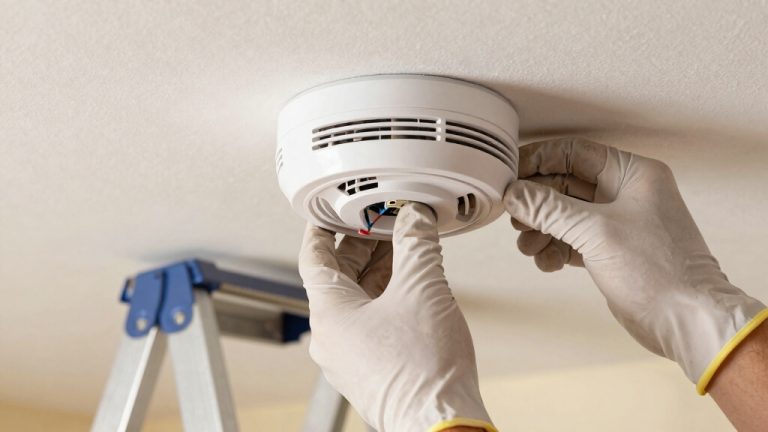

You’ll find the simplest fire alarm system in a conventional hardwired setup that uses zone-based detection. It connects detectors and manual pull stations via wired circuits to a central panel, signaling alarms by interrupting power in defined zones.
This design offers reliable operation and straightforward installation, especially for small properties with basic fire risks. While it lacks device-specific diagnostics, its simplicity keeps costs low and maintenance easy.
Explore how this approach works and when it fits best.
Key Takeaways
- The simplest fire alarm system is a conventional hardwired setup using zone-based detection without device-specific identification.
- It connects detectors and manual pull stations via wired circuits to a central control panel for zone monitoring.
- Alarm signals occur through circuit interruptions within designated zones, triggering local audible and visual alerts on-site only.
- This system offers reliable, consistent power from wiring with battery backup, minimizing false alarms and maintenance complexity.
- Best suited for small, straightforward properties with basic fire risk and limited area coverage due to scalability constraints.
How The Simplest Fire Alarm System Works?
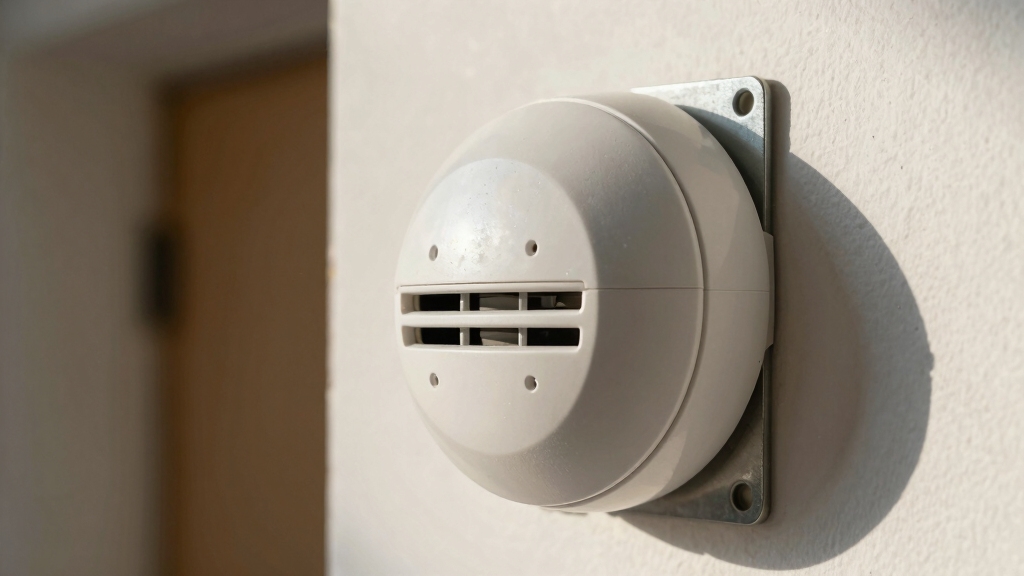
Although it relies on basic technology, the simplest fire alarm system efficiently monitors your property by connecting detectors and initiation devices directly to a central control panel through wired circuits.
The simplest fire alarm system connects detectors and devices directly to a central control panel via wired circuits.
You’ll find smoke and heat detectors arranged in zones, each wired to trigger alarms upon sensing smoke or heat via circuit interruptions.
Initiation devices, like pull stations, integrate seamlessly to manually activate alarms.
Notification appliances such as horns and strobes alert occupants immediately when a zone signals an event.
The hardwired design guarantees consistent power supply without relying on batteries, enhancing reliability.
This system suits smaller properties that don’t require complex processing.
You’ll appreciate its straightforward operation and low installation costs, making it ideal for basic fire detection needs without advanced monitoring or pinpoint device identification.
However, these local alarm systems only sound on-site and do not provide automatic notification to the fire department.
How Detection Zones Simplify Simplest Fire Alarm System Monitoring?
When you monitor a simplest fire alarm system, detection zones streamline the process by grouping multiple devices into manageable sections.
This zoning approach reduces complexity and enhances your ability to quickly identify affected areas without pinpointing individual devices. Zones provide clear, organized monitoring, which is critical in smaller properties.
Here’s how detection zones simplify monitoring:
- Consolidation: Combine multiple detectors into a single circuit for easier supervision.
- Rapid Area Identification: Alert signals specify which zone triggered, accelerating response.
- Simplified Wiring: Reduce wiring complexity by segmenting devices logically.
- Efficient Troubleshooting: Isolate circuit faults within zones, minimizing diagnostic time.
Additionally, detection zones support point identification to enhance response efficiency by narrowing down incident locations within a property.
Key Devices in the Simplest Fire Alarm System
In a basic fire alarm system, you’ll be depending on some key detection devices. These include smoke detectors, heat detectors, and even combination detectors that can sense different fire conditions in each area. They’re your first line of defense!
Now, when it comes to activating the alarm, you’ve got devices like manual pull stations. If someone sees a fire, they can just pull one of these stations to trigger the alarm. It’s pretty straightforward and ensures that everyone is alerted quickly.
Once the alarm is activated, notification appliances come into play. These devices deliver clear audible and visual alerts, making sure that everyone knows it’s time to evacuate. You really want to ensure that the alerts are noticeable, right? That way, everyone can get to safety without delay!
Typically, the system sends an immediate signal to the fire alarm control panel, triggering alarm mode to start the evacuation process.
Essential Detection Devices
Smoke detectors, heat sensors, and pull stations form the backbone of the simplest fire alarm system’s detection network. You rely on these devices to provide rapid, zone-based detection without complexity. Here’s what you need to know:
- Smoke Detectors: Use ionization or photoelectric technology to detect smoke particles and trigger alarms quickly.
- Heat Sensors: Activate when temperature rises beyond a set threshold, ideal for areas prone to dust or steam.
- Pull Stations: Manual initiation devices that allow occupants to activate the alarm during emergencies.
- Wired Connectivity: All devices connect directly to the control panel on dedicated circuits, ensuring reliable signals without batteries.
This setup enables straightforward monitoring within zones, minimizing installation costs and maintenance while maintaining dependable early warning capabilities. Conventional systems use zone-based analog wiring which simplifies installation but limits scalability.
Notification And Activation
After establishing reliable detection through smoke detectors, heat sensors, and pull stations, the system depends on notification and activation devices to alert occupants effectively.
In the simplest fire alarm system, you rely on audible horns and visible strobes wired directly to the control panel.
These devices activate immediately upon circuit interruption caused by triggered detectors or manual pull stations, ensuring prompt occupant notification.
Their hardwired connection guarantees consistent power and eliminates battery dependence, enhancing reliability.
You’ll find these notification appliances strategically placed to maximize coverage within zones, facilitating clear alarm signals throughout the protected area.
While this setup lacks addressable specificity, it provides straightforward activation and dependable alerts suitable for smaller properties requiring uncomplicated, cost-effective fire safety measures.
This simplicity reduces installation and maintenance complexity without compromising essential occupant warning functions.
To further improve safety, ensure that detectors are installed on every level of the home, including basements, to provide early warning throughout the building.
Pros and Cons of the Simplest Fire Alarm System
While the simplest fire alarm system offers cost-effective installation and straightforward maintenance, it presents limitations in scalability and device-specific identification.
You’ll benefit from its reliable zone-based detection and widely available components, making it ideal for smaller properties. However, the system relies on physical wiring and lacks advanced diagnostic capabilities.
Consider these key points:
- Installation costs remain low, suitable for basic residential or commercial use.
- Maintenance is straightforward due to the system’s uncomplicated design.
- Troubleshooting can be slower since it only identifies zones, not individual devices.
- Scalability is limited, making it less effective in complex or large buildings.
It is important to remember that even hardwired systems require a reliable battery backup to ensure continuous protection during power outages. Understanding these pros and cons helps you decide if this system fits your specific fire safety needs.
Comparing Simplest and Addressable Fire Alarm Systems
When you look into the simplest fire alarm systems, you’ll notice they use zone-based detection. This method gives you reliable coverage across a space, but the catch is that it doesn’t identify specific devices. So, if there’s an alarm, you’ll know the general area, but not exactly where the problem is.
On the flip side, addressable systems take things up a notch. They can pinpoint the exact location of each device, which makes troubleshooting a breeze. Plus, they’re great for larger buildings because they scale really well.
Now, while simplest systems might seem appealing due to their lower initial costs, addressable setups really shine when it comes to flexibility and integration. If you’re dealing with a more complex environment, those features can make all the difference!
Additionally, addressable fire alarm systems communicate with a central control panel to enable precise location tracking and coordinated emergency responses.
Zone-Based Detection Benefits
Although simplest fire alarm systems utilize zone-based detection without pinpointing individual devices, this approach offers clear benefits for straightforward environments.
You’ll find the zone-based method efficient for small to medium properties, where quick, reliable alerts matter more than granular device data.
Here’s why zone detection works well:
- Simplifies wiring and installation by grouping devices on shared circuits.
- Reduces upfront costs compared to addressable systems requiring unique device IDs.
- Assures dependable alarm activation through direct circuit monitoring.
- Facilitates easier maintenance by focusing troubleshooting efforts within defined zones.
While it lacks detailed device identification, zone-based detection delivers consistent performance and cost-effectiveness.
You can rely on it for uncomplicated setups where broad area coverage suffices, making it the preferred choice when simplicity and reliability outweigh advanced diagnostics.
Additionally, zone-based systems often integrate well with interconnected alarm networks to improve overall fire safety coordination.
Device Identification Differences
Because simplest fire alarm systems rely on zone-based detection, they don’t identify individual devices like addressable systems do. Instead, they signal alarms based on circuit interruptions within designated zones, providing general location information only.
You won’t get precise pinpointing of the exact detector triggering an alarm, which means troubleshooting takes longer in larger areas. Addressable systems assign unique addresses to each device, enabling you to monitor and identify specific sensors or pull stations instantly.
This granular device identification improves maintenance efficiency and reduces false alarm investigations. However, the simplest system’s lack of unique device IDs keeps installation and operation straightforward.
This makes it ideal for smaller properties where pinpoint accuracy isn’t critical. You’ll trade off device-level diagnostics for simplicity and reliability in straightforward environments.
For enhanced security, integrating systems with real-time alerts can improve monitoring and response efficiency.
Cost and Scalability
While simplest fire alarm systems don’t offer device-specific identification, their cost and scalability present distinct advantages and limitations compared to addressable systems.
You’ll find simplest systems are cost-effective for smaller properties due to straightforward wiring and fewer components. However, scalability becomes challenging as building complexity increases.
Consider these points when comparing cost and scalability:
- Installation expenses for simplest systems are considerably lower than addressable systems, reducing upfront investment.
- Simplest systems rely on zone grouping, limiting expansion in large or complex buildings.
- Addressable systems enable precise device monitoring, improving troubleshooting and future upgrades.
- Physical wiring in simplest systems may increase labor and material costs for extensive layouts.
You should weigh your building’s size and complexity against budget constraints when selecting a system. Regular maintenance, such as cleaning and testing fire alarms, is essential to ensure reliable operation regardless of system type.
When to Choose the Simplest Fire Alarm System?
When deciding on a fire alarm system, you should zero in on the simplest setup if your property is small and straightforward. This conventional hardwired system offers reliable zone-based detection with lower installation costs and easier maintenance.
It’s ideal when you don’t need device-specific identification or complex system integration. Use it when wiring is feasible and cost-effectiveness is a priority.
| Condition | Why Simplest System Fits | When to Avoid |
|---|---|---|
| Small property size | Zones cover limited areas efficiently | Large or multi-floor buildings |
| Basic fire risk profile | Simple smoke/heat detection suffices | High-risk or complex hazard environments |
| Budget constraints | Lower upfront and maintenance costs | When advanced diagnostics are required |
| Limited integration need | No need for networked or addressable features | Integration with multiple safety systems |
Why the Simplest Fire Alarm System Works Best for Small Properties?
A fire alarm system serves as your first line of defense against fire hazards.
The simplest system excels in small properties due to its straightforward design and reliable zone-based detection.
The simplest fire alarm system thrives in small spaces with clear, dependable zone-based detection.
You benefit from clear zone identification without complex device addressing. This streamlines monitoring and response. Its hardwired connections guarantee consistent power and reduce false alarms.
This design suits environments where fire risk areas are limited and easily compartmentalized. Here’s why it works best for you:
- Cost-effective installation minimizes upfront expenses.
- Simple maintenance reduces operational complexity.
- Zone-based alerts allow quick location of fire events.
- Reliable wired circuits provide stable, uninterrupted power.
For small properties, this system balances efficiency, reliability, and ease of use, making it the best choice.
Frequently Asked Questions
How Often Should the Simplest Fire Alarm System Be Professionally Inspected?
You should schedule a professional inspection of the simplest fire alarm system at least once a year.
Regular annual inspections verify the hardwired circuits, detectors, and notification devices function reliably.
Additionally, monthly visual checks and periodic testing of initiation devices help maintain system readiness.
Consistent maintenance prevents faults in zone-based detection and guarantees compliance with safety standards.
This keeps your property protected without costly surprises or downtime.
Can the Simplest Fire Alarm System Be Integrated With Home Automation?
You generally can’t directly integrate the simplest fire alarm system with home automation because it lacks digital communication or unique device addressing.
However, you can use external interface modules or relays to connect alarm signals to your smart home controller.
Keep in mind, this adds complexity and may reduce system reliability.
For seamless integration and advanced monitoring, consider upgrading to an addressable or smart fire alarm system designed for automation compatibility.
What Is the Typical Lifespan of Devices in the Simplest Fire Alarm System?
You can expect the typical lifespan of devices in the simplest fire alarm system to range between 8 and 10 years.
Smoke detectors, heat sensors, and pull stations maintain reliability within this timeframe, assuming proper maintenance.
After that, sensor sensitivity and electronic components degrade, increasing false alarms or failures.
Regular testing is vital, and you should replace devices promptly once they near the end of their effective operational life to guarantee safety.
Are There Specific Regulations for Installing the Simplest Fire Alarm System?
Installing fire alarm systems follows strict regulations to ensure safety and compliance.
You must adhere to local fire codes, NFPA 72 standards, and electrical wiring standards.
These rules specify device placement, circuit wiring, zone configuration, and notification requirements.
You can’t bypass inspections or use non-compliant parts.
Staying within these codes guarantees your system operates reliably and meets legal liability and insurance criteria.
How Do Environmental Factors Affect the Performance of the Simplest Fire Alarm System?
Environmental factors like dust, humidity, and temperature extremes can impair your system’s detectors by causing false alarms or delayed responses.
For instance, excessive dust may block photoelectric sensors, while high humidity can affect ionization detectors.
Temperature fluctuations might trigger heat detectors prematurely or fail to activate them on time.
You need to guarantee proper placement and regular cleaning to maintain peak performance and reliability in varying environmental conditions.
Simple Fire Alarm Systems: Smart Protection Made Easy
You might think the simplest fire alarm system lacks sophistication, but it’s precisely that straightforward design that guarantees reliability and ease of use.
For small properties, it offers effective protection without the complexity or cost of advanced systems.
By focusing on essential detection zones and key devices, you maintain safety without unnecessary features.
Choosing this system means you get dependable, clear alerts, making it the smartest, most practical choice for your needs.