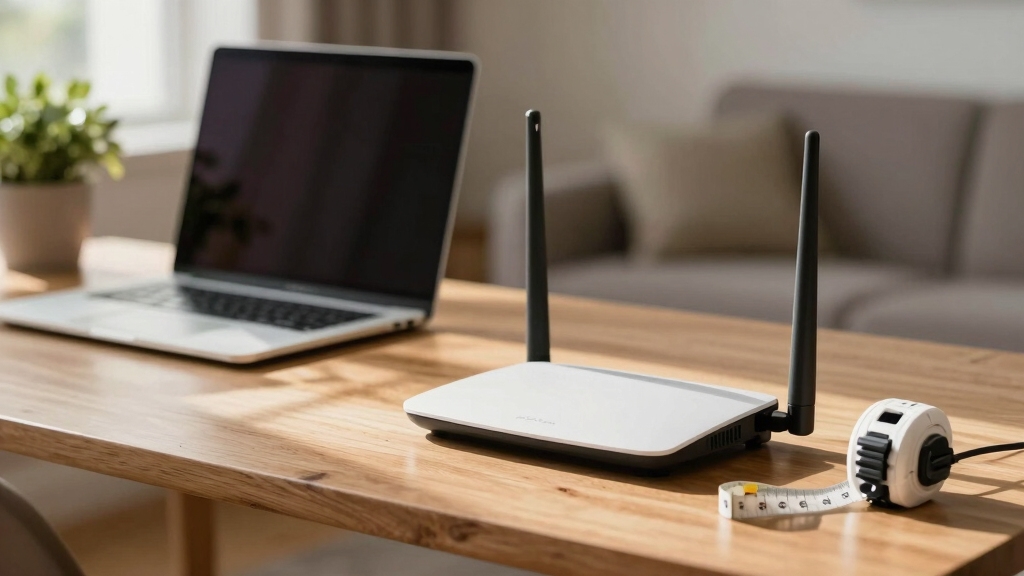

You should keep at least one meter away from your Wi-Fi router to markedly reduce your exposure to radiofrequency radiation. At that distance, field strengths drop to about 2 V/m indoors, well below international safety limits.
Radiation intensity decreases sharply with distance, minimizing absorption by your body. Health authorities agree typical exposure poses no verified risk.
Following this simple spacing guideline enhances safety; exploring further reveals ways to optimize your setup while minimizing emissions.
Key Takeaways
- Maintain at least 1 meter distance from a Wi-Fi router to significantly reduce radiation exposure and align with safety guidelines.
- Wi-Fi radiation power density drops sharply with distance, from about 330 mW/m² at 20 cm to 13 mW/m² at 1 meter.
- Typical indoor electric field strengths are around 5 V/m at 0.5 meters, decreasing to 2 V/m at 1 meter, well below safety limits.
- Regulatory limits and expert assessments confirm no established health risks at common Wi-Fi exposure levels within normal usage distances.
- To minimize exposure, position routers away from frequent seating areas and consider using wired connections for devices when possible.
How Far Should You Stay From a Wi-Fi Router for Safety?
Technically, the exposure to radiofrequency electromagnetic fields (RF-EMF) decreases markedly with distance due to the inverse square law.
At 0.5 meters, typical field strengths are around 5 V/m, dropping to approximately 2 V/m at 1 meter indoors.
Near-field effects are negligible beyond roughly 16 centimeters at 2.45 GHz, the common Wi-Fi frequency.
Power density at 20 cm may peak near 330 mW/m² but falls to about 13 mW/m² at 1 meter, well below international safety limits.
Consequently, maintaining at least one meter distance effectively minimizes exposure, aligning with established safety standards and ensuring negligible health risk.
Similar to how air conditioners do not produce harmful emissions themselves, Wi-Fi routers emit non-ionizing radiation that diminishes rapidly with distance, ensuring safety when proper spacing is maintained from the source of emission.
What Radiation Levels Do Wi-Fi Routers Emit?
Although Wi-Fi routers operate at relatively low power levels, they emit measurable radiofrequency radiation primarily in the 2.4 GHz and 5 GHz bands.
Typical indoor exposure reaches approximately 2 V/m at 1 meter and up to 5 V/m at 0.5 meters from the device.
Power density peaks around 330 mW/m² at 20 cm but decreases sharply with distance, registering near 13 mW/m² at 1 meter.
Regulatory bodies limit indoor transmit power to 100 mW at 2.4 GHz and 200 mW at 5 GHz, ensuring emissions remain well below international safety thresholds such as ICNIRP’s 10 W/m².
Measurements consistently show that Wi-Fi radiation levels stay far below limits that could cause thermal effects or biological harm, aligning with assessments from health authorities worldwide.
However, electromagnetic interference from Wi-Fi devices can cause erratic responses in metal detectors during security checks.
How Does Distance Reduce Wi-Fi Radiation Exposure?
Distance markedly reduces your exposure to Wi-Fi radiation by diminishing both electric field strength and power density.
Increasing distance significantly lowers your exposure to Wi-Fi radiation by reducing electric field strength and power density.
As you move away from the router, the electric field strength drops from around 5 V/m at 0.5 meters to approximately 2 V/m at 1 meter indoors.
Correspondingly, power density decreases sharply, for example, from a peak of 330 mW/m² at 20 cm to about 13 mW/m² at 1 meter.
This attenuation follows the inverse square law, where intensity reduces proportionally to the square of your distance from the source.
Beyond the near-field region, roughly 16 cm at 2.45 GHz, the radiation behaves as a far-field wave, further reducing exposure.
Consequently, increasing distance efficiently lowers the electromagnetic energy your body absorbs, minimizing any potential biological interactions with Wi-Fi signals.
Similar to how photocell sensors detect and adjust to ambient light levels, distance acts as a natural sensor that modulates exposure intensity in real time.
What Do Health Experts Say About Wi-Fi Radiation?
When evaluating Wi-Fi radiation, health experts consistently conclude that current exposure levels pose no established risk to human health.
Organizations like WHO, Health Canada, ARPANSA, and the UK Health Security Agency base this on rigorous assessments comparing measured exposure, typically under 5 V/m at 0.5–1 meter, with international safety limits such as ICNIRP’s 41-58 V/m thresholds.
These limits incorporate substantial safety margins to prevent thermal effects.
Research indicates that Wi-Fi emissions remain far below harmful levels, with no verified adverse biological effects at typical distances.
While some cellular studies report molecular changes near sources, these occur at intensities exceeding usual environmental exposure.
Regulatory agencies recommend compliance with existing guidelines and emphasize that current evidence doesn’t justify additional precautionary measures for everyday Wi-Fi use.
How to Minimize Wi-Fi Radiation Exposure Without Losing Connectivity?
You can reduce your exposure to Wi-Fi radiation by strategically positioning your router and devices without sacrificing signal quality.
Since radiation intensity drops sharply with distance, about 5 V/m at 0.5 m versus 2 V/m at 1 m, you should optimize placement to maintain both safety and connectivity.
Consider these technical steps:
- Place the router at least 1 meter away from high-use areas to reduce power density exposure.
- Elevate the router to minimize obstruction and improve signal distribution.
- Use wired connections (Ethernet) for stationary devices to lower wireless emission.
- Limit simultaneous active devices to reduce cumulative radiation.
- Choose routers with adjustable transmit power, setting it to the minimum required for coverage.
Regular inspection and maintenance, similar to checking sensor alignment and wiring in garage door systems, can help ensure your router operates safely and effectively over time.
Frequently Asked Questions
Can Wi-Fi Radiation Affect Children Differently Than Adults?
Yes, children’s developing tissues can absorb radiofrequency energy differently than adults, potentially leading to higher localized exposure.
Studies indicate cellular effects at very close distances, but current evidence from health authorities shows no established adverse outcomes.
You should note that regulatory limits account for vulnerable groups, including children, and long-term research continues.
While no specific precautions are mandated, maintaining reasonable distance reduces exposure, aligning with precautionary principles.
Are There Specific Health Conditions Worsened by Wi-Fi Exposure?
You’d think Wi-Fi, humming quietly everywhere, would have a list of ailments it worsens, right?
Surprisingly, no specific health conditions have been scientifically proven to worsen due to Wi-Fi exposure.
Regulatory bodies like Health Canada and the WHO confirm current levels don’t cause harm.
While some studies note cellular changes near routers, these remain inconclusive and below safety limits.
How Does Wi-Fi Radiation Compare to Cell Phone Radiation?
You’ll find that Wi-Fi radiation typically involves lower power and exposure levels compared to cell phone radiation.
Cell phones emit higher peak power and closer proximity to your body, increasing specific absorption rates (SAR).
Wi-Fi routers operate at regulated lower power, with exposure dropping markedly beyond 0.5 meters.
While both use similar frequencies, the intermittent, lower-intensity Wi-Fi signals generally present less potential biological impact than prolonged, close-range cell phone use.
Do Wi-Fi Routers Emit Harmful Radiation When Turned Off?
No, Wi-Fi routers don’t emit harmful radiation when turned off because they cease transmitting radiofrequency signals entirely.
Without power, the electromagnetic fields they produce drop to background environmental levels, which are negligible.
Only when active do routers emit RF radiation within regulated limits, proven safe by health authorities.
Is There a Difference in Safety Distance for 2.4 GHZ Vs 5 GHZ Wi-Fi?
You might think 2.4 GHz and 5 GHz signals require totally different safety distances, but the difference is minimal.
Both frequencies drop exposure sharply beyond roughly 30 cm to 1 meter. Since near-field effects vanish past a few wavelengths, 16 cm at 2.45 GHz and 33 cm at 5 GHz, the practical safe distance remains similar.
Regulatory limits and exposure levels guarantee neither frequency poses extra risk within typical indoor distances.
Finding the Sweet Spot Between Wi-Fi and Well-Being
Think of your Wi-Fi router as a campfire: close enough to feel the warmth, but step back to avoid the heat. Staying at a safe distance reduces your exposure to radiation much like moving away lessens the sting of flames.
Experts agree that typical radiation levels are low, but prudent spacing guarantees minimal risk without sacrificing connectivity. By balancing proximity and caution, you optimize safety while keeping your digital signal strong and steady.