
You need at least one fire extinguisher per 200 square metres in your business premises, ensuring no point is farther than 75 feet for Class A hazards or 50 feet for Class B.
Aim for two or more extinguishers per floor, especially in larger or high-risk areas. Follow legal requirements like the UK’s Fire Safety Order or US OSHA and NFPA 10 standards.
Proper placement, type, and maintenance are essential to compliance and safety. More details on optimizing your setup are available.
Key Takeaways
- At least one fire extinguisher per 200–300 square metres is recommended, adjusted for layout and specific fire hazards in the business premises.
- A minimum of two extinguishers per floor should be provided where possible to ensure adequate coverage.
- Position extinguishers so travel distance does not exceed 75 feet for Class A or 50 feet for Class B hazards.
- Follow local legal requirements and standards like the UK Regulatory Reform Order 2005 or US OSHA and NFPA 10 for extinguisher quantity and placement.
- Regularly review extinguisher numbers and locations after workspace changes to maintain compliance and ensure proper coverage.
Calculating How Many Fire Extinguishers Your Business Needs
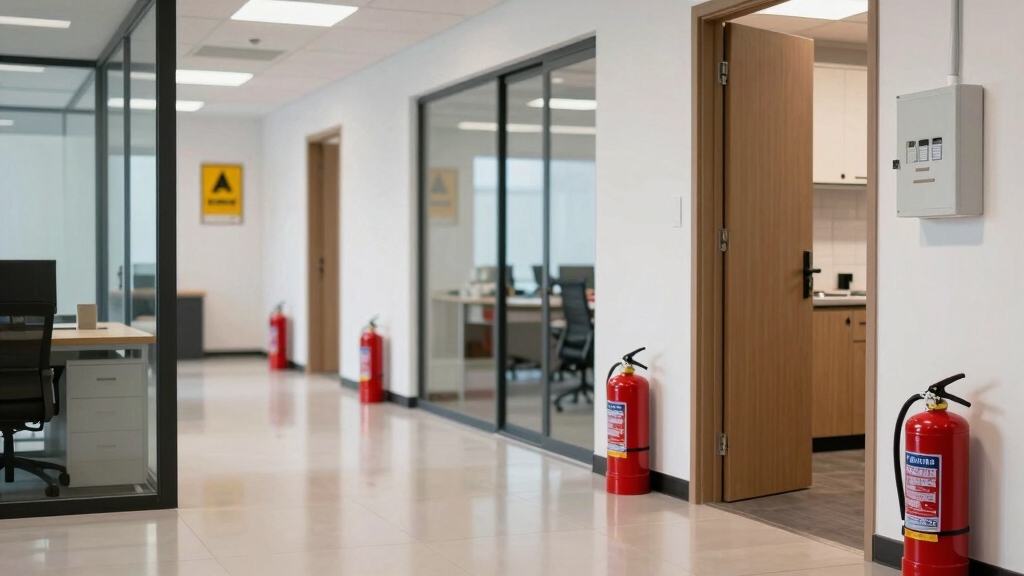
When calculating how many fire extinguishers your business needs, you must consider factors such as floor space, layout, and specific fire hazards.
Generally, one extinguisher per 200 square meters is recommended, with at least two per floor where possible.
You’ll also need to account for travel distances, ensuring no point is more than 75 to 100 feet from an extinguisher, depending on hazard type.
Evaluate your premises’ fire risk classification—light, medium, or high hazard—to select appropriate extinguisher ratings.
Larger or irregularly shaped buildings require additional units to maintain coverage.
Mount extinguishers at accessible heights, considering weight and visibility.
By systematically evaluating these variables, you can determine the exact number and placement of extinguishers.
This ensures compliance and effective fire safety tailored to your business environment.
Proper placement and quantity improve the likelihood of effective fire suppression and minimize damage by enabling rapid response.
UK Fire Extinguisher Laws for Commercial Premises
You’re legally required to have at least one fire extinguisher in your commercial premises, thanks to the Regulatory Reform (Fire Safety) Order 2005.
It’s important to remember that the exact number of extinguishers you need can vary. It really depends on factors like the size and layout of your business, as well as the specific fire risks you might face.
As a general guideline, you might want to consider having one extinguisher for every 200 square metres. This is just a starting point, though!
The key is to assess your unique situation to ensure you’re fully compliant and ready for any emergencies that might arise. So, it’s worth taking the time to evaluate your needs!
Additionally, regular inspections and maintenance are crucial to ensure your fire extinguishers remain effective and safe to use, particularly to avoid issues related to expired fire extinguishers.
Legal Requirements Overview
Although UK law doesn’t specify an exact number of fire extinguishers for businesses, it clearly requires every commercial premises to have at least one suitable extinguisher. The Regulatory Reform (Fire Safety) Order 2005 mandates this for non-domestic premises in England and Wales.
You must assess your premises’ size, layout, and fire risks to guarantee compliance. There’s no one-size-fits-all answer, so you need to tailor your fire safety measures accordingly.
| Aspect | Requirement |
|---|---|
| Legal basis | Regulatory Reform (Fire Safety) Order 2005 |
| Extinguisher quantity | At least one suitable unit per premises |
| Factors influencing | Size, layout, business type, fire hazards |
| Coverage | Extinguisher accessible within reasonable travel distance |
| Compliance | Mandatory for all commercial premises |
It is essential to ensure that fire extinguishers are positioned within the maximum travel distance appropriate to the hazard class to allow quick and safe access.
Recommended Extinguisher Quantity
Determining the recommended number of fire extinguishers for your commercial premises depends primarily on factors like floor space, layout, and specific fire risks.
UK regulations don’t specify a fixed number but require at least one extinguisher per premises. As a rule of thumb, you should provide one extinguisher for every 200 square metres, guaranteeing at least two per floor where possible.
Consider your building’s layout to maintain a maximum travel distance of 30 metres to the nearest extinguisher. For larger or complex sites, increase extinguisher numbers accordingly, focusing on high-risk areas.
Tailoring quantity and placement to your fire risk assessment guarantees compliance with the Regulatory Reform (Fire Safety) Order 2005 and optimizes safety for occupants and property.
It is also important to select extinguishers based on their multi-purpose ABC rating to ensure effectiveness against the most common types of fires encountered in commercial settings.
US Fire Extinguisher Regulations and Standards
When managing fire safety in your business, understanding US fire extinguisher regulations and standards is crucial to guarantee compliance and protect occupants.
You must follow OSHA’s rule 1910.157 and NFPA 10 standards, which set clear requirements for extinguisher placement, maintenance, and accessibility.
Nearly all workplaces need at least one extinguisher, except one- or two-family dwellings.
Key points to remember:
- Provide portable extinguishers in all occupancies except single-family homes.
- Make certain travel distance to an extinguisher doesn’t exceed 75 feet for Class A hazards.
- Maintain extinguishers according to NFPA 10, including regular inspections and servicing.
- Follow local Authority Having Jurisdiction (AHJ) requirements, which may impose stricter rules.
Adhering to these guarantees safety and legal compliance. It is also important to understand that the typical spray duration of fire extinguishers ranges from 8 to 30 seconds, depending on type and maintenance, which impacts effective usage during emergencies.
Fire Hazard Classifications and Matching Extinguisher Types
Because different fire hazards require specific extinguishing agents, you need to match fire extinguisher types to the classification of hazards present in your business.
Class A fires involve ordinary combustibles like paper and wood; use water or multipurpose dry chemical extinguishers rated 2-A or higher.
Class B fires stem from flammable liquids; select extinguishers rated for B hazards, such as 10-B:C or greater, often using foam or dry chemical agents.
Class C fires involve electrical equipment; only non-conductive extinguishers like CO2 or dry chemical should be used.
For specialized risks, Class D covers combustible metals, and Class K targets cooking oils and fats in commercial kitchens.
Selecting the right extinguisher guarantees effective fire control and compliance with safety regulations specific to your premises’ risk profile.
Understanding the fire triangle helps ensure you choose an extinguisher that effectively targets heat, fuel, or oxygen to stop the fire.
Determining Extinguisher Quantity by Building Size and Layout
Although fire extinguisher requirements vary, you should always base the number of units on your building’s size and layout to guarantee adequate coverage.
The goal is to ensure easy access within regulated travel distances and sufficient capacity for potential fire risks.
Consider these key points:
- Provide at least one extinguisher per 200 square metres (approx. 2,150 sq ft) of floor space.
- Install a minimum of two extinguishers per floor, especially in larger or multi-wing buildings.
- Guarantee no point is more than 75 feet (US) or 100 feet (UK) from an extinguisher, adjusting for obstructions.
- Distribute extinguishers to cover all occupied areas, including corridors and high-risk zones, based on your layout.
Following these guidelines helps you meet legal requirements while maximizing safety and accessibility. Regular inspection and maintenance ensure extinguishers remain operable and ready when needed.
Fire Extinguisher Ratings for Different Business Areas
Understanding fire extinguisher ratings is crucial for choosing the right protection for your business areas. Each rating corresponds to specific fire hazards, like ordinary combustibles or flammable liquids, so it’s really important to match them correctly.
Let’s dive into how to identify and select the right extinguishers based on the risks present in your workspace. It’s not just about having an extinguisher on hand; it’s about having the right one for the job! Regular inspection and maintenance ensure extinguishers remain effective and safe to use when needed.
Extinguisher Ratings Explained
When selecting fire extinguishers for your business, understanding extinguisher ratings is essential to guarantee effective fire response. Ratings indicate the extinguisher’s capability to tackle specific fire types and sizes, helping you choose the right unit for your premises.
Here’s what you need to know:
- Class A fires involve ordinary combustibles like wood and paper. Extinguishers are rated by a number and “A” (e.g., 2-A) indicating effectiveness.
- Class B covers flammable liquids found in workshops or kitchens. These extinguishers are rated numerically with a “B” and a letter C (e.g., 10-B:C).
- Class C addresses electrical fires, typically combined with other ratings (e.g., B:C).
- The higher the numeric rating, the larger the fire size the extinguisher can handle.
This system ensures you have the right extinguisher for different areas of your business. For kitchen areas specifically, a Class K extinguisher is recommended to safely handle grease fires involving cooking oils and fats.
Matching Ratings To Hazards
Understanding extinguisher ratings lays the foundation for selecting the right units tailored to your business’s specific fire hazards. Each rating corresponds to a fire class and extinguishing capability.
You’ll want to match extinguishers to the area’s predominant fire risk to ensure an effective response.
| Business Area | Hazard Type | Recommended Rating |
|---|---|---|
| Office Spaces | Ordinary combustibles | 2-A:10-B:C |
| Light Manufacturing | Flammable liquids | 3-A:40-B:C |
| Kitchens | Cooking oils | Class K |
| Electrical Rooms | Electrical fires | Class C |
| Warehouses | Combustible metals | Class D |
Water extinguishers are highly effective for Class A fires because of their cooling and steam production mechanisms that reduce heat and oxygen availability to the fire.
Fire Extinguisher Placement and Travel Distance Rules
Although fire extinguisher placement varies depending on building size and hazard type, strict travel distance limits guarantee quick access during emergencies.
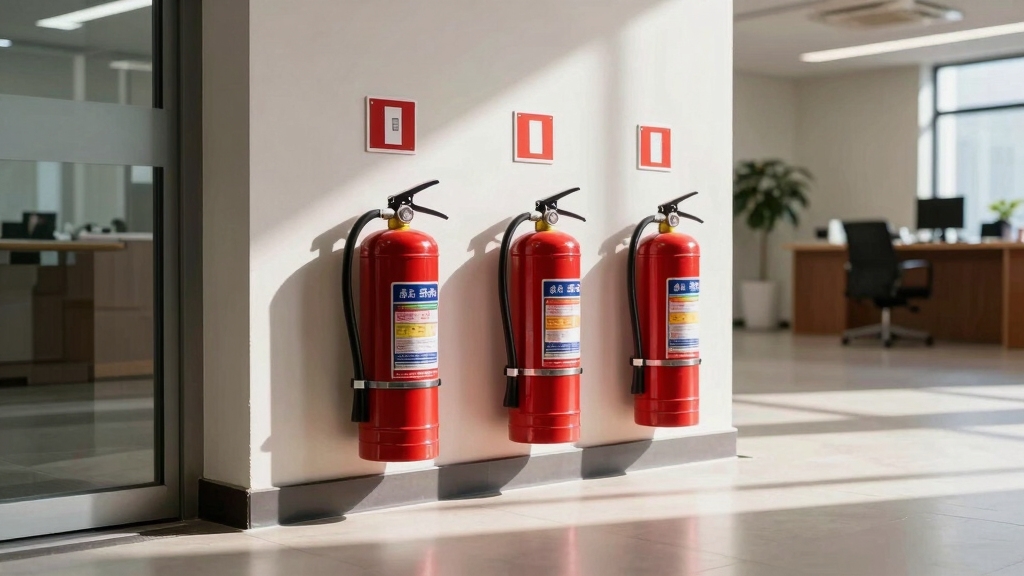
Proper fire extinguisher placement ensures rapid access, adapting to building size and hazard type.
You must position extinguishers so no one travels too far to reach them.
Follow these essential rules:
- Keep travel distance to extinguishers within 75 feet for Class A hazards and 50 feet for Class B.
- Mount units with their bottoms at least 4 inches above the floor; heavier extinguishers can be higher.
- Place at least one extinguisher per 200–300 square meters, adjusting for layout and hazards.
- Ensure multiple extinguishers on larger floors or wings to maintain coverage.
Fire Extinguisher Requirements for Small, Medium, and Large Offices
In small offices, which are up to 3,000 square feet, you’ll typically need one or two fire extinguishers. It’s best to place them centrally so they can effectively cover the space.
Now, if you’re working in a medium office that falls between 3,000 and 6,000 square feet, you’ll want to have two to four extinguishers. This way, you can ensure that no point in the office is more than 75 feet away from an extinguisher.
For those larger offices, which are over 6,000 square feet, it’s important to plan for multiple extinguishers on each floor or wing. This not only meets safety standards but also ensures quick access when it’s needed most. Safety first, right?
Small Office Extinguisher Needs
When managing fire safety in a small office of 3,000 square feet or less, you’ll typically need one to two fire extinguishers placed centrally for quick access. The number depends on your office layout and fire risks. Your extinguishers must be strategically located to meet legal and safety standards.
Consider these key points:
- Install at least one extinguisher per 3,000 sq ft or major fraction thereof.
- Choose 2-A:10-B:C rated extinguishers suitable for typical office hazards.
- Ensure travel distance to the nearest extinguisher doesn’t exceed 75 feet.
- Mount extinguishers between 4 and 5 feet above the floor for accessibility.
Medium Office Fire Safety
Managing fire safety in a medium-sized office requires a strategic placement of two to four fire extinguishers to guarantee quick access and compliance with safety standards.
You should position extinguishers so no employee travels more than 75 feet to reach one, adhering to fire codes and minimizing response time.
Select units rated at least 2-A for Class A fire hazards common in office environments.
Distribute extinguishers evenly across floors or wings, considering layout and potential fire risks.
Mount them at accessible heights, typically with the bottom four inches off the ground, ensuring visibility and ease of use.
Regular inspections and maintenance are essential to keep extinguishers operational.
Large Office Extinguisher Placement
Expanding from medium-sized offices, large office environments demand a more extensive fire extinguisher strategy to guarantee safety across multiple floors or wings.
You must make certain extinguishers are strategically placed to comply with legal and safety standards, factoring in travel distance and layout complexity. Here’s what to focus on:
- Install at least four extinguishers per floor or wing, depending on size and layout.
- Maintain a maximum travel distance of 75 feet to the nearest extinguisher.
- Choose extinguishers with a minimum 2A rating to cover typical office combustibles.
- Position extinguishers clearly visible, mounted 4 inches off the ground for accessibility.
Tips for Staying Compliant With Fire Extinguisher Regulations
Regularly inspecting and maintaining your fire extinguishers guarantees you stay compliant with regulations and keep your workplace safe.
Conduct monthly visual checks to ensure extinguishers are accessible, fully charged, and free from damage.
Perform monthly visual inspections to confirm fire extinguishers are accessible, charged, and undamaged.
Schedule annual professional maintenance to meet NFPA 10 or local standards.
Keep clear signage indicating extinguisher locations and guarantee travel distances don’t exceed legal limits.
Document all inspections and maintenance activities thoroughly; this record helps during audits and demonstrates due diligence.
Train your staff on extinguisher use and emergency procedures to enhance safety and compliance.
Review your extinguisher placement whenever you modify your workspace to maintain adherence to size and hazard-specific requirements.
Common Mistakes to Avoid When Choosing and Placing Extinguishers
After ensuring your extinguishers are well-maintained and your staff is trained, the next step is to avoid common errors in selecting and positioning your fire extinguishers.
These mistakes can compromise safety and compliance. Here are key pitfalls to watch for:
- Choosing the wrong extinguisher class. Match extinguishers to specific fire hazards. A Class A extinguisher won’t work effectively on flammable liquids.
- Insufficient quantity. Follow guidelines for floor area and hazard classification. Don’t understock.
- Improper placement. Make certain travel distances comply with standards (≤75 feet for Class A, ≤50 feet for Class B).
- Mounting errors. Mount extinguishers at the correct height (bottom 4 inches off the floor) for accessibility.
Avoiding these mistakes guarantees your fire protection is both effective and compliant.
Frequently Asked Questions
How Often Should Fire Extinguishers Be Inspected and Maintained?
You should inspect fire extinguishers monthly to ensure they’re accessible, fully charged, and undamaged.
A thorough maintenance check by a qualified professional must happen annually, verifying mechanical parts, extinguishing agent, and pressure.
Additionally, hydrostatic testing is needed every 5 to 12 years, depending on the extinguisher type.
Staying on top of these inspections and maintenance keeps your extinguishers reliable and compliant with safety regulations.
Can Employees Be Trained to Use Fire Extinguishers Effectively?
You can train employees to use fire extinguishers effectively, and it’s vital.
Studies show trained staff respond 50% faster in emergencies.
With proper instruction, you’ll boost confidence and safety.
Training covers extinguisher types, the PASS technique (Pull, Aim, Squeeze, Sweep), and recognizing fire classes.
Regular drills and refreshers guarantee skills stay sharp.
This proactive approach reduces risks and helps you meet legal safety obligations in your workplace.
Are There Specific Fire Extinguisher Types for Kitchen Areas?
Yes, you need specific fire extinguishers for kitchens.
Class K extinguishers are designed for kitchen fires involving cooking oils and fats. They use a wet chemical agent that cools and suppresses flames effectively.
Using the wrong extinguisher can spread grease fires, so placing Class K units near cooking appliances is essential.
Make sure your kitchen’s extinguisher meets local fire codes and is maintained regularly for safety.
What Is the Lifespan of a Typical Fire Extinguisher?
A typical fire extinguisher lasts about 5 to 15 years, depending on its type and maintenance.
You should check the pressure gauge monthly and inspect for damage annually.
Recharge or service it after any use or if the gauge shows low pressure.
Proper maintenance makes certain it functions reliably when you need it most.
Always follow manufacturer guidelines and local regulations for servicing and replacement to keep your extinguisher effective and compliant.
How Should Fire Extinguishers Be Disposed of When Expired?
When your fire extinguisher expires, don’t throw it in the trash. You should contact your local fire department or hazardous waste disposal service for safe handling.
Many areas require you to dispose of extinguishers as hazardous waste due to chemical contents. If possible, have a certified professional recharge or recycle it.
Proper disposal guarantees environmental safety and compliance with regulations. Always follow local guidelines to avoid fines or hazards.
Smart Safety Starts with Proper Fire Extinguisher Planning
You need at least one fire extinguisher for every 3,000 square feet in your business premises, but this varies with hazard level and layout. Remember, 60% of businesses that fail to comply with fire extinguisher regulations face fines or shutdowns.
Stay proactive by matching extinguisher types to fire hazards and following placement rules. Regularly review your setup to guarantee safety and compliance. It’s essential for protecting your property, employees, and customers.