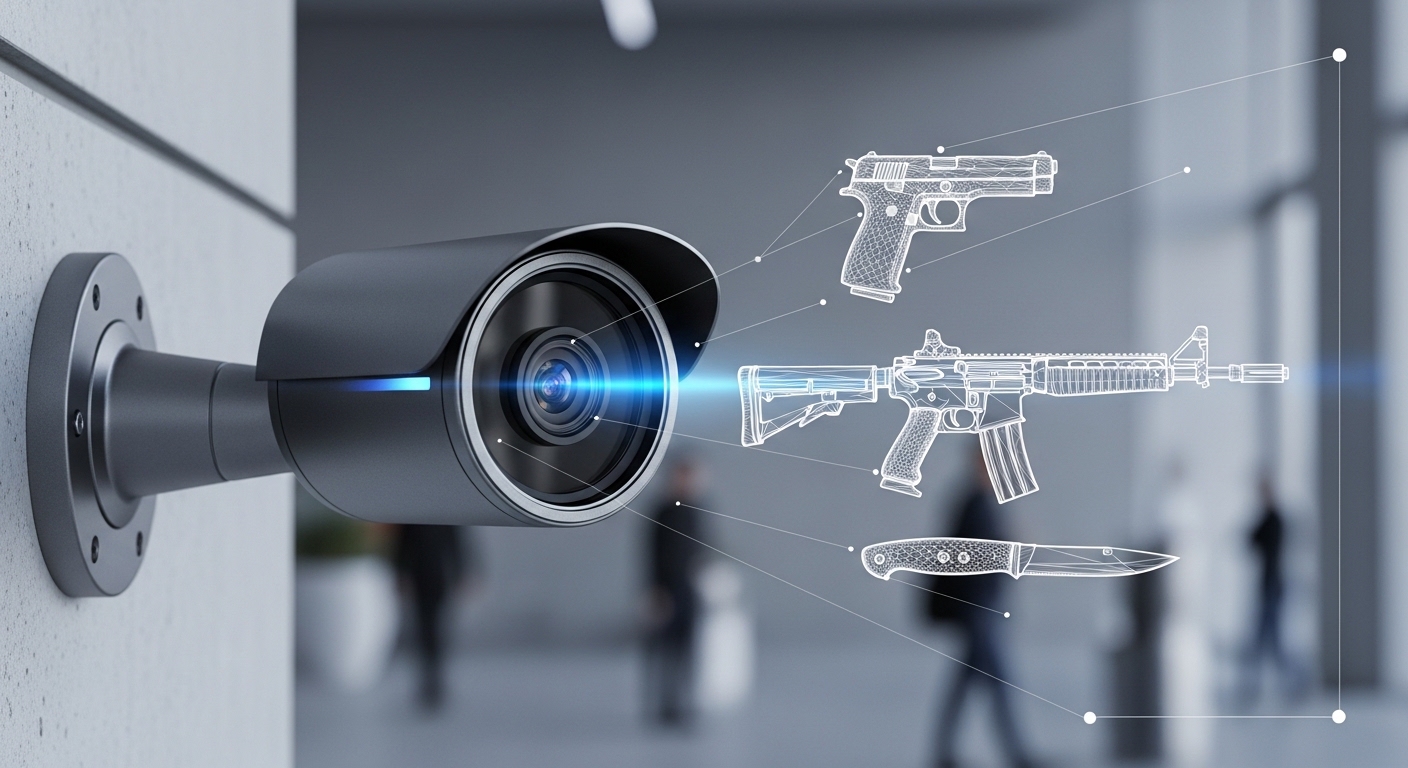

Yes, you can use AI-powered security cameras that detect weapons with remarkable speed and precision. These systems analyze video frames using deep-learning models trained on extensive firearm images, achieving over 99% accuracy.
They combine geometric recognition and contextual cues like uniforms or holsters. Alerts are delivered within milliseconds, often under two seconds, while integrating smoothly with existing cameras.
Human verification further reduces false alarms, ensuring reliable threat identification. Explore how these technologies integrate, operate, and respond in diverse environments.
Key Takeaways
- AI-powered security cameras use deep learning to detect firearms and knives in real time with high accuracy and low false positives.
- These cameras combine edge-based processing and cloud validation for fast, reliable weapon detection within milliseconds or under two seconds.
- Contextual analysis of uniforms, holsters, and behavior enhances detection accuracy beyond simple object recognition.
- Integration with existing security infrastructure enables rapid deployment without costly hardware upgrades.
- Optional human verification filters false alarms, improving alert reliability and operational trust in weapon detection systems.
How AI-Powered Weapon Detection Cameras Identify Threats?
AI-powered weapon detection cameras identify threats by analyzing each video frame with advanced object-detection engines trained on thousands of labeled images of firearms and knives.
AI-driven cameras detect weapons by analyzing every video frame using advanced object-detection trained on thousands of labeled images.
They rely on deep-learning models that isolate weapons by recognizing their unique geometric features and contextual elements like uniforms or holsters.
These systems combine edge-based detection directly on cameras with cloud validation, filtering out false positives efficiently.
Processing up to 36,000 frames per second, the AI detects firearms within milliseconds, ensuring rapid identification.
Machine learning continuously refines detection accuracy and can incorporate optional human verification, reducing false alerts by over 90%.
Integration with advanced video processing improves accuracy and scalability across diverse environments.
What Makes AI Gun Detection So Accurate?
To accurately detect guns, we lean on deep learning models that have been trained on extensive datasets featuring various firearm shapes. This training helps the system recognize weapons with impressive precision.
But it doesn’t stop there! The technology also incorporates contextual analysis layers. These layers assess the surrounding elements, such as uniforms and crowd behavior, which significantly reduces the chances of false positives.
And here’s the kicker: we integrate human verification into the process. This means that before any alerts escalate, trained personnel confirm the potential threats. This extra step really helps refine accuracy and keeps things as reliable as possible.
Additionally, secure systems often rely on a device’s unique identifier to ensure the integrity and authentication of alerts, preventing tampering or false reports.
Deep Learning Models
| Feature | Description | Impact |
|---|---|---|
| Dataset Size | Thousands of labeled firearm images. | Enhances model generalization. |
| CNN Architecture | Multi-layered neural networks. | Precise feature extraction. |
| Real-time Processing | 36,000+ video frames per second. | Instant threat detection. |
| Accuracy | >99% weapon identification. | Minimizes false alarms. |
| False Positive Rate | Reduced via layered analysis. | Improves operational trust. |
These models often incorporate motion detection algorithms to optimize processing efficiency by focusing on frames with relevant activity.
Contextual Analysis Layers
Beyond the raw ability of deep learning models to identify firearms based on shape and texture, contextual analysis layers play a pivotal role in improving detection accuracy.
These layers analyze surrounding elements, like uniforms, holsters, and crowd behavior, to differentiate actual threats from innocuous objects. By integrating environmental cues, the AI reduces false positives that simple geometry recognition might trigger.
This multi-dimensional approach leverages patterns and situational context, refining detection precision. Additionally, combining edge-based detection with cloud-based validation further filters out errors, ensuring you receive reliable alerts.
When you rely on these contextual layers, the system adapts to complex scenarios, such as partial concealment or varying lighting, enhancing real-world effectiveness. This nuanced analysis is critical for maintaining high accuracy in dynamic environments.
Moreover, smart home systems often utilize cloud services and networked video recorders to enable real-time remote monitoring and enhanced data processing, which significantly boosts the reliability of AI-driven gun detection.
Human Verification Integration
Although AI weapon detection systems have achieved remarkable accuracy through advanced algorithms, integrating human verification remains essential to maximize reliability.
You rely on trained professionals to review flagged footage, reducing false positives over 90%. This dual-layer process guarantees immediate, precise threat confirmation before alerts reach responders, balancing speed with accuracy.
| Aspect | AI Detection | Human Verification |
|---|---|---|
| Speed | Milliseconds per frame | Seconds per alert |
| Accuracy | 99%+ with multi-layered models | Further reduces false positives |
| Response Coordination | Automatic alert generation | Contextual threat assessment |
How AI Systems Reduce False Alarms in Weapon Detection?
You know, when it comes to weapon detection, we really rely on some clever multi-layered AI filtering. It sifts through video frames, using techniques like edge detection and cloud validation to cut down on those pesky false alarms.
But it doesn’t stop there! We also use contextual deep learning to analyze the environment. This means looking at things like uniforms and crowd behavior, which helps us achieve a level of accuracy that’s way beyond just basic shape recognition.
And here’s where it gets even better: we’ve human verification as a final check. This step is crucial because it helps reduce false positives by over 90% before any alerts even get to the security teams. So, it’s a pretty robust system we’ve got going!
To maintain consistent performance, it’s important to regularly update firmware and adjust camera angles as needed to ensure optimal detection accuracy.
Multi-Layered AI Filtering
| Layer | Function | Benefit |
|---|---|---|
| Edge Detection | Real-time frame analysis | Immediate alerts |
| Cloud Validation | Contextual data cross-check | False positive reduction |
| Machine Learning | Pattern recognition & adaptive learning | Continuous accuracy improvement |
You’ll see false alarms drop markedly as these layers validate detections before triggering alerts. This ensures higher reliability in security operations. Modern AI weapon detection systems often integrate with IP cameras to leverage their advanced analytics and remote access capabilities.
Human Verification Role
Since AI-powered weapon detection systems rely heavily on automated analysis, incorporating human verification plays a critical role in minimizing false alarms. You benefit from this by having trained personnel review flagged events to confirm threats, which markedly reduces false positives.
Here’s how human verification enhances accuracy:
- Validates AI alerts with contextual understanding beyond algorithmic limits.
- Filters out benign objects or actions misinterpreted as weapons.
- Provides real-time decision-making to prioritize genuine threats.
- Reduces false alarm rates by over 90%, improving operational efficiency.
Proper maintenance and optimized sensor settings further minimize false alarms, ensuring reliable protection without unnecessary disruptions, as highlighted in false alarm optimization.
Contextual Deep Learning
Building on human verification’s ability to filter false alarms, contextual deep learning further refines weapon detection by analyzing visual and situational cues beyond simple object shapes.
These AI models assess uniforms, holsters, and crowd behavior to distinguish actual threats from innocuous items. This layered analysis reduces false positives markedly by integrating edge-based camera detection with cloud validation.
The system processes thousands of video frames per second, evaluating both geometric weapon features and contextual factors in real time.
By combining multi-layered algorithms with large datasets of labeled firearm and environment images, you get accuracy rates exceeding 99%.
This precision minimizes unnecessary alerts, enabling you to rely on automated detection confidently before human verification confirms the threat.
This optimizes response times and operational efficiency.
However, to fully leverage real-time alert functions, these systems typically require a reliable WiFi connection to transmit data instantly for rapid response.
How Fast Can AI Cameras Detect Weapons?
AI cameras typically detect weapons with remarkable speed, often delivering alerts in under two seconds. This rapid detection hinges on advanced object-detection engines processing thousands of video frames per second, pinpointing firearm geometries instantly.
You can expect real-time processing of up to 36,000 frames per second, enabling identification within milliseconds. Visual-only AI systems issue alerts fast enough to trigger lockdowns or notify responders preemptively.
Multi-layered validation combines edge detection and cloud analysis to reduce false positives without slowing alerts. Optional human verification integrates seamlessly, balancing speed with accuracy in critical seconds.
This swift detection guarantees you gain vital response time before a threat escalates, enhancing overall security effectiveness. Integrating AI cameras with AHD cameras’ minimal latency can further optimize real-time weapon detection by reducing video transmission delays.
Can AI Weapon Detection Work With Your Existing Cameras?
When integrating weapon detection capabilities, you don’t have to replace your entire camera infrastructure.
AI weapon detection systems seamlessly connect with existing security cameras, including popular models like Axis, Hikvision, and Avigilon.
AI weapon detection integrates effortlessly with leading security cameras such as Axis, Hikvision, and Avigilon.
These solutions leverage your current video feeds, enabling rapid deployment often within 15 minutes, without costly hardware upgrades.
Cloud-based processing handles the intensive computation, minimizing bandwidth consumption while maximizing your security investment.
This integration guarantees real-time threat detection without compromising system performance or requiring on-site processing power.
By working with your existing video management systems, AI weapon detection enhances situational awareness efficiently and cost-effectively.
Therefore, you can upgrade your security posture with AI analytics while preserving your current surveillance ecosystem, accelerating deployment and reducing operational disruption.
Many AI weapon detection solutions are compatible with both NVR and DVR systems, ensuring flexibility regardless of your current setup.
How Does Human Verification Improve AI Weapon Alerts?
Human verification sharpens weapon detection accuracy by providing a critical layer of judgment beyond algorithmic analysis.
While AI algorithms process thousands of frames per second to identify potential threats, human reviewers evaluate context and subtle cues that AI might misinterpret.
This combination markedly reduces false positives and enhances reliability. You can expect these key benefits from human verification:
- Rapid assessment of ambiguous detections to confirm true threats.
- Filtering over 90% of false positives generated by AI models.
- Contextual analysis beyond geometric weapon recognition, such as behavior and environment.
- Immediate escalation of verified threats to security personnel for timely response.
Where Is AI-Powered Weapon Detection Used Today?
Weapon detection systems have gained traction across various sectors, providing critical real-time alerts that enhance security protocols and emergency responses.
You’ll find them deployed in educational institutions like Temple University, where AI-powered software identifies threats before weapons are discharged.
Corporate campuses and government buildings integrate these systems with existing camera infrastructure, ensuring rapid detection without costly hardware overhauls.
High-risk venues such as airports and stadiums rely on continuous 24/7 monitoring by trained operators who complement AI alerts with human verification, reducing false positives.
Law enforcement agencies also utilize these technologies for proactive threat identification, benefiting from precise location data and video evidence.
What Happens After AI Detects a Weapon?
After AI pinpoints a potential threat, the system immediately initiates a series of automated responses designed to maximize safety and expedite intervention.
You’ll see real-time alerts sent to security personnel, enabling rapid decision-making. Simultaneously, the system can trigger lockdown protocols to contain the threat.
Video footage of the incident, including weapon type and location data, is streamed to responders for situational awareness.
To summarize, the post-detection workflow involves:
- Instant alert delivery to designated security operators.
- Activation of automated lockdown or access control measures.
- Real-time video and metadata transmission to first responders.
- Optional human verification to confirm threat accuracy and reduce false positives.
This layered response framework guarantees swift, coordinated reaction to potential weapon threats.
Choosing the Right AI Weapon Detection System for Your Needs
When selecting an AI-powered weapon detection system, you must assess factors such as detection accuracy, integration capabilities, response times, and operational coverage to guarantee alignment with your security requirements.
Prioritize systems with over 99% accuracy and advanced false positive reduction through deep-learning contextual analysis and human verification. Make certain compatibility with your existing camera infrastructure to minimize costs and complexity.
Prioritize AI weapon detection systems exceeding 99% accuracy with deep-learning false positive reduction and human verification.
Favor cloud-based solutions for scalability and bandwidth efficiency. Evaluate detection speed; systems delivering alerts within 2 to 5 seconds enable timely lockdowns and first-responder notifications.
Consider operational coverage, emphasizing solutions offering continuous monitoring combined with real-time human verification to maintain reliability in high-risk environments.
Frequently Asked Questions
How Do AI Weapon Detection Systems Protect Privacy and Data Security?
You can trust AI weapon detection systems to protect privacy by processing video data locally on edge devices, minimizing sensitive data transmission.
They use encrypted cloud validation to secure data during analysis and storage.
Systems implement strict access controls and anonymize non-threat information, focusing only on weapon-related detection.
These layered security measures guarantee compliance with data privacy standards while maintaining rapid, accurate threat identification without exposing personal identities unnecessarily.
Can AI Detection Distinguish Between Real Guns and Toy or Replica Weapons?
You might worry AI can’t tell real guns from replicas. However, advanced models use deep learning to analyze subtle geometric features and contextual clues like materials and handling.
These systems process thousands of labeled images, enabling them to distinguish authentic firearms with over 99% accuracy. Multi-layered verification, including human review, further reduces false positives by more than 90%.
This ensures reliable detection even under challenging conditions or with toy weapons present.
What Are the Costs Involved in Installing AI Weapon Detection Cameras?
You’ll face variable costs installing AI weapon detection cameras, largely depending on existing infrastructure.
If you already have compatible cameras like Axis or Hikvision, integration software typically costs less than full hardware replacement.
Cloud-based processing reduces on-site hardware expenses but involves subscription fees.
Expect initial setup, licensing, and ongoing monitoring costs.
For example, Pelco Elevate and ZeroEyes systems include human verification, adding operational expenses but markedly improving accuracy and reducing false positives.
How Do Weather and Lighting Conditions Affect AI Weapon Detection Performance?
You’ll find AI weapon detection remains highly accurate despite varied lighting, as deep-learning models adapt to shadows, glare, and low-light conditions using extensive training datasets.
However, extreme weather like heavy rain, fog, or snow can degrade video clarity, reducing detection speed and increasing false positives.
Systems mitigate this with multi-layered validation and human verification, ensuring consistent performance by analyzing contextual cues beyond visual weapon geometry even when environmental factors challenge image quality.
Are There Legal Restrictions on Using AI Weapon Detection Cameras in Public Spaces?
Think of AI weapon detection cameras as vigilant sentinels steering through a complex legal maze.
You must comply with privacy laws like GDPR or CCPA, which regulate data collection and storage.
Public surveillance often demands clear signage and transparency regarding monitoring.
Additionally, some jurisdictions limit facial recognition or require consent.
Before deployment, you should conduct thorough legal reviews to make certain your AI security system respects individual rights while enhancing public safety.
Precision, Speed, and Safety: The New Security Standard
AI-powered weapon detection cameras act like a vigilant sentinel, spotting threats quickly and accurately.
By integrating seamlessly with your existing systems and minimizing false alarms, they enhance real-time security without overwhelming you.
Human verification adds a vital layer of precision, ensuring alerts are actionable.
As these technologies evolve, choosing the right system tailored to your environment becomes essential for proactive threat management and effective incident response.