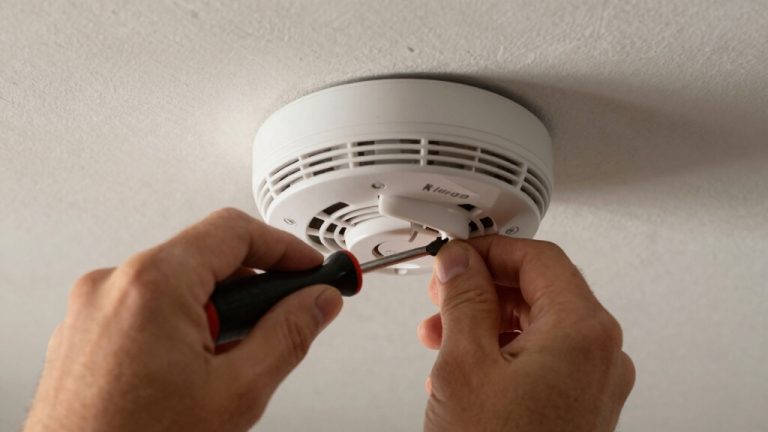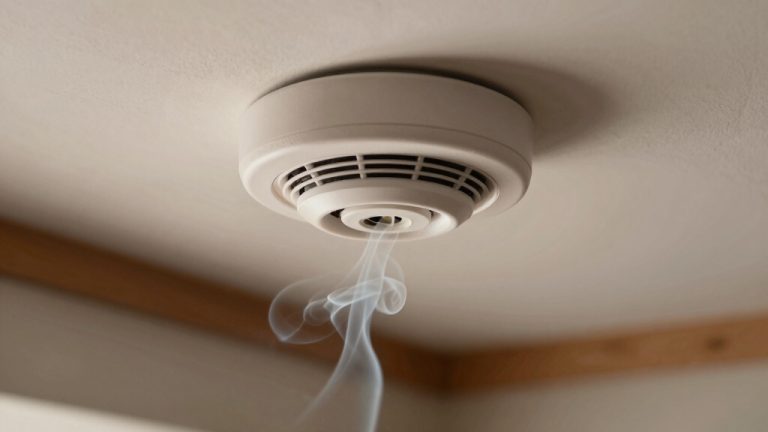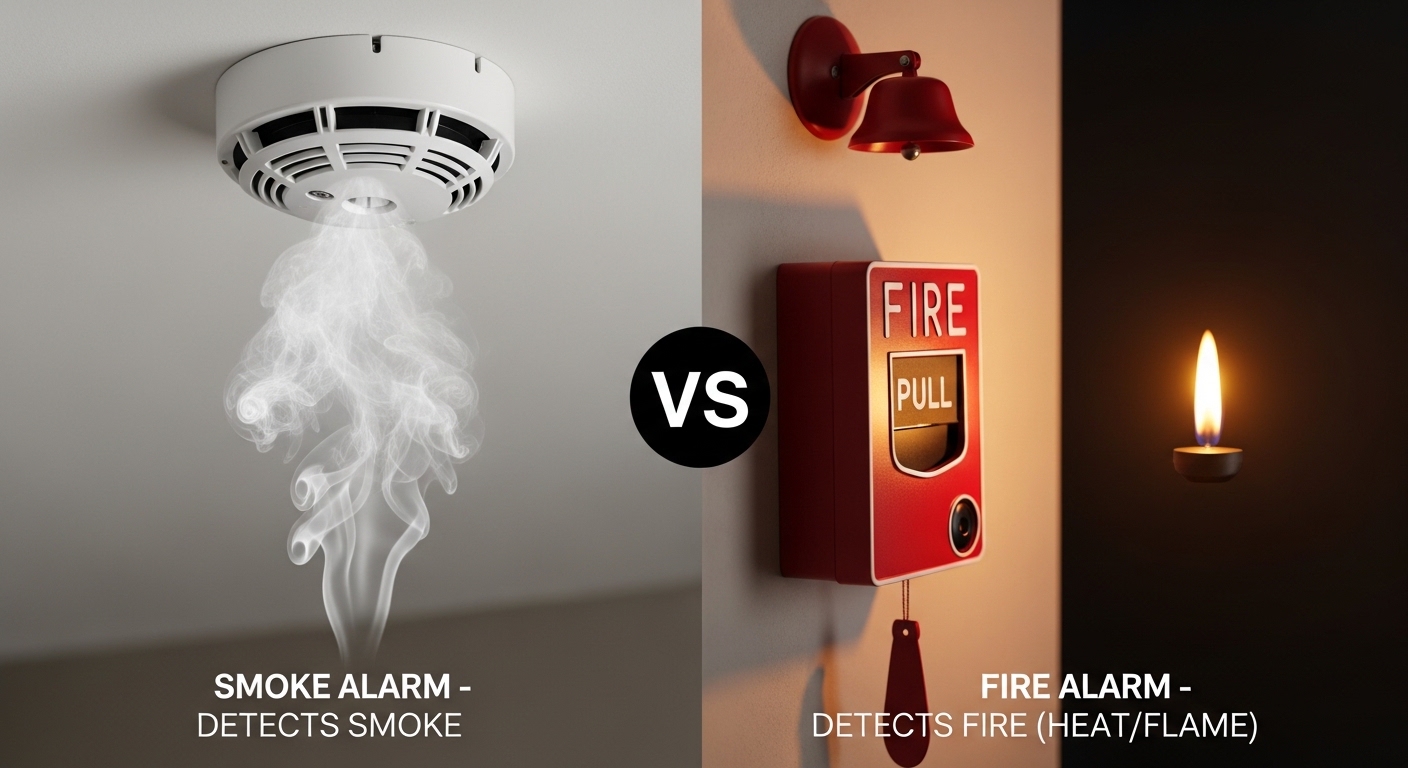

You’ll find that a smoke alarm is a self-contained unit detecting smoke and sounding a local alert to warn you of fire nearby.
In contrast, a fire alarm system uses multiple sensors linked to a central panel, activating building-wide notifications, emergency controls, and sometimes notifying fire services automatically.
Smoke alarms focus solely on smoke detection, while fire alarms manage broader safety protocols.
Understanding these distinctions will help you grasp how both systems protect life and property.
Key Takeaways
- Smoke alarms are standalone devices that detect smoke and emit local audible warnings to alert occupants immediately.
- Fire alarms are integrated systems using various sensors to trigger building-wide notifications and safety controls like door closures and HVAC shutdowns.
- Smoke alarms only detect smoke, while fire alarms monitor multiple indicators such as smoke, heat, and flames for comprehensive detection.
- Fire alarms communicate with a central control panel to identify fire location and can notify emergency services automatically; smoke alarms do not.
- Smoke alarms are common in residences, whereas fire alarms are essential in commercial buildings for coordinated emergency responses.
Difference Between Fire Alarm and Smoke Alarm: Side-by-Side Comparison
| Feature | Smoke Alarm | Fire Alarm System |
|---|---|---|
| Purpose | Detects smoke only and sounds local alert | Detects smoke, heat, flames and manages full response |
| System Type | Standalone device | Integrated system with central control panel |
| Coverage Area | Individual room or home level | Entire building or facility |
| Detection Technology | Ionization, photoelectric, or dual-sensor | Multiple detectors (smoke, heat, flame) |
| Emergency Response | Audible alarm only | Activates alarms, sprinklers, HVAC shutdown, emergency alerts |
| Location Identification | Does not show fire location | Provides precise zone/device location data |
| Common Use | Residential homes and apartments | Commercial, industrial, large buildings |
| Monitoring Capability | Not monitored externally | Can connect to central monitoring services |
Fire Alarms: Definition and How They Work
Fire alarms detect fire-related hazards such as smoke, heat, or flames and trigger integrated systems that notify occupants and initiate safety protocols.
Fire alarms sense smoke, heat, or flames, activating systems to alert occupants and start safety measures.
When sensors detect a fire condition, they send signals to a central fire alarm control panel, which activates audible alarms, visual indicators, and emergency communication systems.
You’ll find these systems programmed to initiate automatic responses like door closures, elevator recalls, and HVAC shutdowns to contain fire spread and aid evacuation.
Fire alarms provide precise location data by zone or device identification, enabling quick emergency response.
Unlike standalone smoke alarms, fire alarms integrate multiple detection technologies, including smoke, heat, and flame sensors.
They’re essential in commercial and industrial settings where all-encompassing fire management and compliance with safety standards, such as AS1670, are mandatory for occupant protection and property preservation.
Monitored fire alarm systems can automatically notify the fire department, significantly reducing emergency response times through central station monitoring.
Smoke Alarms: Definition and How They Work
Smoke alarms are those trusty devices we often take for granted, but they play a crucial role in keeping us safe from fires. You know how they work, right? They detect smoke and then let out loud alerts to warn us of potential danger. Pretty helpful, don’t you think?
Now, here’s where it gets interesting. There are different types of smoke alarms that use varying technologies. For instance, some of them have ionization sensors, which are great for spotting fast-flaming fires.
On the flip side, you have photoelectric sensors that are specifically designed to sense smoldering fires by detecting different types of particles. It’s fascinating to understand how these technologies operate because it can really help you choose the right smoke alarm for your needs.
After all, early warnings can make a big difference! Photoelectric alarms work by using light scattering to detect smoke particles in a dark optical chamber, making them especially effective for early detection of smoldering fires.
Smoke Alarm Basics
Typically installed in homes and apartments, smoke alarms detect the presence of smoke particles and emit loud audible alerts to warn occupants of potential fire hazards.
These self-contained units combine smoke detection and alarm functions, enabling immediate warning without external connections.
You’ll find them powered by batteries or hardwired with battery backup, guaranteeing continuous operation during power outages.
Smoke alarms activate when smoke particles enter the sensing chamber, triggering an internal mechanism that sounds a piercing alarm.
While they don’t identify fire location or type, their prompt alerts are critical for early evacuation.
To maintain effectiveness, you should test smoke alarms monthly and replace batteries annually or as indicated.
Many hardwired smoke alarms include a battery backup system that ensures functionality during electrical outages.
Understanding these basics helps you assure your smoke alarms provide reliable, life-saving warnings in residential settings.
Detection Technologies Used
Understanding how smoke alarms detect smoke is key to appreciating their function. You’ll find two primary detection technologies: ionization and photoelectric.
Ionization alarms use a small electric current between charged plates. When smoke particles enter, they disrupt this current, triggering the alarm. These detectors respond rapidly to flaming fires producing small combustion particles.
Photoelectric alarms, on the other hand, rely on a light source and sensor. Smoke particles scatter the light beam, activating the sensor when scattered light reaches a threshold. This makes them more sensitive to smoldering fires with larger particles.
Some models combine both technologies, providing all-encompassing detection. Optical detection systems monitor light interruption over sizable areas, reporting smoke density or device condition to fire system managers for enhanced reliability and safety.
Regular maintenance, including cleaning vents and sensors, is essential to prevent false alarms and ensure reliable operation of smoke alarms.
Key Technical and Functional Differences Between Fire and Smoke Alarms
Although both fire alarms and smoke alarms serve essential roles in fire safety, they differ markedly in technical design and operational function.
You’ll find that fire alarms are all-encompassing systems integrating detection, notification, and control mechanisms, while smoke alarms are standalone devices combining smoke detection with audible alerts.
- Fire alarms activate building-wide notifications and safety controls; smoke alarms emit local audible warnings only.
- Smoke alarms detect smoke independently; fire alarms receive input from multiple detectors, including smoke sensors.
- Fire alarms provide precise fire location data to occupants and emergency responders; smoke alarms don’t.
- Fire alarms monitor various fire indicators (heat, smoke); smoke alarms focus solely on smoke detection.
- Unlike local smoke alarms, fire alarms linked to a central monitoring system can automatically notify emergency services to ensure rapid response even when occupants are absent.
Understanding these distinctions helps you choose appropriate safety solutions for different environments.
How Smoke Detectors Work in Fire Alarm Systems?
Did you know that smoke detectors in fire alarm systems mainly rely on ionization or photoelectric technology to detect smoke particles? It’s pretty fascinating!
But here’s the thing: these detectors don’t actually sound the alarms on their own. Instead, they communicate with a central fire panel, which is responsible for managing alerts and responses.
For safety, it’s crucial to position near an exit so you can evacuate quickly if the alarm sounds.
Smoke Detection Technologies
Smoke detectors typically rely on two primary technologies to sense the presence of smoke particles: ionization and photoelectric detection. Ionization detectors use a small amount of radioactive material to ionize air in a sensing chamber. When smoke enters, it disrupts the current, triggering an alarm.
Photoelectric detectors employ a light source and sensor; smoke particles scatter the light beam, activating the alarm. You’ll also find dual-sensor detectors combining both methods for enhanced detection.
- Ionization excels at detecting fast-flaming fires with small particles.
- Photoelectric is more sensitive to smoldering fires with larger particles.
- Dual-sensor units provide all-encompassing coverage across fire types.
- Advanced models report smoke density levels to fire monitoring systems.
Understanding these technologies helps you select appropriate smoke detection for safety needs. Many smoke detectors use 9V alkaline batteries to power these sensors reliably in standalone and hardwired units.
Integration With Fire Panels
After identifying the types of smoke detection technologies, it’s important to understand how these detectors function within broader fire alarm systems.
Smoke detectors don’t operate independently; instead, they connect directly to a central fire alarm panel. When a detector senses smoke, it sends an electronic signal to the panel, which then processes the information to determine appropriate responses.
This integration allows for precise location identification and coordinated actions, such as activating alarms, initiating evacuation protocols, and notifying emergency services.
Unlike standalone smoke alarms, detectors rely on continuous monitoring by the fire panel to maintain system integrity. This setup is essential for commercial buildings where compliance with standards like AS1670 mandates centralized control and real-time supervision of smoke detection devices.
Proper wiring and power supply are critical for ensuring reliable detector signals and system functionality within fire alarm panels.
Ionization vs. Photoelectric Smoke Alarms: What You Need to Know
Although both ionization and photoelectric smoke alarms serve the critical function of early fire detection, they utilize distinct technologies that target different fire characteristics. You should understand these differences to choose the right alarm for your environment.
- Ionization alarms detect small soot particles from fast-flaming fires by sensing disruptions in an electric current.
- Photoelectric alarms identify larger smoke particles from smoldering fires via light beam scattering.
- Ionization models react faster to rapid, flaming fires; photoelectric units excel in detecting slow, smoky fires.
- Each type has specific maintenance needs and performance profiles, influencing reliability and response times.
Knowing these facts helps you optimize safety, ensuring timely alerts tailored to the fire types most likely in your space.
Additionally, understanding the fire triangle—oxygen, fuel, and heat—can improve your awareness of how fires start and how alarms detect early signs.
Why Dual-Sensor Smoke Alarms Provide Better Protection?
When it comes to fire safety, dual-sensor smoke alarms really stand out. By combining ionization and photoelectric sensors, these alarms provide a broader range of fire detection. This means they’re equipped to handle both fast-flaming fires and those sneaky smoldering ones. Pretty neat, right?
What’s even better is that this integration boosts their early warning capabilities. They can detect a wider variety of smoke particles, which gives you more time to react. Plus, one of the best features of dual-sensor alarms is that they help cut down on false alarms. They do this by cross-checking smoke signals before sounding the alarm, giving you peace of mind when it matters most.
For optimal performance, it’s important to install smoke alarms in locations that avoid dead-air spots and areas with poor air circulation to ensure reliable detection.
Ionization Vs Photoelectric
Frequently, choosing the right smoke alarm technology can markedly impact early fire detection and safety.
You’ll find two primary types: ionization and photoelectric smoke alarms. Each detects different fire characteristics, so understanding their distinctions is pivotal.
- Ionization alarms use an electric current disrupted by small particles from fast-flaming fires, providing rapid alerts for sudden flames.
- Photoelectric alarms detect larger smoke particles from smoldering fires, offering earlier warnings for slow-burning fires.
- Ionization sensors respond quickly but can be prone to false alarms from cooking or steam.
- Photoelectric sensors reduce false alarms and perform better in detecting smoky, smoldering fires common in residential settings.
Enhanced Fire Detection
By combining ionization and photoelectric technologies, dual-sensor smoke alarms provide more thorough fire detection than single-sensor models. You benefit from rapid response to both flaming and smoldering fires, vital for early warning and safety.
This hybrid approach increases detection accuracy by monitoring different smoke particle types simultaneously.
| Sensor Type | Detects |
|---|---|
| Ionization | Fast-flaming fires with small particles |
| Photoelectric | Smoldering fires with larger particles |
| Dual-Sensor | Both fire types for extensive coverage |
| Coverage Area | Up to 30 m² with optical monitoring |
Using dual-sensor alarms, you enhance protection by reducing the chance of undetected fires. This ensures quicker alerts and safer evacuation times.
Reduced False Alarms
Although smoke alarms play a crucial role in early fire detection, false alarms can undermine their effectiveness and lead to complacency.
Dual-sensor smoke alarms, combining ionization and photoelectric technologies, markedly reduce false alarms by accurately distinguishing between real fire conditions and benign particulates.
You’ll benefit from enhanced protection because these alarms:
- Detect both fast-flaming and smoldering fires, minimizing missed events.
- Avoid nuisance triggers from cooking smoke or steam by cross-verifying sensor data.
- Provide more reliable alerts, decreasing the chance of alarm fatigue.
- Maintain consistent sensitivity over time, reducing malfunctions caused by sensor contamination.
Common Installation Locations for Fire and Smoke Alarms
When installing fire and smoke alarms, you need to place them strategically to maximize early detection and safety.
For smoke alarms, install them inside each bedroom, outside sleeping areas, and on every level of your home, including basements. Position them on ceilings or high on walls since smoke rises. Avoid areas near windows, doors, or ducts where drafts can interfere with detection.
For fire alarm systems in commercial or large residential buildings, place smoke detectors in hallways, stairwells, and large open areas to guarantee thorough coverage.
Fire alarm control panels usually monitor multiple detectors, so correct sensor placement guarantees accurate location identification. Follow local codes like AS1670 for spacing and mounting height to maintain system reliability and reduce false alarms.
How Fire Alarms Notify You and Manage Emergencies?
Fire alarm systems activate multiple notification methods to alert occupants and coordinate emergency responses efficiently. When triggered by smoke, heat, or fire detection, these systems not only sound audible alarms but also initiate organized emergency protocols.
You’ll rely on them to guarantee swift evacuation and minimize damage. Here’s how fire alarms notify and manage emergencies:
- Audible Alarms: Loud sirens and voice commands guide you to safety.
- Visual Alerts: Strobe lights assist occupants with hearing impairments.
- Central Panel Notifications: Fire detection signals transmit to control panels, enabling precise location tracking.
- Emergency System Integration: Fire alarms can activate sprinklers, emergency lighting, and notify fire departments automatically.
Essential Maintenance Tips for Fire and Smoke Alarm Systems
Regular maintenance guarantees your fire and smoke alarm systems operate reliably when needed. Test each smoke alarm monthly by pressing the test button to verify the audible alert.
Replace batteries annually or use sealed 10-year battery units to prevent power failure. Clean detectors quarterly to remove dust and debris that can impair sensing.
For fire alarm systems, reassure panel connectivity and sensor functionality are checked by professionals regularly.
| Maintenance Task | Frequency |
|---|---|
| Test alarms | Monthly |
| Replace batteries | Annually |
| Clean detectors | Quarterly |
Following these steps assures early detection and timely alarms, markedly reducing fire hazards and enhancing occupant safety.
Choosing the Right Fire or Smoke Alarm to Save Lives
Although selecting a smoke or fire alarm may seem straightforward, understanding the differences in detection technology and application guarantees you choose a device that effectively protects your space.
Choosing the right fire alarm means understanding detection technologies to ensure your space is properly protected.
To select the right alarm, consider these factors:
- Detection Type: Choose ionization alarms for fast-flaming fires or photoelectric for smoldering fires. Dual-sensor models offer thorough coverage.
- Installation Environment: Use standalone smoke alarms for residences. Integrate smoke detectors with fire alarm panels in commercial buildings.
- Power Source: Opt for sealed 10-year battery units to assure reliability without frequent maintenance.
- Additional Features: Select alarms with strobe lights for hearing-impaired occupants. Interconnected hardwired systems provide seamless alerts.
Frequently Asked Questions
Can Fire Alarms Detect Carbon Monoxide as Well as Smoke?
You should know that standard fire alarms primarily detect smoke, heat, or flames but typically don’t detect carbon monoxide (CO).
However, some advanced fire alarm systems integrate CO sensors to monitor both smoke and carbon monoxide levels simultaneously.
If you want all-inclusive protection, consider installing combination detectors designed for both smoke and CO detection.
This ensures early warnings for fire and toxic gas hazards, enhancing safety in your home or building.
Are There Wireless Options for Interconnected Smoke Alarms?
You’ll find wireless interconnected smoke alarms that simplify home safety without complex wiring.
NFPA reports working smoke alarms cut fire death risk by half, making these wireless models essential.
They communicate via radio signals, triggering all alarms when one detects smoke.
These devices often include 10-year sealed batteries, reducing maintenance.
You can install them throughout your residence, ensuring early alerts and coordinated evacuation during emergencies.
How Loud Are Smoke Alarm Sirens Compared to Fire Alarms?
Smoke alarm sirens typically emit sounds around 85 decibels at 10 feet, enough to wake sleeping occupants.
Fire alarm sirens in commercial systems often reach 90-110 decibels, designed to alert larger areas and overcome ambient noise.
You’ll find smoke alarms focus on personal, close-range alerts, while fire alarms provide louder, more far-reaching signals to coordinate evacuations and system responses in bigger buildings or noisy environments.
Do Smoke Alarms Work During Power Outages Without Batteries?
You can’t exactly count on a smoke alarm without batteries during a power outage. It won’t work.
Since many smoke alarms rely on batteries as a backup, if you remove them, the alarm loses its power source. Hardwired units usually have battery backups for this reason.
Can Pets Trigger False Alarms in Smoke or Fire Detectors?
Yes, pets can trigger false alarms in smoke or fire detectors, especially those using ionization technology sensitive to small particles.
Pet dander or movement may disturb sensor readings, causing nuisance alerts.
To minimize this, you should install photoelectric or dual-sensor alarms that better differentiate smoke from pet-related particles.
Regular cleaning and proper placement away from pet areas also help reduce false alarms triggered by your pets.
Make Safer Decisions With a Clear Understanding of Fire Alarm vs Smoke Alarm
Understanding the distinct differences between fire alarms and smoke alarms empowers you to protect your property and people precisely.
By prioritizing proper placement, performing periodic maintenance, and picking the perfect device, whether ionization or photoelectric, you’ll make certain swift, sound safety signals.
Staying sharp and savvy with these systems saves lives, secures spaces, and supports swift emergency responses.
Don’t delay; deploy dependable detectors and decisively defend against danger every day.