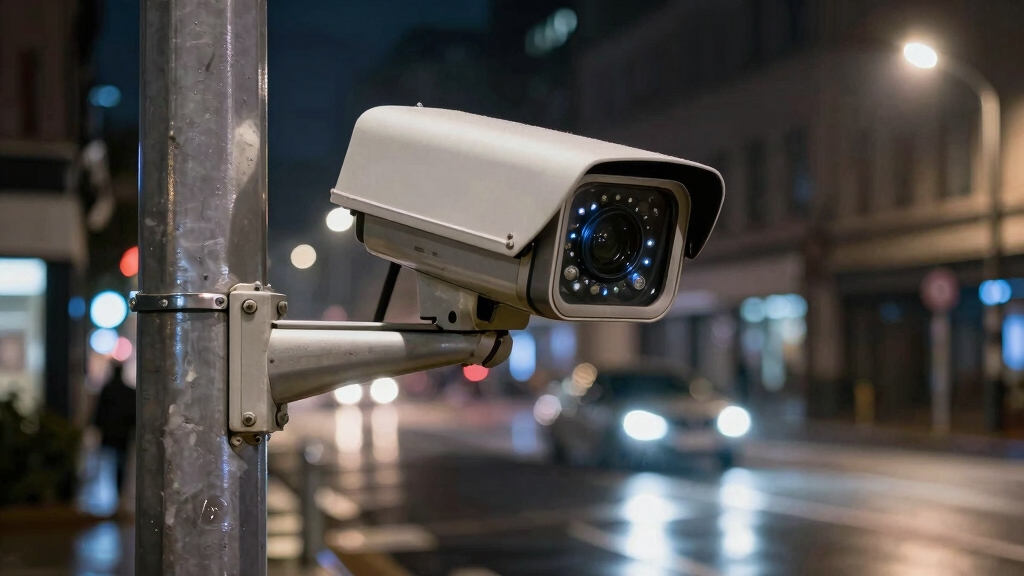

You need a high-resolution license plate recognition camera with a 1.3 to 4 MP sensor and motorized varifocal lenses to capture sharp, adjustable focus images across varied distances.
These cameras use AI-powered OCR and deep learning to automatically detect, segment, and interpret plates, even in low light or adverse weather with infrared and WDR.
IP66/IP67-rated weatherproofing guarantees durability. Integration with network recorders enables real-time alerts and automated access control.
Explore how these features enhance security and data management.
Key Takeaways
- License Plate Recognition (LPR) cameras use AI and OCR to automatically detect and read license plates in real-time.
- High-resolution sensors (1.3 MP to 4 MP) with motorized varifocal lenses ensure sharp images from 27 to over 3,200 feet.
- Night vision with infrared and low-lux color display allows accurate plate reading in near-total darkness.
- Weatherproof housings (IP66/IP67) protect cameras for reliable operation in rain, dust, and extreme temperatures.
- Integration with management systems enables automated access control, real-time alerts, and efficient data retrieval.
How License Plate Recognition Cameras Capture Plate Details?
License plate recognition cameras capture plate details by combining high-resolution imaging with advanced image processing algorithms.
License plate recognition cameras blend high-resolution imaging with sophisticated algorithms to accurately capture plate details.
You’ll find that these cameras utilize HD image sensors, typically between 1.3 and 4 megapixels, to deliver clear, crisp images of license plates even at distances up to several hundred feet.
Once the image is acquired, the system isolates the plate area by detecting contrast edges and shapes. It then segments individual characters using Optical Character Recognition (OCR) software.
This process converts pixels into alphanumeric text swiftly and accurately.
You’ll notice that motorized varifocal lenses adjust focus dynamically to optimize clarity under varying lighting and distance conditions.
Additionally, real-time processing makes certain that plate data is extracted and transmitted within milliseconds for immediate use.
To ensure optimal visibility under challenging lighting conditions, many license plate recognition cameras incorporate Wide Dynamic Range (WDR) technology.
The Technology Behind License Plate Recognition Cameras
Understanding the technology behind plate recognition cameras requires diving into the integrated components that work seamlessly to capture and process vehicle information.
You rely on high-resolution image sensors combined with motorized varifocal lenses to isolate plates under varying distances and lighting.
Optical Character Recognition (OCR) software then translates images into text by detecting plate boundaries and segmenting characters.
Artificial Intelligence further refines recognition by identifying vehicle attributes.
Data transmits instantly to centralized systems for real-time analysis and storage.
Each camera is identified by a unique UID that ensures secure remote access and device authentication in the network.
| Component | Function | Specification |
|---|---|---|
| Image Sensor | Captures clear plate images | 1.3 MP to 4 MP |
| OCR Software | Converts image pixels to text | Character segmentation |
| AI & Deep Learning | Enhances vehicle and plate recognition | Vehicle fingerprinting |
Types of License Plate Recognition Cameras Explained
With the technology that powers plate recognition cameras clearly outlined, it’s important to distinguish the various types of these specialized devices to understand their capabilities and applications.
License Plate Capture (LPC) cameras primarily record license plate images with basic video functionality. In contrast, License Plate Recognition (LPR) cameras integrate advanced Artificial Intelligence, ANPR/ALPR software, and deep learning algorithms to automatically detect, segment, and interpret plate characters in real time.
These cameras feature HD image sensors from 1.3 MP to 4 MP and motorized varifocal lenses to optimize focus across distances spanning 27 to over 3,200 feet.
You’ll find LPR cameras equipped for high-speed processing, enabling instant transmission of plate data to management systems. This makes them ideal for automated access control, law enforcement, and security applications requiring precise and rapid license plate identification.
Many of these cameras utilize AHD technology to deliver high-definition analog video with minimal latency and reliable performance over coaxial cables.
Night and Weather Performance of License Plate Cameras
Although lighting and weather conditions can severely impact image quality, modern plate recognition cameras are engineered to maintain accurate performance around the clock.
Modern plate recognition cameras deliver consistent accuracy despite challenging lighting and weather conditions.
They employ low-lux color night display technology combined with infrared night vision to capture clear license plate images in near-total darkness.
Weatherproof housings rated IP66 or IP67 protect sensitive optics and electronics from rain, dust, and temperature extremes.
Motorized varifocal lenses dynamically adjust focus to compensate for fog, rain, or glare, ensuring peak image sharpness.
These cameras also feature adaptive exposure control to mitigate the effects of headlights or street lighting.
Together, these technical enhancements enable reliable license plate detection and OCR functionality during adverse weather and nighttime, supporting continuous surveillance without manual intervention.
Additionally, features like glare reduction significantly improve image clarity by minimizing the interference caused by headlights and streetlights.
Integrating License Plate Cameras With Security Systems
Integrating license plate cameras with existing security systems enhances real-time monitoring and automated response capabilities. You can link these cameras directly to centralized management platforms, enabling instantaneous data transmission and analysis.
The system leverages OCR and AI algorithms to convert captured images into actionable data, which triggers predefined security protocols. Integration with access control systems automates gate operations based on whitelist or blacklist recognition, reducing manual intervention.
You’ll also benefit from seamless synchronization with video management software, allowing simultaneous review of license plate data and surveillance footage. Networked configurations provide scalable deployments, supporting multi-camera setups across sites.
Additionally, you can configure alerting mechanisms that notify security personnel via email or mobile when flagged vehicles are detected. This ensures immediate situational awareness and response.
Using NVR systems with PoE capabilities simplifies installation by combining power and data transmission over a single Ethernet cable, reducing cable clutter and enhancing flexibility in camera placement.
Security and Access Benefits of License Plate Cameras
You know, automating access control can really make a difference. By setting up license plate cameras, you can instantly verify which vehicles are authorized. This means gates or barriers can open without any need for manual input, making the whole process smoother.
Plus, these systems take security monitoring up a notch. They continuously capture and analyze vehicle data, which helps flag any unauthorized or suspicious plates in real time. It’s like having an extra set of eyes on the perimeter.
And let’s not forget about response times. Integrating this technology really cuts down on delays and improves perimeter control. With precise, data-driven enforcement, you can feel more confident about your security measures.
For optimal performance, especially in permanent installations, using wired cameras ensures stable, high-quality video capture with minimal latency, which is crucial for accurate license plate recognition.
Automated Access Control
You set up authorized vehicle lists, or whitelists, that the system cross-references in real time through Optical Character Recognition and AI-driven vehicle profiling.
When a vehicle approaches, the system identifies the plate, compares it against your database, and triggers gate or barrier access automatically, eliminating delays and human error.
You can configure selective entry by property zones and receive immediate alerts for unauthorized or blacklisted plates.
Integration with entry/exit monitoring enables customized rules, improving traffic flow during peak hours without physical credentials or staff intervention.
This technology guarantees precise, efficient, and secure perimeter control, enhancing operational productivity while maintaining strict access governance.
For optimal performance, these cameras typically require a reliable WiFi connection to enable real-time alerts and remote monitoring.
Enhanced Security Monitoring
While managing access control is critical, enhancing overall security monitoring through license plate-reading cameras provides a thorough layer of protection.
You gain real-time vehicle identification by leveraging Optical Character Recognition and AI-driven vehicle profiling, which automatically captures and analyzes license plates alongside make, model, and color data.
This data feeds into centralized systems, enabling immediate cross-referencing with watch lists and rapid alert generation for flagged vehicles.
Continuous 24/7 operation, including low-light and adverse weather conditions, guarantees no gaps in surveillance.
You also benefit from searchable databases that facilitate forensic investigations and pattern recognition, improving threat detection and response times.
Moreover, active deterrence features like sirens and two-way audio allow you to engage intruders remotely, enhancing situational control and crime prevention at your secured premises.
For optimal performance, ensure cameras are mounted with clear sightlines to avoid blind spots and maximize image clarity.
Detecting and Preventing Crime With License Plate Cameras
Because license plate-reading cameras continuously capture and analyze vehicle data in real-time, they provide a critical tool for detecting and preventing crime. You can identify stolen vehicles instantly as the system cross-references plates with law enforcement databases.
Additionally, suspicious vehicle behavior triggers immediate alerts to security teams, enhancing rapid response capabilities. These cameras also detect obscured or altered plates, flagging potential criminal intent.
| Feature | Function | Benefit |
|---|---|---|
| Real-time Data Capture | Continuous vehicle monitoring | Immediate crime detection |
| Automatic Alerts | Flagged plates notification | Faster law enforcement action |
| Vehicle Profiling | Make, model, color analysis | Enhanced suspect identification |
| Obscured Plate Detection | Identifies hidden plates | Prevents evasion attempts |
You gain powerful crime deterrence and investigation support using these systems. Integrating these cameras with smart alerts enhances situational awareness by providing real-time notifications that improve security response times.
Managing and Searching License Plate Camera Data Efficiently
Effective crime detection relies on more than just capturing license plate data. It demands streamlined management and rapid search capabilities within vast databases.
You need a centralized system that indexes metadata like plate numbers, timestamps, location, and vehicle attributes instantly. Efficient storage architectures optimize retrieval speed by segmenting data chronologically and categorically.
When searching, advanced filtering lets you combine parameters such as date range, vehicle color, or plate state. This narrows down results swiftly.
Implementing AI-driven pattern recognition accelerates anomaly detection and flagging of suspicious vehicles. Additionally, real-time synchronization across multiple camera feeds guarantees exhaustive coverage without lag.
Robust query engines support concurrent user access, enabling law enforcement and security personnel to perform forensic investigations and immediate alerts effectively. This minimizes downtime and manual review efforts.
For optimal system performance, ensure all camera connections are secure and properly weatherproofed to maintain consistent data capture and transmission weatherproof connections.
Key Features for Choosing a License Plate Camera
When selecting a license plate camera, you must prioritize features that guarantee accurate plate capture under diverse conditions and seamless integration with your existing security infrastructure.
Look for high-resolution sensors (1.3 MP to 4 MP) paired with motorized varifocal lenses to maintain sharp recognition across varying distances and lighting.
Make certain the camera supports advanced OCR and AI-driven analytics for precise character segmentation and vehicle profiling.
Night vision capabilities with low-lux color display and infrared illumination are essential for 24/7 operation.
Weatherproof ratings (IP66/IP67) confirm durability in harsh environments.
Additionally, verify compatibility with network video recorders and centralized management systems for real-time alerts, automated access control, and efficient data retrieval.
These technical specifications collectively optimize performance and reliability in license plate recognition applications.
Frequently Asked Questions
How Much Does a License Plate Recognition Camera Typically Cost?
You’ll typically find license plate recognition cameras priced between $500 and $2,500, depending on features.
Basic models with standard resolution and limited range cost less, while advanced systems with higher megapixels, AI-driven analytics, and extended detection distances push toward the upper end.
Additional costs may include installation, integration with security networks, and software licenses.
Expect to invest more if you need robust low-light performance, weatherproofing, or 24/7 operational capabilities.
Are There Privacy Concerns With License Plate Recognition Cameras?
Privacy pitfalls persist with license plate recognition cameras, as they collect and store detailed data continuously.
You must consider how personal information, like vehicle location and travel patterns, is handled and who accesses it.
Unauthorized use or data breaches could expose sensitive details.
To protect privacy, guarantee strict data encryption, controlled access, clear retention policies, and compliance with legal regulations governing surveillance to prevent misuse or overreach.
Can These Cameras Work With Non-Standard or Damaged Plates?
You’ll find that license plate recognition cameras struggle with non-standard or damaged plates.
OCR algorithms rely on clear character segmentation. However, advanced AI models can sometimes compensate by analyzing vehicle make, model, and color to improve identification accuracy.
Severe damage or intentional alterations often reduce recognition rates markedly.
To maximize results, you should use high-resolution cameras with adaptive lighting and periodic maintenance to minimize misreads on imperfect plates.
What Maintenance Is Required for License Plate Recognition Cameras?
Think of your camera as a high-performance race car. It needs regular tuning. You should clean lenses frequently to avoid dirt blurring plate images.
Update software and AI algorithms to maintain recognition accuracy. Check and adjust motorized varifocal lenses for peak focus.
Inspect infrared LEDs and housing seals to guarantee reliable night vision and weatherproofing. Finally, verify data transmission and storage systems to prevent data loss and maintain smooth operation.
How Quickly Can Alerts Be Sent After Detecting a License Plate?
You’ll receive alerts within milliseconds after a license plate is detected.
The system processes plate data using Optical Character Recognition and AI algorithms instantly, then transmits this information to centralized management systems.
This rapid data flow enables real-time cross-referencing against watch lists, triggering automated notifications without delay.
Such speed guarantees timely responses for security or law enforcement, maximizing the effectiveness of monitoring and threat detection at your site.
Unlock Next-Level Protection with Advanced Camera Technology
You’ve seen how license plate recognition cameras blend cutting-edge technology with practical security needs, much like the telegraph once revolutionized communication.
These cameras capture intricate plate details, perform reliably in tough conditions, and integrate seamlessly with your security system.
By choosing the right features, you guarantee efficient data management and enhanced crime prevention.
Embrace this technology to safeguard your property with precision and confidence, leveraging a tool as transformative today as the telegraph was in its time.