
You rely on thermal imaging cameras and night-vision goggles to detect infrared waves.
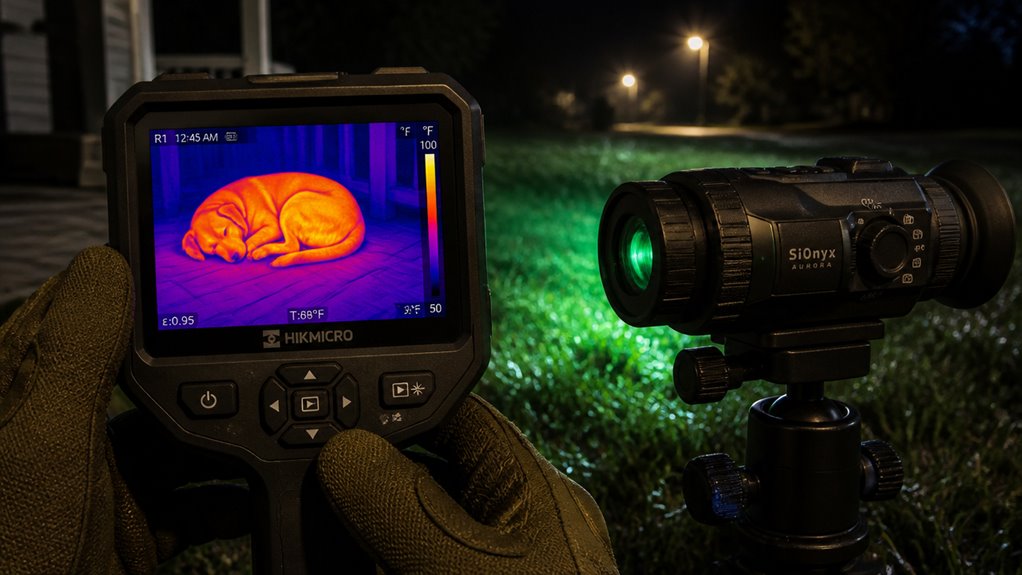
Thermal cameras capture the heat objects naturally emit, using sensors tuned to far-infrared wavelengths (9–14 μm) to create thermograms showing temperature contrasts.
Night-vision goggles detect reflected infrared light, often enhanced by active IR illumination, converting it into visible images in darkness.
Each technology targets different infrared properties, providing complementary insights into heat signatures and spatial details.
Exploring their mechanisms reveals how they extend human perception beyond visible light.
Key Takeaways
- Thermal imaging cameras detect infrared radiation emitted as heat using sensors tuned to far-infrared wavelengths (9–14 μm).
- Night-vision goggles detect reflected near-infrared light, often using active IR illumination invisible to the human eye.
- Thermal imaging converts emitted infrared energy into thermograms showing temperature variations on object surfaces.
- Night-vision devices amplify reflected infrared photons to create visible images revealing shapes and movements in darkness.
- Both technologies complement each other by detecting different infrared wavelengths and enhancing visibility under various conditions.
How Thermal Imaging Cameras Detect Infrared Radiation Emitted as Heat?
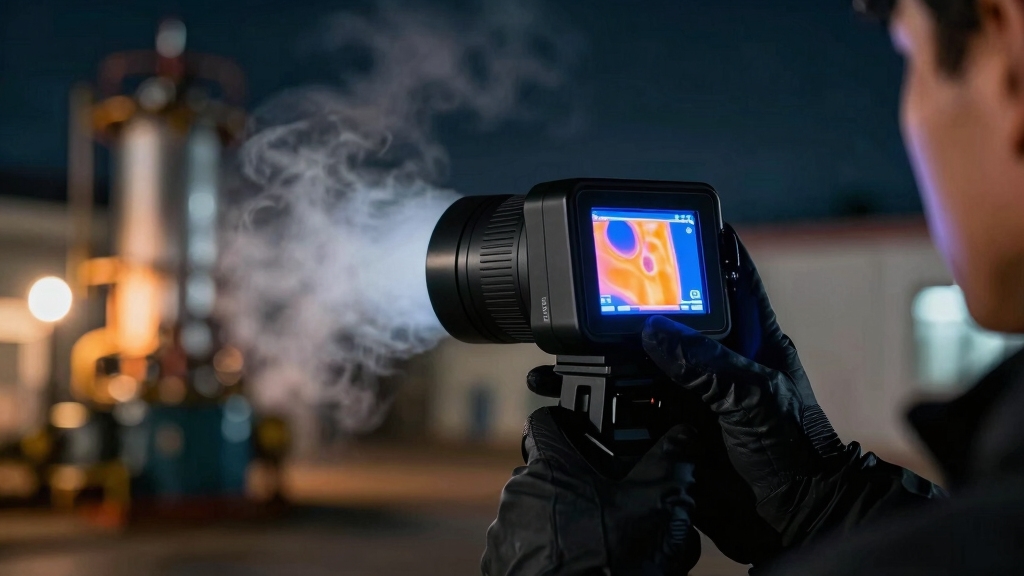
Thermal imaging cameras detect infrared radiation by capturing the heat naturally emitted by objects rather than relying on visible light.
Thermal cameras reveal heat signatures by sensing infrared radiation emitted by objects, independent of visible light.
You use sensors, often bolometers or photodiodes, tuned to the far-infrared spectrum (about 9–14 μm) to measure this radiation.
The detected infrared energy corresponds directly to surface temperature variations.
Your camera’s electronics convert these signals into an electronic image called a thermogram, representing thermal contrasts visually.
This method doesn’t depend on external illumination, so it works in complete darkness and through obscurants like smoke.
By interpreting heat patterns, you can identify temperature differences precisely, enabling applications such as firefighting or industrial inspection.
However, it is important to note that thermal imaging cameras cannot see through glass, as glass blocks far-infrared wavelengths and only shows the glass temperature itself.
How Night-Vision Goggles Detect Reflected Infrared Light to See in Darkness?
Although night-vision goggles operate in darkness, they don’t rely solely on heat emission like thermal cameras. Instead, they detect infrared light reflected from objects, typically illuminated by an active infrared source invisible to your eyes.
The goggles employ specialized IR-sensitive sensors coupled with lenses to capture this reflected infrared radiation. These sensors convert the reflected IR photons into electronic signals, which the device amplifies and processes to form a visible image.
This method enables you to discern shapes and movements in low or no ambient light by exploiting near-infrared wavelengths rather than relying on emitted heat signatures. Consequently, night-vision goggles excel in revealing detailed spatial information under darkness, complementing thermal imaging’s emphasis on temperature differences. Many security cameras incorporate night vision/infrared technology to mitigate low-light issues and enhance surveillance capabilities.
Frequently Asked Questions
What Types of Sensors Are Used to Detect Different Infrared Wavelengths?
You use different sensors to detect various infrared wavelengths.
Bolometers and thermopiles work well for broad-range IR detection by measuring heat.
Photodiodes are sensitive to near-infrared wavelengths.
For mid- to long-wave IR, InGaAs detectors excel in shorter IR bands.
MCT (mercury cadmium telluride) detectors handle longer wavelengths efficiently.
Choosing the right sensor depends on the specific IR wavelength range and the intensity of the signal you need to capture.
How Do Thermal Cameras Differentiate Between Temperature Variations?
You can imagine thermal cameras as hyper-sensitive heat detectives, capable of distinguishing even the tiniest temperature shifts across a surface.
They achieve this by using infrared sensors that measure emitted radiation intensity, converting it into precise electronic signals.
These signals get processed into detailed thermograms, mapping temperature differences pixel by pixel.
The camera’s calibration and sensor sensitivity guarantee you accurately see subtle thermal contrasts, revealing variations invisible to the naked eye with remarkable fidelity.
Can Infrared Detection Be Used for Medical Diagnostics Beyond Temperature?
Yes, infrared detection goes beyond temperature measurement in medical diagnostics.
You can use it to monitor blood flow, detect inflammation, and identify abnormal tissue metabolism.
By analyzing the thermogram patterns, you gain insights into vascular conditions and early-stage diseases.
This non-contact method provides real-time, precise data, enhancing diagnostic accuracy while minimizing patient discomfort during examinations.
What Industries Benefit Most From Infrared Detection Technologies?
You’ll find infrared detection technologies indispensable in firefighting, security, industrial inspection, medical diagnostics, and military operations.
Firefighters use them to locate hotspots and victims, while security teams monitor low-light environments.
Industrial sectors rely on IR to detect overheating components, and healthcare professionals employ it for temperature and blood flow analysis.
The military applies these tools for navigation and target tracking, maximizing operational efficiency across diverse, critical fields.
How Do Environmental Conditions Affect Infrared Wave Detection Accuracy?
Environmental conditions can massively skew your infrared detection accuracy, like trying to spot a candle flame in a blizzard.
Moisture, fog, rain, and dust scatter or absorb infrared waves, reducing sensor sensitivity.
Temperature fluctuations affect detector calibration and signal-to-noise ratios.
You must also consider reflective surfaces, which distort IR readings.
To optimize accuracy, you need to adjust settings and apply compensation algorithms tailored to these environmental factors.
Thermal Imaging vs. Night Vision: Which Technology Is Right for Your Needs?
You rely on thermal imaging cameras and night-vision goggles to detect infrared waves in different ways.
Thermal cameras capture the heat infrared radiation objects emit, allowing you to visualize temperature differences.
Night-vision goggles detect infrared light reflected from surfaces, enabling you to see in darkness.
Significantly, thermal imaging can detect temperature variations as small as 0.05°C, giving you precise, real-time insights that are essential for applications like surveillance and search-and-rescue operations.