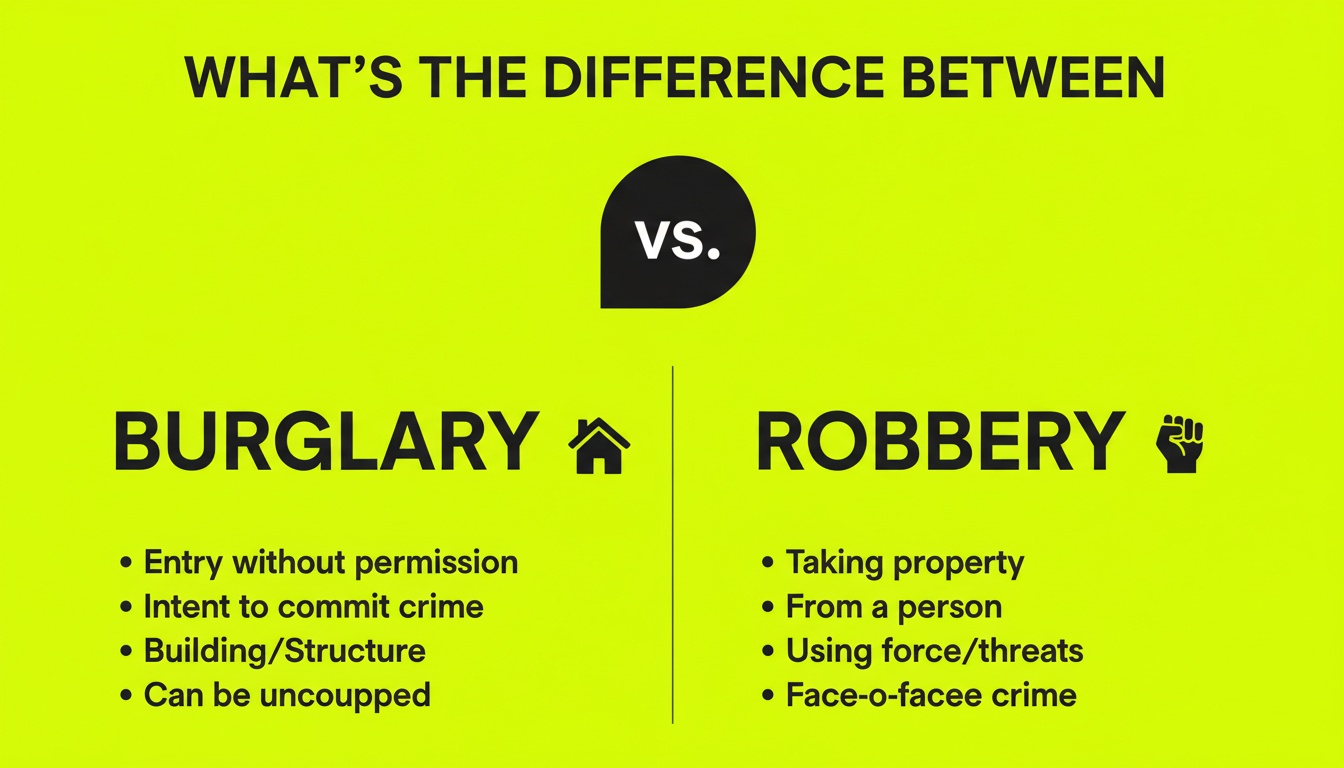

You’ll find the key difference between burglary and robbery lies in presence and force. Burglary means unlawfully entering a building intending to commit a crime, often when no one’s home, without needing confrontation.
Robbery, however, demands directly confronting a victim and using force or threats to take property. Burglary targets locations; robbery targets people, making it a violent crime with harsher penalties.
Understanding these factors uncovers how the law treats each offense distinctly.
Key Takeaways
- Robbery involves taking property directly from a person using force or threat, while burglary involves unlawful entry to commit a felony or theft inside a structure.
- Victim presence is required in robbery, but burglary can occur without the victim being present.
- Robbery is classified as a violent crime due to use of force or intimidation; burglary typically involves no direct violence against persons.
- Burglary focuses on unauthorized entry plus intent to commit a crime inside, while robbery centers on confronting and overpowering a victim to steal.
- Penalties for robbery are generally harsher than burglary because robbery endangers personal safety through violence or threats.
Difference Between Burglary and Robbery
| Aspect | Burglary | Robbery |
|---|---|---|
| Basic Definition | Unlawful entry into a building, structure, or vehicle with intent to commit a crime inside | Taking property directly from a person using force or threats |
| Victim Presence | Not required; often occurs when no one is present | Required; victim must be present |
| Use of Force | No force or violence against a person is required | Force, violence, or intimidation is essential |
| Primary Target | Property or location (house, building, vehicle) | Person or property in a person’s immediate presence |
| Type of Crime | Typically a non-violent property crime | Classified as a violent crime |
| Confrontation | No direct confrontation with a victim | Direct confrontation with a victim |
| Key Legal Element | Unauthorized entry + intent to commit a felony or theft | Force or threat used to steal from a person |
| When It Occurs | Often when premises are unoccupied | Occurs where victims are present (public or private places) |
| Severity of Penalties | Serious, but generally less severe than robbery | Harsher penalties due to risk to personal safety |
| Can It Escalate? | Yes—if weapons or violence are involved, charges become more severe | Already severe due to inherent violence |
What Makes Robbery a Violent Crime?
Because robbery involves taking property directly from a person through force or the threat of force, it qualifies as a violent crime.
You must understand that robbery hinges on confrontation, where the victim is present and directly threatened or harmed. This use of intimidation or physical violence elevates the crime beyond simple theft.
The law classifies robbery as violent because it endangers personal safety, not just property.
When you commit robbery, you intend to permanently deprive the owner of their property by overcoming their resistance through fear or aggression.
Unlike other theft-related crimes, robbery’s defining element is this coercive interaction with the victim.
As a result, it carries felony charges with severe penalties, reflecting the serious risk posed to individuals during the act.
In contrast, certain security vulnerabilities such as lock bumping can facilitate unauthorized entry without direct confrontation, highlighting the importance of advanced protective measures.
How Is Burglary Defined and Different From Robbery?
Burglary is all about entering a building or property illegally with the intention of committing a crime inside. The interesting thing is that this often happens without the victim being there, and there’s usually no force involved.
Now, on the flip side, we’ve robbery. This one is more intense because it involves using force or intimidation against a person to take their property.
So, when you break it down, the main differences come down to presence, force, intent, and how entry is made. These factors are what set burglary and robbery apart in the eyes of the law.
Legal Definitions Explained
Although burglary and robbery both involve theft, their legal definitions differ markedly in key aspects such as method and victim involvement.
Burglary centers on unlawful entry into a building, structure, or vehicle with intent to commit a felony or theft inside, regardless of whether theft occurs or a victim is present.
Robbery, on the other hand, requires taking property directly from a person or their immediate presence by using force or intimidation.
This means robbery inherently involves victim confrontation, while burglary targets the location itself.
You’ll find burglary charges focus on unauthorized entry combined with criminal intent, whereas robbery charges emphasize the violent or threatening means used to obtain property.
Understanding these distinctions clarifies how the law categorizes and prosecutes each offense based on specific elements.
Presence And Force Role
When distinguishing burglary from robbery, the roles of presence and force are essential. You must recognize that robbery requires the victim’s presence and the use or threat of force to take property directly from them.
Burglary, however, involves unlawful entry without needing the victim present or any force used against a person. This distinction impacts how each crime is prosecuted and punished.
| Element | Burglary | Robbery |
|---|---|---|
| Victim Presence | Not required | Victim must be present |
| Use of Force | No force necessary | Force or threat of force used |
| Target | Structure or vehicle | Person or immediate presence |
Understanding these differences clarifies why robbery is classified as a violent crime, unlike burglary.
Intent And Entry Differences
Beyond the roles of victim presence and force, the defining characteristics of burglary and robbery also hinge on intent and entry.
When you analyze these crimes, you’ll see:
- Burglary involves unlawful entry into a building or vehicle with intent to commit a felony or theft inside, regardless of victim presence.
- Robbery requires no unauthorized entry but depends on force or intimidation directly against a person to take property.
- Burglary’s core element is the unauthorized entry coupled with criminal intent, even if no theft occurs.
- Robbery centers on taking property from a person or their presence by force or threat, emphasizing direct confrontation.
Understanding these distinctions clarifies why burglary targets structures and intent, while robbery targets persons and involves violence.
Why Victim Presence Matters in Robbery and Burglary?
Why does victim presence play a pivotal role in distinguishing robbery from burglary?
When you analyze robbery, the victim must be present because the crime involves taking property directly from a person using force or intimidation.
This presence transforms the act into a violent confrontation, elevating the offense’s severity.
In contrast, burglary centers on unlawful entry into a structure with intent to commit a felony or theft, regardless of whether anyone is inside.
Burglary involves unlawful entry with intent to commit a felony or theft, regardless of occupant presence.
You don’t need the victim there for burglary to occur. This distinction matters because robbery targets the individual, while burglary targets the location.
Understanding victim presence clarifies why robbery is classified as a violent crime and why burglary may occur even in unoccupied premises. This influences both charges and penalties.
How Force and Threats Distinguish Robbery From Burglary?
Victim presence sets the stage, but force and threats define the clear line between robbery and burglary. In robbery, you must confront the victim directly, using force or intimidation to seize property.
Burglary lacks this personal confrontation, focusing instead on unlawful entry without applying force against persons.
Consider these distinctions:
- Robbery requires force or threat during the theft; burglary does not.
- Robbery involves victim interaction; burglary targets structures.
- Threats in robbery create immediate fear; burglary may occur unnoticed.
- Presence of force elevates robbery to a violent crime, unlike burglary.
Understanding these elements clarifies why robbery carries harsher penalties.
If you face a case, evaluating the use or absence of force and threats is essential to distinguishing these offenses.
What Unauthorized Entry Means in Burglary Cases?
Unauthorized entry in burglary cases is a key concept to grasp. Essentially, it means stepping into a building, structure, or vehicle without the owner’s permission.
Even if nothing else happens inside, just that act of entering without consent sets the stage for a burglary charge.
So, why is this such a big deal? Well, legally speaking, unauthorized entry shows that there’s an intent to commit a felony.
This intent is crucial for prosecutors to prove in court. It’s not just about what happens once you’re inside; it’s about that initial act of crossing the threshold without okay from the owner.
Defining Unauthorized Entry
In burglary cases, unauthorized entry means entering a building, structure, or vehicle without permission or legal right.
You don’t need to break in physically; even opening an unlocked door or window counts if you lack consent. The focus lies on your lack of authorization at the time of entry.
Consider these scenarios to understand unauthorized entry:
- Entering a home after the owner explicitly denies access.
- Using a key copied without the owner’s knowledge.
- Remaining inside a property after permission to enter has expired.
- Opening a vehicle door without the owner’s approval.
This element is essential because burglary hinges on your unlawful presence combined with intent, distinguishing it from other crimes like robbery.
Certified professionals use verification protocols to confirm authorization and prevent unauthorized entry during safe opening.
Legal Implications Explained
Understanding unauthorized entry sets the foundation for grasping its legal consequences in burglary cases. When you unlawfully enter a building, vehicle, or structure without permission, the law interprets this act as a breach of property rights.
This holds true regardless of whether you commit theft or another felony inside. Unauthorized entry alone establishes the crime’s core element, making intent to commit a felony inside essential.
You don’t need to use force or confront a victim; the crime hinges on your presence where you’re not allowed. Legally, this means you can face felony charges even if you fail to complete the intended crime.
The severity of penalties often escalates if the property is occupied or if weapons are involved. This underscores how unauthorized entry triggers serious legal ramifications in burglary prosecutions.
In some cases, perpetrators attempt to bypass security by exploiting hidden door lock mechanisms, which complicates both detection and prosecution.
Typical Locations for Robbery vs. Burglary
Locations play a crucial role in distinguishing robbery from burglary, as each crime typically unfolds in different settings based on their defining elements.
When you consider robbery, it usually happens where the victim is present, often in public or semi-public spaces.
Burglary, however, involves unlawful entry into structures without the victim’s presence, focusing on property rather than direct confrontation.
Typical locations include:
- Robbery: Streets, parking lots, and commercial establishments where victims carry valuables.
- Burglary: Residential homes, unoccupied buildings, or vehicles.
- Robbery: Banks or convenience stores during operating hours.
- Burglary: Warehouses or closed retail stores after hours.
Understanding these settings helps you grasp the tactical and legal distinctions between robbery and burglary. Additionally, just as different factors influence crime settings, environmental causes can affect the security and behavior of protective systems in homes and businesses.
How Legal Penalties Differ for Robbery and Burglary?
The settings where robbery and burglary occur directly influence how the law punishes each offense. Since robbery involves force or threat against a person during the crime, it’s classified as a violent felony.
This typically attracts harsher penalties, often ranging from Level 5 to Level 1 felonies depending on severity.
Burglary penalties also vary between Level 5 and Level 1 felonies but hinge more on factors like whether the structure was occupied.
While burglary lacks the direct confrontation element, unlawful entry with intent to commit a crime still carries significant consequences.
You’ll find robbery sentences generally stiffer because the law prioritizes protecting individuals from violence.
Burglary penalties focus on the violation of property rights and potential harm based on circumstances like occupancy.
How Violence or Weapons Affect Burglary Charges?
While burglary primarily involves unlawful entry with criminal intent, introducing violence or weapons markedly escalates its legal consequences.
When you bring force or arms into the scenario, the law views the offense with heightened severity, often classifying it as aggravated burglary. This shift affects how courts assess your case and the resulting penalties.
Consider these key impacts:
- Increased felony level classification, raising potential prison time.
- Mandatory minimum sentences may apply due to weapon use.
- Higher likelihood of bail denial or stricter release conditions.
- Prosecution may pursue additional charges like assault or possession of a deadly weapon.
Understanding these factors is essential, as employing violence or weapons transforms burglary into a far graver offense with considerably harsher legal outcomes.
How Robbery and Burglary Relate to Theft Charges?
Understanding how violence or weapons elevate burglary charges helps clarify the distinct ways robbery and burglary connect to theft offenses.
When you consider robbery, it’s fundamentally theft combined with force, intimidation, or fear directed at a victim present during the crime. This direct confrontation categorizes robbery as a violent crime, thereby intensifying penalties beyond standard theft charges.
Robbery is theft involving force or intimidation against a victim, making it a violent crime with harsher penalties.
Burglary, on the other hand, involves unlawful entry with intent to commit theft or another felony inside a structure, regardless of victim presence or completed theft.
While burglary doesn’t require force against a person, it still relates closely to theft by targeting property unlawfully.
In both cases, theft forms the underlying offense, but robbery and burglary add critical elements that elevate the severity and classification of these crimes in the legal system.
Additional costs for emergency locksmith services can increase significantly, similar to how robbery charges are elevated by the presence of force or intimidation, with emergency surcharges often adding 25%–100% to base fees.
Frequently Asked Questions
Can Someone Be Charged With Both Robbery and Burglary Simultaneously?
You can face both robbery and burglary charges simultaneously when your actions weave through unauthorized entry and violent theft.
If you break into a building (burglary) and confront someone to forcibly take property (robbery), the law treats them as distinct offenses because each targets different legal elements—entry plus intent versus force plus victim presence.
Courts will analyze both to guarantee full accountability for the breadth of your criminal conduct.
How Do Intent and Planning Influence Burglary Charges?
Your intent and planning play essential roles in burglary charges. If you unlawfully enter a building with the clear intent to commit a felony or theft, that intent alone can lead to charges, even if you don’t complete the crime.
Pre-planning shows deliberate criminal purpose, strengthening the prosecution’s case against you. Courts treat burglary seriously because your intent to commit a crime inside demonstrates a proactive threat to property security.
Are There Common Defenses Specific to Robbery Cases?
You wouldn’t expect a defense from the Wild West to help today, but in robbery cases, common defenses include mistaken identity, lack of intent, and absence of force or intimidation.
You need to prove you didn’t use or threaten force, or the alleged victim’s testimony is unreliable. Also, alibi and coercion defenses can be effective.
Focus on disproving the prosecution’s claim that you directly confronted or intimidated the victim during the crime.
Does the Time of Day Affect Burglary Severity?
Yes, the time of day can affect burglary severity. If you commit burglary at night, especially in an occupied home, courts often consider it more serious due to increased danger to occupants.
Nighttime burglaries typically carry harsher penalties because they pose greater risks. Conversely, daytime burglaries may be viewed as less threatening but still serious.
Always understand that courts weigh timing alongside other factors like occupancy and use of weapons when determining severity.
How Do Repeat Offenses Impact Sentencing for Robbery or Burglary?
Repeat offenses markedly increase your sentencing severity for both robbery and burglary.
Courts view recidivism as a sign of heightened risk, often imposing longer prison terms, mandatory minimums, or enhanced felony levels.
For robbery, the violent nature compounds penalties further. Burglary sentences escalate especially if prior convictions involve weapons or occupied structures.
You’ll likely face stricter parole conditions and reduced chances for leniency due to your criminal history.
Understanding the Legal Weight of Robbery vs Burglary
Now that you know robbery involves direct confrontation and force, while burglary hinges on unauthorized entry without immediate violence, you might think the lines are clear. But here’s the twist: the presence of a victim and use of threats can dramatically change charges and penalties.
So next time you hear these terms, remember what seems like a simple theft could escalate into something far more serious, with consequences you might not expect.