
To block your neighbor’s security camera, start by calmly discussing privacy concerns and requesting a slight camera angle adjustment.
Use tall, dense plants like bamboo or arborvitae along your property line to obstruct views without trespassing.
Consider installing privacy fences or screens and employ motion-triggered lighting to disrupt the camera’s visibility legally.
Always document your efforts and know local laws before taking action.
Exploring these methods further will help you protect your privacy effectively and ethically.
Key Takeaways
- Talk politely with your neighbor to request adjusting the camera angle away from your property for privacy concerns.
- Plant tall, dense shrubs or fast-growing trees along your property line to block the camera’s line of sight.
- Install taller fences, privacy screens, or lattice panels on your property to physically obstruct camera views.
- Use motion-activated floodlights or hidden IR LEDs to create glare and obscure camera recordings legally.
- Document camera positions and consult local laws or an attorney before pursuing legal or mediation steps.
Talk To Your Neighbor About Invasive Cameras
Although addressing privacy concerns can feel uncomfortable, talking directly to your neighbor about their security camera is often the most effective first step.
Approach the conversation calmly and politely, focusing on how the camera’s angle might inadvertently invade your private space.
Avoid accusations; instead, request a slight adjustment of the camera’s direction to alleviate your concerns.
Use a fact-finding tone to understand why the camera is positioned as it is. This can foster cooperation.
Documenting the date, time, and content of your discussion is prudent for future reference if issues escalate.
This transparent, ethical communication often resolves conflicts amicably, as neighbors may be unaware of the camera’s intrusive impact.
Taking this respectful approach preserves relationships and paves the way for mutually agreeable solutions.
If necessary, suggest implementing privacy boundaries such as masking or cropping sensitive zones to protect both parties’ privacy.
Use Plants And Landscaping To Shield Against Cameras
If a polite conversation with your neighbor doesn’t lead to adjusting the camera angle, you can enhance your privacy by strategically using plants and landscaping.
Plant tall, fast-growing species like bamboo, arborvitae, or cypress along your property line to interrupt the camera’s line of sight effectively. Dense shrubs or hedges also provide consistent year-round coverage.
Use tall, fast-growing plants like bamboo or cypress to block camera views and maintain year-round privacy.
Position these plants to create natural visual barriers without encroaching on your neighbor’s property, ensuring compliance with local regulations.
This approach not only improves your privacy but also enhances your landscape’s aesthetic appeal. Avoid invasive or slow-growing plants that may delay results.
For optimal effectiveness, consider how camera mounting heights influence the line of sight when planning your plant placement.
Add Physical Barriers To Block Neighbor Cameras
Creating physical barriers provides a direct and effective means to obstruct your neighbor’s security camera without infringing on their property or equipment.
You can install taller fences or fence extensions within your property line and local zoning regulations.
Using privacy screens, lattice panels, or decorative walls strategically placed can block camera sightlines while enhancing your space.
Inside, consider hanging curtains, blinds, or shades to prevent indoor visibility.
Additionally, mounting shade sails or pergolas over outdoor areas disrupts camera angles legally and ethically.
Make certain all installations remain on your land to avoid boundary disputes or legal issues.
By implementing these physical barriers thoughtfully, you protect your privacy while respecting your neighbor’s rights and complying with local laws.
This helps maintain a harmonious neighborhood environment.
For enhanced privacy, consider materials with impact-resistant glass properties to reduce visibility while maintaining durability.
Use Lighting To Protect Your Privacy From Cameras
Utilizing strategic lighting can effectively safeguard your privacy from intrusive security cameras without physically tampering with their equipment.
You can install motion-triggered floodlights to overexpose the camera’s sensor, rendering footage unusable.
Infrared (IR) LED arrays, discreetly positioned, create glare and blur images without alerting neighbors.
Avoid illegal methods like lasers, which pose legal risks.
Lighting solutions provide a legal, technical means to protect your space ethically.
| Lighting Method | Purpose | Effect on Camera Footage |
|---|---|---|
| Motion-triggered floodlights | Overexpose camera sensor | Bright, washed-out video |
| Hidden IR LED arrays | Create infrared glare | Blurred or obscured images |
| Adjustable brightness | Control light intensity | Prevents clear video capture |
| Directional lighting | Target specific camera angles | Limits effective surveillance |
| Timed lighting cycles | Disrupt continuous recording | Intermittent footage interference |
Use lighting smartly to protect your privacy within legal boundaries.
Legal Steps For Invasive Neighbor Cameras
When conversations and informal adjustments fail to resolve concerns about a neighbor’s intrusive security camera, you should explore legal steps to protect your privacy.
If informal talks don’t work, consider legal options to safeguard your privacy from intrusive neighbor cameras.
First, document the camera’s position, angle, and the areas it captures using photos from your property.
Review local privacy laws to determine if the camera unlawfully invades your private space, especially indoor areas.
If necessary, consult an attorney to understand your rights and possible actions.
You can also seek mediation or involve local authorities to request the neighbor adjust the camera angle or add privacy masks.
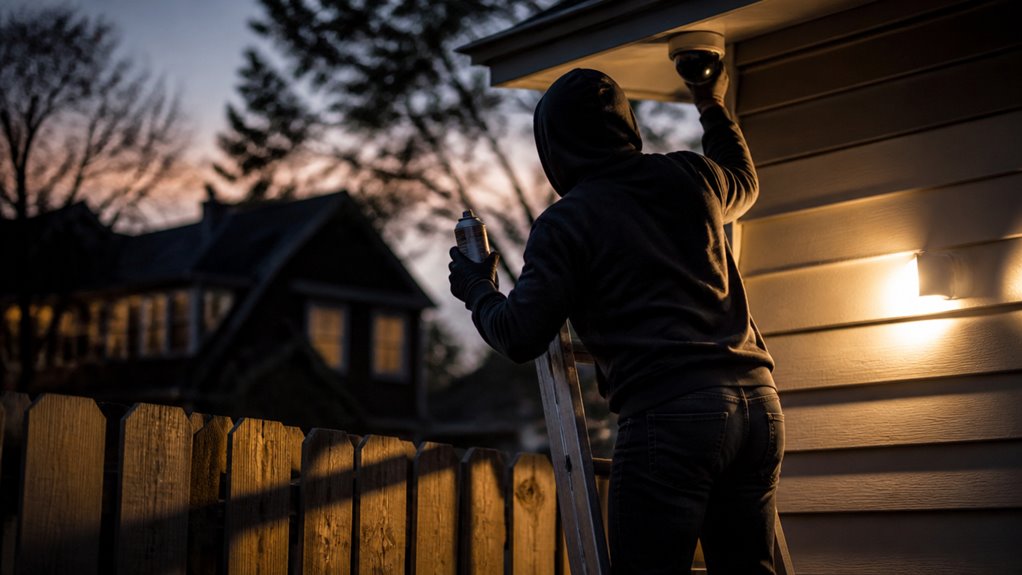
Avoid any physical interference with the device, as tampering may lead to legal penalties.
Focus on compliant, ethical measures to protect your privacy without infringing on your neighbor’s property rights.
Additionally, understanding legal and audio considerations related to hidden cameras can help you navigate your rights and responsibilities effectively.
Frequently Asked Questions
Can I Use Reflective Window Film to Block Camera Views?
Yes, you can use reflective window film to limit your indoor visibility from your neighbor’s security camera. This film reduces glare and blocks views into your home, enhancing privacy without interfering with their equipment.
Make sure to apply it only on your property’s windows and choose a quality product that complies with local regulations. This approach respects legal boundaries while effectively protecting your privacy indoors.
How Do Weather Conditions Affect Camera Effectiveness?
Weather conditions act like a veil, dimming your neighbor’s camera vision. Rain, fog, and snow scatter infrared light, reducing image clarity and range.
Bright sunlight can cause glare or shadows, distorting footage. Wind may shake cameras, blurring images.
While these natural elements degrade effectiveness, they don’t guarantee privacy. You should rely on legal, ethical measures to protect your space rather than hoping for weather’s unpredictable interference.
Are There Privacy Apps to Detect Hidden Cameras Nearby?
Yes, you can use privacy apps to detect hidden cameras nearby. These apps scan for unusual Wi-Fi or Bluetooth devices and analyze infrared signals or radio frequencies that cameras emit.
However, detection effectiveness varies by device type and environment. Always use these tools ethically and respect others’ privacy.
Can Sound Devices Disrupt Camera Recording?
Imagine you use a white noise generator near a neighbor’s camera. It won’t disrupt recording since cameras rely on visual sensors, not audio.
Sound devices can interfere with microphones if the camera has one, but they won’t block video capture. Instead, focus on legal, physical, or lighting solutions to protect your privacy.
Avoid illegal interference like jamming or hacking, which can lead to serious legal consequences.
Is It Possible to Angle My Own Security Cameras to Deter Neighbors?
Yes, you can angle your security cameras strategically to deter neighbors from intrusive surveillance.
Position your cameras to cover your property’s boundaries clearly, ensuring they don’t invade neighbors’ privacy.
Use wide-angle lenses to maximize coverage and visible camera placement to discourage unwanted filming.
This approach respects legal boundaries, promotes mutual privacy, and acts as a non-confrontational deterrent without interfering with their equipment or violating laws.
Keep Your Home Private and Neighbor Relations Calm
Blocking your neighbor’s security camera requires a balanced approach, like weaving a shield that’s both firm and respectful.
Start by communicating clearly to address concerns directly. Use strategic landscaping and physical barriers to create private zones without infringing on legal boundaries.
Adjust lighting to reduce unwanted visibility. If needed, pursue legal channels thoughtfully, ensuring your actions respect privacy laws.
This methodical, ethical approach protects your space while maintaining neighborly trust.