
If you can’t find the circuit breaker for your smoke detector, start by checking the electrical panel for labeled circuits like “Smoke Alarms.”
Use a circuit breaker finder by plugging the transmitter into an outlet near the detector and scanning breakers to pinpoint the right one.
For hardwired detectors, toggle breakers off one at a time while monitoring the detector’s response. Battery-only units won’t connect to breakers.
If you need more precise troubleshooting or wiring details, further guidance can help resolve it.
Key Takeaways
- Use a circuit breaker finder by plugging its transmitter near the detector’s circuit to locate the correct breaker before toggling any switch.
- Check the electrical panel for labels or home plans indicating the smoke detector circuit to narrow down breaker possibilities.
- Toggle breakers one at a time while monitoring the detector for power loss or reset signals to confirm the correct breaker.
- Verify whether the detector is hardwired or battery-operated, as battery-only units are not connected to any breaker.
- Contact the installing electrician or previous homeowner if panel labels and plans are unavailable or the breaker remains unidentified.
How to Identify Your Smoke Detector’s Circuit Breaker?
To identify your smoke detector’s circuit breaker, start by checking your electrical panel for any breakers labeled “Smoke Alarms” or similar.
Begin by inspecting your electrical panel for breakers labeled “Smoke Alarms” or similar identifiers.
If labels aren’t clear, methodically flip each breaker off one at a time while monitoring your detectors for power loss or reset signals.
Use a circuit breaker finder tool by plugging its transmitter into an outlet or fixture on the suspected circuit. Then scan breakers with the receiver to detect a signal.
Cross-reference with any available home electrical plans to narrow down possibilities.
If uncertainty remains, consult the installing electrician for precise circuit assignments.
This systematic approach guarantees you accurately pinpoint the dedicated or shared breaker controlling your smoke detectors without trial-and-error risks or unnecessary power interruptions.
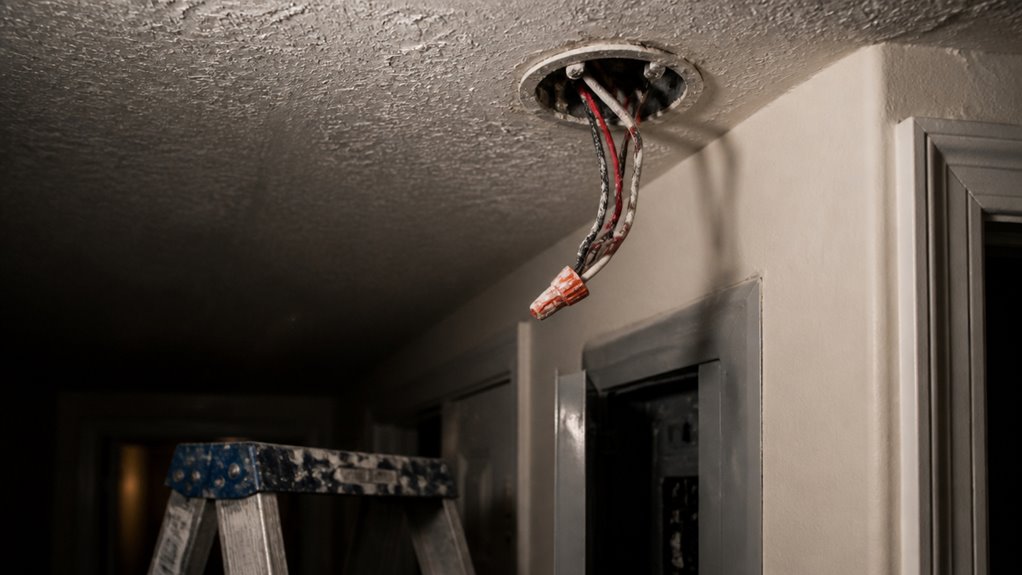
Remember to always turn off the breaker and verify power absence with a voltage detector before inspecting or working on smoke detector wiring.
How Detector Type Affects Circuit Breaker Identification?
Because the type of smoke detector you have directly influences how you identify its circuit breaker, understanding the distinction between battery-operated and hardwired units is essential.
Battery-only detectors operate independently of your home’s electrical system, so they don’t connect to any circuit breaker. Hardwired detectors, however, rely on a dedicated or essential-area circuit breaker for power, often with battery backup.
Regular testing and maintenance of hardwired detectors, including checking the backup battery, ensure reliable operation and safety.
| Detector Type | Power Source |
|---|---|
| Battery-Operated | Batteries (9V or AA) |
| Hardwired | 120V home circuit + backup |
| Battery Replacement | 6-12 months or 10 years |
| Circuit Breaker | None (battery only) |
| Dedicated or shared breaker |
Knowing this helps you focus your search on the correct electrical panel circuit when locating the breaker for hardwired detectors.
How to Check Your Electrical Panel Labels and Home Plans?
A well-organized electrical panel will have clear, specific labels identifying each circuit breaker’s function, including those protecting your smoke detectors.
Begin by inspecting the panel door or interior for labels such as “Smoke Alarms” or “Fire Detectors.” If labels are missing or vague, consult your home’s electrical plans, which often detail circuit assignments and breaker locations.
Start by checking panel labels like “Smoke Alarms” or refer to your home’s electrical plans for clarity.
These plans can clarify which breakers control essential circuits, per NEC requirements. Compare the panel’s layout with the schematic to identify the correct breaker.
If the plans aren’t available, check with the installing electrician or previous homeowner for documentation. Accurate labeling and referencing home plans reduce trial and error, ensuring you isolate the proper circuit efficiently without disrupting unrelated systems.
Many hardwired smoke detectors draw power directly from the home’s electrical system for continuous readiness and require professional installation to ensure proper integration.
Using a Circuit Breaker Finder for Your Smoke Detector
Sure! Here’s a more conversational version of your text:
First things first, let’s make sure we don’t get any false signals while testing. Go ahead and remove the backup battery from your hardwired smoke detector. It’s a simple step, but it really helps.
Next up, take your circuit breaker finder’s transmitter and plug it into an outlet or light socket that’s on the same circuit as your smoke detector. This part is pretty straightforward!
Now, grab the handheld receiver. It’s time to scan through the breakers. As you do this, keep an eye on the smoke detector’s power status. When you find the right breaker, just toggle it off and see if the detector powers down. That’ll confirm you’re on the right track!
Remember to enter your security code on the keypad to silence any tamper alerts that might activate during the process.
Preparing Detector For Test
Before using a circuit breaker finder on your smoke detector, you should remove its backup battery to prevent false alarms during testing. This step guarantees the detector won’t trigger unnecessarily when power cycles occur.
Next, confirm the detector is hardwired and has battery backup. Battery-only units don’t connect to breakers. Prepare tools like a ladder and a flashlight for safe access.
Remember to shut off power at the circuit breaker before disconnecting any hard-wired smoke alarm to ensure safety.
| Step | Action | Purpose |
|---|---|---|
| 1 | Remove backup battery | Avoid false alarms |
| 2 | Confirm detector type | Identify if breaker applies |
| 3 | Gather test tools | Guarantee safe, efficient test |
| 4 | Inform household members | Prevent panic or confusion |
| 5 | Prepare breaker finder device | Ready for accurate detection |
Using The Transmitter
Once you’ve removed the backup battery and confirmed the detector is hardwired, plug the circuit breaker finder’s transmitter into an outlet or light socket on the same circuit as the smoke detector.
Make sure the transmitter is fully seated and powered on.
Next, systematically scan the electrical panel with the receiver, moving it slowly near each breaker.
The receiver will emit a signal when it detects the transmitter’s frequency on that circuit.
Avoid interference by keeping the receiver steady and close to breakers.
Do not toggle breakers yet, as confirmation occurs later.
If your model includes a non-contact voltage tester, verify power presence before scanning.
This methodical approach narrows down the correct breaker without guesswork, facilitating safe, efficient identification of the smoke detector’s circuit in unlabeled or complex panels.
For added safety, ensure all wiring complies with UL certification standards to minimize electrical hazards during testing.
Confirming Breaker Identification
Although the circuit breaker finder helps you narrow down the possible breakers, you’ll need to confirm the specific breaker controlling your smoke detector by toggling it off and on.
First, note the breaker flagged by the finder, then switch it off. Observe whether the smoke detector loses power or resets.
Hardwired units will typically silence or reset, while battery-operated units remain unaffected. If the detector remains powered, restore the breaker and test the next candidate.
Repeat systematically until you identify the correct breaker. Once confirmed, label it clearly in your electrical panel for future reference.
This methodical approach guarantees you isolate the detector’s circuit accurately, preventing accidental power loss to unrelated circuits and maintaining compliance with NEC guidelines. Be sure to verify power supply stability before testing to ensure accurate identification and avoid system disruptions.
How Many Smoke Detectors Can One Circuit Breaker Support?
Did you know that a standard 15-amp circuit breaker can usually support up to 12 interconnected smoke detectors? It’s pretty impressive! Each detector only uses about 2 to 4 watts, which keeps things efficient.
However, it’s important to keep that limit in mind. If you go over 12 detectors, you might run into nuisance trips or other power issues, and nobody wants that.
Additionally, to ensure continuous operation during power outages, hardwired smoke detectors require battery backups as a reliable secondary power source.
Circuit Breaker Capacity
Calculate the load on a 15-amp circuit breaker to determine how many smoke detectors it can support effectively. Each hardwired smoke detector typically consumes 2 to 4 watts of power.
A 15-amp breaker on a 120-volt circuit can handle up to 1,800 watts (15 amps × 120 volts). Dividing 1,800 watts by 4 watts per detector yields a theoretical maximum of 450 detectors.
However, the National Electrical Code (NEC) and practical considerations limit this number to about 12 detectors per circuit to guarantee reliable operation and accommodate other potential loads.
You should also factor in any additional devices sharing the circuit, such as carbon monoxide detectors. Adhering to these limits prevents nuisance trips and maintains system integrity.
For precise capacity, consult an electrician or use a circuit load calculator.
Hardwired smoke detectors are designed to draw continuous power with a backup battery to ensure uninterrupted operation during outages.
Interconnected Detector Limits
When determining how many smoke detectors one circuit breaker can support, you must consider the limitations imposed by both electrical capacity and the interconnected system design.
A standard 15-amp circuit typically supports up to 12 hardwired smoke detectors, each drawing approximately 2-4 watts. This guarantees the total load remains within safe operational limits without tripping the breaker.
Interconnection wiring causes all detectors to sound simultaneously, but it doesn’t appreciably increase power demand. However, you must avoid combining smoke detectors with high-load appliances on the same circuit to prevent nuisance trips.
Adhering to NEC recommendations, detectors should connect to dedicated or essential-area circuits to guarantee reliable operation.
Always verify your system’s load and wiring configuration before adding detectors to maintain safety and code compliance.
Hardwired smoke detectors typically include battery backups to ensure continuous operation during power outages.
Troubleshooting Smoke Detector Circuit Breaker Issues
Although smoke detectors are designed to operate reliably, issues with their circuit breakers can disrupt power and compromise safety.
To troubleshoot, first identify if your detector is hardwired or battery-operated. Only hardwired units rely on circuit breakers.
Use a circuit breaker finder to locate the correct breaker. Test by toggling breakers while observing detector status.
If power is unstable, check for overloaded circuits or shared loads. Reset the breaker and test detector function.
Replace batteries and hold the test button for 15 seconds to clear errors.
| Issue | Cause | Action |
|---|---|---|
| No power to detector | Tripped breaker or loose wiring | Reset breaker, inspect wiring |
| Frequent trips | Overloaded circuit | Reduce load, redistribute devices |
| False alarms | Power fluctuations | Stabilize power, check connections |
When to Call an Electrician for Smoke Detector Circuit Problems?
If persistent issues with your smoke detector’s circuit breaker arise despite basic troubleshooting, you should call an electrician. This includes repeated breaker trips, inability to identify the correct breaker, or failure to restore power after resetting.
An electrician can methodically test circuit continuity, verify wiring integrity, and guarantee compliance with NEC standards, such as dedicated or essential-area circuits. They’ll also inspect for interference from other appliances or overloaded circuits.
Attempting advanced diagnostics without expertise risks damage or code violations. If your detector is hardwired and power cycling or battery replacement doesn’t resolve alerts, professional evaluation is necessary.
Ultimately, a licensed electrician guarantees safe, reliable operation of your smoke alarm system and corrects hidden electrical faults that simple resets or breaker checks can’t address.
Frequently Asked Questions
How Often Should Smoke Detector Batteries Be Replaced?
You should replace smoke detector batteries every 6 to 12 months to guarantee consistent functionality.
For sealed 10-year units, replace the entire detector at the end of its life span. Regular battery replacement prevents low power chirps and maintains safety.
Always test detectors monthly and replace batteries immediately if the unit signals low power. This methodical approach keeps your smoke alarms reliable and compliant with safety standards.
Can Carbon Monoxide Detectors Share the Same Circuit as Smoke Detectors?
Yes, carbon monoxide detectors can share the same circuit as smoke detectors because their electrical requirements align closely.
Both devices need reliable, essential-area circuits to function correctly, per NEC standards.
When you wire them together, you guarantee consistent power and reduce circuit complexity.
Just make sure the circuit isn’t easily turned off by mistake and can handle the combined load, typically low wattage, to maintain safety and compliance.
What Power Consumption Do Hardwired Smoke Detectors Typically Have?
Hardwired smoke detectors typically consume about 2 to 4 watts of power. This low wattage allows you to connect multiple detectors on a single 15-amp circuit without overloading it.
When you install or troubleshoot these units, remember they include a battery backup for outages and draw minimal current during normal operation. This efficiency helps maintain continuous protection while minimizing electrical load on your household wiring.
Are Sealed 10-Year Smoke Detectors Reliable Without Battery Changes?
Yes, sealed 10-year smoke detectors are reliable without battery changes because their lithium batteries are designed to last the entire unit lifespan.
You won’t need to replace batteries annually, reducing maintenance. However, after 10 years, you must replace the entire detector since the battery and sensor degrade over time.
This guarantees consistent performance and compliance with safety standards, so you maintain effective fire detection without frequent battery monitoring.
What Causes Smoke Detectors to Chirp Unexpectedly?
Imagine your smoke detector as a watchful sentinel whose faint chirp signals a warning flag.
It chirps unexpectedly mainly because its battery runs low, signaling you to replace it promptly.
Other causes include electrical issues in hardwired units, dust accumulation interfering with sensors, or nearing the device’s end of life.
To fix it, methodically check battery health, clean the unit, and reset or replace the detector if needed.
Don’t Panic – Your Smoke Detector Solution Is Within Reach
If you’re still having trouble locating your smoke detector’s circuit breaker, don’t stress. It’s a common challenge.
Methodically retrace your steps: review panel labels, consult home plans, or use a circuit breaker finder to illuminate the path.
Remember, smoke detectors are crucial guardians, so ensuring their power source is secure is essential.
When uncertainty persists, enlisting a professional electrician can provide clarity and peace of mind, safeguarding both your home and well-being.