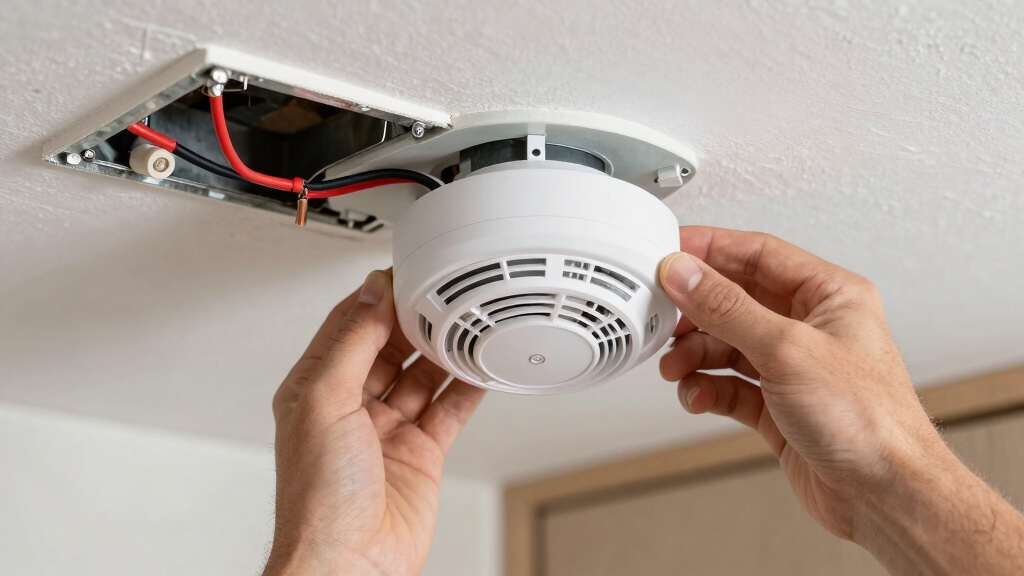

You wire smoke detectors by first turning off power. Then run 12-2 NMB cable from the panel to the first unit, and 12-3 NMB between subsequent alarms for interconnection.
Black carries hot 120V, white is neutral, and red transmits interconnect signals. Connections are secured with wire nuts and tested for continuity using a multimeter.
Backup batteries assure operation during outages. Proper routing, secure connections, and testing guarantee safety and code compliance.
Understanding these fundamentals sets the stage for mastering complex installations.
Key Takeaways
- Turn off the breaker before wiring hardwired smoke detectors to ensure electrical safety.
- Use 12-2 NMB cable from the panel to the first detector, then 12-3 NMB cables for interconnecting additional units.
- Connect black wires for hot power, white wires for neutral, and red wires for interconnect signaling between detectors.
- Secure wire connections with wire nuts or push-connects and insulate with electrical tape to prevent shorts and faults.
- After installation, restore power, install backup batteries, and test all detectors to confirm synchronized alarms and proper wiring.
How to Wire Hardwired Smoke Detectors Step-by-Step?
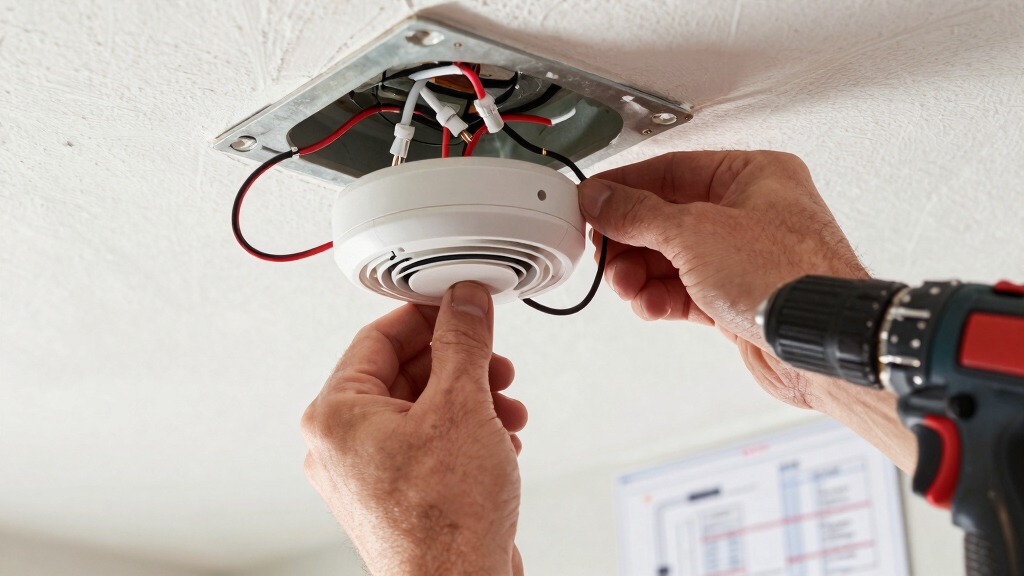
Before you begin wiring hardwired smoke detectors, make sure the power is off at the breaker.
Always turn off the breaker before starting to wire hardwired smoke detectors for safety.
Verify with a voltage detector to prevent electrical hazards.
Next, run the appropriate cables, typically 12-2 NMB from the panel to the first detector and 12-3 NMB between subsequent units.
Pull about 10 inches of wire into each junction or remodeling box.
Strip ½ to ¾ inch of insulation from wire ends for secure connections.
Connect black wires together (hot) and white wires together (neutral).
Link red wires for interconnection signals, matching the detector’s color-coding.
Use wire nuts or push-connects, twist securely, and cover exposed wire with electrical tape.
Finally, attach each detector to its mounting plate by twisting it to lock in place.
Ensure all wiring remains contained within the box.
It is crucial to install a reliable battery backup to maintain detector functionality during power outages.
How Hardwired Smoke Detectors Get Power?
You know, hardwired smoke detectors are pretty convenient. They hook right up to your home’s electrical system using black and white wires, providing a steady 120-volt power supply. This means you don’t have to worry about changing batteries all the time!
But here’s the best part: they come with a backup battery. So, even if there’s a power outage, your detector will still be up and running, keeping you safe without missing a beat.
Plus, these systems can be linked together with power distribution wiring. This allows multiple units to work as one cohesive unit, so if one detector goes off, the rest will follow suit. It’s all about enhancing safety in your home!
Professional installation is usually required to ensure proper integration with the home’s electrical circuit and compliance with safety standards for effective operation of hardwired smoke detectors.
Home Electrical Connection
Within a hardwired smoke detector system, power is supplied directly from the home’s 120-volt electrical circuit through dedicated wiring.
You’ll use black (hot) and white (neutral) wires to establish a stable electrical connection, ensuring continuous operation.
The red wire links detectors, enabling interconnection signals. Proper wiring prevents false alarms and guarantees system reliability.
When handling the home electrical connection, remember:
- Turn off the breaker to avoid electrical hazards.
- Use 12-2 or 12-3 NMB cables matching wiring requirements.
- Secure wire connections tightly with wire nuts and electrical tape.
- Test the circuit for voltage presence before finalizing installation.
This precise setup delivers constant power, making your smoke detectors dependable for safety.
Hardwired detectors typically include battery backups to maintain operation during power outages.
Backup Battery Function
Although hardwired smoke detectors draw steady power from the home’s electrical system, they rely on backup batteries to maintain functionality during power outages.
The battery acts as a secondary power source, ensuring continuous operation when mains power is interrupted.
Typically, these batteries are 9-volt or sealed lithium types, providing several hours to days of autonomy depending on the model and battery condition.
You’ll find the battery compartment integrated within the detector housing for easy access and periodic replacement.
This design prevents system failure and false alarms due to power loss.
When wiring, you don’t connect the battery to the home’s electrical circuit; instead, it remains isolated until needed.
Monitoring circuitry inside the detector constantly checks battery voltage, alerting you with chirps when replacement is necessary.
Regular maintenance, including annual battery replacement, is essential to ensure the backup power source remains reliable.
Power Distribution Wiring
Backup batteries guarantee smoke detectors remain operational during outages. The primary power source comes directly from the home’s electrical wiring.
Hardwired detectors connect to a 120-volt circuit, ensuring a continuous, reliable power supply. You’ll use specific wiring: black for hot, white for neutral, and red for interconnection signals. This setup allows detectors to communicate and trigger simultaneously.
Key considerations include:
- Ensuring proper wire gauge (typically 12-2 or 12-3 NMB) for safety and code compliance.
- Connecting wires securely with wire nuts or push connectors to prevent faults.
- Maintaining polarity and color consistency to avoid wiring errors.
- Testing the entire system post-installation to confirm power distribution and interconnect functionality.
The dual-source design of hardwired smoke detectors provides fail-safe continuous power by combining main electrical supply with a backup battery for enhanced reliability.
What Wire Colors Mean in Hardwired Smoke Detector Wiring?
When you wire hardwired smoke detectors, understanding the color coding of wires is essential for safe and effective installation.
The black wire carries the hot or live current from the electrical panel, providing continuous power to the detector.
The black wire delivers continuous live power from the electrical panel to the smoke detector.
The white wire functions as the neutral return path, completing the circuit.
The red wire is critical for interconnecting multiple alarms; it transmits the signal that triggers all units when one detects smoke.
Properly connecting these wires secures both power delivery and system-wide alert functionality.
You should never interchange these colors, as incorrect connections can cause malfunction or safety hazards.
Maintaining consistent color coding throughout your wiring simplifies troubleshooting and guarantees compliance with electrical standards in your smoke detector network.
Before handling any wiring, always turn off the main breaker to safely disconnect power from hardwired smoke alarms.
Which Wire Types Are Used in Hardwired Smoke Detector Systems?
Since proper wiring guarantees both power delivery and interconnection signaling, you’ll use specific wire types designed for these tasks in hardwired smoke detector systems. The wiring must handle consistent 120V power, neutral return paths, and inter-device communication without interference or failure.
Here are the essential wire types you’ll encounter:
- 12-2 NMB with ground: Runs from the main panel to the first smoke detector, providing hot (black), neutral (white), and ground wires.
- 12-3 NMB with ground: Connects subsequent detectors, adding a red wire for interconnection signaling.
- Black wire: Delivers the hot power supply.
- Red wire: Facilitates interconnect signals between detectors, assuring system-wide alerts.
Using these wires precisely assures reliable operation and safety compliance. Hardwired smoke detectors with battery backup and interconnection capabilities are preferred to ensure simultaneous alarms throughout the home in case of smoke detection.
How to Interconnect Multiple Hardwired Smoke Detectors?
To interconnect multiple hardwired smoke detectors, you’ll want to pay close attention to the wiring colors. It’s pretty straightforward: black is for power, white is for neutral, and red is the one you’ll use for the interconnect signal. Just make sure you get those connections right!
Once you’ve got everything wired up, take a moment to secure all your connections with wire connectors. It’s really important to insulate them properly to avoid any shorts. Safety first, right?
After you’ve done the wiring, don’t forget to test each alarm. You’ll want to make sure that when one goes off, the entire system responds. It’s a quick check that ensures everything’s working as it should!
Remember to turn off the breaker before wiring to ensure safe installation of your hardwired units.
Wiring Color Connections
In wiring multiple hardwired smoke detectors, you’ll need to carefully match specific wire colors to guarantee proper interconnection and reliable operation.
Black wires carry the hot 120V power, white wires serve as neutral, and red wires handle the interconnect signaling. Misconnecting these can cause alarm failure or false triggers.
Follow these key steps:
- Connect all black wires together to supply consistent power.
- Join all white wires to complete the neutral circuit.
- Link red wires across detectors to enable simultaneous alarm triggering.
- Secure connections with wire nuts and insulation tape to prevent shorts.
Strict adherence to color coding guarantees your smoke detector system communicates flawlessly. This enhances safety and provides peace of mind. Additionally, many hardwired systems use battery backup options such as sealed 10-year lithium batteries to ensure continuous operation during power outages.
Testing Interconnected Alarms
Although proper wiring is vital, verifying the interconnection of multiple hardwired smoke detectors guarantees the system functions as intended during an emergency.
To test interconnected alarms, first restore power and install backup batteries. Press the test button on one detector; all alarms in the system should sound simultaneously.
If any alarm fails to respond, inspect wiring connections, focusing on the red interconnect wires. Use a multimeter to check continuity between detectors.
Make sure wire nuts are secure and no insulation is damaged. Test each detector individually to confirm local alarm operation and interconnection signal transmission.
Regular testing after installation and periodically thereafter confirms system integrity, providing reliable, synchronized alerts essential for occupant safety.
Document test results and address any faults immediately to maintain compliance and functionality.
Remember to press and hold the test button for 15–30 seconds to discharge any residual power and ensure a proper reset before testing.
How Backup Batteries Support Hardwired Smoke Alarms?
Because hardwired smoke alarms rely on your home’s electrical system, backup batteries play a critical role in maintaining continuous operation during power outages.
These batteries guarantee your safety alarm remains functional when AC power is lost, preventing dangerous blind spots in protection.
You should understand that backup batteries:
- Automatically activate upon power failure, keeping the detector powered.
- Provide enough energy for the alarm’s sensors and interconnection signals.
- Require regular replacement to avoid undetected failures.
- Serve as a fail-safe layer, guaranteeing alarms sound even without main power.
How to Safely Run Hardwired Smoke Detector Wiring Through Walls?
When running hardwired smoke detector wiring through walls, you must carefully plan cable routes to avoid electrical interference, structural elements, and HVAC systems.
Identify clear pathways between junction boxes and detector locations, guaranteeing cables don’t cross existing electrical circuits to prevent electromagnetic interference.
Use drill bits sized to accommodate 12-2 or 12-3 NMB cables without damaging studs or insulation.
Protect wiring with conduit or grommets when passing through metal studs or sharp edges to prevent abrasion.
Maintain compliance with local electrical codes by securing cables at regular intervals using staples or clamps.
Avoid tightly bundling wires, which can cause heat buildup and signal distortion.
Finally, label wiring runs and verify accessibility for future maintenance without compromising wall integrity.
This approach guarantees a safe, code-compliant installation that optimizes system reliability.
Common Wiring Variations in Hardwired Smoke Detectors
Several common wiring variations exist in hardwired smoke detector systems, each tailored to specific installation needs and technologies. Understanding these variations guarantees you select and install the correct system for reliable performance.
- Standard 3-Wire Configuration: Uses black (hot), white (neutral), and red (interconnect) wires. This setup supports up to 12 detectors for synchronized alarms.
- 4-Wire Detectors: Separate 12VDC power (red/black) from the signal loop. This enhances control but requires precise wiring.
- 2-Wire Systems: Combine power and signaling via polarity reversal. This simplifies wiring but limits compatibility.
- Wireless Interconnection: Eliminates interconnect wiring and relies on radio signals. However, this may sacrifice fault detection.
How to Test and Confirm Hardwired Smoke Detector Interconnection?
Understanding the wiring variations in your hardwired smoke detector system sets the stage for accurately testing and confirming interconnection functionality.
First, guarantee power is on and backup batteries are installed. Trigger one detector’s test button; if the system is correctly interconnected, all alarms should sound simultaneously.
Use a multimeter to verify continuity on the red interconnect wires between detectors, confirming no breaks exist. Measure voltage across black (hot) and white (neutral) wires to guarantee consistent 120V supply.
Inspect wire connectors for secure, color-matched connections without exposed copper. If any detector fails to sound, isolate and retest wiring segments sequentially.
This methodical approach helps identify faults in interconnect wiring or power supply, guaranteeing your smoke detector system provides reliable, synchronized alerts during emergencies.
Frequently Asked Questions
Can I Install Hardwired Smoke Detectors Myself Without an Electrician?
Yes, you can install hardwired smoke detectors yourself if you have basic electrical knowledge and follow safety protocols.
Make sure to turn off the power at the breaker and verify with a voltage detector before starting. Use proper wire connectors, match wire colors accurately, and secure all connections tightly.
If you feel unsure at any step, consult a professional to avoid potential hazards or code violations. Testing after installation is essential.
How Often Should I Replace Hardwired Smoke Detector Batteries?
You should replace the backup batteries in your hardwired smoke detectors at least once a year to guarantee reliable operation during power outages.
Even though the detectors receive continuous power from your home’s electrical system, the batteries degrade over time.
Additionally, test the batteries monthly and replace them immediately if alarms sound intermittently or chirp, signaling low battery voltage.
Regular replacement maintains system integrity and prevents false alarms or detector failure.
What Causes False Alarms in Hardwired Smoke Detectors?
False alarms in hardwired smoke detectors often result from dust accumulation, insects inside the sensing chamber, or electrical interference from nearby devices.
You might also experience false triggers due to steam, cooking fumes, or strong chemical odors.
Faulty wiring or low backup battery voltage can cause erratic signals.
To minimize false alarms, regularly clean detectors and ensure proper installation away from humidity sources.
Verify all electrical connections are secure and compliant with standards.
Are Hardwired Smoke Detectors Compatible With Smart Home Systems?
Think of hardwired smoke detectors as the backbone of your home’s safety network.
Yes, many hardwired detectors can integrate with smart home systems, but compatibility depends on the model and communication protocols.
You’ll often need additional interfaces or smart hubs to bridge traditional wiring with Wi-Fi or Zigbee.
Make certain the detectors support smart features like remote alerts or voice assistant integration before assuming seamless connectivity.
How Do I Upgrade From Battery-Only to Hardwired Smoke Detectors?
To upgrade from battery-only to hardwired smoke detectors, first turn off your home’s power at the breaker.
Run 12-2 NM cable from your electrical panel to the first detector location, then 12-3 NM cable between detectors.
Connect black wires to hot, white to neutral, and red for interconnect signals.
Secure connections with wire nuts and electrical tape.
Mount detectors, install backup batteries, and test each unit to guarantee proper interconnection and power supply.
Building a Safer Home with Smart Smoke Detector Wiring
Now that you understand how hardwired smoke detectors are wired, you can see the critical role of proper wiring and interconnection for reliable safety.
The theory that interconnected alarms improve response time holds true. When one sounds, all do, alerting everyone instantly.
Using correct wire colors and types, along with backup batteries, guarantees continuous power.
By following safe wiring practices and testing regularly, you’ll maintain a dependable smoke detection system that truly protects your home.

[…] all wire connections are secure with wire nuts or push-connects and properly insulated is critical to preventing shorts and faults that cause trouble […]
[…] Addressing these factors helps restore stable power and stops chirping without immediately replacing the alarm or batteries. Regular replacement and monthly testing of backup batteries are recommended to avoid undetected failures. […]