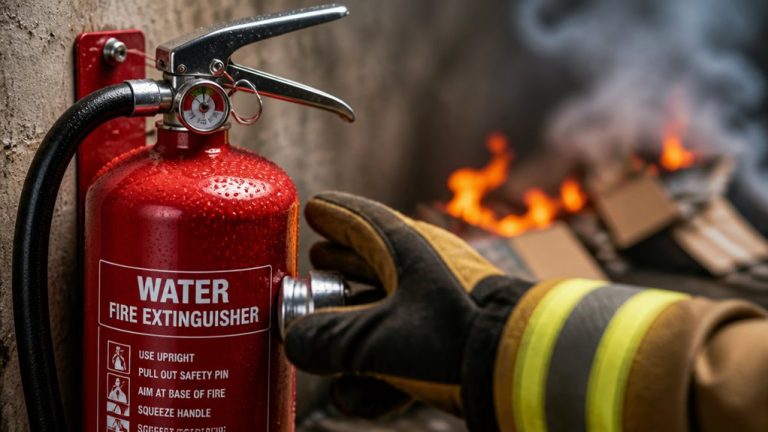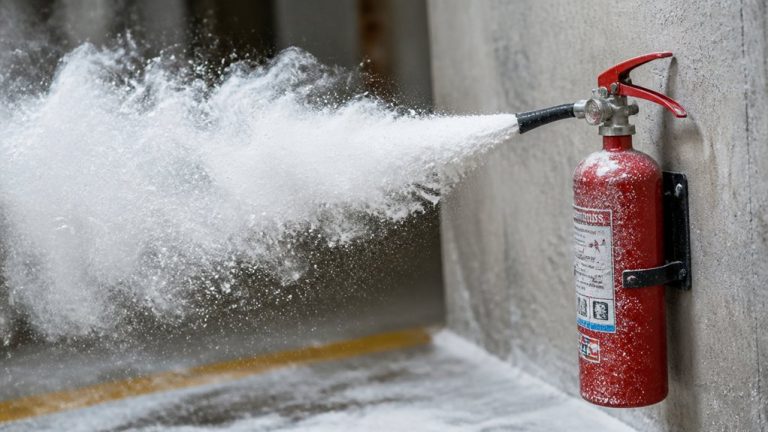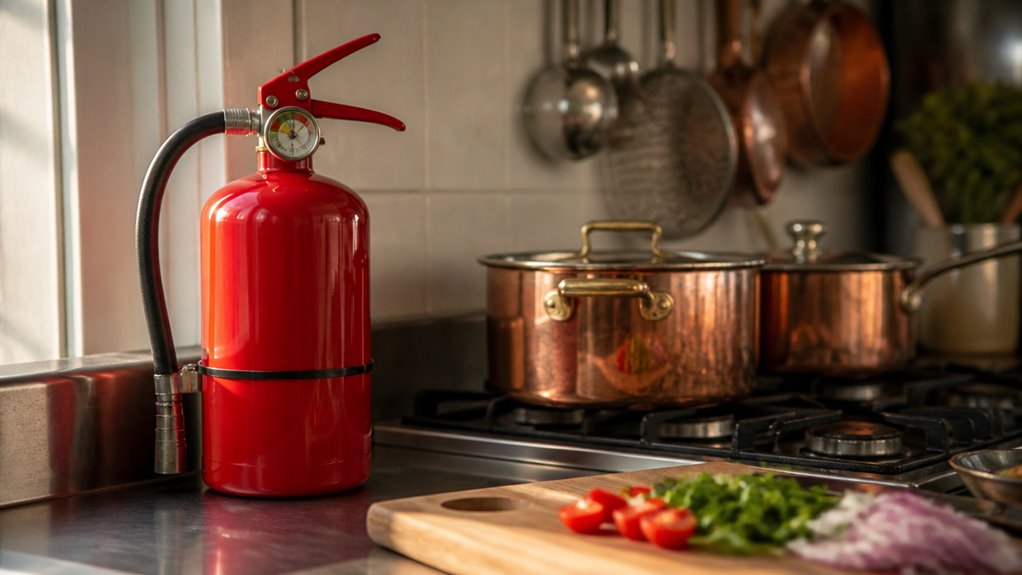

You should use a Class K fire extinguisher for kitchen fires involving cooking oils and fats. It features a wet-chemical agent that cools and chemically neutralizes grease fires, preventing reignition.
For home kitchens, an ABC extinguisher offers versatility against paper, liquid, and electrical fires but isn’t suited for high-temperature grease fires.
Avoid relying on BC or Class B units for grease as they lack the necessary saponification effect. Understanding these distinctions guarantees proper fire control and safety in your kitchen environment.
Key Takeaways
- Use Class K wet-chemical extinguishers for commercial kitchens to effectively suppress cooking oil and grease fires with saponification and cooling.
- ABC multipurpose extinguishers are suitable for home kitchens, covering paper, grease, and electrical fires with versatility.
- Avoid BC or Class B extinguishers in kitchens as they lack saponification and may spread or reignite cooking oil fires.
- Position extinguishers near kitchen entrances for quick access, avoiding placement near heat sources or inside cooking zones.
- Regularly inspect extinguishers for pressure, damage, and seals, and ensure proper training in the PASS operation method for safety.
What Types of Kitchen Fires Require a Fire Extinguisher?
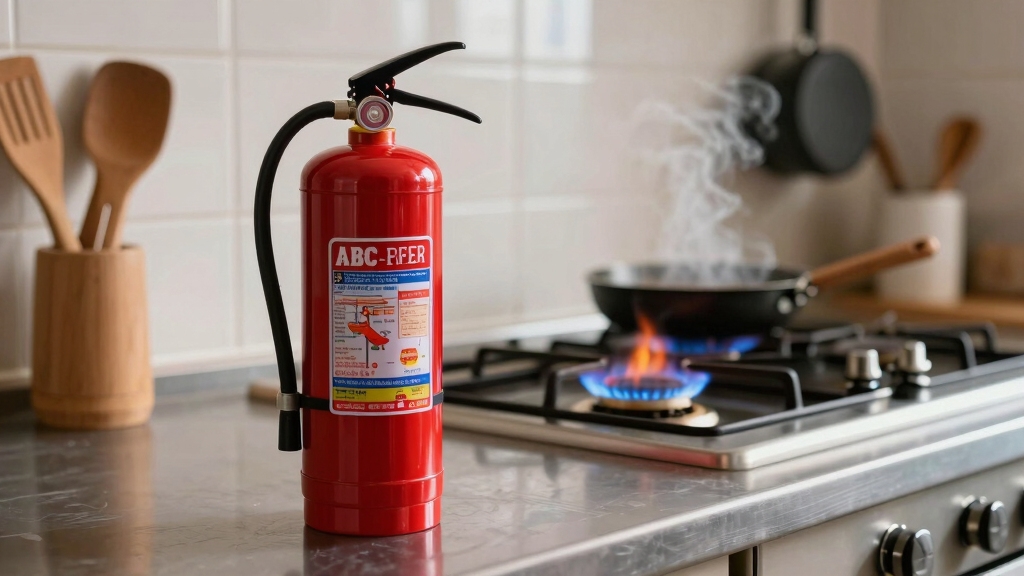
Kitchen fires can flare up from various sources, and understanding the types of fires you might face is critical for choosing the right extinguisher.
In kitchens, fires commonly involve Class K hazards: combustible cooking media such as vegetable or animal oils and fats.
You may also encounter Class B fires, which include flammable liquids like grease, and Class C fires involving energized electrical appliances.
Ordinary combustibles like paper, wood, or cloth, classified as Class A, can ignite as well.
Knowing these distinctions helps you identify whether a Class K, BC, or multipurpose ABC extinguisher is appropriate.
Each fire class demands a specific suppression agent. Using the wrong extinguisher risks ineffective control or fire escalation.
Proper extinguisher selection hinges on matching it to the fire class most likely to occur in your kitchen environment.
It is also essential to keep a Class K extinguisher accessible in your kitchen and know how to use it properly to handle grease fires safely.
Why Picking the Right Kitchen Fire Extinguisher Matters?
Choosing the right fire extinguisher for your kitchen is super important. You need one that’s compatible with the specific types of fires you might encounter there. This ensures effective suppression when it counts!
Now, it’s not just about picking the right type; you also want to think about where you place it. Having quick access during an emergency can really make a difference.
Whether you’re setting up a cozy home kitchen or a bustling commercial space, matching the extinguisher to your environment and the potential hazards is essential for keeping everyone safe.
For kitchen fires, a Class K wet chemical extinguisher is recommended specifically for grease fires, with an ABC unit as a helpful supplement nearby.
Fire Class Compatibility
Because different types of fires involve distinct combustible materials, selecting a fire extinguisher that matches the specific fire class is critical for effective suppression and safety.
For kitchens, you must recognize that Class K extinguishers target fires involving cooking oils and fats, common in commercial settings.
ABC multipurpose extinguishers cover ordinary combustibles, flammable liquids, and energized electrical fires, making them suitable for most home kitchens.
BC or Class B extinguishers handle flammable liquids but lack the specialized design for cooking grease fires.
Using an extinguisher incompatible with the fire class risks ineffective suppression or exacerbating the hazard.
Always verify the extinguisher’s label for supported fire classes to ensure your choice aligns with the combustibles present in your kitchen environment.
Because ABC extinguishers use monoammonium phosphate-based dry chemical, they are versatile but not designed for the high-temperature grease fires typical in kitchens.
Safety And Accessibility
Although selecting the correct fire extinguisher might seem straightforward, choosing one that matches your kitchen’s specific hazards directly impacts your safety and emergency response effectiveness.
You must pick an extinguisher rated for the fire classes relevant to your kitchen—typically ABC for home use or Class K for cooking oils and fats.
Placement is equally critical; position the extinguisher near the kitchen entrance, away from heat sources, ensuring immediate access during emergencies.
Avoid hiding it inside cooking zones where flames may block reach. Familiarize yourself with proper operation using the PASS method before a fire occurs.
Mount the extinguisher securely at a height between 3½ and 5 feet and ensure it is clearly visible with unobstructed access for quick retrieval during an emergency, following height and mounting requirements.
Home Versus Commercial
When selecting a fire extinguisher for your kitchen, understanding the distinct differences between home and commercial environments is essential to guarantee effective fire suppression.
Home kitchens typically require multipurpose ABC extinguishers to cover common combustibles, flammable liquids, and electrical fires.
Commercial kitchens demand Class K extinguishers designed specifically for fires involving cooking oils and fats.
| Aspect | Home Kitchen |
|---|---|
| Extinguisher Type | ABC multipurpose |
| Fire Risks | Paper, grease, electrical |
| Placement | Near kitchen exit |
| Usage Frequency | Occasional |
| Aspect | Commercial Kitchen |
| Extinguisher Type | Class K |
| Fire Risks | Vegetable/animal oils/fats |
| Placement | Close to cooking appliances |
| Usage Frequency | Frequent |
Choosing the right extinguisher guarantees peak response to specific fire hazards. It is important to identify grease fires correctly to prevent using ineffective or dangerous suppression methods.
Understanding Class K, ABC, BC, and Class B Kitchen Fire Extinguishers
To effectively tackle kitchen fire hazards, it’s important to understand the differences between Class K, ABC, BC, and Class B fire extinguishers.
Each type is designed for specific fire classes, so picking the right one for your kitchen’s risks is essential.
When you choose the appropriate extinguisher, you ensure rapid suppression of fires and help minimize damage during an emergency.
It’s all about being prepared!
For fires involving energized equipment, using a fire extinguisher with a Class C rating ensures safety by preventing electrical shock hazards.
Fire Extinguisher Class Types
Selecting the right fire extinguisher class is essential for effectively combating kitchen fires, which vary markedly in their fuel sources.
Class K extinguishers target fires fueled by cooking oils and fats, common in commercial kitchens.
You’ll find ABC multipurpose extinguishers suitable for home kitchens, covering ordinary combustibles, flammable liquids, and electrical fires.
BC extinguishers address flammable liquid and grease fires but lack coverage for electrical components.
Class B extinguishers work on grease fires but aren’t optimized for cooking oils.
Avoid assuming one extinguisher fits all kitchen fire risks; instead, match the extinguisher class to the fire type you may encounter.
Proper selection guarantees rapid, effective suppression, minimizing damage and risk.
Always verify extinguisher labels for supported fire classes before placement.
Keep in mind that knowing the extinguisher’s P-class rating and location is crucial for effective use during a grease fire emergency.
Kitchen Fire Hazards
Although kitchen fires may seem straightforward, understanding the specific hazards associated with cooking environments is essential for choosing the right extinguisher.
Kitchen fires often involve unique risks that differ from general household fires, mainly due to the presence of cooking oils, grease, and electrical appliances.
You need to recognize how these hazards influence fire extinguisher types:
Class K fires involve vegetable or animal oils and fats, requiring wet-chemical extinguishers.
ABC extinguishers cover ordinary combustibles, flammable liquids, and energized electrical fires, suitable for home kitchens.
BC extinguishers target flammable liquid and grease fires but may lack effectiveness on cooking oil fires.
Class B extinguishers cover flammable liquids but aren’t specifically designed for kitchen grease.
Identifying these hazards ensures you select an extinguisher that effectively controls the specific fire risks in your kitchen. It is also vital to be trained in the P.A.S.S. technique to use any extinguisher safely and effectively during an emergency.
Choosing Suitable Extinguishers
Recognizing the unique hazards of kitchen fires sets the foundation for choosing the right extinguisher.
You need to match the extinguisher to the fire class: Class K extinguishers are essential for commercial kitchens, designed specifically for fires involving vegetable or animal oils and fats.
For home kitchens, multipurpose ABC extinguishers provide broad coverage, handling ordinary combustibles, flammable liquids, and energized electrical fires.
BC and Class B extinguishers can tackle grease and flammable liquid fires but lack the specialized wet-chemical agents found in Class K units.
Avoid assuming one extinguisher fits all kitchen risks; always verify the fire classes indicated on the label.
Position your extinguisher near exits but away from heat sources to guarantee accessibility during emergencies.
This precise selection optimizes safety and fire suppression effectiveness.
Regular maintenance and clear labeling ensure your extinguisher is ready when needed, similar to how labeling cables enhances surveillance system reliability.
How Commercial Kitchen Fire Extinguishers Differ From Home Use?
When you manage fire safety in a commercial kitchen, you need extinguishers specifically designed for the high-risk environment created by cooking oils and fats. Unlike home kitchens, where multipurpose ABC extinguishers suffice, commercial settings demand Class K extinguishers tailored to suppress fires involving vegetable or animal oils.
Commercial kitchens require Class K extinguishers designed for high-risk grease and oil fire suppression.
You should note these key differences:
Class K extinguishers use wet chemical agents optimized for rapid grease fire suppression. Commercial units comply with stricter regulations reflecting higher fire load and risk.
These extinguishers feature specialized nozzles for effective coverage on deep fryers and cooking surfaces. Home kitchen extinguishers prioritize versatility, covering electrical and ordinary combustibles besides grease.
Understanding these distinctions ensures you select the correct extinguisher for your environment, maximizing safety and compliance. For high-risk areas involving flammable liquids and energized electrical fires, extinguishers like Purple K agents provide superior performance and safety.
Can BC and Class B Kitchen Fire Extinguishers Handle Grease Fires?
Absolutely, you can use BC extinguishers for grease fires because they work well on flammable liquids like oil and grease.
That said, it’s worth noting that while Class B extinguishers are effective for flammable liquids, they aren’t specifically tailored for kitchen grease fires that involve cooking oils.
So, it’s really important to keep their limitations in mind.
You might want to think about whether a more specialized extinguisher could be a better fit for the specific hazards in your kitchen.
After all, safety first, right?
BC Extinguishers and Grease
Although BC extinguishers are often described as suitable for kitchen grease fires, they aren’t specifically designed to handle the unique properties of cooking oils and fats involved in these fires.
Grease fires require agents that can cool and saponify the burning oil, something BC units don’t provide. You should understand these key points when considering BC extinguishers for kitchen use:
BC extinguishers use dry chemical agents effective on flammable liquids but lack wet chemical action needed for grease fires.
They can suppress flames briefly but may allow reignition due to burning oil residues.
BC units are more appropriate for flammable liquid fires outside cooking contexts.
For effective grease fire suppression, rely on Class K extinguishers designed for this hazard.
Choosing the proper extinguisher guarantees safety and fire control efficiency in your kitchen.
Class B Fire Coverage
Many kitchen fire safety plans consider BC and Class B extinguishers as options for grease fires. However, these units don’t fully address the unique challenges posed by burning cooking oils and fats.
Class B extinguishers target flammable liquids like gasoline and alcohol. While they can suppress some grease fires, they lack the specialized wet-chemical agents designed to cool and saponify oils.
BC extinguishers discharge dry chemicals that may scatter burning grease, potentially spreading the fire. You should recognize that Class B extinguishers offer limited effectiveness on kitchen grease fires, which demand agents that interrupt combustion without splattering.
For thorough fire suppression where cooking oils and fats are involved, relying solely on Class B or BC extinguishers compromises safety and fire control efficacy.
Limitations on Kitchen Use
When dealing with kitchen grease fires, BC and Class B fire extinguishers show significant limitations due to their chemical agents and discharge methods. Although they target flammable liquids, these extinguishers aren’t optimized for the high heat and rapid spread characteristic of cooking oil fires.
You should consider these key limitations:
Their dry chemical agents may scatter burning grease, worsening the fire. They lack the saponification effect needed to cool and seal oil fires. The discharge can damage kitchen surfaces and appliances. They provide less effective suppression compared to Class K extinguishers designed for cooking oils.
For grease fires, Class K extinguishers remain the authoritative choice, ensuring safer and more effective fire control in kitchen environments.
Where to Place Kitchen Fire Extinguishers for Quick Access?
Because quick access during a fire emergency is critical, you should place kitchen fire extinguishers near the kitchen entrance or door. This location guarantees you can quickly grab the extinguisher while maintaining a safe exit path.
Avoid placing extinguishers close to heat sources or cooking appliances, where flames may block access or damage the unit.
| Location | Reason |
|---|---|
| Near kitchen door | Enables rapid access and escape |
| Away from stove | Prevents heat damage to extinguisher |
| Mounted at waist height | Allows quick, ergonomic reach |
| Visible and unobstructed | Guarantees immediate identification |
Following these guidelines will optimize response time and safety during kitchen fire incidents.
How to Use a Kitchen Fire Extinguisher Safely?
Placing your kitchen fire extinguisher where you can quickly access it sets the stage for effective fire control.
Keep your kitchen fire extinguisher within reach to ensure prompt and effective fire response.
When a fire starts, act decisively and follow the PASS method:
Pull the pin to disengage the extinguisher’s operating lever.
Aim the nozzle at the base of the fire, targeting the fuel source, not the flames.
Squeeze the handle steadily to release the extinguishing agent.
Sweep the nozzle side to side across the fire’s base until the flames are completely out.
Before an emergency, familiarize yourself with your extinguisher’s operation.
Always maintain a safe distance and keep an exit behind you.
Never turn your back on a fire.
Proper use minimizes risk and maximizes suppression effectiveness.
When You Should Call the Fire Department Instead of Fighting a Fire?
If a fire grows beyond your control or spreads quickly, you must call the fire department immediately. Attempting to fight large or rapidly expanding fires puts you at severe risk and delays professional intervention.
You should also call emergency services if the fire involves hazardous materials or electrical systems beyond a small appliance. If smoke impairs visibility and breathing, call for help.
When unsure about the fire’s scope or if your extinguisher is insufficient for the fire class involved, evacuate and alert firefighters. Never re-enter a burning building once outside.
Your priority is safety. Fighting the fire should only occur if it’s small, contained, and you have an appropriate extinguisher nearby. Promptly summoning experts guarantees effective suppression and prevents escalation or structural damage.
How to Maintain and Check Your Kitchen Fire Extinguisher?
Knowing when to call the fire department is vital, but so is making certain your kitchen fire extinguisher is always ready to perform effectively.
You must perform regular maintenance and checks to guarantee functionality. Start by inspecting the pressure gauge monthly. Confirm it’s in the green zone, indicating proper pressure.
Verify the extinguisher’s physical condition; look for corrosion, dents, or leaks. Confirm the pull pin and tamper seal are intact.
Finally, weigh the extinguisher to check for any loss of extinguishing agent.
- Check the pressure gauge monthly for correct pressure.
- Inspect for physical damage or corrosion.
- Make certain the pull pin and tamper seal are intact.
- Weigh the extinguisher to detect agent loss.
Regular maintenance guarantees your extinguisher functions at its best during emergencies.
Essential Safety Tips for Using Kitchen Fire Extinguishers
Before using a kitchen fire extinguisher, familiarize yourself with the PASS technique: Pull the pin, Aim low at the fire’s base, Squeeze the handle, and Sweep side to side. This method guarantees effective suppression and minimizes risks.
Always position yourself with an unobstructed exit route. Never turn your back on a fire. Confirm the extinguisher matches the fire class: ABC for home kitchens and Class K for commercial settings.
| Step | Action | Key Point |
|---|---|---|
| Pull | Remove pin | Enables handle operation |
| Aim | At fire base | Targets fuel source |
| Squeeze | Apply steady pressure | Releases extinguishing agent |
| Sweep | Side to side | Covers entire fire base |
| Exit | Retreat if needed | Prioritize personal safety |
Frequently Asked Questions
How Often Should I Replace My Kitchen Fire Extinguisher?
You should replace your kitchen fire extinguisher every 5 to 15 years, depending on the manufacturer’s guidelines.
Always check the pressure gauge regularly and inspect the unit for damage or corrosion.
If the extinguisher has been used, even partially, replace or service it immediately.
Regular maintenance by a certified professional makes certain it remains effective.
Don’t wait for visible wear; schedule inspections annually to guarantee reliable performance during emergencies.
Can I Use a Fire Extinguisher on a Microwave Fire?
Yes, you can use a fire extinguisher on a microwave fire, but choose the right type. An ABC multipurpose extinguisher works well because it handles electrical fires (Class C) and ordinary combustibles.
Avoid water-based extinguishers; they risk electrical shock. Always pull the extinguisher, aim at the fire’s base, squeeze, and sweep side to side.
If the fire grows or you feel unsafe, evacuate and call emergency services immediately.
Are There Eco-Friendly Fire Extinguishers for Kitchen Use?
Imagine your kitchen fire extinguisher as a hybrid car, effective but eco-conscious.
Yes, you can get eco-friendly kitchen fire extinguishers, often using clean agents like potassium bicarbonate or biodegradable wet chemicals.
These suppress fires without harmful residues or ozone depletion.
When choosing, check certifications ensuring environmental safety alongside Class K or ABC ratings.
You’ll protect your kitchen and the planet simultaneously, balancing performance with sustainability in your fire safety plan.
What Is the Average Cost of a Kitchen Fire Extinguisher?
You can expect to pay between $30 and $70 for a standard multipurpose ABC kitchen fire extinguisher.
Class K extinguishers, designed for commercial kitchens, typically cost more, ranging from $100 to $200 or higher due to their wet-chemical agents.
Prices vary based on size, certification, and brand. Investing in a reliable unit guarantees effective fire suppression and safety compliance, making it essential to balance cost with the extinguisher’s intended kitchen application.
Can Children Safely Operate a Kitchen Fire Extinguisher?
Children generally shouldn’t operate a kitchen fire extinguisher without adult supervision. The extinguisher requires strength and understanding to use the PASS technique correctly: Pull, Aim, Squeeze, Sweep.
Misuse can worsen the fire or cause injury. However, with proper training and age-appropriate guidance, older children might assist safely.
Always prioritize adult intervention. Make certain children know to alert adults immediately during a kitchen fire emergency.
Protect Your Kitchen Before a Fire Starts
When it comes to kitchen fires, choosing the right extinguisher is pivotal. Did you know that 60% of home kitchen fires involve cooking oil or grease?
Using a Class K extinguisher specifically designed for these fires greatly increases your chances of effectively controlling the blaze. Always check your extinguisher regularly and know when to call the fire department.
Taking these steps guarantees you’re prepared, protecting lives and property with confidence and precision.