
You extinguish lithium battery fires by matching suppression methods to the battery type.
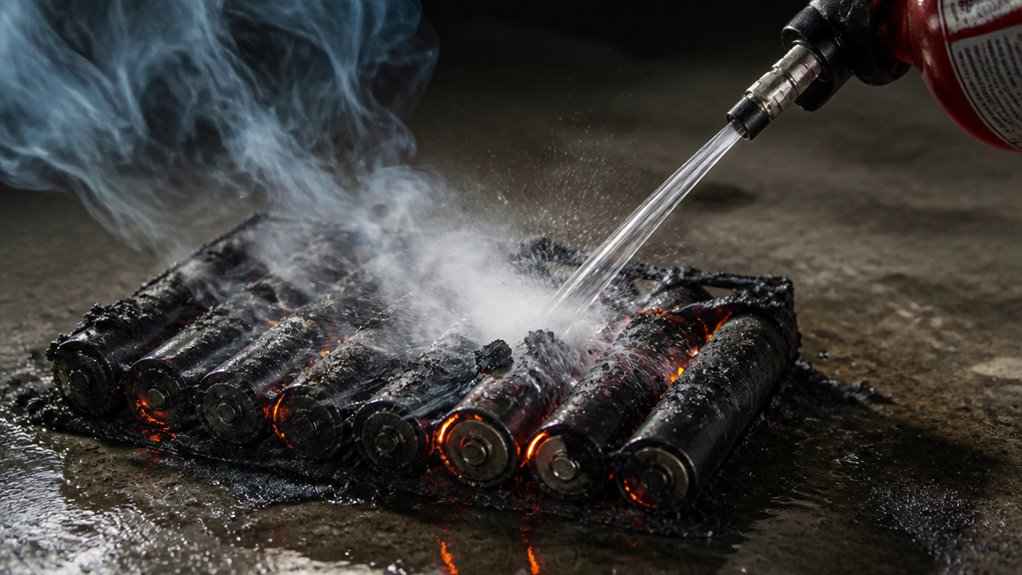
Use copious water for lithium-ion fires to cool cells and stop thermal runaway effectively.
Avoid water on lithium-metal fires as it causes violent reactions.
Opt instead for Class D extinguishers with dry powders designed for combustible metals.
Employ continuous cooling and monitoring to prevent reignition, especially with large packs.
Understanding these distinctions guarantees you’ll manage battery fires with precision and safety.
Key Takeaways
- Lithium-ion battery fires require copious water application to cool cells and stop thermal runaway effectively.
- Lithium-metal battery fires must be extinguished with Class D dry powder extinguishers, avoiding water to prevent violent reactions.
- Dry chemical extinguishers quickly suppress flames on small lithium-ion fires but do not cool the battery core, risking reignition.
- Sand or clay can isolate burning cells to prevent heat spread and secondary fire risks.
- Continuous cooling and monitoring are essential to prevent reignition and ensure complete fire suppression in lithium battery incidents.
Core Steps to Respond to Lithium Battery Fires
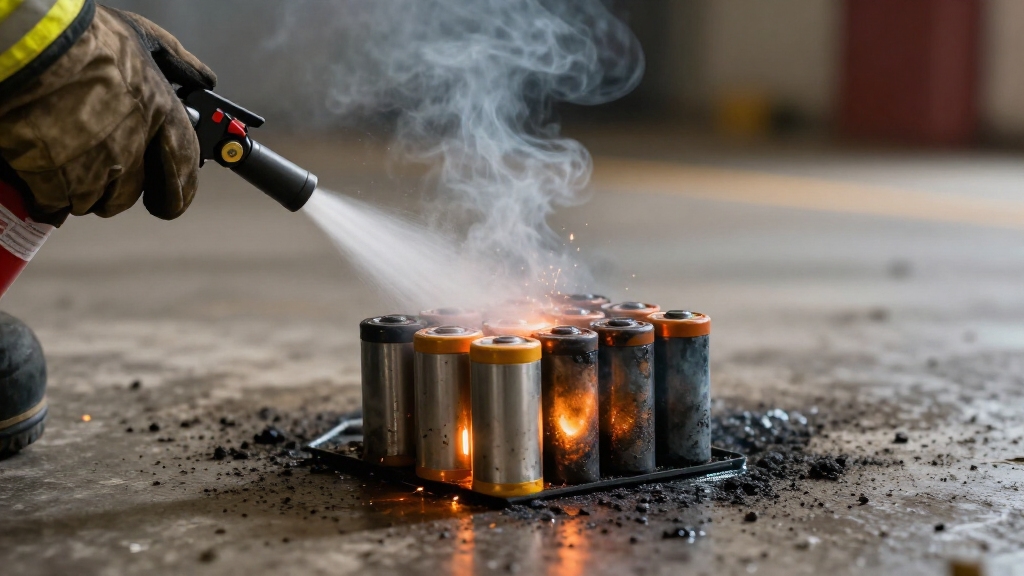
When you encounter a lithium battery fire, your first priority is to evacuate the area and alert emergency services if the fire is uncontrollable or spreading rapidly.
Next, identify the battery chemistry if possible, since lithium-ion and lithium-metal fires demand distinct suppression methods.
For lithium-ion fires, apply copious water directly to cool the cells and halt thermal runaway.
For lithium-metal fires, avoid water and use Class D extinguishers designed for combustible metals.
Always monitor the battery after extinguishment because reignition is common due to retained heat or internal failure.
Avoid relying solely on standard extinguishers, as they may not remove sufficient heat.
Maintain observation for hours, especially with large packs, to ensure complete suppression and prevent flare-ups.
Prompt, chemistry-specific response minimizes hazards effectively.
Use thermal imaging and gas detectors for continuous monitoring of reignition and toxic emissions to enhance safety during and after suppression.
Differences Between Lithium-Ion and Lithium-Metal Battery Fires
Although both lithium-ion and lithium-metal battery fires involve lithium, their combustion behaviors and suppression requirements differ markedly due to the chemical form of lithium present.
Lithium-ion batteries contain lithium in a salt electrolyte form. This makes water an effective extinguishing agent to cool and stop thermal runaway.
In contrast, lithium-metal batteries harbor reactive metallic lithium. This requires Class D extinguishers or dry powders to avoid violent reactions with water.
| Battery Type | Lithium Form | Fire Suppression Approach |
|---|---|---|
| Lithium-Ion | Lithium salts | Water cooling, ABC dry chemical |
| Lithium-Metal | Metallic lithium | Class D extinguishers, dry powders |
| Risk of Ignition | Moderate | High (violent reaction possible) |
You must identify the battery chemistry first to select the correct extinguishing method and prevent worsening the fire. Proper use of certified fire extinguishers inspected and serviced by professionals is essential to ensure effective suppression and safety.
Why Water Is Best for Extinguishing Lithium-Ion Battery Fires?
You really need water when dealing with lithium-ion battery fires. It cools the cells down effectively, which is crucial for stopping thermal runaway before it gets out of hand.
When you apply water directly to the battery, it helps the heat dissipate quickly. This rapid cooling is key because it prevents the fire from spreading inside the battery itself.
Water’s high specific heat capacity allows it to absorb large amounts of heat, making it highly effective for cooling and heat absorption in such fires.
Cooling Effectiveness
Water consistently proves to be the most effective agent for extinguishing lithium-ion battery fires because it directly cools the cells, interrupting the thermal runaway process.
By removing excessive heat, water prevents the fire from sustaining itself and spreading within the battery pack. When you apply water, you reduce the internal temperature rapidly, halting the chemical reactions fueling the fire.
Consider these critical factors:
- Rapid heat dissipation reduces the risk of reignition, providing safer conditions post-extinguishment.
- Direct cell cooling stops the propagation of thermal events within interconnected cells.
- Sustained water application guarantees thorough temperature control, especially in large battery systems where hidden heat remains.
Understanding water’s superior cooling capability empowers you to respond effectively and mitigate hazards inherent to lithium-ion fires. Additionally, the high latent heat of vaporization allows water to absorb immense heat energy, significantly lowering fuel temperature below ignition points.
Thermal Runaway Prevention
Effective cooling directly targets the root cause of lithium-ion battery fires: thermal runaway. When a cell overheats, exothermic reactions accelerate, causing a self-sustaining heat increase that spreads to adjacent cells.
You need to apply sufficient water volume to absorb this heat rapidly, interrupting the chain reaction. Water’s high specific heat capacity and evaporative cooling efficiently remove thermal energy, preventing temperature escalation.
Unlike dry chemical agents, water penetrates the battery casing and cools internal components, reducing combustion risk. You must maintain continuous water application because partial cooling can allow thermal runaway to resume.
Additionally, ensuring proper ventilation during firefighting helps minimize inhalation exposure to potentially harmful combustion byproducts released during battery fires.
Direct Cell Application
Targeting individual cells during a lithium-ion battery fire allows you to directly interrupt thermal runaway at its source. This is critical for halting the self-sustaining reaction.
Applying water directly to the cells provides rapid cooling, reducing internal temperatures and preventing propagation to neighboring cells. Water’s high heat capacity and accessibility make it the most effective agent for this task.
When you act quickly and precisely, you can minimize damage and safety risks.
Consider these points:
- Direct water application cools cells faster, stopping chain reactions before they escalate.
- Thermal runaway can reignite, so thorough, persistent cooling is essential.
- Inaccessible cells may require copious water to penetrate and cool effectively.
Your focused intervention with water can decisively control lithium-ion battery fires. However, it is important to ensure the fire does not involve energized electrical components, as water use on Class C fires can pose shock hazards.
Cooling Lithium-Ion Batteries to Stop Thermal Runaway
When dealing with a lithium-ion battery fire, rapidly reducing the battery’s temperature is critical to halting thermal runaway. You must apply copious water directly to the cells whenever accessible, as heat removal interrupts the self-sustaining exothermic reaction.
Rapidly cooling lithium-ion cells with ample water is essential to stop thermal runaway and control the fire.
Cooling prevents further electrolyte decomposition and gas venting, which exacerbate the fire. It’s vital to maintain water flow for an extended period, especially with large battery packs, to guarantee internal temperatures drop below critical thresholds.
Simply suppressing visible flames is insufficient; internal heat can cause reignition. You should continuously monitor the battery after initial knockdown and continue cooling until stable.
Effective temperature control disrupts thermal propagation, minimizing the risk of aggressive flaring or explosion. This cooling-focused approach aligns with NFPA recommendations and is fundamental in lithium-ion fire management.
For fires involving energized electrical equipment, dry chemical powders are effective because they suppress flames without conducting electricity, making them an important tool in Class C fire suppression.
Using Dry Chemical Extinguishers for Small Lithium-Ion Fires
You can definitely use dry chemical extinguishers to quickly tackle small lithium-ion battery fires. They’re pretty effective at smothering flames, which is a plus. However, keep in mind that they don’t really cool things down enough to stop thermal runaway.
It’s important to be aware that while the dry chemical agent works well to put out the fire, it can leave behind a messy residue. This residue can complicate cleanup and might even hide some hotspots, making it tricky to ensure everything’s safe afterward. Additionally, the abrasive and corrosive effects of dry chemical powder can damage electronic components and increase the risk of equipment failure after suppression.
Effectiveness On Small Fires
A dry chemical extinguisher can effectively suppress small lithium-ion battery fires by interrupting the chemical reaction fueling the flames.
When you face a minor lithium-ion fire, this method provides rapid flame knockdown, limiting fire spread and immediate hazards.
However, it doesn’t cool the battery, so heat retention might cause reignition if you don’t monitor the site closely.
Consider these critical points:
- Quick suppression reduces damage but doesn’t eliminate internal heat risks.
- Residue from dry chemicals may complicate clean-up and obscure damage assessment.
- Follow-up cooling is essential to prevent flare-ups, as extinguishment alone isn’t enough.
Using a dry chemical extinguisher buys you vital time, but you must stay vigilant and apply additional cooling measures to guarantee complete fire control.
Purple K, a dry-chemical agent known for rapid chemical chain reaction interruption, is an effective option for such fire suppression and leaves minimal residue compared to other agents.
Cooling And Residue Issues
Dry chemical extinguishers effectively knock down flames in small lithium-ion battery fires but fall short in addressing retained heat within the cells.
While they interrupt combustion quickly, these agents don’t cool the battery core. This leaves internal temperatures high enough to trigger reignition.
You must understand that extinguishing visible flames isn’t sufficient. Without rapid and thorough cooling, thermal runaway can continue internally.
Additionally, dry chemicals leave a residue that complicates post-fire cleanup and potentially interferes with further cooling efforts.
After initial suppression, you should apply water or another cooling method directly to accessible cells to dissipate heat effectively.
Continuous monitoring is essential because the residue masks ongoing thermal activity. This increases the risk of flare-ups if the battery remains hot internally.
Proper cleanup using a HEPA vacuum can minimize airborne particles and protect surrounding equipment from damage.
Foam and Specialized Agents for Lithium-Ion Battery Fire Control
Foam agents step in as a valuable option when tackling lithium-ion battery fires, especially in larger-scale incidents where water alone mightn’t suffice.
Foam agents provide crucial support in managing large lithium-ion battery fires beyond water’s capabilities.
You can use standard foam or specialized formulations designed to improve suppression by smothering flames and limiting oxygen access.
These agents also help contain fire spread across battery packs.
However, foam’s primary benefit is cooling and isolation rather than chemical neutralization.
When choosing foam or specialized agents, consider:
- The fire’s scale; larger fires need more extensive foam application for effective coverage.
- Agent compatibility with lithium-ion chemistry to avoid adverse reactions.
- The need for prolonged cooling to prevent reignition despite initial suppression.
While foam supports fire control, you must still prioritize direct cooling and continuous monitoring to guarantee total extinguishment.
Why Avoid Water When Fighting Lithium-Metal Battery Fires?
When dealing with lithium-metal battery fires, it’s crucial to steer clear of water. Why? Well, metallic lithium doesn’t play nice with water. When they meet, they react violently, generating flammable hydrogen gas along with a lot of heat. This reaction can actually make the fire worse or even lead to explosions, which is definitely not what you want!
Reactivity Of Lithium Metal
Lithium metal reacts violently with water, producing hydrogen gas and intense heat that can exacerbate fires. Confronting a lithium-metal battery fire requires avoiding water, as this reaction can lead to rapid flame spread and potential explosions.
You must understand these hazards:
- Hydrogen gas generation: This highly flammable gas can ignite instantly, increasing fire intensity and risk of blast.
- Exothermic reaction: The heat released raises the temperature, accelerating thermal runaway and worsening the fire.
- Chemical reactivity: Lithium’s strong reducing properties cause it to react aggressively, making conventional extinguishing methods ineffective or dangerous.
Recognizing lithium metal’s reactivity guides you to safer suppression tactics. Emphasize Class D extinguishers and dry powders over water-based agents.
Risks Of Water Use
Although water is effective for many types of fires, applying it to lithium-metal battery fires can dangerously escalate the situation.
Lithium metal reacts violently with water, producing hydrogen gas and heat, which can intensify the fire or cause explosions.
When you use water on a lithium-metal fire, you risk rapid combustion and spreading hazards instead of suppression.
This contrasts sharply with lithium-ion fires, where water cools and suppresses thermal runaway.
For lithium-metal fires, you should avoid water and instead use Class D extinguishing agents like graphite or copper powder, designed to smother combustible metals safely.
Recognizing the battery chemistry before firefighting is critical. Using the wrong extinguishing agent can worsen the hazard, putting you and others in greater danger.
When to Use Class D Extinguishers for Lithium-Metal Fires?
When dealing with fires involving lithium-metal batteries, selecting the correct extinguishing agent is critical to prevent exacerbating the incident.
Class D extinguishers are specifically designed to handle combustible metal fires, including lithium-metal. Using water or other agents can intensify the fire due to lithium’s highly reactive metallic nature.
You should choose Class D extinguishers when:
- The fire involves pure lithium metal or lithium-metal batteries, not lithium-ion variants.
- You need to smother the fire with dry powder agents like graphite or copper powder that absorb heat and isolate oxygen.
- Cooling alone won’t suppress the fire effectively because lithium-metal reacts violently with water or foam.
Always confirm the battery chemistry before acting, as the wrong choice could escalate the hazard and endanger lives.
Preventing Reignition After a Lithium Battery Fire
Since damaged lithium battery cells can retain heat internally even after visible flames are extinguished, you must continuously monitor the fire site to forestall reignition.
Thermal runaway can persist within hidden cells, causing delayed flare-ups. Employ continuous temperature measurements and visual inspections for smoke or vapor emissions.
Applying copious water post-extinguishment is critical to dissipate residual heat effectively. Avoid premature abandonment of the scene, as incomplete cooling may lead to reignition.
In larger battery packs, prolonged water application and extended observation, often hours, are necessary. Consider isolating the battery from combustible materials to reduce secondary fire risk.
Your vigilance during this phase guarantees that latent thermal energy dissipates fully, preventing further hazard and facilitating safe incident resolution.
Safe Handling of Small Lithium Battery Fires
Handling small lithium battery fires demands prompt, targeted action to prevent escalation and guarantee safety. You need to act quickly using appropriate suppression methods to control the fire and avoid thermal runaway. For small lithium-ion battery fires, water or ABC dry chemical extinguishers can be effective if applied directly to the cells. Avoid relying solely on CO₂, as it may not cool the battery sufficiently.
Keep these critical steps in mind:
- Isolate the burning cell using sand or clay to contain heat and prevent spread.
- Apply water or ABC extinguisher promptly to cool and suppress flames.
- Monitor the battery closely after extinguishment to detect and manage potential reignition.
Your precise, immediate response reduces risk and enhances safety during these incidents.
Frequently Asked Questions
Can Lithium Battery Fires Produce Toxic Smoke or Gases?
Yes, lithium battery fires produce toxic smoke and gases. When you encounter such a fire, be aware that burning electrolytes release harmful compounds like hydrogen fluoride and other volatile organic compounds.
These substances pose significant inhalation risks. You must ventilate the area and use appropriate respiratory protection if you’re near the fire.
Always treat the smoke as hazardous and avoid direct exposure to minimize health dangers during firefighting or cleanup.
How Should Damaged Lithium Batteries Be Stored After a Fire?
Don’t put all your eggs in one basket. Store damaged lithium batteries separately in a non-combustible container filled with sand or clay to isolate them.
Keep them outdoors or in a well-ventilated area away from flammable materials. Monitor them continuously for signs of heat or smoke, as they can reignite hours after a fire.
Always follow local regulations and dispose of them through certified hazardous waste channels to guarantee safety.
What Personal Protective Equipment Is Recommended for Lithium Battery Fires?
You should wear full protective gear, including flame-resistant clothing, chemical-resistant gloves, and eye protection like goggles or a face shield.
Respiratory protection is vital; use a NIOSH-approved respirator or SCBA to guard against toxic fumes and smoke.
Since lithium battery fires release hazardous gases and risk thermal injury, ensure your PPE covers skin completely.
Proper footwear and a helmet with face shield complete your defense against heat, chemicals, and debris.
Are There Specific Disposal Methods for Fire-Damaged Lithium Batteries?
Think of a fire-damaged lithium battery as a wounded beast.
You wouldn’t just toss it in the trash.
You need to isolate it carefully.
You should never mix it with regular waste; instead, store it in a cool, non-flammable container filled with sand or inert material.
Then, hand it over to hazardous waste specialists who follow strict protocols to neutralize chemical risks and prevent reignition.
This ensures safe disposal aligned with environmental regulations.
Can Lithium Battery Fires Cause Explosions or Secondary Hazards?
Yes, lithium battery fires can cause explosions and secondary hazards.
You need to understand that thermal runaway generates intense heat and gas buildup, potentially leading to violent ruptures or explosions.
Toxic fumes and chemical vapors can also pose respiratory risks.
Consequently, you must maintain safe distances, guarantee proper ventilation, and be cautious of reignition.
Continuous monitoring after extinguishment is essential to manage these ongoing hazards effectively and prevent further incidents.
Final Answer: What Extinguishes a Lithium Battery Fire?
When a lithium battery fire erupts, you might worry that water will worsen the blaze. However, for lithium-ion fires, water is your best ally. It cools the battery, halting thermal runaway quickly.
Just remember, lithium-metal fires demand Class D extinguishers to avoid explosive reactions. By matching your response precisely to the battery type and using the right extinguisher, you’ll contain the fire efficiently.
Stay vigilant; every second counts in controlling these fires safely.