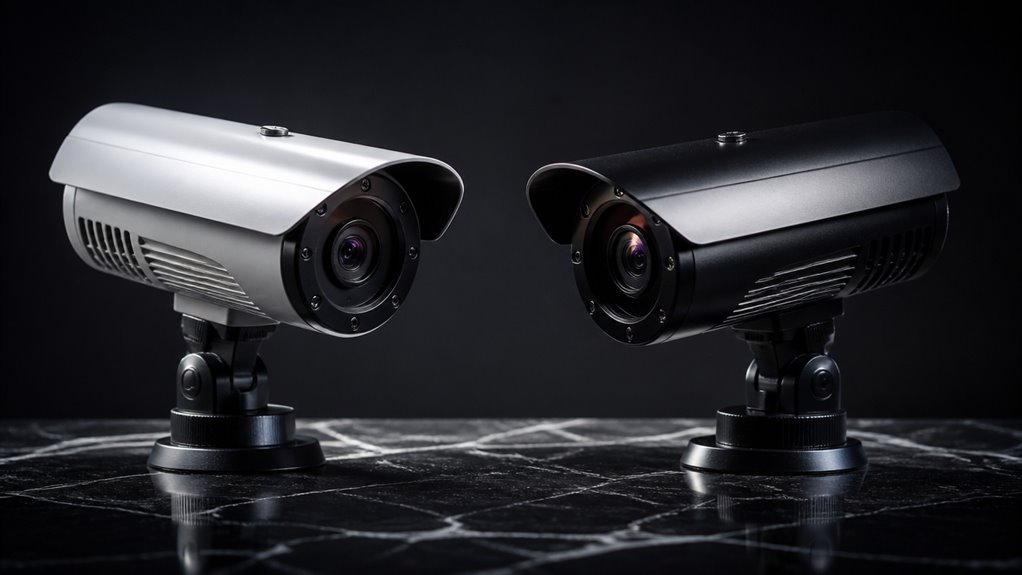

If you’re choosing between Hikvision and Dahua, know Hikvision leads with about 25% global market share and excels in advanced AI and a wide product range.
Dahua offers a more cost-effective portfolio with strong AI features and easier installation via ePoE.
Hikvision slightly outperforms Dahua in low-light clarity and high-end analytics, while Dahua wins on price-to-feature ratio.
Your choice depends on budget, use case, and security needs; detailed comparisons reveal deeper differences in performance and risk.

- 【Please Notice】This is a Professional 3.5″ Metal Pan-Tilt-Zoom IP IR PTZ Dome Security Camera…
- 【H.265 Full HD 1080P】1080P 1920(H)*1080(V) HD Resolution@ 20FPS. Adopt New Video Compression…
- 【Plug&Play with Hikvision NVR】Work with Hikvision ,Dahua ,UniView,XM NVR/POE NVR. Support HTTP…
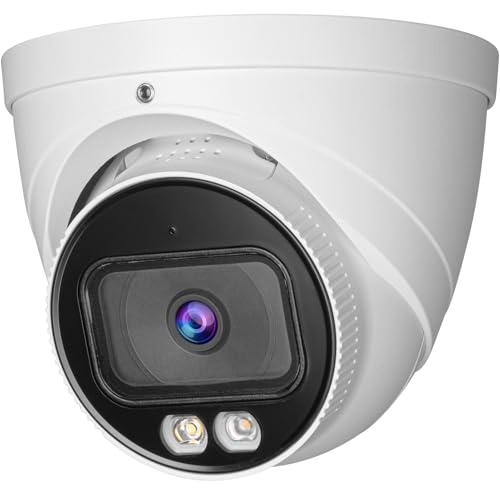
- 5MP HD Security Camera: Capture every detail with 5MP high-definition resolution (2592×1944) powered…
- Smart Security Camera with AI Detection: Cut through irrelevant motion with AI-powered human/vehicle…
- PoE Powered Installation: Power over Ethernet technology allows single-cable installation for both…
Key Takeaways
- Hikvision leads the market with 23%-25.7% share, offering broader product range and advanced AI analytics compared to Dahua’s 10%-11% share.
- Hikvision’s ColorVu excels in low-light full-color imaging, while Dahua’s WizSense provides cost-effective human/vehicle detection for residential use.
- Dahua focuses on value-oriented, budget-friendly models with practical features like ePoE, whereas Hikvision targets enterprise-grade deployments with advanced sensors.
- Both brands use AI-driven detection, but Hikvision’s premium models typically offer slightly higher accuracy and clearer night images.
- Hikvision and Dahua each provide proprietary apps (Hik-Connect vs DMSS/gDMSS) for streamlined device management and monitoring.
Hikvision vs Dahua: Key Differences in Camera Quality, AI Features, Night Vision, and Security
| Comparison Factors | Hikvision | Dahua |
|---|---|---|
| Primary Strength | Extensive camera range and advanced analytics | Practical surveillance features and flexible deployment options |
| Product Range | Residential, commercial, and enterprise cameras | Residential, commercial, and enterprise cameras |
| Image Quality | High-resolution imaging with advanced sensor options | High-resolution imaging with competitive processing technology |
| Night Vision Technology | ColorVu and infrared night vision | Full-color low-light imaging and infrared night vision |
| Low-Light Performance | Article emphasizes strong performance in premium ColorVu models | Article highlights competitive low-light camera options |
| AI Detection Technology | AcuSense, DeepinView, and DeepinMind | WizSense, SMD Plus, and WizMind |
| Human and Vehicle Detection | AI-assisted human and vehicle classification | AI-assisted human and vehicle classification |
| Advanced Video Analytics | Deep-learning analytics in selected premium models | Advanced analytics through selected WizMind systems |
| False Alert Reduction | AcuSense filtering helps distinguish relevant activity | WizSense and SMD Plus support intelligent event filtering |
| Mobile Monitoring App | Hik-Connect | DMSS, with gDMSS referenced for older systems |
| Power over Ethernet | PoE support on compatible IP cameras | PoE and ePoE support on compatible models |
| Installation Flexibility | Wired IP camera and recorder integration | Wired integration with extended-distance ePoE options |
| Third-Party Integration | ONVIF support on compatible devices | ONVIF support on compatible devices |
| Network Security | Requires firmware maintenance and secure configuration | Requires firmware maintenance and secure configuration |
| Regulatory Considerations | Restrictions may apply depending on jurisdiction and application | Restrictions may apply depending on jurisdiction and application |
| Best Applications | Homes, businesses, and complex enterprise surveillance | Homes, businesses, and scalable surveillance deployments |
| Overall Recommendation | Consider for extensive camera options and specialized analytics | Consider for AI features and deployment flexibility |
Who Leads the Global Surveillance Camera Market: Hikvision or Dahua?
While both Hikvision and Dahua hold significant positions in the global surveillance camera market, Hikvision leads by a notable margin in revenue and market presence.
Hikvision commands approximately 23% to 25.7% of global market share, making it the largest manufacturer worldwide. Dahua typically ranks second, with around 10% to 11% market share.
Hikvision leads globally with 23% to 25.7% market share, while Dahua holds second place at 10% to 11%.
Combined, they control about 39.20% of the surveillance camera sector as of 2025. This dominance reflects Hikvision’s broader product catalog, appealing to entry-level through enterprise customers, which helps maintain its leading position.
Dahua, positioned as a strong value alternative, captures a significant portion but doesn’t match Hikvision’s scale. Understanding these market shares helps you gauge each brand’s influence and industry footprint objectively before considering product specifics or performance.
Both brands offer advanced features such as AI-driven smart detection to enhance security and reduce false alerts, reflecting the evolving technology standards in the market.
Which Brand Offers Better Surveillance Camera Options?
When you’re looking at Hikvision and Dahua, you’ll find that both brands deliver solid image quality. However, Hikvision has a bit of an edge when it comes to low-light performance, thanks to their ColorVu technology. Pretty impressive, right?
Now, let’s talk about AI features. Both brands offer some great options here. Hikvision has its AcuSense, while Dahua counters with WizSense. They both excel at detecting humans and vehicles, but Hikvision tends to be a bit more accurate, especially in their premium models.
Additionally, considering the importance of smart detection can help you choose a system that provides more precise alerts and enhances overall security monitoring.
Image Quality Comparison
How do Hikvision and Dahua compare in image quality for surveillance cameras? Both brands deliver solid performance, but subtle differences matter depending on your needs.
- Hikvision’s flagship low-light models, especially ColorVu, often achieve lower minimum illumination. This provides clearer full-color images at night.
- Dahua offers competitive low-light performance with cost-efficient alternatives. This makes it a value option without sacrificing much clarity.
- At similar price points, both brands deliver broadly comparable base image quality. They balance resolution, color accuracy, and noise reduction effectively.
- Hikvision’s broader product catalog includes more enterprise-grade options with advanced sensors. Dahua focuses on accessible models optimized for cost and decent quality.
If you prioritize top-tier night imaging, Hikvision slightly leads. For balanced quality and budget, Dahua remains a strong contender.
Additionally, considering bitrate and processing algorithms can be crucial, as image clarity depends on more than just resolution alone.
AI Features Overview
Although both Hikvision and Dahua integrate advanced AI capabilities in their surveillance cameras, your choice depends on whether you prioritize accuracy or cost-efficiency.
Hikvision’s AI lineup, including AcuSense and DeepinView, excels at precise person and vehicle filtering with a slight edge in detection accuracy on premium models.
Dahua counters with WizSense, SMD Plus, and WizMind, delivering comparable human and vehicle detection but often at more competitive price points.
Both brands support comprehensive AI analytics for commercial and enterprise deployments, yet Hikvision’s higher-tier models emphasize improved deep learning algorithms.
You’ll also find that Dahua’s AI features deliver solid performance with better cost-to-feature ratios, making it suitable for budget-conscious projects.
Ultimately, your decision hinges on balancing detection precision against overall system investment.
Additionally, some models from these brands offer AI-powered auto-tracking to enhance situational awareness by continuously monitoring moving subjects.
Which Brand Has Better Image Quality and Low-Light Performance?
When you’re looking at image quality and low-light performance, Hikvision usually stands out with lower minimum illumination levels. They really shine in night performance too, especially when you compare them directly with others.
One of their standout features is ColorVu technology, which delivers full-color imaging even in low-light situations. That’s often seen as a major advantage.
Now, Dahua isn’t far behind. They also offer solid full-color low-light options that manage to balance performance and cost-effectiveness quite well.
For those valuing durable and reliable technology, considering devices with rugged construction and clear alert systems can enhance overall user confidence.
Night Performance Comparison
Since image quality and low-light performance are critical factors for surveillance effectiveness, comparing Hikvision and Dahua in these areas reveals important distinctions.
When evaluating night performance, you’ll notice:
- Hikvision’s flagship low-light cameras often achieve lower minimum illumination levels, enhancing detail capture in near-dark conditions.
- Both brands use infrared technology effectively, but Hikvision’s sensors generally provide slightly clearer and sharper images at night.
- Dahua offers competitive night vision quality, usually at a more cost-efficient price point, making it attractive for budget-conscious deployments.
- At equivalent price tiers, the baseline image quality and noise reduction capabilities between Hikvision and Dahua are broadly comparable.
Though Hikvision tends to edge out slightly in scenarios demanding the highest clarity, this comparison underscores Hikvision’s marginal advantage in night performance without disregarding Dahua’s value proposition.
Efficient compression standards like H.265 also play a role in maintaining video quality while optimizing bandwidth during low-light surveillance.
Full-Color Low-Light Imaging
You’ll often find Hikvision’s ColorVu technology delivering superior full-color imaging in low-light conditions. It provides clearer detail and more accurate color reproduction than many competitors.
This advantage stems from advanced sensor sensitivity combined with high-intensity supplemental lighting, enhancing image clarity without sacrificing color fidelity.
Dahua’s low-light solutions, such as their full-color variants, offer competitive performance but typically emphasize cost efficiency over marginal image quality gains.
In side-by-side tests, Hikvision’s ColorVu models tend to produce images with richer color depth and less noise under dim lighting, aiding better scene interpretation.
However, both brands maintain broadly comparable baseline image quality at similar price tiers, with Hikvision slightly edging Dahua in optimized low-light scenarios.
Your choice may hinge on balancing budget constraints against the need for enhanced color accuracy in low-light surveillance.
For users looking to maximize system reliability, following best practices in wiring and solar positioning can help ensure uninterrupted surveillance and consistent camera performance.
Minimum Illumination Levels
Beyond full-color capabilities, minimum illumination levels serve as a key metric for evaluating low-light surveillance performance.
When comparing Hikvision and Dahua, you’ll find nuanced differences that impact image quality in near-dark conditions:
- Hikvision’s flagship low-light models often achieve lower minimum illumination thresholds, yielding clearer night images.
- Dahua provides competitive low-light performance but tends to position these features in more cost-effective tiers.
- At equivalent price points, both brands deliver broadly comparable base image quality, making sensor and lens specifics critical.
- Hikvision’s ColorVu technology enhances full-color imaging at very low lux levels, whereas Dahua balances performance with affordability.
Both brands commonly incorporate dual night vision modes to optimize visibility in varying low-light scenarios.
What AI Features Set Hikvision and Dahua Apart?
Although both Hikvision and Dahua offer advanced AI capabilities for surveillance, their feature sets emphasize different strengths and branding approaches that influence performance and cost-effectiveness.
Hikvision’s AI branding centers on AcuSense for person and vehicle filtering. Higher-end DeepinView and DeepinMind analytics often deliver superior accuracy on premium models.
Hikvision leverages AcuSense and advanced DeepinView analytics for enhanced person and vehicle detection accuracy.
Dahua counters with WizSense and SMD Plus for core detection features, and WizMind for advanced analytics, focusing on competitive cost-to-feature value.
You’ll find Hikvision slightly stronger in AI precision, especially in complex environments, while Dahua balances efficiency and affordability.
Both platforms support similar core AI functions, but your choice hinges on whether you prioritize cutting-edge accuracy or optimized budget performance within your surveillance deployment.
Additionally, many modern security systems now include local AI detection to reduce false alerts and enhance privacy by processing data on-device rather than relying heavily on cloud servers.
How Mobile Apps and Ecosystems Impact Installation and Management?
When setting up surveillance systems, how you manage devices through mobile apps and ecosystem integration can materially affect installation efficiency and ongoing maintenance.
Both Hikvision and Dahua offer proprietary apps, Hik-Connect and DMSS/gDMSS respectively, that streamline device management and real-time monitoring. Choosing a single ecosystem simplifies firmware updates and feature compatibility, reducing troubleshooting complexity.
Key factors to contemplate include:
1. App responsiveness and UI design
Influences ease of configuration and daily use.
2. Integration with recorders and third-party systems
Affects scalability and cross-device communication.
3. Power over Ethernet (PoE) support
Dahua’s ePoE can enhance installation flexibility and reliability.
4. Push notifications and alert customization
Critical for timely incident response and operational oversight.
Understanding these elements helps optimize installation workflows and long-term system management. Additionally, ensuring firmware updates are regularly applied across devices within a single ecosystem can prevent compatibility conflicts and improve security.
Security Risks and Vulnerabilities in Hikvision vs Dahua
Managing surveillance devices through mobile apps and ecosystems improves installation and maintenance, but it also introduces security considerations you can’t ignore.
Both Hikvision and Dahua face documented vulnerabilities, including weak authentication, unencrypted communications, and exploitable software flaws listed in CVE databases.
You should note that Lithuania’s cybersecurity assessments highlighted risks such as poor password management and remote compromise potential in both brands.
While neither is inherently insecure, their widespread deployment demands rigorous firmware updates, network segmentation, and strong password policies to mitigate threats.
Additionally, Western regulatory restrictions reflect concerns over data privacy and potential unauthorized access, which you must consider for sensitive environments.
Ultimately, your risk management should emphasize proactive security practices alongside vendor ecosystem benefits to safeguard surveillance infrastructure effectively.
How Price and Value Affect Choosing Hikvision or Dahua?
Since budget constraints often dictate surveillance system choices, understanding how price influences the value propositions of Hikvision and Dahua is essential. You need to weigh cost against features and performance to optimize your investment.
Hikvision generally commands higher prices due to a broader product range and advanced AI analytics. This offers greater scalability.
Hikvision’s higher prices reflect its extensive product range and advanced AI analytics for enhanced scalability.
Dahua positions itself as a cost-efficient alternative, providing competitive features like WizSense at lower price points.
Both brands deliver comparable base image quality, but Hikvision’s premium lines slightly outperform in low-light conditions.
Choosing between them depends on your specific needs. You can prioritize cutting-edge capabilities and ecosystem integration with Hikvision or seek balanced performance and lower upfront costs with Dahua.
Your decision should align with your surveillance objectives and total cost of ownership considerations.
Best Hikvision vs Dahua Cameras for Home, Business, and Enterprise
To pick the best Hikvision or Dahua camera for your home, business, or enterprise, you’ll need to contemplate how each model’s features align with your security requirements and environment.
For residential use, Hikvision’s ColorVu series offers superior low-light full-color imaging. Dahua’s WizSense delivers cost-effective human and vehicle detection.
In business settings, consider Hikvision’s AcuSense models for refined AI filtering and scalability. Dahua’s ePoE-supported cameras offer installation advantages for medium-sized deployments.
For enterprise, Hikvision’s DeepinView or DeepinMind lines provide advanced analytics and broader product variety, supporting complex ecosystems. Dahua’s WizMind competes on AI features but often at a lower price point.
Both support ONVIF for integration, but maintaining a single vendor’s ecosystem simplifies setup and firmware management. Your final choice should balance image quality, AI capabilities, and deployment scale.
Regulatory Concerns Affecting Hikvision and Dahua Surveillance Cameras
While selecting the right surveillance camera depends heavily on features and deployment scale, it’s equally important to take into account regulatory factors that impact Hikvision and Dahua devices.
Both brands face scrutiny due to cybersecurity vulnerabilities and data privacy concerns. As you evaluate these cameras, consider:
- Government restrictions limiting use in sensitive environments due to potential remote access risks.
- Documented software weaknesses, including unencrypted authentication and poor password management.
- Required compliance with local cybersecurity standards, often mandating firmware updates and network isolation.
- The importance of deploying with strong security protocols to mitigate exposure to hacking and data routing issues.
Understanding these regulatory concerns helps you balance performance with risk. This ensures your surveillance solution meets both operational and legal requirements.
Frequently Asked Questions
How Do Hikvision and Dahua Customer Support Services Compare?
You’ll find both Hikvision and Dahua offer extensive customer support, including technical assistance, online resources, and firmware updates.
Hikvision tends to have a broader global support network and more extensive documentation, which can ease troubleshooting.
Dahua’s support is competitive but sometimes reported as less responsive in certain regions.
You should consider local availability, response times, and language support when evaluating their customer service for your specific deployment needs.
What Warranty and Return Policies Do Hikvision and Dahua Offer?
You’ll find that both brands typically offer standard warranties ranging from one to three years. These warranties cover defects in materials and workmanship.
Return policies often allow for returns within 30 days of purchase, subject to restocking fees and product condition.
It’s essential to review specific terms per vendor or distributor, as warranty extensions, RMA processes, and geographic variations can affect your coverage and return options.
Are Hikvision and Dahua Cameras Compatible With Third-Party Smart Home Systems?
Yes, you’ll find that both Hikvision and Dahua cameras generally support third-party smart home system compatibility through ONVIF standards. This enables integration with various NVRs and management platforms.
However, seamless interoperability depends on the specific devices and firmware versions. You should verify your smart home hub’s supported protocols and make certain the cameras’ firmware is up to date.
Staying within a single vendor ecosystem often simplifies integration and feature consistency.
How Easy Is Firmware Updating for Hikvision and Dahua Devices?
Updating firmware on Hikvision and Dahua devices is like navigating well-marked trails: straightforward but requiring attention.
You’ll typically use their dedicated apps, Hik-Connect for Hikvision and DMSS/gDMSS for Dahua, or access web interfaces.
Both brands offer regular updates, but you must manually check and apply them.
Automation is limited, so staying proactive ensures your devices run securely and efficiently, minimizing vulnerabilities and maximizing performance.
What Are the Typical Installation Requirements for Hikvision Versus Dahua Cameras?
You’ll need standard IP network infrastructure, power over Ethernet (PoE) support, and compatible recorders for both brands.
Hikvision typically integrates with Hik-Connect for mobile management, while Dahua uses DMSS or gDMSS apps.
Dahua’s ePoE support can simplify longer cable runs by enhancing power and signal delivery.
Both support ONVIF for third-party integration, but sticking to one ecosystem guarantees smoother firmware updates, configuration consistency, and feature compatibility during installation.
Choose the Right Surveillance Camera for Your Property
When choosing between Hikvision and Dahua, you need to weigh image quality, AI capabilities, security risks, and price carefully.
Both brands offer strong options, but your specific needs and regulatory environment will tip the scales.
Don’t put all your eggs in one basket; diversify your evaluation to find the best fit for home, business, or enterprise use.
Ultimately, informed decisions will maximize surveillance effectiveness and minimize vulnerabilities.
- 【Please Notice】This is a Professional 3.5″ Metal Pan-Tilt-Zoom IP IR PTZ Dome Security Camera…
- 【H.265 Full HD 1080P】1080P 1920(H)*1080(V) HD Resolution@ 20FPS. Adopt New Video Compression…
- 【Plug&Play with Hikvision NVR】Work with Hikvision ,Dahua ,UniView,XM NVR/POE NVR. Support HTTP…
- 5MP HD Security Camera: Capture every detail with 5MP high-definition resolution (2592×1944) powered…
- Smart Security Camera with AI Detection: Cut through irrelevant motion with AI-powered human/vehicle…
- PoE Powered Installation: Power over Ethernet technology allows single-cable installation for both…
Last update on 2026-11-03 / Affiliate links / Images from Amazon Product Advertising API