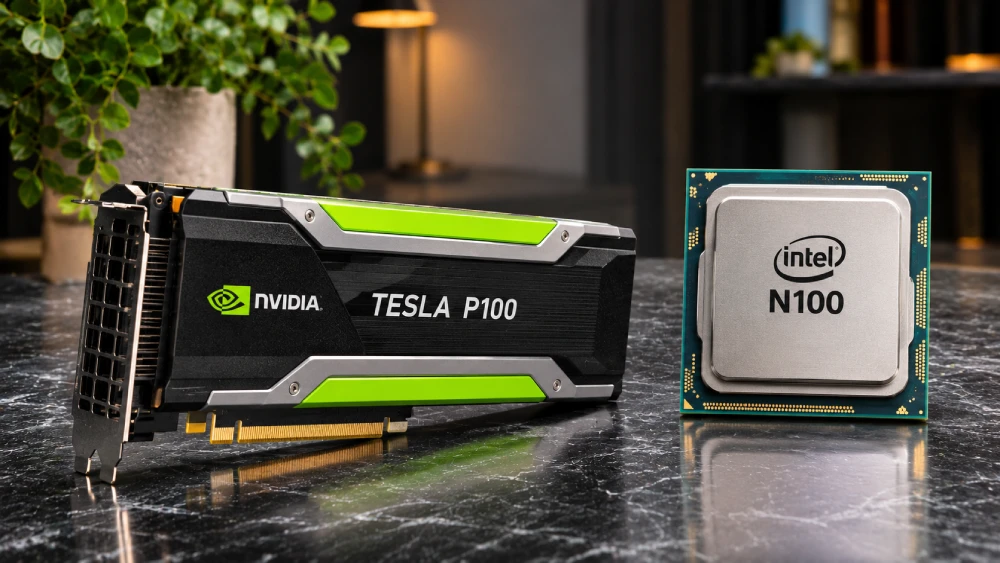

You’ll want the NVIDIA Tesla P100 if you need massive parallel processing and superior memory bandwidth for high-performance computing or AI workloads.
The P100’s 16 nm Pascal architecture, HBM2 memory, and 10.6 TFLOPS throughput outperform the Intel N100 CPU, which targets low-power, general-purpose tasks with four efficiency cores and modest single-threaded performance.
The N100 excels in compact, energy-sensitive setups, while the P100 fits demanding data-center environments. Here’s a detailed comparison to help refine your choice.

- processor calculations processor
- Tesla P100
- 16gb hbm2

- 【Powerful Performance in a Compact Form Factor】 Powered by the latest 12th Gen Intel Alder…
- 【Ample Storage and Upgrade Options】 Equipped with 16GB DDR4 RAM (max 3200MHz) and a 512GB SATA…
- 【Stunning 4K Dual Screen Support】Featuring Intel UHD Graphics (max 750MHz), this mini desktop…
Key Takeaways
- P100 is a high-throughput Pascal GPU designed for parallel computing and AI, while N100 is a low-power Alder Lake-N CPU for general-purpose tasks.
- P100 delivers up to 10.6 TFLOPS single-precision performance, vastly outperforming N100 in floating-point and parallel workloads.
- P100 uses 12-16 GB HBM2 memory with up to 732 GB/s bandwidth; N100 relies on standard system RAM with much lower throughput.
- P100 consumes up to 250 W and requires robust cooling; N100 is optimized for low power and compact, fanless systems.
- Choose P100 for high-performance computing and AI; select N100 for basic productivity and energy-efficient, space-constrained environments.
P100 vs N100: Key Differences in Performance, Architecture, Memory, and Power Efficiency
| Comparison Factors | NVIDIA Tesla P100 | Intel Processor N100 |
|---|---|---|
| Processor Type | Data-center GPU accelerator | Low-power general-purpose CPU |
| Manufacturer | NVIDIA | Intel |
| Architecture | Pascal GP100 | Alder Lake-N |
| Primary Purpose | Parallel computing and GPU acceleration | Everyday computing and power efficiency |
| Manufacturing Technology | 16 nm FinFET | Intel 7 process technology |
| Processing Cores | Thousands of CUDA cores | 4 efficiency cores |
| CPU Threads | Not applicable to GPU architecture | 4 threads |
| Floating-Point Performance | Up to approximately 10.6 TFLOPS FP32 | Not directly comparable using GPU TFLOPS |
| Memory Type | Dedicated HBM2 GPU memory | System memory, typically DDR4 or DDR5 |
| Memory Capacity | 12 GB or 16 GB, depending on variant | Depends on system configuration |
| Memory Bandwidth | Up to approximately 732 GB/s | Much lower bandwidth using system RAM |
| Power Requirements | Approximately 250 W for certain models | 6 W processor base power |
| Cooling Requirements | Requires substantial cooling, often server airflow | Suitable for compact, low-power cooling designs |
| Graphics and Display | Compute-focused GPU without conventional display outputs | Integrated Intel UHD Graphics |
| AI and Machine Learning | Supports compatible CUDA-accelerated workloads | Suitable for lightweight CPU-based workloads |
| Everyday Productivity | Requires a separate host CPU and system | Runs general-purpose applications directly |
| Best Applications | Scientific computing, parallel processing, and compatible AI acceleration | Mini PCs, office applications, media playback, and low-power systems |
Architectural Differences: P100 GPU vs N100 CPU
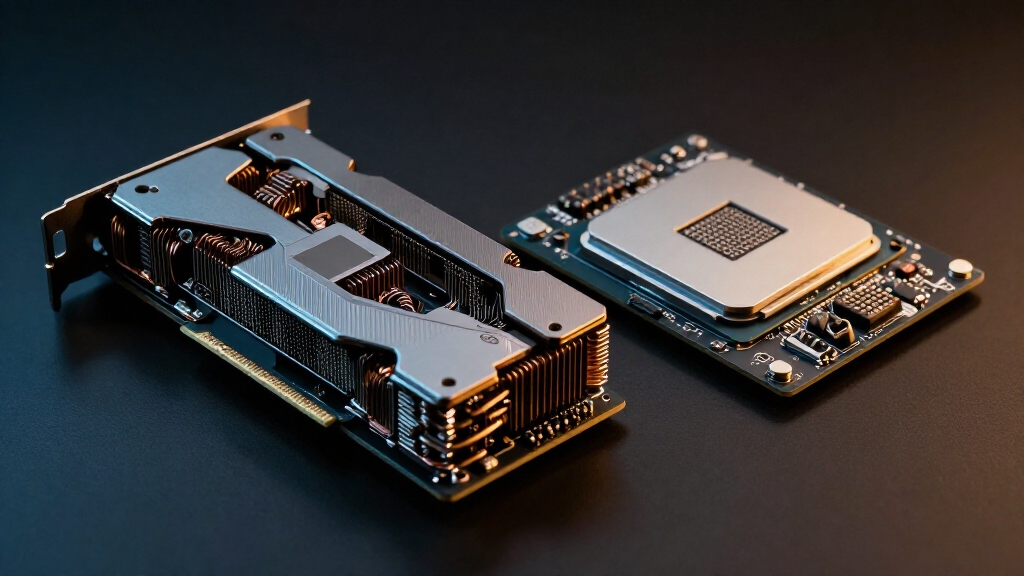
When comparing the architectural foundations of the NVIDIA Tesla P100 GPU and the Intel Processor N100 CPU, you’ll notice they’re built for fundamentally different purposes.
The P100, based on Pascal GP100 architecture, is a high-throughput parallel processor designed for data-center acceleration. It’s manufactured on a 16 nm process with specialized HBM2 memory to optimize bandwidth.
In contrast, the N100 is an Alder Lake-N CPU targeting low-power, general-purpose computing with four efficiency cores and no hyper-threading. It’s optimized for compact systems.
You’ll see the P100’s design prioritizes massive parallelism and memory bandwidth for HPC and AI workloads. Meanwhile, the N100 balances energy efficiency and everyday productivity.
This architectural divergence reflects their distinct roles: P100 as a server-class GPU accelerator and N100 as a low-power CPU for basic computing tasks. The N100’s efficiency-focused design aligns with trends in scalable and efficient setups found in modern networked systems.
Comparing Compute Performance of P100 and N100
Evaluating the compute performance of the NVIDIA Tesla P100 against the Intel Processor N100 reveals a stark contrast driven by their fundamentally different architectures and intended workloads.
Comparing NVIDIA Tesla P100 and Intel N100 highlights their vastly different architectures and specialized performance targets.
The P100, built on Pascal GP100 architecture, delivers up to 10.6 TFLOPS single-precision throughput and excels in parallel compute tasks like HPC and AI training.
In contrast, the N100 is a low-power Alder Lake-N CPU with four efficiency cores optimized for general-purpose tasks, not high-throughput compute.
You’ll find the N100’s single-threaded and lightly threaded performance suitable for office and basic workloads but nowhere near the P100’s GPU-accelerated floating-point capabilities.
When you need massive parallelism and floating-point throughput, the P100 outpaces the N100 by orders of magnitude, highlighting their non-overlapping performance domains.
This difference in design also means the P100 is better suited for high-performance computing environments requiring extensive parallel processing.
Memory and Bandwidth Advantages of P100 Over N100
Leveraging high-bandwidth memory and specialized interconnects, the NVIDIA Tesla P100 markedly outperforms the Intel Processor N100 in memory throughput and data handling.
The P100 employs 12 or 16 GB of HBM2 memory, delivering up to 732 GB/s bandwidth, far exceeding the N100’s reliance on conventional system RAM with markedly lower throughput.
This dedicated high-speed memory enables the P100 to sustain massive data flows critical for HPC and AI workloads.
Additionally, the P100’s support for PCIe Gen3 and NVLink interconnects offers up to 160 GB/s, further accelerating data movement between GPUs and CPUs.
In contrast, the N100’s memory subsystem targets general-purpose tasks, lacking the bandwidth and latency optimizations necessary for parallel compute acceleration.
You’ll find the P100 vastly superior in handling large datasets and memory-intensive computations.
This performance advantage is akin to how AI-driven alerts in advanced security cameras optimize data processing and response efficiency.
Power Consumption and Physical Design Comparison
Although both the NVIDIA Tesla P100 and Intel Processor N100 serve computing roles, their power consumption and physical designs reflect fundamentally different target environments.
The P100 demands up to 250 W and occupies a dual-slot, 10.5-inch server card form factor. It requires robust cooling and power delivery typical in data centers.
In contrast, the N100 targets low-power use cases with a compact thermal envelope designed for fanless or mini PC systems, consuming markedly less power.
This divergence reflects their architectural intent: the P100’s high power and size support parallel GPU acceleration in server racks, while the N100 prioritizes energy efficiency and compactness for everyday computing.
You’ll find the P100 unsuitable for low-power or space-constrained setups, whereas the N100 excels in those environments.
Additionally, the P100’s design aligns with environments demanding high power consumption and robust infrastructure, unlike the N100’s focus on energy efficiency.
Best Workloads for P100 and N100: Choosing the Right Fit
Identify your workload requirements carefully to choose between the NVIDIA Tesla P100 and Intel Processor N100. The P100 excels in HPC, AI training, and large-scale parallel computations. It leverages high memory bandwidth and FP32/FP16 throughput.
Conversely, the N100 suits low-power, everyday computing tasks like office apps and media playback. It focuses on energy efficiency and cost-effectiveness.
Choosing the right processor also means considering scalability and expansion to ensure your system grows with your workload needs.
| Workload Type | Best Fit |
|---|---|
| High-Performance Compute | NVIDIA Tesla P100 |
| AI and Deep Learning | NVIDIA Tesla P100 |
| Basic Productivity | Intel Processor N100 |
| Low-Power Embedded Use | Intel Processor N100 |
Choose P100 when throughput and parallelism dominate. Prefer N100 for lightweight, power-sensitive environments.
Frequently Asked Questions
Can the P100 GPU Be Used in a Standard Consumer Desktop?
You technically can install the P100 GPU in a standard consumer desktop, but it’s not designed for that environment.
The card demands substantial power (up to 250 W) and requires robust cooling.
It fits a dual-slot, 10.5-inch form factor typically supported only by server chassis.
Without proper power delivery and thermal management, you’ll face instability or hardware damage.
It’s optimized for data centers, not typical consumer desktops or gaming rigs.
Is the N100 CPU Compatible With Gaming Applications?
You’ll find the N100 CPU gently suited for casual gaming, handling less demanding titles with ease.
However, it’s not built for intense, graphics-heavy games that push modern hardware limits.
Its efficient cores prioritize low power and everyday tasks.
While you can enjoy light gaming, complex, resource-intensive games may challenge this entry-level processor’s capabilities.
For smooth gaming experiences, pairing it with a dedicated GPU helps considerably.
What Operating Systems Support the P100 GPU?
You’ll find the NVIDIA Tesla P100 GPU supports major server and workstation operating systems like Linux distributions (Ubuntu, CentOS, Red Hat) and Windows Server editions.
NVIDIA provides robust driver and CUDA toolkit support optimized for these environments, enabling HPC and AI workloads.
It doesn’t target consumer OSes but rather data-center OSes designed for GPU acceleration, parallel computing, and deep learning frameworks.
This ensures compatibility with professional and scientific computing stacks.
How Does the Price of P100 Compare to N100 Systems?
You’ll find the P100 markedly more expensive than systems with the N100 processor. The P100 is a specialized data-center GPU with high-performance hardware, pushing prices into thousands of dollars per unit.
In contrast, N100 systems target budget-conscious, low-power devices, often costing just a few hundred dollars. So, if cost-efficiency and everyday tasks matter, N100 systems are far more affordable.
The P100 suits high-end, parallel compute-heavy workloads despite the steep price.
Are There Alternatives to P100 for Low-Power AI Workloads?
Yes, you can consider alternatives like NVIDIA’s Jetson series (e.g., Jetson Xavier NX or Jetson Nano) for low-power AI workloads. They offer efficient GPU acceleration with lower power consumption.
Additionally, Intel’s Movidius Myriad X and Google’s Edge TPU provide specialized AI inference capabilities in compact, energy-efficient designs. These options deliver better power-to-performance ratios for edge AI tasks compared to data-center GPUs designed for heavy parallelism.
Choose Between GPU Power and CPU Efficiency
When choosing between the P100 GPU and N100 CPU, you’ll want to weigh their architectural strengths and workload fit carefully.
The P100 excels in compute-intensive tasks with superior memory bandwidth and parallel processing, much like a trusty abacus speeding calculations centuries ago.
Meanwhile, the N100’s design favors power efficiency and versatility for general computing.
By understanding these differences, you can make an informed decision that optimizes performance without wasting resources.
- processor calculations processor
- Tesla P100
- 16gb hbm2
- 【Powerful Performance in a Compact Form Factor】 Powered by the latest 12th Gen Intel Alder…
- 【Ample Storage and Upgrade Options】 Equipped with 16GB DDR4 RAM (max 3200MHz) and a 512GB SATA…
- 【Stunning 4K Dual Screen Support】Featuring Intel UHD Graphics (max 750MHz), this mini desktop…
Last update on 2026-11-19 / Affiliate links / Images from Amazon Product Advertising API