
You should choose Cat8 only if your network demands ultra-high speeds up to 40 Gbps within short distances of 24-30 meters.
It can justify its higher cost and complex shielding.
Cat5 remains ideal for longer runs up to 100 meters, offering reliable performance at moderate speeds up to 1 Gbps and better budget efficiency.
Matching cable choice to your actual speed, distance, and future needs maximizes value and performance.
More detailed insights will clarify the best fit for your setup.

- EXTENDED CABLE LENGTH; Extends a shorter cable to a longer length by adding 100ft/30m of distance to…
- EASY INSTALLATION; Power, video and audio runs through a single high performance Ethernet cable per…
- MULTIPLE CERTIFICATIONS: Certified by UL with a VW-1 rating for fire resistance to ensure optimal…


- Designed for Outdoor & Direct Burial Installations – Heavy-duty double-shielded Cat8 Ethernet…
- 26AWG for Stable High-Load Networks – Thicker 26AWG conductors provide faster, more stable data…
- F/FTP Shielding & Hyper-Speed Performance: Cat8 Ethernet cable constructed with 4 shielded foiled…
Key Takeaways
- Cat5 supports speeds up to 1 Gbps over 100 meters, while Cat8 supports up to 40 Gbps but only up to 30 meters.
- Cat8 features advanced shielding (S/FTP) for superior EMI protection and minimal crosstalk compared to Cat5’s unshielded twisted pairs.
- Cat5 is cost-effective and suitable for general office/home use, whereas Cat8 is expensive and designed for data centers and high-speed links.
- Cat8 operates at frequencies up to 2000 MHz, vastly outperforming Cat5’s 100 MHz bandwidth for high-throughput demands.
- Choose Cat5 for extended cable runs and moderate speeds; opt for Cat8 only when short-distance, ultra-high-speed network performance is essential.
Cat5 vs Cat8: Key Differences in Speed, Bandwidth, Distance, and Network Performance
| Comparison Factors | Cat5 Ethernet Cable | Cat8 Ethernet Cable |
|---|---|---|
| Cable Category | Category 5 | Category 8 |
| Typical Network Speed | 100 Mbps, with Gigabit support possible on suitable installations | 25 Gbps or 40 Gbps with compatible equipment |
| Maximum Supported Speed | Up to 1 Gbps under suitable conditions, although 100 Mbps is the conventional baseline | Up to 40 Gbps over specified short-distance links |
| Frequency Bandwidth | 100 MHz | 2000 MHz |
| Maximum Cable Distance | 100 meters (328 feet) for supported Ethernet applications | 30 meters (approximately 98 feet) for 25G/40GBASE-T channels |
| Permanent Link Length | Up to 90 meters in a conventional structured cabling layout | Up to 24 meters |
| Shielding Type | Typically UTP (Unshielded Twisted Pair) | Shielded construction, commonly S/FTP |
| EMI Protection | Basic interference resistance through twisted pairs | Enhanced protection against electromagnetic interference |
| Crosstalk Reduction | Standard twisted-pair crosstalk control | Advanced shielding for improved crosstalk control |
| Cable Flexibility | Generally thinner and easier to route | Typically thicker and less flexible |
| Connector Type | Commonly 8P8C modular connectors (RJ45-style) | Shielded 8P8C modular connectors in common installations |
| Backward Compatibility | Supports older compatible Ethernet equipment | Can connect to lower-speed compatible Ethernet equipment |
| Installation Complexity | Simpler cable routing and termination | More demanding shielding and termination requirements |
| Power over Ethernet | Possible with suitable cable and supported equipment | Supports PoE when cable and equipment meet applicable requirements |
| Common Applications | Older home networks, basic office connections, and legacy systems | Data centers, server rooms, and short high-speed links |
| Future Network Upgrades | Limited by its lower bandwidth classification | High bandwidth for specialized short-distance connections |
| Overall Recommendation | Retain for compatible legacy networks; consider newer cabling for upgrades | Choose for compatible 25G/40G short-distance applications |
Cat5 vs Cat8: Which Cable Should You Choose?
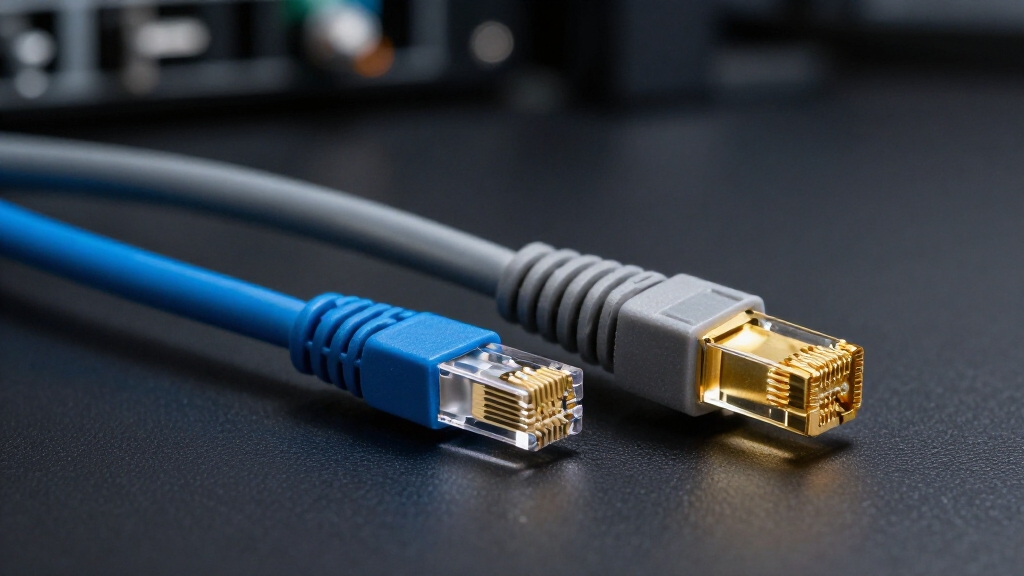
When deciding between Cat5 and Cat8 cables, you need to take into account your network’s speed requirements, distance constraints, and budget.
Consider your network speed, distance needs, and budget when choosing between Cat5 and Cat8 cables.
Cat5 supports up to 100 meters and suits standard Ethernet speeds. It’s effective for general-purpose and longer runs at lower costs.
Cat8 is engineered for short distances, up to 30 meters maximum, and delivers markedly higher shielding and performance. It’s ideal for high-speed 25GBASE-T and 40GBASE-T applications.
You should opt for Cat8 only if your equipment and network demands justify the expense and limited range. If you require reliable, budget-friendly cabling for moderate speeds over extended distances, Cat5 remains practical.
Conversely, choose Cat8 when short, high-throughput links and future-proofing outweigh cost and length considerations.
Both cables typically use twisted pairs with polyethylene insulation designed to reduce interference and maintain signal integrity.
How Do Cat5 and Cat8 Compare in Speed and Bandwidth?
How much faster can Cat8 run compared to Cat5?
Cat8 supports data rates up to 40 Gbps, vastly outpacing Cat5’s typical 100 Mbps and occasional gigabit Ethernet capability.
This difference stems from Cat8’s ability to operate at frequencies up to 2000 MHz, compared to Cat5’s 100 MHz bandwidth.
Consequently, Cat8 handles markedly higher throughput and supports modern 25GBASE-T and 40GBASE-T applications, making it suitable for data centers and high-performance setups.
In contrast, Cat5 targets lower-speed environments, adequate for basic networking but insufficient for emerging high-speed demands.
When you require maximum bandwidth and speed, Cat8 offers roughly 400 times the nominal data rate of Cat5, reflecting a substantial leap in performance driven by advanced shielding and cabling technology.
Additionally, the use of PoE technology with higher-category cables like Cat8 can simplify power and data delivery, enhancing installation efficiency and reliability.
How Far Can Cat5 and Cat8 Cables Run?
When considering cable options, it’s important to note that Cat5 cables can reliably run up to 100 meters. This makes them a solid choice for longer in-building installations.
On the other hand, Cat8 cables are designed for much higher speeds but come with a catch—they’re limited to shorter runs of about 30 meters. Plus, there’s a permanent link length cap at 24 meters.
Additionally, choosing the correct cable jacket type, such as plenum-rated cable, is essential for meeting fire safety codes based on the installation environment.
Maximum Distance Limits
In networking setups, understanding the maximum cable distance is essential for maintaining signal integrity and performance.
Cat5 cables can run up to 100 meters (328 feet) on standard Ethernet connections, making them suitable for longer in-building runs.
In contrast, Cat8 cables are designed for high-speed, short-distance applications, with a maximum channel length of 30 meters (100 feet) and a permanent link length capped at 24 meters (78 feet).
These limits reflect Cat8’s emphasis on minimizing attenuation and crosstalk at very high frequencies.
Cat5 supports longer distances but at lower speeds and bandwidth.
Cat8 prioritizes speed and shielding, limiting its maximum usable length.
Exceeding specified limits can degrade performance and cause signal loss.
You should choose cable types based on your network’s distance and speed demands.
Using cables with PoE capability can also simplify powering devices like IP cameras while maintaining network performance.
Suitable Installation Lengths
Because cable length directly impacts signal quality and network performance, selecting the appropriate installation length for Cat5 and Cat8 cables is essential.
Cat5 cables support runs up to 100 meters (328 feet) without significant degradation, making them ideal for longer in-building installations where moderate speeds suffice.
In contrast, Cat8 cables are optimized for short, high-speed connections, with maximum channel lengths limited to 30 meters (100 feet) and permanent link lengths capped at 24 meters (78 feet).
This restriction stems from Cat8’s higher frequency operation and shielding requirements, which reduce signal loss but limit distance.
When planning your network, choose Cat5 for extended runs with standard speeds and Cat8 when you need ultra-high throughput over short distances, such as in data centers or server racks.
Moreover, understanding the distance limits of Ethernet cables is crucial to ensure optimal performance and avoid signal degradation in your network setup.
Why Shielding Matters: Cat5 vs Cat8 Cable Construction?
When it comes to Cat8 cables, you’ll see that they use advanced shielding techniques like S/FTP. This helps minimize crosstalk and keeps the signal strong, even at high frequencies.
On the other hand, Cat5 cables are pretty basic—they rely on twisted pairs with just a bit of shielding.
This difference really matters, especially if you’re in an environment with a lot of electromagnetic interference. It can directly impact the quality and performance of your network.
To ensure reliable performance, it’s also important to use weatherproof cables and connectors when installing outdoor network wiring.
Shielding Types Explained
Although both Cat5 and Cat8 cables rely on twisted copper pairs to transmit data, their shielding designs differ markedly, impacting performance in high-frequency environments.
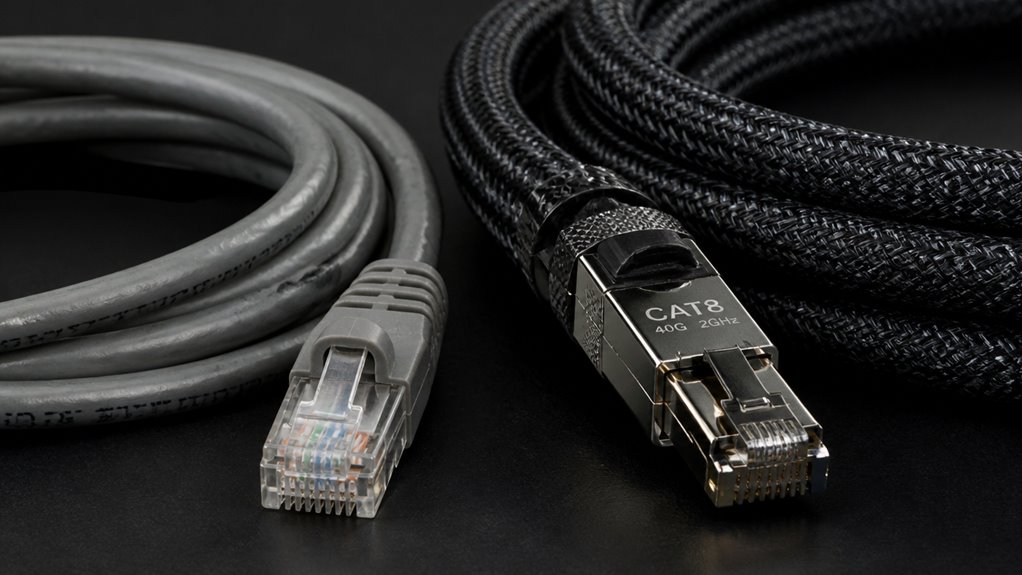
Cat5 typically uses unshielded twisted pairs (UTP), which suffice for lower-frequency signals but offer limited protection against electromagnetic interference (EMI).
Cat8, however, employs a sophisticated shielded configuration, commonly S/FTP (shielded foil twisted pair), where each pair is individually foil-shielded and the entire cable is wrapped in an overall braid shield.
This advanced shielding provides superior EMI and crosstalk mitigation for ultra-high frequencies. It also enhances signal integrity in dense data center environments.
Additionally, it increases cable rigidity and cost due to complex materials and construction.
Understanding these shielding types helps you select the right cable for your performance and environmental requirements.
When selecting cables, considering fire safety ratings is crucial, especially in environments requiring plenum-rated cables with low-smoke, flame-retardant jackets.
Impact on Signal Quality
When you compare Cat5 and Cat8 cables, the shielding design directly influences signal quality by controlling electromagnetic interference (EMI) and crosstalk.
Cat8’s S/FTP shielding markedly reduces noise, ensuring data integrity at high frequencies up to 2000 MHz.
In contrast, Cat5’s limited shielding struggles beyond 100 MHz. This difference affects reliability in high-speed environments, where interference can degrade signals.
| Feature | Cat5 | Cat8 |
|---|---|---|
| Shielding Type | Unshielded or simple | S/FTP (shielded pairs) |
| EMI Protection | Low | High |
| Crosstalk Control | Moderate | Excellent |
| Max Frequency | 100 MHz | 2000 MHz |
| Suitable Use | Basic networks | Data centers, 40G Ethernet |
You’ll get cleaner signals and less packet loss with Cat8 in demanding setups. Choosing the right cable depends on balancing coverage and detail, similar to selecting the appropriate lens focal length in security cameras for optimal performance.
Are Cat5 and Cat8 Connectors Compatible?
Since both Cat5 and Cat8 cables use the standard 8-position modular connector, commonly known as RJ-45 or 8P8C, their connectors are physically compatible. This means you can plug a Cat8 cable into a Cat5 port and vice versa without issue.
However, compatibility in connectors doesn’t imply identical performance or support for maximum speeds.
Keep in mind:
Cat8 connectors maintain backward compatibility with Cat5e, Cat6, and Cat6a systems, provided the hardware supports it.
The connector design alone doesn’t influence data rates; cable category and length govern performance.
Using Cat8 connectors with Cat5 cable will limit speeds to what the Cat5 cable can handle, typically up to 100 Mbps or 1 Gbps.
For optimal network performance and to avoid IP conflicts, it is important to assign static IP addresses appropriately when configuring devices connected via these cables.
Which Handles Interference Better: Cat5 or Cat8?
While Cat5 and Cat8 cables share connector compatibility, their ability to handle interference differs markedly due to construction and shielding.
Cat5 cables use unshielded twisted pairs, offering basic crosstalk reduction suitable for 100 MHz bandwidth environments.
Cat5 cables feature unshielded twisted pairs, providing fundamental crosstalk reduction ideal for 100 MHz bandwidth scenarios.
In contrast, Cat8 employs shielded twisted pairs (S/FTP), incorporating individual shielding around each pair plus an overall shield.
This design markedly reduces electromagnetic interference (EMI) and alien crosstalk, especially at Cat8’s higher frequencies up to 2000 MHz.
When you deploy Cat8, you benefit from minimized signal degradation in high-density or electrically noisy environments.
Cat5’s simpler construction makes it vulnerable to interference beyond moderate speeds and distances.
Consequently, if you require superior interference rejection for high-speed data transmissions, Cat8 clearly outperforms Cat5 through advanced shielding and twisted-pair engineering.
Additionally, advanced systems leverage H.265+ compression to efficiently handle large data volumes, highlighting the importance of high-quality cabling in maintaining signal integrity.
Cat8 Cost: When Is It Worth the Investment?
Although Cat8 cables come with a higher price tag due to advanced shielding and materials, investing in them makes sense only if your network equipment and speed requirements justify the expense.
You should weigh the cost against your actual performance needs and deployment environment. Consider these factors carefully:
You require ultra-high data rates (up to 40 Gbps) typically found in data centers or specialized setups.
Your cable runs are short (under 30 meters), where Cat8’s enhanced shielding reduces interference and signal loss.
Future-proofing your infrastructure against rapid technology upgrades outweighs the upfront cost.
If your network operates below 10 Gbps or requires longer cable runs, Cat8’s premium cost may not deliver proportional benefits.
In such cases, lower-category cables like Cat5 or Cat6 remain more cost-effective.
Where Do You Use Cat5 vs Cat8 Cables?
You’ll find Cat5 cables primarily in everyday home and office networks where moderate speeds and longer cable runs are common.
Cat5 supports up to 100 Mbps and can reach lengths of 100 meters, making it ideal for general-purpose networking with standard Ethernet equipment.
In contrast, Cat8 is designed for data centers and environments demanding ultra-high speeds up to 40 Gbps over short distances, typically no longer than 30 meters.
Its fully shielded twisted-pair construction minimizes crosstalk and signal loss in high-frequency, high-throughput scenarios.
You’d use Cat8 for 25GBASE-T or 40GBASE-T applications requiring robust shielding and minimal latency.
For most residential or typical office setups, Cat5 is sufficient due to its cost-effectiveness and longer reach.
Cat8 suits specialized, short-distance links where maximum bandwidth and shielding are critical.
Future-Proofing Your Network: Cat5 vs Cat8
To future-proof your network, it’s all about finding the right balance between speed, bandwidth needs, and how long you want your setup to last.
You’ve got Cat8 on one side, which really shines with its higher data rates and extra shielding. However, it does come with a steeper price tag and a shorter maximum cable length compared to Cat5.
Speed And Bandwidth
Understanding the speed and bandwidth differences between Cat5 and Cat8 cables is essential when future-proofing your network.
Cat5 supports up to 100 Mbps with a 100 MHz bandwidth, adequate for many home or office setups but limited for high-demand tasks.
In contrast, Cat8 delivers up to 40 Gbps and 2000 MHz bandwidth, designed for cutting-edge applications like 25GBASE-T and 40GBASE-T.
When choosing between them, consider:
Cat5’s maximum bandwidth suits basic and moderate-speed needs.
Cat8 offers roughly 400 times the bandwidth of Cat5, enabling ultra-high throughput.
Cat8’s performance supports short-distance, data-intensive environments requiring extreme speed.
Longevity And Compatibility
While speed and bandwidth define immediate capabilities, longevity and compatibility determine how well your network adapts to evolving technologies.
Cat8 offers superior future-proofing due to its support for 25GBASE-T and 40GBASE-T standards, enabling compatibility with emerging high-speed equipment. Its shielded twisted-pair construction and robust materials also extend cable lifespan in demanding environments.
Conversely, Cat5’s simpler design and lower performance limit its relevance as network speeds increase, though it remains compatible with most standard Ethernet hardware.
Importantly, Cat8 connectors maintain backward compatibility with Cat5e and Cat6 devices, easing integration during upgrades.
However, you must consider Cat8’s shorter maximum cable lengths, which may constrain installation flexibility compared to Cat5’s longer reach.
Ultimately, Cat8 better guarantees long-term adaptability, while Cat5 suits legacy systems with modest speed needs.
Cost Versus Performance
When weighing Cat5 against Cat8, you need to balance upfront costs with long-term network performance and scalability. Cat5 offers a budget-friendly option with adequate speeds for many home or small office setups, but it caps at 100 Mbps or 1 Gbps depending on the variant.
Conversely, Cat8 demands a higher initial investment due to advanced shielding and materials. Yet it delivers up to 40 Gbps, ideal for data centers or bandwidth-intensive environments.
Consider these factors:
- Cost efficiency: Cat5 suits low-speed, longer runs without breaking the bank.
- Performance needs: Cat8 excels in short, high-speed links where maximum throughput is critical.
- Future-proofing: Cat8’s superior bandwidth supports evolving network demands, justifying its price if you require scalability.
Choose based on your specific workload and network lifespan expectations.
How to Pick the Right Cable for Your Network Needs?
Assess your network’s speed requirements and physical layout before choosing between Cat5 and Cat8 cables.
Evaluate your network speed and layout carefully to select the right cable between Cat5 and Cat8.
If your setup demands speeds up to 1 Gbps over longer distances, Cat5’s 100-meter range and simpler construction suffice.
However, for high-throughput environments requiring 25 or 40 Gbps within 30 meters, Cat8’s superior shielding and bandwidth (up to 2000 MHz) are essential.
Consider the installation’s physical constraints. Cat8’s shorter maximum length (24-30 meters) limits its use to data centers or server racks.
Cat5 suits broader in-building runs. Also, evaluate budget versus performance; Cat8’s advanced materials increase cost and complexity.
Ultimately, pick Cat5 for cost-effective, moderate-speed networks and Cat8 for short-distance, high-speed, interference-sensitive applications.
Ensure compatibility with your existing hardware and future scalability needs.
Frequently Asked Questions
Can Cat8 Cables Be Used Outdoors or Buried Underground?
Cat8 cables aren’t designed for outdoor use or burial without additional protection. Their shielding helps with interference but doesn’t provide weatherproofing or UV resistance.
If you need to run Cat8 outdoors or underground, you’ll have to use specialized outdoor-rated conduits or armored cables to protect against moisture, temperature changes, and physical damage.
Otherwise, the cable’s performance and longevity might degrade markedly in such environments.
How Do Cat5 and Cat8 Cables Perform in Extreme Temperatures?
Think of Cat5 as a sturdy old ship built for calm seas.
It handles moderate temperature swings but struggles in extremes.
Cat8 is like a high-tech submarine, engineered with shielding and materials that better withstand harsh thermal conditions.
You’ll find Cat8 maintains signal integrity and performance more reliably in extreme temperatures.
Cat5’s simpler build makes it more vulnerable to degradation and reduced lifespan under intense heat or cold.
Are There Differences in Cable Flexibility Between Cat5 and Cat8?
You’ll notice Cat5 cables are generally more flexible than Cat8 due to their simpler, unshielded or lightly shielded construction.
Cat8’s heavy shielding and thicker insulation reduce its bend radius, making it stiffer and harder to route in tight spaces.
If you need easy handling and frequent maneuvering, Cat5 suits better.
But for high-frequency environments where shielding’s essential, you’ll accept less flexibility with Cat8 for improved performance.
What Tools Are Needed to Install Cat8 Compared to Cat5?
You’ll need a precision cable stripper and a heavy-duty crimping tool for Cat8, as its thicker shielding requires careful handling.
Unlike Cat5, Cat8 demands shielded connectors and a torque wrench to guarantee proper grounding.
Maintaining the 24-meter maximum link length means you’ll also use a cable tester supporting 25G/40G speeds to verify integrity.
These tools guarantee high-frequency performance and reduce crosstalk, critical for Cat8’s 2000 MHz bandwidth.
Can Cat8 Cables Support Power Over Ethernet (Poe) Applications?
Yes, Cat8 cables can support Power over Ethernet (PoE) applications. Their shielded twisted-pair construction and higher-quality materials handle the electrical current required for PoE efficiently.
However, you need to make certain your network equipment supports PoE standards compatible with Cat8.
Also, keep in mind Cat8’s shorter maximum length limits might affect deployment in PoE setups. Plan cable runs carefully to maintain both power delivery and data performance.
Choose the Right Cable for Speed and Reliability
Choosing between Cat5 and Cat8 cables is like selecting the right tool from a toolbox: Cat5 suits basic, everyday tasks, while Cat8 handles high-demand, cutting-edge projects.
You’ll want to weigh speed, distance, shielding, and cost against your network needs.
By understanding these factors, you can future-proof your setup efficiently.
This ensures your connection runs smoothly without overspending on unnecessary capabilities.
Make your choice with precision for peak network performance.
- EXTENDED CABLE LENGTH; Extends a shorter cable to a longer length by adding 100ft/30m of distance to…
- EASY INSTALLATION; Power, video and audio runs through a single high performance Ethernet cable per…
- MULTIPLE CERTIFICATIONS: Certified by UL with a VW-1 rating for fire resistance to ensure optimal…
- Designed for Outdoor & Direct Burial Installations – Heavy-duty double-shielded Cat8 Ethernet…
- 26AWG for Stable High-Load Networks – Thicker 26AWG conductors provide faster, more stable data…
- F/FTP Shielding & Hyper-Speed Performance: Cat8 Ethernet cable constructed with 4 shielded foiled…
Last update on 2026-11-05 / Affiliate links / Images from Amazon Product Advertising API