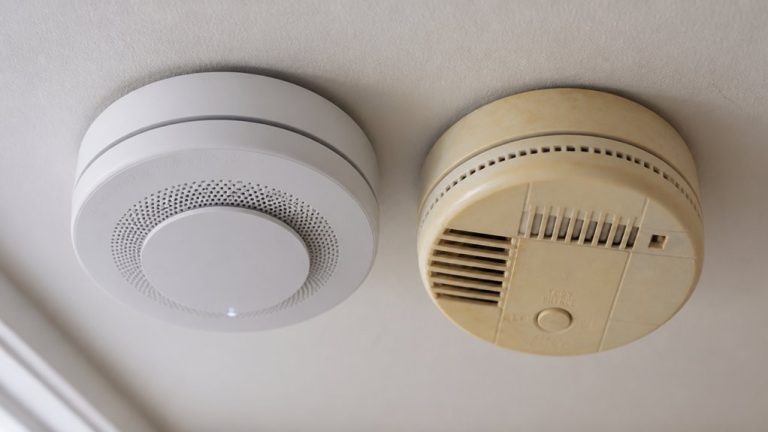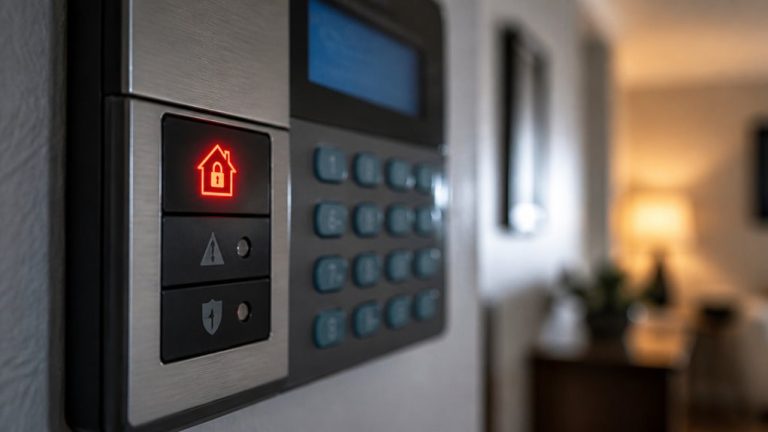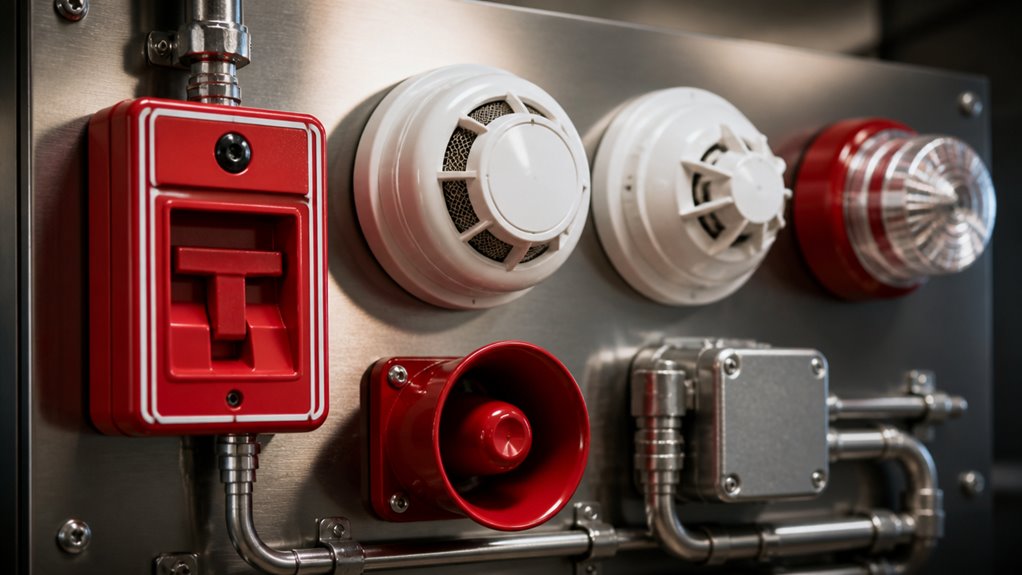

You’ll find four main types of fire alarm systems: conventional, addressable, wireless, and intelligent.
Conventional systems group devices into zones, making them cost-effective for small sites.
Addressable systems assign unique IDs to each device, enabling precise fault and alarm pinpointing. This makes them ideal for large or complex facilities.
Wireless systems use RF signals to avoid extensive wiring, which is suited for retrofits or challenging layouts.
Intelligent systems analyze multiple sensors for fewer false alarms and enhanced reliability.
Exploring their features helps match the best system to your building’s needs.
Key Takeaways
- Conventional systems use zone-based detection, suitable for small properties and simple layouts with cost-effective installation.
- Addressable systems assign unique addresses to devices, enabling precise alarm source identification and reducing troubleshooting time.
- Wireless systems communicate via radio frequency, offering flexible installation where wiring is impractical or costly.
- Intelligent systems analyze multiple sensor inputs dynamically, reducing false alarms and supporting predictive maintenance in complex environments.
- Integrated systems combine flame, gas, heat, and smoke detectors for precise detection and fewer nuisance alarms in specialized facilities.
Fire Alarm System Types: Conventional, Addressable, Wireless, and Intelligent
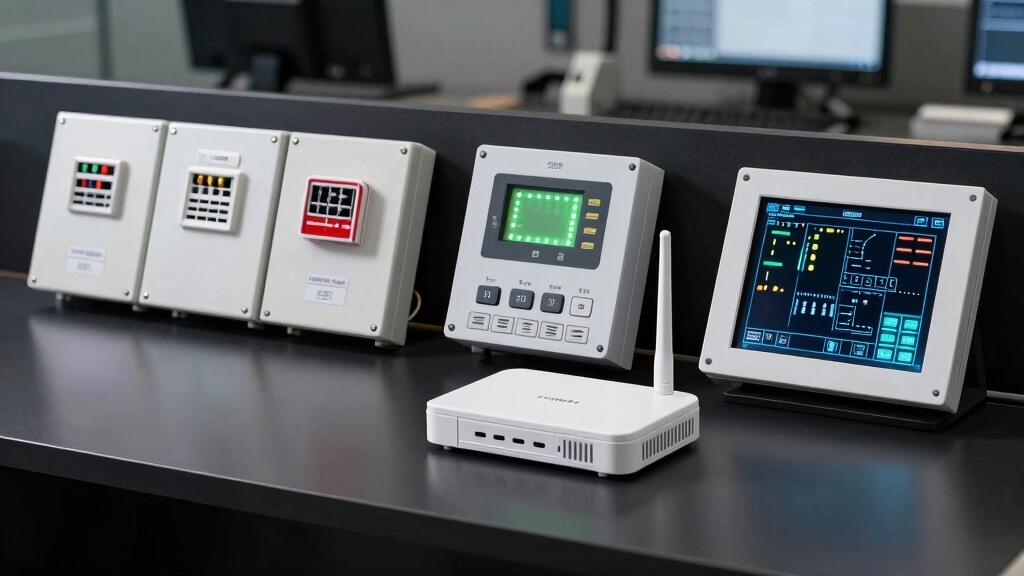
When selecting a fire alarm system, you’ll encounter four primary types: conventional, addressable, wireless, and intelligent.
Choosing a fire alarm system involves understanding four main types: conventional, addressable, wireless, and intelligent.
Conventional systems segment wiring into zones, allowing the panel to identify only the general area of activation. This limits pinpointing exact device faults.
Addressable systems assign unique identifiers to each device, enabling precise location tracking and streamlined troubleshooting.
Wireless systems rely on radio frequency communication, useful where physical wiring proves impractical or costly. However, they may require careful frequency management to prevent interference.
Intelligent systems analyze device inputs dynamically, reducing false alarms and supporting remote diagnostics through advanced algorithms.
Your choice depends on building complexity, installation constraints, and desired monitoring precision. Addressable and intelligent systems are favored for larger or critical facilities, while conventional and wireless often suit simpler or retrofit scenarios.
Addressable fire alarm systems also provide device-level monitoring and diagnostics, improving maintenance efficiency and reducing false alarms.
Key Components Required in Code-Compliant Fire Alarm Systems
Although fire alarm systems vary widely in design, certain core components remain essential to meet code requirements and guarantee reliable operation.
You need initiating devices like smoke detectors, heat detectors, pull stations, and sprinkler water flow switches to detect fire conditions.
Notification appliances such as horns, strobes, and speakers alert occupants effectively.
The fire alarm control panel acts as the system’s brain, monitoring inputs, managing outputs, and coordinating responses.
Backup power supplies guarantee continuous operation during outages, complying with safety codes.
Additionally, communication links to monitoring centers or emergency responders are critical for rapid intervention.
Each component must be supervised and integrated precisely to maintain compliance and system reliability.
This assures timely detection, occupant notification, and emergency response coordination within your fire protection strategy.
A qualified project manager ensures that all components meet NFPA 72 standards and local codes for safety and compliance.
Manual vs Automatic Fire Alarm Activation
Understanding how fire alarms are activated is fundamental to designing an effective system. You must choose between manual and automatic activation based on your building’s use and risk profile.
Manual systems require a person to trigger the alarm, usually via a pull station. This method relies on occupant awareness and timely response. However, it provides precise activation control.
Automatic systems detect fire indicators such as smoke, heat, or water flow, activating the alarm without human intervention. These systems improve response times and reduce reliance on occupant action. However, they may generate false alarms if not properly configured.
Combining manual and automatic initiating devices enhances overall reliability. This ensures prompt detection and notification under varied conditions. Your selection impacts system complexity, maintenance, and occupant safety effectiveness.
Before troubleshooting any fire alarm equipment, it is critical to contact authorities and place the system in test mode to coordinate response and compliance.
Common Fire Alarm Smoke Detector Technologies and Uses
You’ll come across two main types of smoke detector technologies: ionization and photoelectric. They each have their own strengths when it comes to detecting different kinds of fires. For instance, ionization detectors are really good at spotting flaming fires. On the other hand, photoelectric units shine when it comes to detecting smoldering fires.
Now, here’s the interesting part: if you combine both technologies in one detector, you get a system that’s not only more reliable but also helps cut down on false alarms. So, it’s definitely worth considering a combo detector for better safety in your space!
Photoelectric alarms provide early warning for slow, smoldering fires by detecting larger smoke particles through light scattering, giving occupants crucial extra time to respond before flames develop.
Ionization vs Photoelectric
When selecting smoke detectors for a fire alarm system, you’ll encounter two primary technologies: ionization and photoelectric.
Ionization detectors use a small radioactive source to ionize air between two electrodes. They detect smoke by changes in current caused by smaller, fast-flaming particles.
They respond quickly to flaming fires but are less sensitive to smoldering smoke.
Photoelectric detectors employ a light source and sensor; smoke particles scatter light into the sensor, triggering the alarm.
These detectors excel at sensing larger particles from smoldering fires, offering earlier warning in those conditions.
Choosing between them depends on the fire risk scenario: ionization suits fast-flaming fire detection, while photoelectric is preferable for slower, smoldering fires.
Understanding these functional differences helps you optimize detection efficacy for specific environments.
Ionization alarms contain a tiny amount of americium-241, a radioactive element that enables their detection mechanism while remaining safe for home use.
Combined Detector Advantages
Both ionization and photoelectric detectors have distinct strengths in sensing different fire conditions, but relying on one technology alone can leave gaps in detection coverage.
Combined ionization/photoelectric detectors integrate both sensing methods, improving detection reliability across diverse fire scenarios. This dual-technology approach enhances early warning capabilities by detecting both flaming and smoldering fires effectively.
When you choose combined detectors, you benefit from:
- Broader detection spectrum addressing multiple fire types
- Reduced false alarms due to complementary sensor validation
- Simplified installation versus separate devices for each technology
- Compliance with safety codes favoring multi-criteria detection
Additionally, dual-sensor units provide enhanced all-encompassing detection by combining the strengths of both sensor types in a single device.
Selecting Heat, Flame, and Gas Detectors for Fire Alarm Systems
When you’re choosing detectors for your fire alarm system, it’s important to think about heat sensors, especially in places where smoke detection mightn’t work well—like areas filled with dust or fumes. They can really save the day in those tricky environments.
Now, if you’re in an industrial setting, flame detectors become essential. They help you quickly spot visible flames, which is super important for maintaining safety. You want to catch any signs of trouble as fast as possible, right?
And let’s not forget about gas detectors! These little heroes are crucial for spotting hazardous combustion gases before things get out of hand. They give you that extra layer of protection, ensuring that fire conditions don’t escalate unexpectedly. So, it’s all about choosing the right detectors for the specific challenges you face! Proper maintenance, including regular cleaning to prevent dust and debris buildup, ensures the sensors remain accurate and reliable.
Heat Detector Advantages
Recognize that heat detectors excel in environments where smoke detection may prove unreliable, such as areas with high levels of dust, steam, or fumes.
You’ll find heat detectors advantageous when you need stable detection unaffected by airborne particulates or atmospheric conditions that trigger false alarms in smoke detectors.
Their precision in sensing temperature rise or rate-of-rise events guarantees timely fire identification in challenging settings.
Key advantages include:
- Robust operation in dusty, humid, or smoky environments
- Reduced false alarm rates compared to smoke detectors in contaminated air
- Simple installation and maintenance with fewer sensitivity adjustments
- Compatibility with various fire alarm system types, including conventional and addressable
For reliable operation, it is essential to maintain detectors properly and replace batteries promptly, especially when a low-battery chirp is detected.
Flame Detector Applications
Flame detectors provide essential fire detection capabilities in environments where visible flames pose the primary hazard. You’ll find them especially useful in industrial settings like chemical plants, refineries, and manufacturing facilities where rapid flame detection limits damage and enhances safety.
Unlike smoke or heat detectors, flame detectors respond instantly to ultraviolet (UV) or infrared (IR) radiation emitted by flames, offering precise, real-time fire identification. When selecting flame detectors, consider the specific wavelength sensitivity, field of view, and potential false alarm sources such as welding or sunlight.
Integrating flame detectors within addressable or intelligent systems improves fire response accuracy by enabling exact device location identification and reducing nuisance alarms. Ultimately, you’ll rely on flame detectors where early flame recognition is critical to protecting assets and personnel from fast-developing fires. For smaller or less complex properties, simpler zone-based detection systems can complement flame detectors to provide reliable and cost-effective fire protection through zone-based detection.
Gas Detector Importance
Following the rapid detection capabilities of flame detectors, gas detectors add another essential layer of protection by identifying hazardous gases that may signal combustion or fire risks before flames or smoke become apparent.
You’ll find them indispensable in environments where combustible or toxic gases accumulate silently. They enable earlier intervention.
When selecting gas detectors, consider these factors:
- Sensitivity to specific gases relevant to your facility’s processes.
- Integration capability with existing fire alarm control panels for real-time monitoring.
- Response time to guarantee immediate hazard recognition.
- Environmental conditions affecting detector performance, such as temperature and humidity.
Using gas detectors enhances overall fire safety by providing early warnings and reducing false alarms. They also support compliance with safety codes.
You’ll strengthen your system’s reliability by incorporating these detectors alongside heat and flame sensors. Proper placement and maintenance of gas detectors are crucial to ensure optimal performance and early hazard detection, especially in areas prone to gas buildup or poor ventilation, as recommended in detector placement guidelines.
Which Initiating Devices Trigger Fire Alarms and How?
Although fire alarm systems vary in complexity, they all rely on initiating devices to detect conditions that warrant an alarm. You’ll find two main categories: automatic devices like smoke detectors, heat detectors, flame detectors, and sprinkler water flow switches, and manual devices such as pull stations.
Automatic devices continuously monitor environmental changes, smoke density, temperature rise, visible flames, or water flow. They trigger alarms once thresholds are met. Manual devices require a person to activate them.
The fire alarm control panel supervises these devices via dedicated circuits, ensuring system integrity. In addressable systems, each device’s unique address lets you identify the exact source of activation. In conventional systems, only the zone is identified. This precise or zonal detection enables prompt and effective emergency response.
How Wireless Fire Alarm Systems Work and When to Use Them?
While conventional and addressable fire alarm systems rely on hardwired connections to supervise initiating devices, wireless fire alarm systems use radio frequency (RF) communication to link detectors, pull stations, and control panels.
Wireless fire alarm systems connect devices using radio frequency, eliminating the need for hardwired supervision.
This eliminates the need for complex cabling, easing installation in retrofit or architecturally sensitive environments. Wireless systems maintain continuous supervision through encrypted RF signals, guaranteeing device integrity and timely alerts.
You should consider wireless systems when:
- Physical wiring is impractical or cost-prohibitive.
- Temporary or modular buildings require flexible system deployment.
- Architectural constraints limit conduit installation.
- Rapid installation and future scalability are priorities.
Wireless fire alarms offer reliable, code-compliant performance but require careful RF site surveys to mitigate interference and guarantee signal robustness.
Key Features That Set Intelligent Fire Alarm Systems Apart
Intelligent fire alarm systems really stand out because they actively analyze device inputs. This helps reduce false alarms, which is a big win for overall reliability.
Nobody wants to deal with unnecessary alarms, right?
Plus, these systems come with remote diagnostic capabilities. This means you can keep an eye on the system status and troubleshoot any issues without having to be there in person.
How convenient is that?
All of these features work together to enhance operational efficiency and improve response accuracy, especially in critical fire safety environments.
It’s definitely a game changer!
False Alarm Reduction
Because false alarms can disrupt operations and drain resources, intelligent fire alarm systems incorporate advanced features to minimize these occurrences. You’ll benefit from sophisticated algorithms that analyze sensor data to distinguish real threats from nuisances, like dust or steam.
These systems continuously assess environmental inputs to prevent unwarranted alerts without compromising safety.
Key false alarm reduction features include:
- Multi-criteria detection combining smoke, heat, and gas sensor data for reliable verification.
- Adaptive sensitivity adjusting thresholds based on historical alarm patterns and environmental conditions.
- Cross-device correlation identifying consistent signals across multiple detectors before triggering alarms.
- Temporary isolation of nuisance-triggering devices to maintain system integrity during maintenance or environmental changes.
Remote Diagnostic Capabilities
When you manage complex fire alarm systems, remote diagnostic capabilities become essential for maintaining operational integrity without physical site visits.
These intelligent systems enable you to monitor device status, system faults, and alarms in real-time via secure network connections.
You can pinpoint device malfunctions or communication issues promptly, reducing downtime and maintenance costs.
Remote diagnostics also support predictive maintenance by analyzing trends in sensor performance, allowing proactive interventions before failures occur.
This capability is especially critical in large or high-reliability facilities where continuous operation is mandatory.
By integrating remote diagnostics, you enhance system responsiveness, optimize resource allocation, and improve overall safety.
This feature distinctly sets intelligent fire alarm systems apart from conventional or addressable systems lacking thorough remote monitoring functions.
Choosing the Best Fire Alarm System for Your Building Type
In selecting the ideal fire alarm system for your building, consider factors such as size, complexity, and operational requirements to guarantee effective detection and response. Your choice should align with the building’s use, layout, and hazard profile to optimize safety and compliance.
For small properties, conventional systems offer cost-effective, zone-based detection suitable for straightforward layouts.
Larger or complex facilities benefit from addressable systems, enabling precise device identification for quicker troubleshooting.
In environments with wiring challenges, wireless systems provide flexible installation without compromising coverage.
Industrial or specialized buildings may need integrated flame or gas detectors, supplementing smoke and heat sensors for thorough hazard detection.
Analyzing these parameters assures you select a system tailored to your building’s unique needs and operational demands.
Benefits of Addressable and Intelligent Systems for Large Facilities
Maximize your large facility’s fire safety by leveraging the advanced capabilities of addressable and intelligent fire alarm systems.
These systems assign unique addresses to each initiating device, enabling you to pinpoint the exact source of an alarm quickly. This precision reduces troubleshooting time and minimizes operational disruptions.
Intelligent systems further enhance reliability by analyzing sensor data to differentiate between real threats and false alarms, which is critical in complex environments.
They also support remote diagnostics, allowing you to monitor system health proactively.
For large facilities with extensive device networks, these features improve response accuracy and maintenance efficiency.
Ultimately, they safeguard assets and occupants more effectively than conventional zone-based systems.
Implementing addressable and intelligent fire alarms is a strategic choice that optimizes safety management and operational continuity.
Frequently Asked Questions
How Often Should Fire Alarm Systems Be Tested and Maintained?
You should test your fire alarm system at least once a month to ensure all devices function correctly.
A thorough maintenance check, including inspection, cleaning, and battery replacement, should occur annually.
Follow local codes and manufacturer guidelines, as some environments or systems may require more frequent servicing.
Regular testing and maintenance help prevent false alarms and guarantee system reliability when you need it most.
What Are the Typical Costs of Installing Different Fire Alarm Systems?
Installing fire alarm systems can range widely in cost. Think of it like buying a horse carriage versus a modern car.
Conventional systems typically cost $2 to $5 per square foot due to simpler wiring. Addressable systems jump to $4 to $8 per square foot because of device-specific identification.
Wireless setups vary, often $6 to $12 per square foot, reflecting installation ease and tech complexity. Intelligent systems and industrial-grade detectors push costs higher, factoring in advanced analytics and specialized sensors.
Can Fire Alarm Systems Integrate With Building Automation or Security Systems?
Yes, you can integrate fire alarm systems with building automation and security systems. This integration allows centralized monitoring and coordinated responses, enhancing safety and operational efficiency.
Addressable and intelligent fire alarm systems typically support such interoperability through standardized communication protocols. You’ll benefit from real-time data sharing, automated system controls, and streamlined emergency management.
Guarantee compatibility during design to maintain code compliance and optimize system performance across all integrated platforms.
What Are Common Causes of False Alarms in Fire Alarm Systems?
Imagine you’re managing a busy restaurant where steam from cooking often triggers alarms.
Common causes of false alarms include dust accumulation on smoke detectors, steam or humidity, electrical issues, and sensor malfunctions.
These false alarms can disrupt operations and desensitize occupants to real threats.
To reduce them, you need regular maintenance, proper detector placement, and possibly intelligent systems that analyze inputs to distinguish real fires from nuisances accurately.
How Do Fire Alarm Systems Comply With Local Fire Safety Regulations?
You make certain fire alarm systems comply with local fire safety regulations by installing code-mandated components like initiating devices, notification appliances, and backup power.
You follow standards for device placement, system supervision, and communication links to monitoring centers.
Regular inspections and testing confirm functionality and adherence.
You also select systems that meet specific local codes, addressing building type and occupancy needs.
This ensures the system’s design and maintenance align precisely with regulatory requirements.
Smarter Fire Protection Starts with the Right System
Choosing the right fire alarm system isn’t just about compliance; it’s about safety and efficiency tailored to your building’s needs.
Shouldn’t you rely on technology that offers precise detection and swift response?
Whether you opt for conventional, addressable, wireless, or intelligent systems, understanding their components and activation methods guarantees peak protection.
By analyzing your facility’s size and complexity, you can select a system that maximizes early warning and minimizes risk, safeguarding lives and property effectively.