
WDR (Wide Dynamic Range) on a camera helps you capture balanced images in scenes with both bright and dark areas by merging multiple exposures. It uses short exposures for highlights and long exposures for shadows directly on the sensor.
This sensor-level processing preserves details that standard cameras miss by preventing washed-out highlights and crushed shadows. True WDR offers superior image quality compared to software-based digital WDR.
Understanding how WDR works and when to use it will enhance your camera’s performance in challenging lighting.
Key Takeaways
- WDR (Wide Dynamic Range) balances bright and dark areas in a scene to preserve detail in both highlights and shadows.
- True WDR captures multiple exposures on the sensor and merges them for superior image quality in high-contrast environments.
- Digital WDR uses software to brighten shadows but cannot expand the sensor’s actual dynamic range or recover blown highlights.
- WDR is essential for scenes with extreme lighting contrasts, such as backlit entrances, storefronts, and ATM vestibules.
- Effective WDR typically offers a dynamic range of 100 dB or higher, ensuring clear, balanced images in challenging lighting conditions.
What Is WDR on a Camera?
Wide Dynamic Range (WDR) on a camera is a feature that balances extremely bright and dark areas within the same scene to preserve essential detail.
When you use a WDR camera, it captures multiple exposures: short exposure for highlights and longer exposure for shadows, and merges them on the sensor level.
This hardware-based process extends the dynamic range, typically measuring between 100 to 120 decibels (dB), compared to standard cameras around 60 dB.
The result is a single image where both bright and dark regions retain usable detail without being washed out or crushed.
WDR achieves this through advanced sensor technology and on-chip merging rather than simple software brightening.
This provides a technically superior image quality in scenes with extreme contrast.
WDR is often combined with features like Backlight Compensation (BLC) to further optimize visibility in challenging lighting conditions.
Why WDR Matters in Backlit and High-Contrast Scenes?
When you encounter scenes where bright light floods in behind a subject, standard cameras struggle to capture clear details in both the illuminated and shadowed areas.
Bright backlighting challenges standard cameras to capture clear details in both light and shadow.
This happens because the camera’s sensor can’t simultaneously process the extreme brightness and darkness, causing highlights to wash out and shadows to lose detail.
WDR matters here because it expands the camera’s dynamic range, enabling you to see vital information in both parts of the scene.
In backlit or high-contrast environments, like doorways with sunlight outside and dark interiors inside, WDR helps prevent loss of detail that standard cameras miss.
Without WDR, you risk getting unusable images where important features disappear into overly bright or overly dark zones.
This reduces the image’s value for identification or analysis.
Using cameras with wide dynamic range (WDR) technology optimizes image clarity under variable lighting conditions.
How True WDR Balances Bright and Dark Areas?
Although capturing scenes with extreme contrast is challenging, true WDR balances bright and dark areas by capturing multiple exposures at different levels of brightness and merging them into a single image.
Your camera’s sensor takes short exposures to preserve highlight details and longer exposures to capture shadow information.
This multi-exposure data undergoes on-chip processing, where pixel-level adjustments optimize brightness across the frame, preventing washed-out highlights and crushed shadows.
The resulting composite image retains fine detail throughout, maintaining clarity in both sunlit and shaded zones simultaneously.
Unlike simple software tweaks, true WDR’s hardware-based approach expands the dynamic range by physically capturing a broader luminance spectrum.
This method guarantees you get accurate, balanced images even in scenes with intense backlighting or significant contrast disparities.
For optimal results, true WDR is essential in cameras to retain shadow and highlight detail in scenes with extreme lighting contrasts.
True WDR vs Digital WDR: What’s the Difference?
Since lighting conditions can vary drastically, understanding the difference between True WDR and Digital WDR is essential for selecting the right camera technology.
True WDR captures multiple exposures at the sensor level, merging them to create an image that preserves detail in both highlights and shadows. This hardware-based process effectively handles extreme contrast by balancing bright and dark areas simultaneously.
Digital WDR, on the other hand, relies on post-capture software algorithms to brighten shadowed regions and enhance visible contrast without expanding the actual dynamic range.
While Digital WDR improves image brightness in darker areas, it can’t recover blown-out highlights or lost detail as True WDR does. Consequently, True WDR offers superior performance in scenes with severe backlighting or high contrast.
Digital WDR is more limited and less effective in harsh lighting conditions.
Choosing the right lens focal length also complements WDR performance by balancing coverage and image detail in varying lighting and distance scenarios.
How WDR Improves Camera Image Quality and Detail?
Understanding the distinction between True WDR and Digital WDR helps clarify how WDR enhances image quality and detail.
True WDR captures multiple exposures of a scene, short for highlights and long for shadows, and merges them at the sensor level.
True WDR merges multiple exposures at the sensor level to balance highlights and shadows seamlessly.
This process preserves fine detail in both extremely bright and dark regions without losing information.
You benefit from balanced brightness, reduced washed-out areas, and visible shadow detail.
Digital WDR, on the other hand, applies post-capture software adjustments to brighten shadows but can’t recover lost highlight data.
By relying on multi-exposure fusion, True WDR extends the camera’s dynamic range up to 120 dB, improving contrast handling in harsh lighting.
This hardware-based method guarantees sharper, more detailed images than standard or digitally enhanced cameras under challenging illumination.
Selecting cameras with WDR capabilities is especially important in environments with challenging lighting.
Where WDR Cameras Are Used and Why?
You’ll find WDR cameras really shine in places where lighting is all over the place, like at entrances, lobbies, or when you’re moving from outdoors to indoors. They tackle issues like backlighting and the loss of detail in shadows by balancing the exposure throughout the frame.
This feature is super important for surveillance. After all, being able to capture clear and usable images, even in tricky lighting, is key for reliable identification and monitoring.
Common WDR Applications
WDR cameras excel in environments where lighting varies dramatically within a single frame, such as entrances with bright outdoor light contrasting against a darker interior.
You’ll find WDR technology indispensable in security surveillance, especially in storefronts with large glass windows and reception areas facing natural light.
It’s also critical in outdoor applications like gate entrances, drive-thru lanes, and loading docks, where shadows and bright skies coexist.
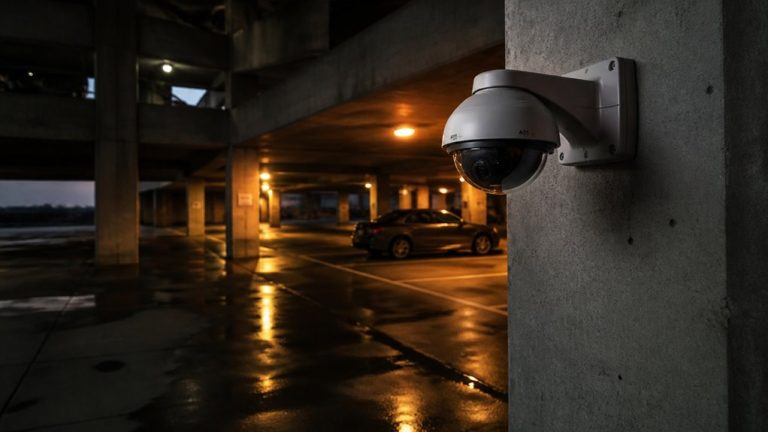
When monitoring ATMs or parking garages, WDR guarantees crucial detail isn’t lost in shadow or glare.
Using true WDR, these cameras capture multiple exposures, merging them to balance highlights and shadows.
This ensures you get clear, usable images regardless of lighting extremes.
This capability markedly enhances object recognition and situational awareness in high-contrast scenes.
For optimal security, WDR cameras are often strategically placed alongside cameras covering key entry points to ensure no critical details are missed due to lighting challenges.
Lighting Challenges Addressed
When a camera faces scenes with extreme contrasts, such as bright sunlight streaming through a doorway while the interior remains dim, capturing clear details in both areas becomes challenging.
WDR cameras address this by simultaneously capturing multiple exposures, merging bright and dark regions to reveal details usually lost in shadows or highlights.
You’ll find WDR especially useful in environments like storefronts with reflective glass, lobbies adjacent to windows, or outdoor entrances where backlighting occurs.
It also performs well in scenes combining bright skies and shaded zones, such as loading docks or drive-thru lanes.
By balancing exposure dynamically across the frame, WDR cameras overcome the limitations of standard sensors.
This ensures both overexposed and underexposed regions retain usable detail despite harsh lighting contrasts.
For optimal performance, mounting cameras at 8–10 feet high with a slight downward angle enhances WDR effectiveness and overall image clarity.
Benefits in Surveillance
Surveillance environments often present challenging lighting conditions where bright and dark areas coexist within the same frame, making image clarity essential for security purposes. WDR cameras excel here by capturing multiple exposures and merging them to balance extreme contrasts.
You’ll find WDR most effective in entrances with backlighting, glass storefronts, and ATM vestibules, where sunlight and shadows overlap. This technology preserves critical details in both highlights and shadows, enabling reliable identification of people, objects, and activities.
With WDR, you avoid washed-out bright spots and crushed dark areas, which standard cameras struggle with. It also enhances video review by delivering more balanced, interpretable footage.
When you deploy WDR cameras in surveillance, you guarantee consistent image quality despite harsh lighting. This improves overall security monitoring and evidence collection. Additionally, WDR technology benefits significantly from larger sensor sizes found in IP cameras, which improve low-light performance and reduce noise for clearer images.
Key Features to Evaluate When Choosing a WDR Camera
When you’re selecting a WDR camera, it’s important to understand the difference between true WDR and digital WDR. True WDR combines multiple exposures right at the sensor level, while digital WDR relies on software enhancements. This distinction can really affect the quality of your images.
Next, take a close look at the camera’s dynamic range rating. You’ll want something that’s ideally 100 dB or higher. This ensures that the camera can handle extreme contrast effectively.
Also, don’t forget to consider the specific conditions of your scene. WDR performance can really vary based on how bright and dark areas balance out in your environment. So, think about where you’ll be using the camera!
For added security and device management, consider cameras with a unique UID identifier that ensures secure connectivity and reliable asset tracking.
True vs Digital WDR
Distinguishing between true WDR and digital WDR is essential for selecting a camera that meets your lighting challenges effectively. True WDR captures multiple exposures and merges them at the sensor level, maintaining detail in both highlights and shadows.
Digital WDR relies on software algorithms to brighten dark areas after capture, lacking true dynamic range expansion. You’ll find true WDR excels in high-contrast scenes, while digital WDR may struggle with severe backlighting.
| Feature | True WDR | Digital WDR |
|---|---|---|
| Exposure Method | Multi-exposure sensor capture | Single exposure, software-based |
| Dynamic Range | Extended, hardware-level | Limited, post-processing only |
| Image Quality | High detail retention | Possible highlight clipping |
| Lighting Scenarios | Strong backlight, extreme contrast | Moderate lighting conditions |
| Cost | Typically higher | Generally lower |
Ensuring clear visibility and unobstructed accessibility is crucial in safety-related camera placements, similar to how fire extinguishers must be strategically placed for quick and safe access.
WDR Dynamic Range
Understanding WDR dynamic range is critical to selecting a camera that performs reliably in challenging lighting. The dynamic range, measured in decibels (dB), quantifies the span between the brightest and darkest image parts the camera can capture simultaneously.
When evaluating WDR, consider these key factors:
- Dynamic Range Value: Aim for 100 dB or higher for effective contrast management in extreme conditions.
- True vs Digital WDR: True WDR uses multi-exposure techniques to extend dynamic range, outperforming digital WDR’s software adjustments.
- Sensor Capability: Check if the sensor supports pixel-level exposure control for finer detail preservation.
- Hardware Integration: Confirm that WDR processing occurs on-chip to guarantee accurate merging of exposures and avoid artifacts.
Focusing on these metrics will help you choose a WDR camera that delivers precise, balanced images under high-contrast scenes.
Scene Compatibility Considerations
Although WDR technology enhances image clarity in high-contrast environments, you need to carefully assess scene compatibility to guarantee peak performance.
Evaluate whether your scene contains simultaneous bright and dark areas, such as entrances with backlighting or storefronts with reflective glass.
Confirm that the camera’s WDR rating, ideally around 120 dB, matches the lighting challenges you face.
True WDR cameras excel in scenes with extreme contrast due to multi-exposure capture, while digital WDR might underperform.
Consider the presence of dynamic lighting changes, as rapid shifts can affect image merging.
Also, verify the camera’s sensor capabilities and processing speed to handle your specific environment.
Properly matching WDR features with your scene secures balanced, detailed images without overexposure or crushed shadows.
Frequently Asked Questions
Can WDR Affect Camera Frame Rate or Performance?
Yes, enabling WDR can affect your camera’s frame rate and performance. True WDR requires capturing multiple exposures per frame and merging them, which demands more processing power and can reduce frame rates.
This impact depends on the camera’s hardware capabilities. Digital WDR, relying on software adjustments, has less effect but may still add slight latency.
Does WDR Work in Low-Light Nighttime Conditions?
WDR doesn’t notably improve low-light nighttime conditions because it’s designed to balance bright and dark areas within the same frame, not amplify light.
In low-light, shadows dominate, so WDR’s multi-exposure merging offers limited benefit. You’ll still need good low-light sensitivity or infrared illumination for clear nighttime images.
Rely on WDR primarily when you face scenes with extreme contrast, not when lighting is uniformly dim or dark.
How Does WDR Impact Video File Size or Compression?
WDR can increase video file size slightly because it combines multiple exposures into one frame, adding detail in bright and dark areas.
This richer data requires more bits to encode, which can reduce compression efficiency.
However, the impact varies with the codec and compression settings you use.
Overall, expect a moderate file size increase due to enhanced image complexity.
Efficient compression algorithms can help manage this without drastically inflating storage needs.
Can WDR Be Manually Adjusted or Customized by Users?
Think of WDR like tuning a radio dial to balance static and signal; yes, you can often manually adjust it.
Many cameras let you customize WDR strength through settings, tweaking exposure ratios or selecting between true and digital WDR modes.
This control lets you optimize image balance for specific lighting conditions, improving detail in shadows or highlights.
Check your camera’s menu or software to finely calibrate WDR based on your scene’s contrast demands.
Is WDR Compatible With All Camera Lenses and Sensors?
WDR isn’t universally compatible with all camera lenses and sensors. You’ll need a sensor capable of multi-exposure capture or pixel-level exposure control for true WDR.
Some lenses may cause flare or reflections that degrade WDR effectiveness. Additionally, digital WDR can work with more sensors but offers limited benefits.
Know When WDR Makes the Biggest Difference
Think of WDR as your camera’s balancing act, skillfully managing light like a tightrope walker steering between shadows and highlights.
When you choose a camera with true WDR, you’re ensuring every detail, whether in bright or dark areas, is captured with precision.
This technology isn’t just a feature; it’s essential for clarity in challenging lighting.
By understanding WDR’s role, you can confidently select a camera that delivers consistent, high-quality images in any environment.