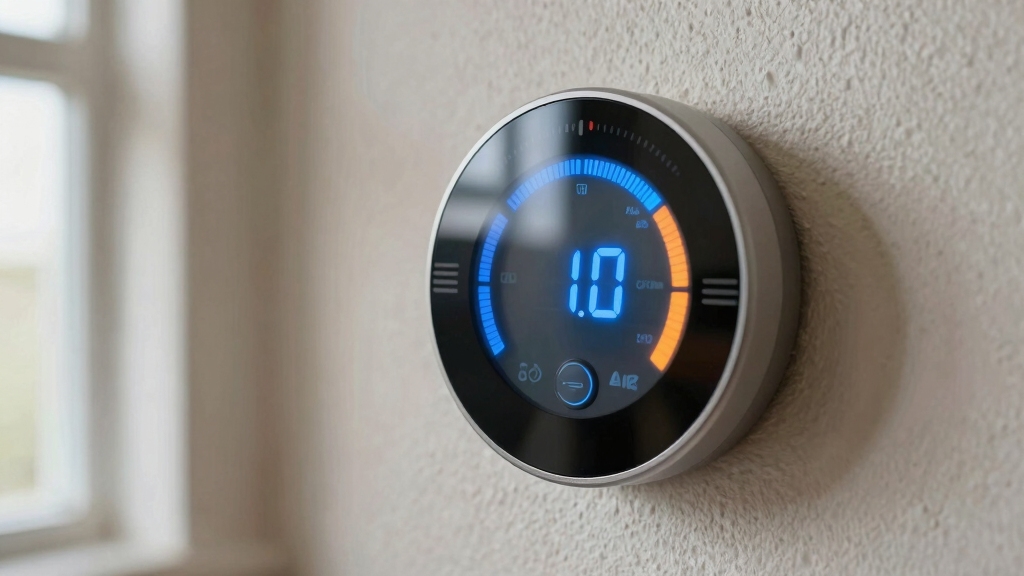

Your home thermostat senses room temperature using elements like bimetallic strips or gas-filled bellows that physically move as they heat or cool.
This movement triggers electrical switches that complete or break low-voltage circuits, signaling your HVAC system to turn on or off.
You adjust the setpoint dial to set your desired temperature, controlling when heating or cooling activates. Precise mechanical and electrical actions guarantee stable, efficient climate control.
Discover how these components work together for comfort and efficiency in your home.
Key Takeaways
- A thermostat uses temperature-sensitive elements like bimetallic strips or gas-filled bellows to detect ambient temperature changes.
- These elements physically move to open or close electrical circuits controlling heating or cooling systems.
- Closing specific terminals (e.g., R-to-W for heat, R-to-Y for cooling) signals the HVAC system to activate.
- Users adjust a temperature dial that sets the threshold for when the thermostat triggers heating or cooling.
- The thermostat continuously monitors temperature to maintain the setpoint, preventing rapid cycling and ensuring system stability.
How Your Thermostat Detects Room Temperature?
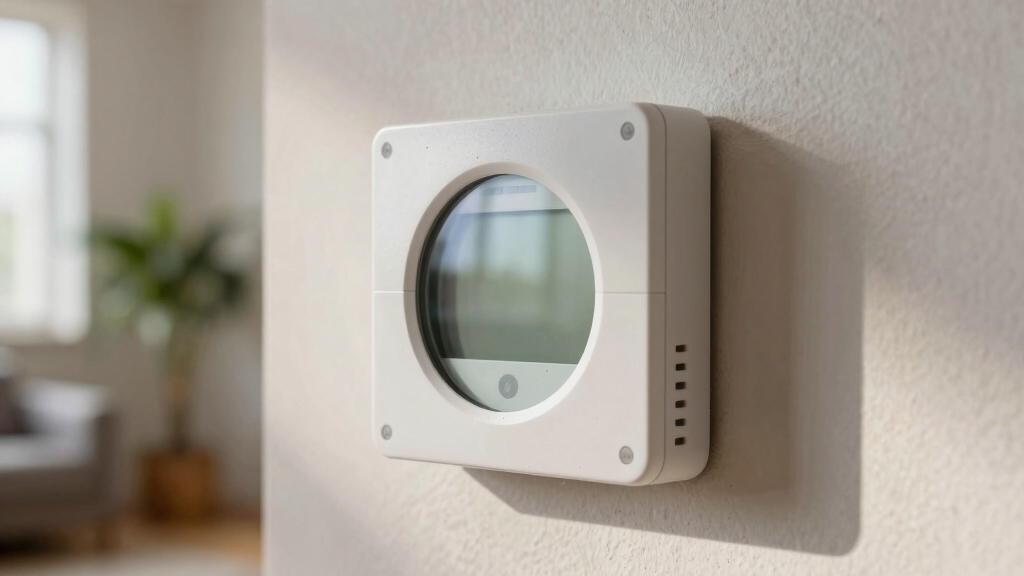
Detecting room temperature relies on built-in temperature sensors that continuously monitor the ambient environment.
Built-in sensors constantly measure the room’s temperature to ensure accurate monitoring.
These sensors use temperature-sensitive elements that physically move in response to fluctuations. As the room heats up, the elements expand or rise, triggering switches that can open or close electrical circuits.
When the temperature drops, the elements contract or lower, activating different circuits to turn heating systems on. You can adjust the temperature dial to set the exact threshold where these switches operate, tailoring your comfort level.
This continuous feedback loop guarantees the thermostat maintains the desired room temperature by activating or deactivating heating or cooling systems precisely.
The design prevents rapid cycling, providing stable temperature control without unnecessary wear on your HVAC equipment.
Additionally, many thermostats include a compressor protection delay that prevents the cooling system from restarting too quickly after shutdowns, safeguarding the compressor from damage.
The Role of Thermal Expansion in Thermostat Operation
Understanding how temperature-sensitive elements move requires knowing the role thermal expansion plays in thermostat operation.
When the ambient temperature rises, materials inside the thermostat expand; as temperatures fall, they contract.
This physical change causes components like metal strips or gas-filled bellows to move, triggering switches that control heating or cooling circuits.
You rely on this principle to maintain your set temperature without constant manual adjustments.
Thermal expansion guarantees gradual, precise movements, preventing rapid cycling of your HVAC system.
By converting temperature changes into mechanical motion, the thermostat can open or close electrical circuits, activating or deactivating your heating and cooling systems.
This seamless conversion of heat into movement is fundamental for the thermostat’s accurate and reliable temperature regulation in your home.
Modern smart thermostats enhance this process by using adaptive learning and sensors to optimize energy savings and comfort.
How Bimetallic Strips Control Heating and Cooling?
Bimetallic strips bend in response to temperature changes by exploiting the differing expansion rates of two metals joined together.
When the temperature rises, one metal expands more than the other, causing the strip to curve. This mechanical movement breaks the electrical circuit that powers your heating system, effectively turning it off.
As the room cools, the strip contracts back to its original shape, closing the circuit and reactivating the heat. This gradual bending and straightening prevent rapid cycling of your heating system, ensuring efficient temperature control.
By adjusting the temperature dial, you set the threshold at which the strip actuates, allowing precise control over heating activation and deactivation without complex electronics.
This simple yet effective mechanism forms the core of traditional thermostat operation. For optimal safety, it is important to place heating controls and sensors in locations that avoid direct heat sources or drafts to maintain accurate readings and prevent false triggers, following best placement principles.
How Gas-Filled Bellows Improve Temperature Response?
Gas-filled bellows are pretty impressive when it comes to responding to temperature changes. They actually do it a lot faster than bimetallic strips.
Why is that? It’s all about the rapid expansion and contraction of the gas inside.
This quick reaction makes the thermostat way more sensitive. So, as the temperature rises, the bellows can press a microswitch much quicker.
And you know what that means? Your heating system can maintain a more stable and accurate temperature control. Pretty neat, right?
For optimal performance, these thermostats often use low voltage wiring to safely transmit control signals without risk of electrical shock.
Faster Reaction Mechanism
Gas-filled bellows speed up a thermostat’s response to temperature changes by reacting more quickly than traditional bimetallic strips.
The gas inside expands or contracts rapidly with temperature shifts, pushing metal discs to activate or deactivate the microswitch faster.
This mechanism shortens the delay between temperature change and system response, improving comfort and energy efficiency.
| Feature | Benefit |
|---|---|
| Gas expansion speed | Immediate mechanical movement |
| Metal disc area | Faster heat absorption |
| Microswitch contact | Quick circuit interruption |
| Bellows contraction | Rapid reset for next cycle |
For enhanced functionality, just as a wide-angle peephole improves visibility and security in doors, optimizing thermostat components can similarly enhance system responsiveness and user experience.
Enhanced Temperature Sensitivity
Because temperature changes can be subtle and rapid, the bellows mechanism enhances sensitivity by responding to even small fluctuations more effectively than traditional components.
Gas-filled bellows expand or contract with temperature variation, mechanically amplifying these changes through metal discs.
This design increases surface area contact, allowing the inner disc to quickly engage or disengage a microswitch.
When the gas expands, it pushes the discs apart, activating the switch to break the heating circuit promptly.
As the gas contracts, the discs return, closing the circuit and restoring heat.
This rapid, precise movement reduces lag in temperature response, ensuring your thermostat maintains tighter control over ambient conditions.
The use of mechanical components like bellows emphasizes the importance of precise movement in controlling electrical circuits for safety and efficiency.
How Thermostats Use Electrical Circuits to Switch Systems?
Thermostats control heating and cooling systems by completing or breaking electrical circuits that connect specific terminals. When the temperature drops, the thermostat closes the circuit between the R (power) and W (heat) terminals, signaling the furnace to start.
Conversely, when cooling is needed, it closes the circuit between R and Y (cooling) terminals, activating the air conditioner. These low-voltage electrical signals energize relays in your HVAC system, switching components on or off precisely.
Circuits operate at 24 volts supplied by transformers to guarantee safe control. The thermostat’s internal switches respond automatically to temperature-sensitive elements.
Reversing valves controlled by the thermostat enable seamless heating and cooling shifts. This precise circuit switching maintains your set temperature efficiently and reliably.
Modern thermostats often include programmable setbacks that lower or raise temperatures automatically to optimize energy use and comfort.
What Happens When You Adjust the Thermostat Dial?
When you adjust the thermostat dial, you’re actually changing the temperature setpoint that triggers the system’s electrical circuits. Pretty cool, right?
This shift alters the activation thresholds, which means that heating or cooling components will turn on or off at different temperatures.
Regular maintenance, like cleaning dust from sensors, ensures accurate temperature readings and prevents false triggers in your HVAC system, similar to how regular cleaning prevents false alerts in fire alarms.
Temperature Setpoint Adjustment
Adjusting the thermostat dial directly changes the temperature setpoint, which determines the threshold at which the heating or cooling circuits activate or deactivate.
When you turn the dial, you’re effectively shifting the temperature point that triggers the thermostat’s internal mechanisms to respond. This adjustment alters the tension or position of temperature-sensitive elements like bimetallic strips or gas-filled bellows, setting a new activation boundary for the system.
It modifies the mechanical or electronic reference that controls circuit closure or opening. The thermostat continuously compares ambient room temperature against this updated setpoint.
Changing the setpoint doesn’t alter internal components but redefines when the system cycles on or off.
Similar to how photocell sensors detect ambient light to automatically activate dusk to dawn lights, the thermostat uses temperature sensing to automate heating or cooling activation.
Circuit Activation Changes
Shifting the thermostat dial changes the point at which electrical circuits inside the device activate or deactivate.
When you adjust the dial, you’re effectively setting a new temperature threshold for the internal temperature-sensitive elements, whether a bimetallic strip or gas-filled bellows, to respond.
As the ambient temperature reaches this new setpoint, these elements physically move to either complete or break electrical circuits.
Completing the circuit between specific terminals, like R and W, signals your heating system to turn on, while breaking it tells the system to shut off.
This precise control guarantees your HVAC operates only when necessary, maintaining your desired comfort level efficiently.
The thermostat’s electrical integration relies on these changes to regulate heating or cooling without altering internal components.
Proper wiring of the thermostat’s load wires is essential to ensure safe and continuous power delivery to downstream HVAC components.
How Thermostats Automatically Control Heating and Cooling Cycles?
Although thermostats rely on mechanical or electronic sensors to detect temperature changes, they automatically cycle heating and cooling systems by completing or breaking electrical circuits that trigger these units.
Thermostats use sensors to detect temperature and control heating and cooling by completing or breaking electrical circuits.
When the ambient temperature deviates from your setpoint, the temperature-sensitive element moves to either close or open specific electrical contacts. This action energizes relays, signaling the furnace or air conditioner to start or stop.
Key aspects include:
Mechanical elements like bimetallic strips or gas-filled bellows physically shift to open or close circuits.
Electrical terminals (R, W, Y) coordinate power flow, activating heating or cooling components.
The thermostat continuously monitors temperature, repeating cycles to maintain your desired climate efficiently.
Zoned Thermostat Control for Heating and Cooling
So, let’s talk about zoned thermostat control for heating and cooling. You know how you can control multiple thermostats that manage different areas of your home? Each zone can have its own temperature settings, which is pretty cool.
Now, here’s the neat part: the zone valves or dampers respond to these thermostats and only direct heating or cooling where it’s needed. This means you get to enjoy precise climate regulation in each area without messing with the entire system.
Isn’t that a great way to keep things comfy? It makes a noticeable difference, especially if some rooms tend to get hotter or colder than others!
Multiple Thermostat Integration
When managing multiple areas within a building, zoned thermostat control uses several thermostats to regulate heating and cooling independently.
Integrating multiple thermostats allows precise temperature management tailored to different zones, improving comfort and energy efficiency. Each thermostat communicates with the central HVAC system, activating specific dampers or valves to direct airflow or heating fluid as needed.
Key aspects to contemplate include:
Coordinated control guarantees simultaneous yet independent operation of heating and cooling units across zones.
Electrical integration involves linking multiple thermostats to a central controller or zoning panel.
Programmable settings allow you to customize temperature schedules for each zone, optimizing system performance and energy use.
Zone Valve Operation
Zone valves regulate the flow of heating or cooling medium to specific areas by opening or closing in response to signals from individual thermostats.
When a thermostat detects a temperature below its setpoint, it sends an electrical signal to the zone valve’s actuator motor.
This motor then opens the valve, allowing hot water or steam to flow into the designated zone’s radiator or baseboard.
As the zone reaches the desired temperature, the thermostat stops sending the signal, causing the valve to close and halt the flow.
This targeted control prevents overheating and improves energy efficiency.
You’ll find zone valves essential in multi-zone systems, ensuring each area receives customized heating or cooling without affecting other zones.
This maintains balanced comfort throughout your home.
Independent Temperature Regulation
Although multiple thermostats control different areas within a building, each operates independently to regulate temperature precisely according to its zone’s needs.
This zoned thermostat control allows you to tailor heating and cooling for specific rooms without affecting the entire system, improving comfort and efficiency.
You’ll find that each thermostat monitors its zone’s temperature and activates its heating or cooling circuits accordingly, using electric motors to open or close valves and dampers.
Key features include:
- Autonomous temperature sensing and control per zone
- Individual circuit activation to manage heating and cooling
- Integration with electric actuators for precise airflow or water flow regulation
Benefits of Programmable Thermostats for Temperature Control
Since programmable thermostats allow you to set specific temperature schedules, they optimize energy use by automatically adjusting heating and cooling based on your daily routine.
You can program temperature setpoints for different times, reducing heating or cooling when you’re away or asleep, and restoring comfort before you return. This precise control minimizes energy waste and lowers utility costs.
Additionally, programmable thermostats maintain consistent indoor temperatures by initiating heating or cooling cycles only when necessary, preventing frequent system toggling.
They also simplify managing multiple zones by integrating with complex HVAC configurations, ensuring each area receives tailored temperature control.
Key Mechanical and Electrical Thermostat Components
Understanding how programmable thermostats manage temperature schedules requires familiarity with the mechanical and electrical components inside a thermostat.
Programmable thermostats control temperature by integrating mechanical and electrical components within their design.
You’ll find temperature-sensitive elements like bimetallic strips or gas-filled bellows that physically move in response to heat changes, triggering switches.
These switches open or close electrical circuits to activate heating or cooling systems. The thermostat’s internal sensors continuously monitor ambient temperature, while the adjustable setpoint lets you define when these circuits engage or disengage.
Key components include:
- Bimetallic strips that bend with heat, breaking or completing circuits
- Gas-filled bellows for faster temperature response via microswitches
- Electrical terminals (R, W, Y, O) linking the thermostat to HVAC controls
Together, these parts enable precise, automated temperature regulation.
Frequently Asked Questions
How Do Thermostats Communicate With Smart Home Systems?
You connect thermostats to smart home systems via Wi-Fi or Zigbee protocols, enabling real-time temperature data exchange.
The thermostat’s built-in sensors report ambient conditions to your smart hub, which processes this info and sends commands back.
This communication lets you remotely adjust settings, create schedules, and integrate with other devices.
The system uses APIs and encrypted signals to guarantee precise, secure control without manual intervention.
What Maintenance Is Required to Keep a Thermostat Functioning Properly?
You should regularly clean the thermostat’s exterior and interior components to prevent dust buildup that can interfere with sensors and switches.
Check wiring connections for corrosion or looseness and tighten as needed.
Replace batteries annually if your thermostat uses them.
Calibrate the temperature sensor occasionally to make certain accurate readings.
For programmable or smart thermostats, update firmware and verify settings.
Proper maintenance keeps your thermostat responsive and prolongs its operational lifespan.
Can a Thermostat Affect Indoor Air Quality?
While a thermostat might seem like a telegraph from the past, it can influence indoor air quality indirectly.
By regulating heating and cooling cycles, you control humidity and temperature, which affect mold growth and airborne allergens.
Proper thermostat settings prevent excessive moisture and stale air buildup.
However, the thermostat itself doesn’t filter air; you’ll need a well-maintained HVAC system and filters to assure better air quality alongside precise temperature control.
How Does a Thermostat Handle Power Outages or Surges?
Your thermostat typically loses power during outages, causing it to reset or turn off your HVAC system.
Most mechanical thermostats don’t require power, so they keep working, but digital or programmable ones may need battery backup to retain settings.
Power surges can damage internal circuits, so installing surge protectors safeguards your thermostat.
After power is restored, your thermostat resumes normal operation, but you might need to reprogram settings if no backup exists.
Are There Any Safety Features Built Into Modern Thermostats?
Sure, your thermostat isn’t just a glorified switch waiting to spark a fireball.
Modern thermostats include safety features like built-in temperature limits to prevent overheating and short-circuit protection within their electrical circuits.
They often have surge protectors and fail-safes that shut down the system if sensors detect dangerous conditions.
These measures guarantee your heating and cooling systems operate reliably and safely, protecting both your home and equipment.
Your Thermostat: The Silent Guardian of Comfort
Now that you understand how a thermostat detects temperature and controls heating or cooling through mechanical and electrical means, you can appreciate its role in maintaining comfort efficiently.
Like a conductor guiding an orchestra, your thermostat precisely coordinates various components to keep your home’s climate steady.
By using programmable and zoned controls, it adapts to your needs, ensuring energy isn’t wasted while delivering consistent temperature regulation throughout your space.