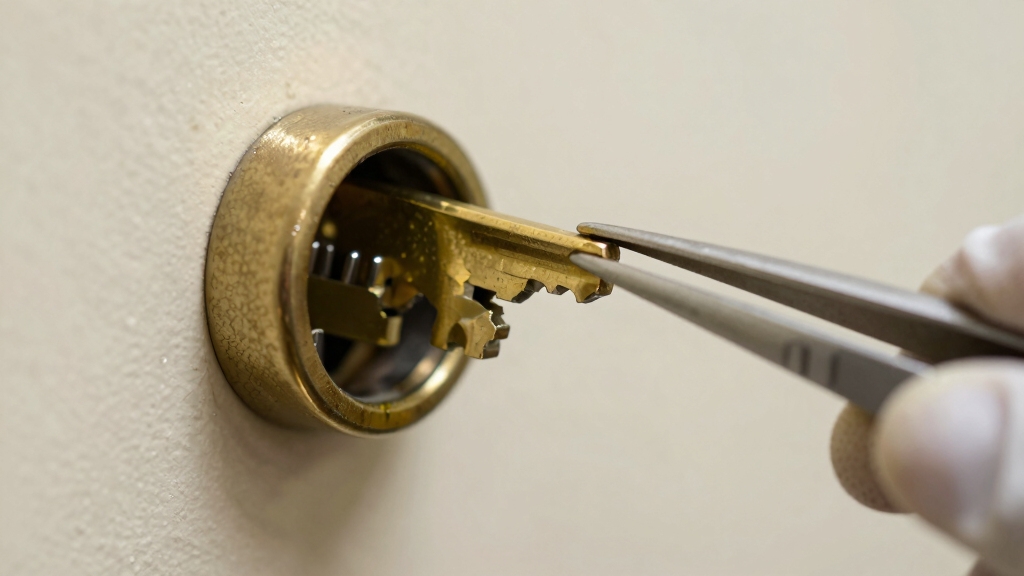

To get a snapped key out of a door, first assess if the key is protruding, flush, or recessed. Apply lubricant and clean the keyway to ease extraction.
Use needle nose pliers for protruding keys, gripping firmly and pulling gently while rotating. For flush or recessed fragments, try a paperclip or pen spring hooked onto the key’s teeth.
If the key is deeply stuck or the lock is damaged, consult a locksmith. Following precise techniques can prevent further damage and guarantee success. More detailed methods can guide your next steps.
Key Takeaways
- Apply lubricant and position the lock cylinder horizontally to ease extraction of the broken key fragment.
- Use needle nose pliers to firmly grasp and gently wiggle protruding key sections while pulling outward steadily.
- For flush or recessed keys, insert a hooked paperclip, bobby pin, or pen spring to hook and slowly pull the fragment out.
- Avoid excessive twisting or force to prevent further key breakage or lock damage during extraction attempts.
- Call a professional locksmith if the key is deeply stuck or extraction proves difficult to avoid damaging the lock.
How to Prepare for Broken Key Extraction?
Before attempting to remove a broken key from a lock, start by applying lubricant to the lock cylinder to guarantee smoother extraction.
Begin key extraction by lubricating the lock cylinder for easier and safer removal.
Position the lock cylinder horizontally, as you’d for normal key insertion, ensuring the broken key’s protruding part is accessible for gripping.
Avoid forcing tools into the lock to prevent internal damage.
Before engaging any extraction method, clean debris or dust from the keyway with compressed air or a soft brush.
This clears the path and improves visibility.
Inspect the keyway carefully to confirm the broken fragment’s orientation and depth.
Preparing the lock properly minimizes resistance and reduces the risk of jamming.
Taking these steps ensures you can proceed with extraction methods more efficiently and safely, increasing your chances of successful key removal without damaging the lock mechanism.
For best results, keep the broken key fragment dry and clean to prevent moisture or dirt from affecting the lock components during extraction, a crucial preparation step.
Extract Protruding Broken Keys With Needle Nose Pliers
First off, grab those needle nose pliers and get a good grip on the broken key. You want to hold it firmly so it doesn’t slip out of your hands.
Next, try rotating the key vertically. This helps you align it just right for the best leverage.
Now, here’s the trick: apply gentle, steady pressure while you wiggle the key outward. This way, you can avoid causing any damage to the lock.
If the key is deeply stuck, consider calling a locksmith who uses precision tools to extract broken keys without damaging the lock.
Good luck!
Secure Grip Techniques
Grasp the protruding section of the broken key firmly with needle nose pliers to establish a secure hold.
Position the pliers so their jaws align with the key’s flat surfaces, avoiding slippage.
Apply steady pressure without crushing the key fragment. Maintain a vertical orientation to maximize grip strength.
Once secured, wiggle the key gently to loosen it from the lock pins.
Avoid twisting excessively to prevent further key breakage or lock damage.
If the key is slippery, wipe it dry or use pliers with textured jaws for better traction.
Confirm the key is visible and accessible before attempting extraction.
This method works best when part of the key protrudes from the lock, allowing the pliers to clamp securely for controlled removal.
For more complex cases where the key is deeply lodged, locksmiths may use specialized tools and techniques to extract the fragment without damaging the lock.
Proper Key Rotation
Rotate the broken key vertically once you have a firm grip with the needle nose pliers. This vertical rotation aligns the key’s teeth with the lock pins, reducing friction and increasing leverage.
Apply steady, controlled pressure to avoid bending or breaking the key further. Rotate the key slowly to feel when it moves freely inside the lock cylinder.
Avoid twisting excessively to prevent damaging internal lock components. Once rotated, gently wiggle the key while maintaining vertical alignment to loosen its hold.
Continue this controlled rotation and slight movement until the key begins to slide outward. Keep your grip firm but steady, ensuring the pliers don’t slip.
Proper key rotation markedly improves your chances of extracting a protruding broken key cleanly and efficiently.
If the lock is a high-security or reinforced type, it is best to seek professional locksmith intervention to avoid further damage.
Gentle Extraction Tips
Although extracting a broken key requires patience, using needle nose pliers lets you apply controlled, steady pressure to avoid further damage. First, make sure the protruding key piece is accessible and clean the keyway to prevent debris interference.
Grip the broken key firmly with the pliers, aligning the key vertically for peak leverage. Then, gently wiggle and pull the key outward while maintaining steady pressure without twisting excessively, which could worsen the situation.
Position the lock cylinder horizontally for better access. Apply lubricant to ease extraction. Use needle nose pliers to grasp the visible key section securely. Pull with slow, consistent force, avoiding sudden jerks.
This method suits keys visibly extending from the lock and minimizes lock damage risk. Understanding the internal mechanics of pin-tumbler locks can help avoid damaging delicate components during extraction.
Remove Flush Broken Keys Using Paperclips or Bobby Pins
Alright, let’s tackle that broken key situation! First, grab a paperclip or a bobby pin and straighten it out. You’re going to want it to be a nice, narrow pick that’s sturdy enough for the job.
Now, gently insert your makeshift tool into the keyway. Take your time here; you want to maneuver it carefully around the lock pins until you can reach the edge of the broken key. Once you feel it hook onto that fragment, give it a slow twist and pull.
The goal is to extract that flush key piece without causing any damage to the lock itself.
And just like that, you might just be able to save the day! Keep in mind that professional broken key extraction typically costs between 50–200 dollars, depending on damage severity.
Preparing Paperclip Tools
When preparing paperclip tools to remove a flush broken key, you’ll need to first straighten the paperclip or bobby pin completely, shaping it into a slender pick. This allows you to maneuver inside the keyway and hook onto the broken key edge effectively.
Use a pair of pliers or your fingers to guarantee the tool is rigid yet thin enough to fit. Avoid bending it excessively to maintain control.
Choose a sturdy, medium-gauge paperclip or metal bobby pin. Use pliers to create a small hook at the tip for catching the key. Ensure the tool’s length is sufficient to reach at least 1 cm inside the lock.
Remove any coating or paint to reduce friction inside the keyway. This preparation is vital before attempting extraction.
For better hygiene and durability, consider using tools made from stainless steel, which resists corrosion and is easy to clean.
Maneuvering Inside Lock
Insert your prepared paperclip or bobby pin gently into the keyway, aiming to navigate around the lock pins without forcing the tool.
Carefully maneuver the tool until you locate the edge of the broken key. Once you hook onto the key’s edge, maintain a firm grip by slightly bending the paperclip or pin to secure contact.
Slowly twist the tool to engage the key’s teeth, avoiding sudden movements that could jam the key further.
Apply steady, controlled pulling pressure while continuing to hold the hooked key. If resistance increases, pause and adjust the tool’s position to prevent damage to the lock mechanism.
Repeat this process patiently until the flush broken key slides out smoothly from the lock cylinder.
For added security in your entryways, consider installing a peephole for metal doors to monitor visitors before unlocking the door.
Use Pen Spring or Wire Hooks for Recessed Keys
To tackle a recessed broken key, you’ll need to extract the spiral spring from a click pen and bend its tip slightly to form a small hook. This tool allows you to reach deep into the lock and catch the key’s teeth for extraction.
Insert the spring into the keyway alongside the broken key, pushing at least 1 cm deep. Twist the spring gently to hook the key, then pull carefully to avoid further damage.
Slide the bent spring into the gap beside the key. Rotate the spring to catch the key’s teeth firmly. Pull the key slowly, maintaining a steady grip. If unstable, reinsert the pen’s ink tube backwards for added support.
This method works best for recessed keys unreachable by pliers or picks. For enhanced security, consider replacing damaged door components promptly to maintain the intended security level.
Lift Keys With Knife or Blade Extraction Techniques
If the broken key sits too flush for hooks or spring tools to catch, a knife or blade can provide the leverage needed to lift and extract it.
Insert the knife blade carefully on either side of the broken key, ensuring it slips into the narrowest gap without forcing.
Apply upward pressure against the lock body to lift the key slightly, creating enough space to grip.
Maintain steady pressure while slowly pulling the key outward to avoid pushing it further inside.
For tighter fits, use a fret saw blade oriented toward the key teeth.
Insert it into the widest accessible gap and gently maneuver it to hook and extract the key.
Always proceed with caution to prevent damage to the lock mechanism during this process.
Ensuring precision and care in each step is crucial, much like the accuracy in measuring door hinges that guarantees smooth operation and durability.
Use Advanced Tools or Call a Locksmith for Help
When simpler methods fail to remove a broken key, advanced tools like spiral key extractors or specialized grips can provide the necessary precision and control. You can attempt these tools to avoid damaging the lock or keyway further. If you’re unsure or the key is deeply embedded, calling a locksmith is the safest option.
Consider these advanced approaches:
- Use a spiral key extractor, inserting and twisting it to engage the broken key teeth.
- Employ fingernail clippers or small pliers to firmly grip and pull the key edge.
- Insert a flathead screwdriver into gaps for gentle leverage.
- Test a strong magnet cautiously if the key is non-metallic or magnetic.
Prioritize professional assistance if tools don’t work or the lock shows signs of damage.
Frequently Asked Questions
How Can I Prevent My Key From Snapping in the Lock?
You can prevent your key from snapping by regularly lubricating the lock to reduce friction.
Always insert the key gently and avoid forcing it when turning.
Keep the key and lock clean from debris to guarantee smooth operation.
Don’t use excessive pressure or twist the key sharply.
If you feel resistance, stop and inspect the key and lock for damage or misalignment before proceeding to avoid breaking the key inside.
What Types of Lubricants Are Best for Lock Maintenance?
You should use graphite powder or silicone-based lubricants for lock maintenance, as they won’t attract dirt or grime.
Avoid oil-based lubricants like WD-40 since they can gum up the mechanism.
Apply a small amount directly into the keyway, insert and turn the key several times to distribute evenly.
Regular lubrication keeps pins moving smoothly, prevents rust, and reduces wear.
Use lubricant sparingly to maintain peak lock function.
Can Temperature Changes Cause Keys to Break Inside Locks?
Ever wondered why your key snapped on a freezing morning? Yes, temperature changes can cause keys to break inside locks.
When metal contracts in cold or expands in heat, it creates stress points, weakening the key’s structure.
If you force the key during these conditions, it’s more likely to snap.
To prevent this, avoid using excessive force in extreme temperatures and consider lubricating the lock to reduce friction and stress.
How Do I Know if My Lock Is Damaged After Key Removal?
You’ll know your lock is damaged after key removal if you notice difficulty turning the key or lock cylinder, unusual resistance, or if the lock feels loose or wobbly.
Check for visible internal damage or debris inside the keyway. If the lock jams, produces grinding noises, or fails to engage smoothly, it’s likely compromised.
In such cases, avoid forcing the lock and consider consulting a locksmith for repair or replacement.
Are There Special Keys Designed to Avoid Breaking Inside Locks?
Yes, there are special keys designed to minimize breakage inside locks. You’ll find keys made from stronger, flexible materials like nickel silver or reinforced brass, which resist snapping.
Additionally, some keys feature rounded edges and optimized thickness to reduce stress points. When selecting keys, make sure they match your lock’s specifications precisely.
Using quality key blanks and avoiding excessive force during use also helps prevent breakage.
Stuck Key? Now You Know Exactly What to Do
Remember, about 30% of locksmith calls involve broken keys stuck in locks, so knowing how to extract them saves time and money.
Always start by preparing your workspace and evaluating how much of the key is exposed. Use needle nose pliers for protruding keys, paperclips or bobby pins for flush ones, and wire hooks or blades for recessed keys.
If these methods fail, don’t hesitate to use advanced tools or call a professional locksmith to avoid damaging your lock.