
To secure your French doors, install double cylinder deadbolts top and bottom to distribute force and require keys on both sides. Combine this with multipoint locking systems for three-point anchoring.
Reinforce the passive door with flush bolts and steel strike plates to prevent buckling and prying. Replace standard glass with laminated, impact-resistant panels.
Add handle locks to immobilize door handles and security hinges or door jammers to block forced entry. Motion-activated lights and alarms boost deterrence.
Discover detailed strategies to elevate your door’s defense further.
Key Takeaways
- Install double cylinder deadbolts at top and bottom of the active door for distributed, key-controlled locking resistance.
- Reinforce the passive door with flush bolts and steel handle locks to secure it firmly and prevent prying.
- Use laminated, impact-resistant glass panels to reduce breakage risk and delay forced entry attempts.
- Fit specialized handle locks and reinforced strike plates to prevent handle rotation and strengthen door frames.
- Add security hinges with non-removable pins and door jammers to resist hinge tampering and inward pressure.
Why French Doors Need Extra Security Measures?
Because French doors feature large glass panels and lack a central frame, they present unique security vulnerabilities that standard doors do not.
French doors’ large glass panels and missing central frame create unique security challenges not found in standard doors.
The expansive glass increases susceptibility to breakage and reach-through intrusions. The absence of a solid center frame reduces structural resistance to forced entry.
This design makes it easier for intruders to pry doors apart at the meeting point. Additionally, standard locks often rely on a central frame for stability, which French doors lack.
This causes conventional locking mechanisms to be less effective. You must address these weaknesses by reinforcing glass integrity and enhancing door frame strength.
Implementing specialized hardware and securing both the active and passive door components is essential for distributing force evenly. This prevents exploitation of the door’s inherent structural gaps.
Applying shatterproof security film to the glass panels can hold shards together and deter break-ins effectively.
Choose the Right Deadbolt Locks for French Doors
Addressing the vulnerabilities of French doors starts with selecting deadbolt locks designed to compensate for their unique structure.
You should opt for double cylinder deadbolts installed at both the top and bottom of the active door to evenly distribute force and prevent lock slippage due to the lack of a center frame.
These locks require a key on both sides, enhancing resistance against prying at the door’s center.
While fire safety concerns exist, double cylinder deadbolts markedly increase security when combined with multipoint locking systems.
Make certain the deadbolt’s bolt extends deeply into reinforced strike plates to resist kick-in attacks.
Additionally, integrating a multi-point locking system can further distribute locking force across the door, significantly enhancing resistance to forced entry.
Use Handle Locks to Secure French Door Handles
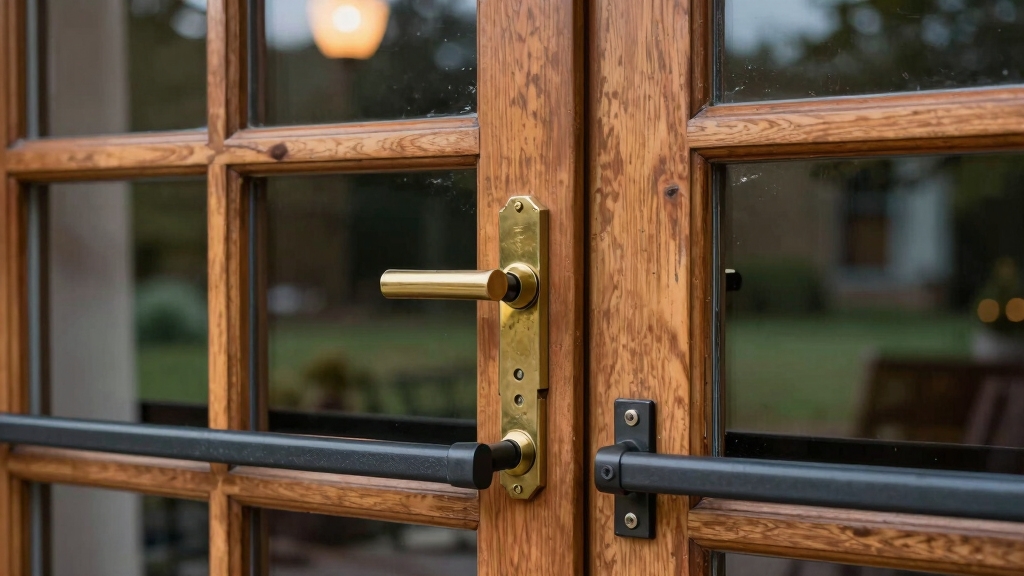
Secure your French door handles with specialized handle locks designed to prevent turning and resist inward buckling.
These steel security devices fit over the knobs or levers, immobilizing the handles as one solid piece from both sides.
Their 3-position adjustable pin slot accommodates double doors, ensuring a snug, secure fit that reinforces the center connection.
By preventing handle rotation, you eliminate a common weakness that intruders exploit to pry doors apart.
Handle locks provide unobtrusive yet effective structural support, complementing other locking mechanisms without altering door aesthetics.
Installing them is straightforward, requiring no extensive modification.
For peak security, combine handle locks with robust deadbolts and a secured passive door to create a thorough barrier against forced entry through your French doors.
To further enhance protection, consider integrating reinforced steel strike plates to resist pry attacks and increase overall door frame strength.
Reinforce Passive French Doors With Flush Bolts and Screws
While handle locks fortify the center of your French doors, reinforcing the passive door is equally important to prevent forced entry. You must install flush bolts at the top and bottom edges of the passive door.
These bolts slide into the door frame and floor, anchoring the door firmly. To enhance security, drive screws directly into the flush bolts once extended, eliminating any movement and preventing the door from being pushed inward.
This measure resists buckling under force and is reversible by removing the screws when access is needed. Flush bolt kits designed for French doors include the necessary hardware and guarantee the passive door remains tightly secured, maintaining functionality without compromising safety.
This reinforcement is essential to complement active door locks and deliver complete protection. For an added layer of security, consider installing a peephole compatible with metal doors to monitor visitors before opening the door.
Upgrade to Multipoint Locking Systems for French Doors
Upgrading your French doors to a multipoint locking system can really boost their security. Imagine this: instead of just one lock, you’ll have a system that secures the active door at three or more points with just a single key or switch. Pretty convenient, right?
This means that the door is anchored at the top, middle, and bottom, which makes it much tougher for anyone to force their way in. It’s all about making that separation at the center way more difficult.
And if you want to take it a step further, consider integrating the multipoint lock with a secured passive door. This creates a solid, unified barrier that enhances your security even more.
To further protect against sophisticated entry methods, installing bump-resistant cylinders within your multipoint locking system can significantly reduce vulnerability to lock bumping attacks.
Enhanced Security Points
Because French doors lack a central frame, relying solely on standard locks leaves them vulnerable to forced entry. You need enhanced security points to reinforce weak spots and prevent prying or kicking attacks.
Upgrading to multipoint locking systems guarantees the active door secures at three or more points simultaneously. This distributes force evenly and drastically increases resistance. Pair this with a secured passive door to eliminate any movement and reinforce the center gap.
Consider adding these critical enhancements:
- Double cylinder deadbolts at top and bottom to prevent lock slip and resist prying.
- Burglar-proof laminated or impact-resistant glass to block break-ins through panes.
- Steel handle and center locks to stop handle rotation and door buckling.
These upgrades transform your French doors into a formidable barrier against intrusion. Additionally, regular inspection and maintenance of door hardware, including inspection frequencies, help ensure long-term security and functionality.
Integration With Passive Door
Although multipoint locking systems substantially enhance the security of the active French door, their full potential is realized only when integrated with a properly secured passive door.
You must reinforce the passive door using flush bolts or lock kits to eliminate inward flex and prevent forced entry at the door seam. This integration distributes force evenly and resists prying attempts.
| Component | Function | Benefit |
|---|---|---|
| Multipoint Lock | Locks at top, middle, bottom | Increases door rigidity |
| Flush Bolts | Secures passive door edges | Prevents door buckling |
| Double Cylinder Deadbolts | Top and bottom reinforcement | Enhances resistance to prying |
| Lock Set Kits | Includes flush bolts & hardware | Simplifies passive door security |
| Handle & Center Locks | Supports center joint | Prevents inward door flex |
For optimal security, ensure that all locking hardware is properly aligned and installed on a level and plumb surface to maintain smooth operation and prevent mechanical binding.
Integrating these elements guarantees all-around security for your French doors.
Install Burglar-Proof or Laminated Glass Panels on French Doors
If you’re looking to boost the security of your French doors, consider swapping out the standard glass for laminated or impact-resistant panels. This change can really make a difference!
Laminated glass is designed to hold together even when it’s hit, which means it won’t shatter easily. This makes it much harder for someone to break in and reach through.
But that’s not all! You might also want to think about adding glass break sensors. These handy devices can alert you right away if the glass gets compromised, giving you extra peace of mind. It’s a smart move to enhance your home’s security!
For added protection, integrating glass break sensors with IP cameras can provide real-time alerts and remote monitoring capabilities, enhancing overall security effectiveness.
Benefits Of Laminated Glass
Laminated glass panels provide a crucial layer of security for French doors by combining strength and resilience in a single unit. This glass consists of two or more panes bonded with a tough interlayer, which holds the glass together upon impact.
This prevents shattering and delays forced entry. You’ll enhance your door’s resistance against break-ins, reduce injury risks from broken glass, and maintain privacy even when damaged. Installing laminated glass also improves sound insulation and blocks harmful UV rays.
Feel safer knowing your doors resist smash-and-grab attacks. Gain peace of mind with glass that stays intact under pressure. Protect your family from sharp glass shards during forced entry attempts.
Choosing laminated glass is a smart, effective upgrade to maximize your French door’s security. In addition, the use of optical chamber design principles in laminated glass technology helps improve detection and resistance against intrusion attempts.
Impact-Resistant Glass Features
Frequently installed on French doors, impact-resistant glass markedly enhances security by combining strength and flexibility to withstand forceful impacts.
You should opt for laminated glass panels, which embed a durable interlayer between panes to prevent shattering and deter break-ins. This material preserves door integrity even under aggressive strikes, stopping quick, unauthorized entry.
When selecting glass, consider these core features:
| Feature | Description | Benefit |
|---|---|---|
| Laminated Layers | Polyvinyl butyral (PVB) interlayer | Maintains glass cohesion |
| Impact Resistance | Withstands blunt force and projectiles | Prevents easy penetration |
| Safety Compliance | Meets ANSI Z97.1 or CPSC standards | Ensures reliability |
Incorporate impact-resistant glass to markedly bolster your French door’s defense without compromising aesthetics. For optimal long-term durability, consider factors like UV exposure and moisture when selecting glass and associated materials.
Glass Break Sensor Options
When securing French doors with burglar-proof or laminated glass, integrating glass break sensors adds a critical layer of protection by detecting impacts or shattering attempts immediately.
These sensors use acoustic or vibration technology to identify the distinct sound of glass breaking, triggering alarms before an intruder gains entry. You’ll want to choose sensors calibrated specifically for your glass type to minimize false alarms.
Installation near the glass surface maximizes responsiveness. Feel confident knowing your doors alert you at the first sign of forced entry.
Protect your home with technology designed to detect threats instantly.
Gain peace of mind by reinforcing physical barriers with smart detection. Incorporating glass break sensors complements the strength of laminated panels, ensuring all-encompassing security for your French doors.
Add Security Hinges and Door Jammers for French Doors
Although French doors provide elegant access, their security hinges reinforce vulnerable points like hinges and entry pressure zones.
Start by installing security hinges designed to resist forced entry, especially for outward-opening doors where hinge tampering is common.
These hinges use non-removable pins or reinforced plates to prevent removal or damage.
For inward-opening French doors, add door jammers beneath the handles to block inward pressure and prevent prying.
Door-jammer bars provide a physical obstruction that distributes force, markedly reducing the risk of door buckling.
Combining both security hinges and door jammers forms a robust defense against common attack vectors, ensuring that both hinge and pressure entry points are fortified.
These straightforward, mechanical reinforcements are essential components in a thorough French door security strategy.
Enhance French Door Security With Motion-Activated Lights and Alarms
Securing the physical components of your French doors with hinges and jammers substantially reduces forced entry risks.
Integrating motion-activated lights and alarms adds a powerful layer of deterrence. These systems detect movement near your doors and instantly trigger bright lighting and audible alarms, startling intruders and alerting you to suspicious activity.
You’ll enhance your home’s security perimeter, especially during low-visibility hours, by creating an active defense mechanism.
Consider these benefits:
Immediate illumination exposes potential threats, reducing concealment opportunities.
Loud alarms draw attention, discouraging attempts before damage occurs.
Integration with smart security platforms allows remote monitoring and alerts.
Frequently Asked Questions
Can I Install French Door Security Features Myself or Hire a Professional?
You can install many French door security features yourself, like handle locks or flush bolts, if you have basic tools and follow instructions precisely.
However, for complex systems such as multipoint locks or installing burglar-proof glass, hiring a professional guarantees proper fitting and peak security.
Professionals also guarantee compliance with safety codes and prevent damage.
Weigh your skill level against the system’s complexity before deciding to DIY or hire an expert.
What Maintenance Is Required for Multipoint Locking Systems on French Doors?
Think of your multipoint locking system as the heartbeat of your French door’s security.
It needs regular care to stay strong.
You should clean and lubricate the lock mechanism and bolts every six months with a silicone-based lubricant to prevent sticking.
Check alignment and tighten any loose screws to maintain even engagement along the door’s edge.
Regular inspections guarantee smooth operation and prevent premature wear, preserving the system’s integrity against forced entry.
Are There Pet-Friendly French Door Security Options Available?
Yes, you can secure French doors while accommodating pets.
Opt for pet-friendly multipoint locking systems that allow partial door opening without compromising security.
Install pet doors with reinforced frames and secure locking mechanisms to prevent unauthorized entry.
Consider burglar-proof glass combined with security screens to keep pets safe indoors.
Additionally, use handle and center locks that don’t interfere with pet access, maintaining both security and convenience.
How Do Weather Conditions Affect French Door Security Hardware?
Weather conditions impact French door security hardware by causing metal components to expand, contract, or corrode, potentially weakening locks and hinges.
Moisture can rust multipoint locking systems and degrade weather stripping, reducing seal integrity.
You should choose corrosion-resistant materials like stainless steel and apply weatherproof coatings.
Regular maintenance, including lubrication and inspection after storms, guarantees hardware functions properly and maintains security despite environmental stressors.
Can Smart Home Devices Integrate With French Door Security Systems?
Absolutely, you can integrate smart home devices with French door security systems.
Imagine receiving instant alerts if someone tries to tamper with your multipoint locks or break the burglar-proof glass.
Smart sensors can monitor door status and trigger alarms or cameras.
You’ll also control locks remotely via apps, enhancing convenience and safety.
Just make certain compatibility between your smart hub and security hardware for seamless integration and maximum protection.
Smart Layers, Strong Protection: Securing French Doors the Right Way
Securing your French doors is vital, as homes with vulnerable entry points face a 30% higher burglary risk. You can markedly reduce this by installing deadbolts, flush bolts, and multipoint locking systems.
Adding laminated glass and reinforced hinges further strengthens your defense. Don’t overlook motion-activated lights and alarms; they’re proven deterrents.
Taking these precise, layered steps guarantees your French doors won’t be the weak link in your home’s security.