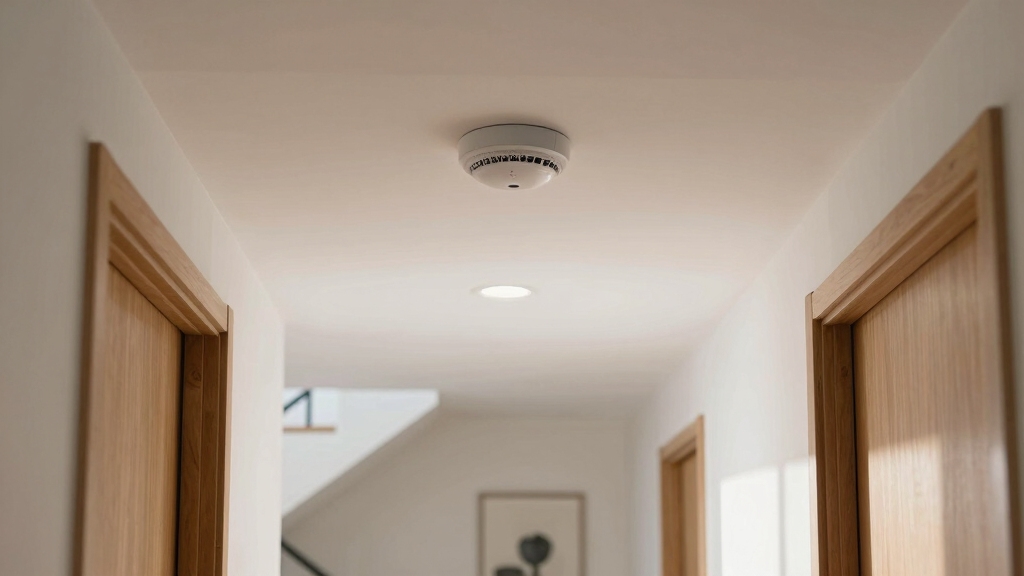

You should install smoke detectors inside each bedroom and outside all sleeping areas. Ensure one is on every floor, including basements and attics, for early, reliable alerts.
Mount them on ceilings away from corners and vents, or on walls 4 to 12 inches below the ceiling. Keep detectors at least 10 feet from cooking appliances to avoid false alarms.
In large homes, place detectors near stairways and use interconnected units. Keep your system well-maintained to guarantee peak performance and safety. Here’s what else you need to know.
Key Takeaways
- Install smoke detectors inside each bedroom and outside sleeping areas for immediate and early alerting during sleep.
- Mount detectors on ceilings away from corners, vents, and drafts, prioritizing ceiling placement over walls.
- Maintain a maximum spacing of 30 feet between smoke detectors for effective coverage throughout the home.
- Place detectors at least 10 feet away from cooking appliances to minimize false alarms.
- Install one smoke detector on every level, including basements and attics, near stairways and access points.
Smoke and Carbon Monoxide Detector Installation Locations
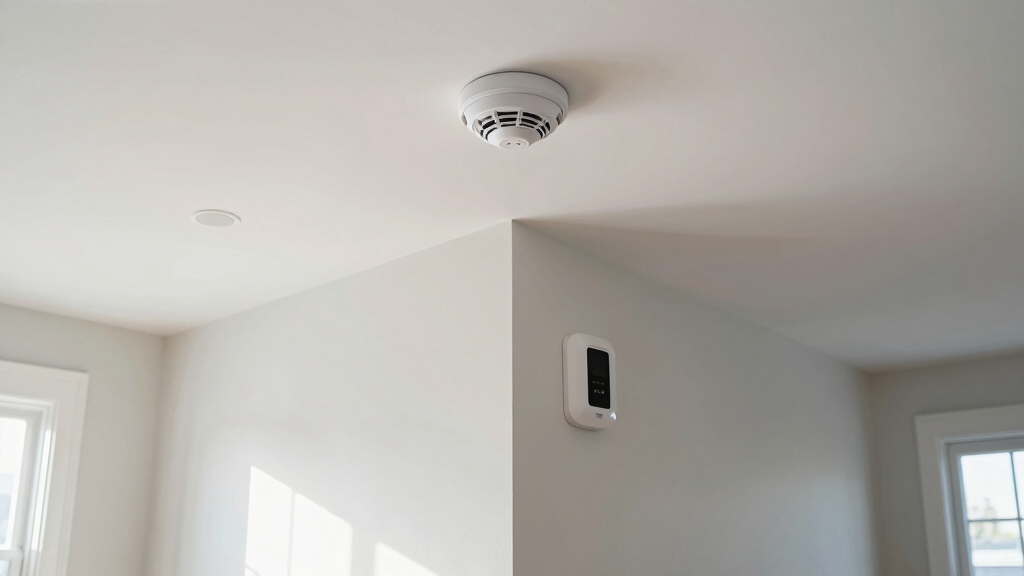
When installing smoke and carbon monoxide detectors, you should place smoke detectors inside each bedroom and outside sleeping areas, such as hallways, to guarantee early warning.
Additionally, position one smoke detector on every level of your home, including basements and attics, ensuring thorough coverage. For levels without bedrooms, install detectors in main living areas near stairways.
Basements require a detector at the ceiling top or bottom of stairs.
For carbon monoxide (CO) detectors, install on every level outside sleeping areas, particularly near bedrooms, fuel-burning appliances, basements, and garage entrances.
Always follow manufacturer instructions for precise placement. Using dual smoke/CO detectors in hallways, living areas, and kitchens is advisable for efficient detection of both hazards.
Proper location is critical to maximize early alerting and occupant safety. Maintain a maximum spacing of 30 feet between smoke detectors to ensure effective coverage throughout the home.
Mounting Smoke and CO Detectors on Ceilings and Walls
Although smoke and carbon monoxide detectors can be mounted on walls or ceilings, you should prioritize ceiling installation because smoke and heat naturally rise, providing faster detection.
Mount smoke detectors on ceilings away from corners, vents, and drafts. If you must mount on walls, position them 4 to 12 inches below the ceiling to optimize sensor exposure.
For sloped or vaulted ceilings, install detectors 4 to 12 inches from the highest point. Keep units at least 10 feet from cooking appliances to avoid false alarms.
Carbon monoxide detectors require specific placement near bedrooms and fuel-burning appliances, following manufacturer height guidelines.
Always install detectors out of children’s and pets’ reach. Ensuring proper mounting height and location markedly improves early warning capabilities and compliance with safety standards.
Additionally, hardwired smoke detectors should always have a battery backup installed to ensure continuous operation during power outages.
Placement Tips for Large Homes, Basements, and Attics
Since large homes often have multiple levels and complex layouts, you’ll need to install smoke detectors on every floor, including basements and attics, to guarantee complete coverage.
Focus on strategic placement to ensure early detection across all living spaces and transitional areas.
Install detectors inside each bedroom and outside sleeping areas on every floor.
Place detectors on basement ceilings near stairways for timely alerts.
Mount detectors in attics close to access points but away from drafts or vents.
Use interconnected systems so alarms on one level trigger alerts throughout the home.
Prioritize mounting detectors at accessible heights—about 5 feet above the floor or 6 inches below the ceiling—to align with the breathing zone and typical airflow for reliable detection.
Common Mistakes When Installing Smoke and CO Detectors
Mistakes in smoke and CO detector installation often compromise their effectiveness and your home’s safety. You must avoid placing detectors too close to cooking appliances or vents, as this causes false alarms or missed alerts.
Mounting detectors too low or in corners obstructs smoke and CO detection. Failing to install detectors outside each sleeping area and on every home level reduces early warning capability.
| Common Mistake | Impact |
|---|---|
| Near cooking appliances | Frequent false alarms |
| Improper mounting location | Delayed smoke or CO detection |
| Insufficient coverage levels | Incomplete home protection |
Install detectors on ceilings or high walls, away from airflow disturbances. Ensure coverage in bedrooms, hallways, basements, and attics for peak safety. Detectors should have a reliable battery backup to maintain protection during power outages.
How to Maintain and Test Your Smoke and CO Detectors?
To make sure your smoke and CO detectors function reliably, you must test them monthly and replace their batteries annually. Regular maintenance guarantees prompt alerts and minimizes false alarms. Follow these key steps:
Test smoke and CO detectors monthly and replace batteries yearly to ensure reliable alerts and reduce false alarms.
Press the test button until the alarm sounds to confirm sensor and battery integrity.
Clean detectors with a vacuum or soft brush to remove dust that can impair sensors.
Replace units every 7–10 years per manufacturer guidelines to maintain sensitivity.
Assure replacement batteries are fresh and correctly installed to prevent power failures.
Additionally, avoid placing detectors near vents or cooking appliances to reduce nuisance alarms. Keep them out of reach of children and pets to prevent tampering.
Regular cleaning prevents dust and moisture buildup that cause false alerts and unnecessary beeping.
Frequently Asked Questions
What Types of Smoke Detectors Are Best for Different Home Environments?
You should use both ionization and photoelectric smoke detectors for all-encompassing protection.
Ionization detectors quickly sense fast-flaming fires, ideal for kitchens and living rooms.
Photoelectric detectors excel at detecting smoldering fires, perfect near bedrooms and sleeping areas.
For large homes or multi-level residences, combine types and consider interconnected systems.
Dual smoke/CO detectors work well near fuel appliances and garages.
Always follow manufacturer guidelines to optimize placement and performance.
How Do Ionization and Photoelectric Smoke Detectors Differ in Detecting Fires?
Back in the day, you’d rely on your trusty candle to spot danger, but now you rely on detectors.
Ionization detectors excel at sensing fast, flaming fires by detecting tiny smoke particles.
Photoelectric detectors catch slow, smoldering fires by sensing larger smoke particles using a light beam.
You should use both types together to cover all fire scenarios efficiently.
This ensures quicker alerts and enhanced safety for your home.
Can I Install Smoke Detectors Myself, or Should a Professional Do It?
You can install smoke detectors yourself if you follow manufacturer guidelines and local codes carefully.
Make certain proper placement, secure mounting on ceilings or walls, and correct wiring for interconnected systems.
However, if you’re unsure about electrical connections or complex setups, hiring a professional guarantees compliance and safety.
Professionals can also verify prime locations and system integration, reducing false alarms and improving overall protection.
Always test detectors after installation.
How Do Interconnected Smoke Detectors Communicate With Each Other?
Think of interconnected smoke detectors as a well-oiled machine, communicating instantly through wired or wireless signals.
When one detector senses smoke or fire, it sends an immediate alert to all others in the network. This triggers alarms throughout your home simultaneously.
This synchronized communication guarantees you won’t miss a warning, no matter where you are.
The system uses specific protocols to avoid interference, providing reliable, real-time alerts for your safety.
What Are the Signs That My Smoke Detector Needs Full Replacement?
You need to replace your smoke detector if it no longer sounds during monthly tests or has frequent false alarms.
Also, check the manufacturer’s expiration date. Most detectors last 8-10 years.
If the indicator light fails or the unit responds sluggishly to smoke, it’s time for replacement.
Persistent battery issues, despite fresh batteries, also signal a failing detector.
Always follow manufacturer guidelines for safe, reliable operation.
Protect Your Home with Smart Detector Placement
You can’t afford to underestimate the importance of properly placing your smoke and carbon monoxide detectors. They’re your first line of defense against invisible dangers.
By installing them on ceilings or high on walls, especially near bedrooms and key living areas, you maximize early warnings.
Avoid common mistakes like ignoring basements or attics. Regular maintenance and testing guarantee they function flawlessly. Follow these precise guidelines, and you’ll have a safety net that’s as reliable as a fortress.