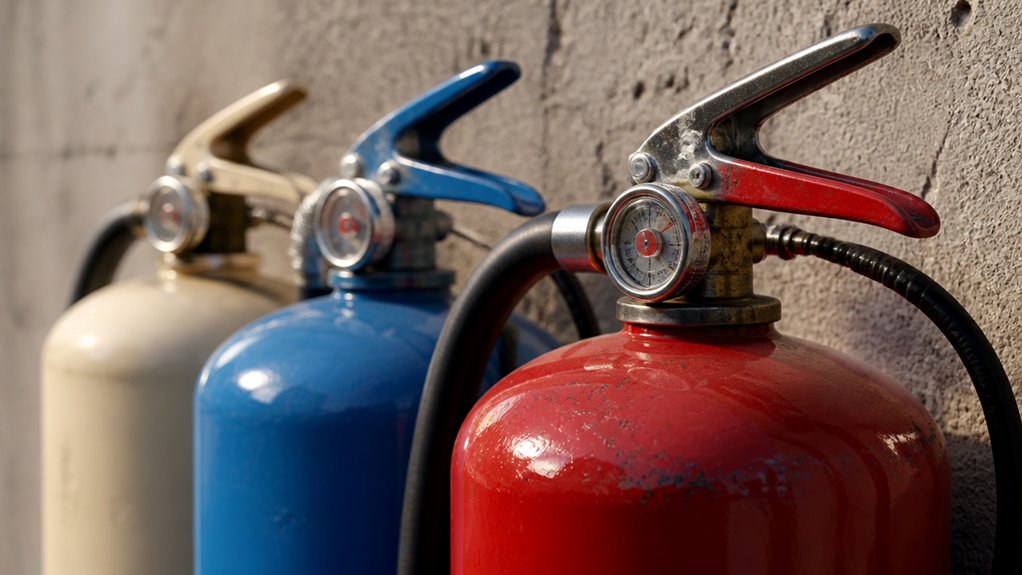

Fire extinguishers are colour coded to help you quickly identify the right type during emergencies, reducing response time and preventing dangerous misuse.
The signal red body indicates water-based extinguishers for Class A fires, while coloured bands—cream for foam, blue for dry powder, black for CO2, and yellow for wet chemical—specify agents and suitable fire classes.
This standardisation follows BS EN3 rules for clear visibility, especially in smoky conditions. Understanding these codes guarantees safer, faster fire control and proper extinguisher use.
More detailed insights follow.
Key Takeaways
- Fire extinguishers have a red body with a coloured band indicating the extinguishing agent and fire class.
- Cream bands identify foam extinguishers for Class A and B fires involving solids and flammable liquids.
- Blue bands mark dry powder extinguishers suitable for Class A, B, C, and electrical fires.
- Black bands indicate CO2 extinguishers used for electrical and flammable liquid fires.
- Yellow bands signify wet chemical extinguishers designed for Class F kitchen oil and fat fires.
Why Fire Extinguishers Are Colour Coded?
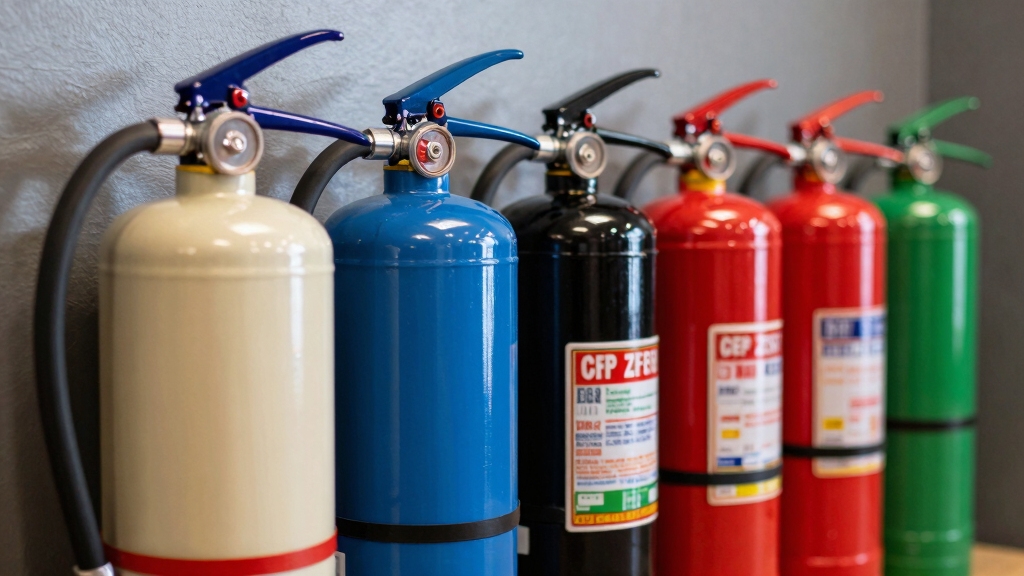
Because quick identification is vital during emergencies, fire extinguishers are colour coded to help you instantly recognize the correct type for different fire classes.
Quick identification during emergencies is crucial, so fire extinguishers are colour coded for instant recognition.
Modern UK extinguishers feature a standard signal red body per BS EN3, with a colour band or label covering at least 5% of the surface.
This design enhances visibility, especially in smoke-filled environments, and aligns with EU standards for uniformity.
The colour coding allows you to distinguish extinguisher contents quickly: water, foam, dry powder, CO2, or wet chemical.
Each is suited for specific fire types.
This system reduces response time and prevents misuse of extinguishers, which could worsen certain fires.
Knowing these colour cues guarantees you select the right extinguisher, improving your safety and the effectiveness of fire suppression.
For optimal safety, extinguishers should also be placed along normal travel paths and near exits to ensure rapid access during emergencies.
How Modern Fire Extinguisher Colour Coding Improves Safety?
You know how crucial it’s to spot fire extinguishers quickly, especially in smoke-filled environments. That’s where clear colour coding comes in handy.
It really enhances visibility for firefighters, making it easier to find the right equipment when every second counts.
Plus, those standardized bands? They let you identify the correct type of extinguisher at a glance. This speeds up response time significantly.
When you’re in a high-pressure situation, reducing errors is key. With the right extinguisher in hand for each fire class, you can tackle the situation more effectively and safely.
Understanding the multi-purpose design of ABC fire extinguishers ensures you choose the proper extinguisher for Class A, B, and C fires.
Enhanced Firefighter Visibility
Although smoke and poor lighting often hinder emergency response efforts, modern fire extinguisher colour coding greatly enhances firefighter visibility and identification during critical incidents.
The signal red body, mandated since 1997 under BS EN3, guarantees extinguishers stand out in low-visibility environments, enabling quick localization.
The identifying colour bands or labels, covering at least 5% of the surface, offer high-contrast visual cues that reduce confusion and errors.
This standardisation aligns with EU regulations, creating a uniform appearance across various extinguisher types.
As a firefighter, you benefit from the clear differentiation of extinguishers by their coloured markings—cream, blue, black, or yellow—against the red backdrop.
This allows you to maintain situational awareness and operate efficiently even under adverse conditions, ultimately improving safety and response effectiveness.
Regular professional servicing ensures that these colour-coded extinguishers remain functional and ready for use when needed.
Faster Fire Type Identification
Effective identification of fire extinguisher types hinges on the clear, standardized colour coding applied to modern extinguishers.
With a signal red body and distinct coloured bands or labels covering at least 5% of the surface, you can instantly recognize the extinguisher’s specific fire class suitability.
For example, cream indicates foam for Class A and B fires. Blue signals dry powder for versatile Class A, B, and C fires.
Black denotes CO2 for electrical and liquid fires, and yellow marks wet chemical for Class F kitchen fires.
This consistent coding cuts down the time you spend identifying the correct extinguisher, enabling quicker, more confident selection during emergencies.
The red base also enhances visibility in smoke, ensuring you locate the right extinguisher swiftly, improving safety outcomes.
Regular inspection and maintenance of extinguishers ensure that their components and agents remain effective when needed.
Reduced Emergency Response Errors
Minimizing errors during emergency fire response materially depends on the clear, standardized colour coding of modern fire extinguishers.
By using a signal red body with distinct coloured bands or labels, you can quickly identify the appropriate extinguisher type under stress.
Cream is for foam, blue for dry powder, black for CO2, and yellow for wet chemical.
This reduces the risk of deploying the wrong agent, which can worsen the fire or cause harm, such as using water (red) on electrical or flammable liquid fires.
The consistent BS EN3 standard enhances recognition, enabling you to act swiftly and correctly.
Clear visual cues cut down cognitive load and hesitation, improving response accuracy in smoke-filled or low-visibility environments.
Ultimately, this boosts safety for you and others during emergencies.
Understanding the UL ratings on extinguisher labels also helps confirm their effectiveness against different fire types, further ensuring proper use.
What the Red Colour Means on Water-Based Fire Extinguishers?
You’ll easily spot water-based fire extinguishers thanks to their bright red body, which really helps in emergencies.
These extinguishers are designed specifically for Class A fires, which means they’re great for tackling solid combustibles like wood and paper.
But here’s the important part: they’re not meant for electrical fires or flammable liquids.
Regular inspection and servicing by licensed fire protection services ensure these extinguishers remain effective and compliant with safety standards.
Red Colour Significance
When you see a fire extinguisher with a signal red body, it signifies a water-based agent designed primarily for Class A fires involving solid combustibles such as wood and paper.
This colour coding follows the BS EN3 standard, ensuring quick identification and enhanced visibility, especially in smoke-filled environments.
The red body indicates extinguishers that use water in spray or mist form to cool and suppress fire by absorbing heat.
You should note that these extinguishers are unsuitable for electrical fires or flammable liquid fires due to the risk of electric shock and spread of flames.
The consistent red colour aligns with EU standards, promoting uniformity and safety across various settings.
This makes it easier for you to respond swiftly and appropriately during emergencies.
For optimal safety, ensure that fire extinguishers and their signage are clearly visible and unobstructed, complying with regulations to enable quick emergency response.
Suitable Fire Classes
Although water-based fire extinguishers with a signal red body are primarily designed for Class A fires, understanding the specific fire classes they effectively combat is essential for safe and efficient use.
These extinguishers target solid combustibles by cooling and soaking the material to prevent re-ignition. You should note the following:
- Class A fires involve ordinary combustibles such as wood, paper, textiles, and some plastics.
- Red water-based extinguishers are ineffective and unsafe on electrical fires due to the risk of electrocution.
- They must never be used on flammable liquid fires (Class B), as water can spread the fire.
Using the correct extinguisher for the fire class guarantees peak suppression and safety. For fires involving energized electrical equipment, dry chemical extinguishers use non-conductive powders to safely suppress flames without risk of shock.
What Cream-Coloured Bands Mean on Foam Fire Extinguishers?
Recognize cream-colored bands on fire extinguishers as the clear indicator of foam agents designed to tackle Class A and B fires.
These extinguishers contain aqueous film-forming foam that smothers flames by creating a blanket over solid combustibles and flammable liquids, effectively cutting off the oxygen supply.
You’ll find the cream band on a signal red body, complying with BS EN3 standards, ensuring quick identification even in smoky environments.
While foam extinguishers are suitable for Class A fires involving materials like wood and paper, and Class B fires with flammable liquids, they’re only safe for electrical fires if dielectrically tested.
Their mechanism prevents re-ignition by cooling surfaces and isolating fuel, making them a reliable choice for mixed fire hazards in industrial and commercial settings.
For fires involving flammable liquids and electrical equipment, specialized agents like Purple K extinguishers offer superior performance and safety.
When to Use Blue-Banded Dry Powder Fire Extinguishers?
Foam extinguishers with cream bands effectively handle Class A and B fires, but you’ll need a different tool for a broader range of fire types.
Blue-banded dry powder extinguishers are versatile and essential when facing more complex hazards. You should use them when:
- You encounter Class A fires involving solids like wood or paper, as they interrupt the chemical reaction efficiently.
- Fires involve flammable liquids (Class B) or gases (Class C), where powder smothers flames and halts combustion.
- Electrical fires pose a risk, since dry powder is non-conductive and safe on energized equipment.
Keep in mind, dry powder leaves residue, so avoid using it where sensitive electronics or clean environments are critical.
Use these extinguishers for broad-spectrum fire protection in mixed-risk settings.
Remember to follow the PASS technique to operate extinguishers safely and effectively.
What Black Bands Mean on CO2 Fire Extinguishers?
When you see a black band or label on a fire extinguisher’s signal red body, it identifies a CO2 extinguisher designed specifically for Class B fires involving flammable liquids and electrical hazards.
These extinguishers work by displacing oxygen around the fire, effectively suffocating the flames without leaving any residue. This makes them ideal for use on electrical equipment, as they won’t cause damage like powder-based extinguishers.
However, CO2 extinguishers aren’t suitable for outdoor use since the gas quickly disperses in open air, reducing effectiveness. The black band covers at least 5% of the surface, ensuring quick recognition per BS EN3 standards.
When handling a fire involving flammable liquids or live electrical sources, you can rely on the black-banded CO2 extinguisher for precise, residue-free suppression.
Why Yellow Bands Matter for Wet Chemical Fire Extinguishers?
Pay close attention to the yellow band on a fire extinguisher. It signals a wet chemical type specifically engineered for Class F fires involving cooking oils and fats. You need these extinguishers in kitchens where grease fires pose significant risks.
Their unique formulation creates saponification, a chemical reaction that forms a soapy layer. This effectively smothers the fire and prevents re-ignition.
Here’s why the yellow band matters:
- It identifies the extinguisher’s suitability for high-temperature cooking oil fires. Water or powder extinguishers can worsen these situations.
- It guarantees quick recognition during emergencies, minimizing response time.
- It highlights compliance with UK safety standards, signaling proper placement in commercial kitchens and food preparation areas.
Understanding the yellow band helps you select the correct extinguisher and enhances fire safety in critical environments.
Key Facts About Older Fire Extinguisher Colour Styles and Usage
Understanding the significance of the yellow band on wet chemical extinguishers sets the stage for recognizing how fire extinguisher colour coding has evolved over time. Before 1997, extinguishers were fully coloured bodies, making identification less consistent.
Today, the red body with a coloured band improves visibility and standardizes recognition across types.
| Old Colour Style | Modern Band Colour | Primary Use |
|---|---|---|
| Fully Red | Red Band | Water – Class A fires |
| Fully Cream | Cream Band | Foam – Class A & B fires |
| Fully Blue | Blue Band | Dry Powder – Class A, B, C fires |
| Fully Black | Black Band | CO2 – Class B & electrical fires |
Knowing these facts helps you identify and use extinguishers effectively. Despite older styles still being legal if functional, modern standards enhance safety.
Frequently Asked Questions
How Often Should Fire Extinguishers Be Inspected and Maintained?
You should inspect fire extinguishers monthly, checking pressure gauges, seals, and physical condition.
A thorough maintenance check by a qualified technician must occur annually, ensuring internal components work correctly.
Recharge or replace extinguishers as needed. Records of inspections and maintenance should be kept.
Regular checks guarantee readiness and compliance with safety regulations, preventing failure during emergencies.
This also extends extinguisher lifespan effectively.
Can Fire Extinguisher Colours Vary by Country Outside the UK?
Yes, fire extinguisher colours can vary by country outside the UK.
Different nations adopt their own standards reflecting local regulations and safety protocols.
While the UK uses a signal red body with coloured bands per BS EN3, other countries might employ fully coloured bodies or distinct colour schemes.
You should always verify the specific standards in your region to correctly identify extinguisher types and their appropriate uses for safety compliance.
What Training Is Needed to Use Different Types of Extinguishers Safely?
Before the age of steam engines, you’d still need proper training to use fire extinguishers safely.
You must learn to identify extinguisher types, understand fire classes, and operate the PASS technique: Pull, Aim, Squeeze, Sweep.
Training includes hands-on practice, recognizing hazards like electrical or grease fires, and knowing extinguisher limitations.
Regular refresher courses guarantee you stay confident and effective during emergencies, preventing misuse that could worsen fires or cause injury.
How Long Do Fire Extinguishers Typically Remain Effective?
Fire extinguishers typically remain effective for 5 to 10 years, depending on the type and manufacturer guidelines.
You should check the pressure gauge, seals, and overall condition annually and have a professional inspection every year.
After use, even partial discharge requires recharging or replacement.
Environmental factors like temperature and humidity also affect lifespan.
Regular maintenance guarantees your extinguisher will perform reliably when you need it most.
Are There Specific Disposal Guidelines for Expired Extinguishers?
Imagine an expired extinguisher like a phone with a dead battery. It won’t save you when you need it most.
You must never throw it in regular trash. Instead, you should contact local hazardous waste disposal or fire safety services for proper decommissioning.
They’ll safely remove the chemicals and metals, preventing environmental harm. Following these strict disposal guidelines guarantees safety and compliance with regulations, protecting people and the planet.
Stay Safer by Understanding Colour-Coded Extinguishers
You might think all fire extinguishers look the same, but their colour codes reveal critical differences you can’t afford to ignore.
Knowing the specific colour bands—red for water, cream for foam, blue for dry powder, black for CO2, and yellow for wet chemical—can be the key to effectively tackling a fire and preventing disaster.
Don’t wait until it’s too late; understanding these codes could save lives when every second counts.