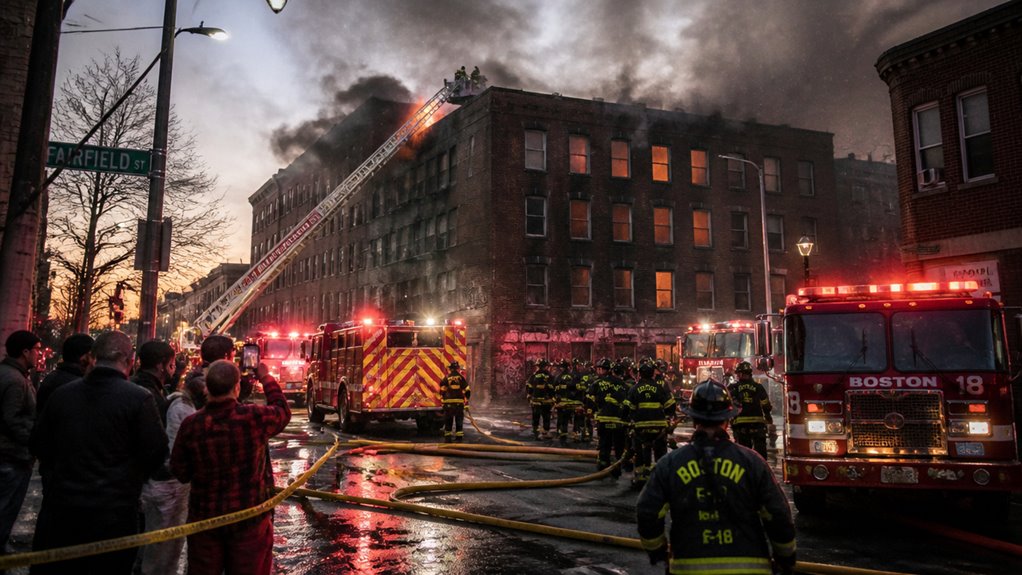

A box alarm fire is a rapid, organized multi-unit response triggered by a single emergency call from a designated geographic area.
You rely on this system to guarantee firefighters arrive quickly with the right equipment based on pre-planned protocols tied to specific locations.
It balances speed and resource allocation, often involving mutual aid for larger incidents.
This reliable method remains essential, especially during 911 outages, and continues shaping modern firefighting strategies you’ll find important to understand.
Key Takeaways
- A box alarm fire triggers a structured, multi-unit fire response from a specific geographic area based on a single reported incident.
- It ensures rapid, organized escalation of firefighting resources for managing larger or complex fires efficiently.
- The system uses unique electrical pulse signals from fire alarm boxes to identify the exact location quickly.
- Dispatchers follow pre-planned response protocols tied to box locations for coordinated deployment of engines and ladders.
- Box alarms serve as reliable backups during 911 outages, maintaining critical communication via dedicated physical lines.
Box Alarm Fires: What They Are and Why They Matter
Although physical fire alarm boxes have become rare, the term “box alarm fire” remains central to firefighting operations.
When you hear “box alarm,” it refers to a pre-designated geographic area, like an intersection or building, with an established response plan.
Activating a box alarm triggers a specific dispatch of fire apparatus tailored to that location’s risks.
This system guarantees you get a rapid, organized response without delay.
It’s not just about tradition; box alarms streamline resource allocation and improve preparedness for fires or disasters.
Even with modern communication, this method provides a reliable, automatic dispatch based on location, enhancing efficiency and safety.
Understanding box alarm fires helps you appreciate how fire departments maintain readiness and coordinate efforts effectively.
Manual fire alarm pull stations serve as a critical component in early fire detection and occupant alert during emergencies.
The History and Evolution of Box Alarm Fire Systems
Box alarm fire systems have quite an interesting history! They actually started back in the mid-1800s with telegraph-based alerts. Can you imagine how important it was to quickly notify firefighters of emergencies back then? These early systems used pulsing electrical signals from street corner boxes, allowing them to pinpoint fire locations almost instantly.
As time went on, things really began to change. By the late 20th century, the technology shifted to digital signals. This was a game-changer! It not only improved the speed of alerts but also made fire response much more accurate. Pretty fascinating how technology has evolved to keep us safer, right? Modern emergency systems must also consider data retention limits to ensure critical footage or alerts are preserved for investigations and legal needs.
Origins of Fire Alarms
When you trace the origins of fire alarm systems, you find they began in the mid-19th century as a crucial innovation for urban safety.
Developed in 1852 by Dr. William F. Channing and Moses G. Farmer in Boston, these early systems transformed how cities responded to fires.
Here’s what you should know:
- Telegraph-based fire alarm boxes were installed on street corners for quick alerts.
- The Gamewell Fire Alarm Telegraph Company, formed in 1879, standardized and expanded these systems.
- Early mechanisms used pulsed electrical signals matching box numbers to notify stations instantly.
- By the late 1800s, urban centers relied heavily on these systems before telephones became widespread.
This foundation set the stage for modern fire alarm responses and continues to influence emergency protocols today. Early fire alarm boxes were local systems that alerted only on-site responders, highlighting the need for central monitoring stations for improved emergency response.
Telegraph-Based Alert Systems
The telegraph-based alert system revolutionized fire response by enabling instant communication between the scene of a fire and fire stations.
Developed in 1852, this system used a spring-loaded wheel inside street boxes that, when activated, sent pulsed electrical signals corresponding to a unique box number.
These pulses, repeated in cycles, allowed dispatchers to identify the fire’s location immediately.
Installed on street corners and telephone poles, the boxes connected directly to fire stations, triggering audible alarms for quick recognition.
This setup eliminated delays common in early telephone systems, providing faster, reliable alerts.
You’d see these telegraph boxes as essential tools for urban firefighting, laying the groundwork for today’s rapid, coordinated responses.
Their design guaranteed accuracy and speed, critical for effective early fire suppression efforts.
Modern fire alarm systems build on this foundation by incorporating automatic alerting to notify emergency responders without manual intervention.
Transition to Digital Signals
Although early box alarm systems relied on mechanical pulses to transmit fire alerts, advancements in technology propelled a shift toward digital signaling. This shift enhanced accuracy, speed, and integration with modern dispatch systems.
By 1977, New York City digitized its box alarm system, moving from manual lookup to computerized response coordination.
Here’s what you should know about this evolution:
- Digital signals replaced mechanical pulses, reducing errors and delays.
- Computerized systems automatically matched box numbers to response plans.
- Voice-enabled boxes allowed two-way communication between callers and dispatchers.
- Digital integration enabled multi-alarm coordination and mutual aid across jurisdictions.
This shift not only modernized fire alerts but also guaranteed faster, more reliable firefighter deployment during emergencies. Modern systems often integrate with monitored control circuits to ensure immediate and reliable notification of elevator recalls and other fire safety responses.
How Mechanical Box Alarms Send Fire Alerts?
Since every mechanical box alarm relies on a simple yet reliable mechanism, you can understand how it sends fire alerts by focusing on its spring-loaded wheel.
When you pull the box’s knob or activate its hook, this wheel turns, creating a series of electrical pulses. These pulses correspond to the box’s unique number, transmitted in four repeated rounds to guarantee accuracy.
Each tooth on the code wheel momentarily opens the circuit, producing a Morse-like signal pattern that fire stations decode immediately.
This hardwired connection allows alerts to reach stations faster than phone calls. Once received, the dispatcher references the box number to dispatch predetermined apparatus.
You’ll see how this precise, mechanical signaling formed the backbone of urban fire response before digital systems took over.
Resetting these devices often requires specific manufacturer-specific keys to properly restore normal operation after activation.
Box Alarm Call Boxes: Where to Find Them Today
You can still come across box alarm call boxes in certain cities, especially where reliable backup communication is essential.
Box alarm call boxes remain vital in cities where dependable backup communication is critical.
While their numbers have dwindled with the rise of telephones and digital alerts, these boxes remain indispensable in specific urban areas.
Here’s where you’re most likely to find them today:
- On street corners in historic districts, preserving traditional fire alert methods.
- Mounted on telephone poles in neighborhoods prone to 911 service interruptions.
- Outside commercial buildings in cities with dense fire station networks.
- Near critical infrastructure where direct fire reporting is imperative during emergencies.
These locations guarantee firefighters receive timely alerts even when modern systems fail, maintaining a dependable safety net for communities that prioritize uninterrupted communication. Regular testing and maintenance of alarm systems are crucial to ensure system reliability and effectiveness.
How Fire Stations Decode Box Alarm Signals?
Fire stations rely on a precise decoding process to interpret box alarm signals quickly and accurately.
When a box is activated, it sends a series of electrical pulses corresponding to its unique number. These pulses trigger audible signals, such as horn blasts, bells, or gongs, in the station.
The signals are repeated four times to guarantee accuracy. You listen carefully to the pulse pattern, which represents the box number in a Morse-like code.
Using a lookup card or digital system, you match the signal to a specific location and pre-planned response plan. This method eliminates delays, allowing you to dispatch the correct apparatus immediately.
Though technology has evolved, this decoding process remains essential, especially in outages. It assures firefighters respond swiftly and efficiently to emergencies.
Before any troubleshooting or testing of fire alarm signals, it is critical to contact authorities to place the system in test mode and ensure proper coordination.
Box Alarms’ Role in Modern Fire Dispatching
Although traditional street call boxes have largely faded from the urban landscape, the concept of box alarms remains central to modern fire dispatching.
Traditional street call boxes may be gone, but box alarms still play a key role in fire dispatching today.
You’ll find that box alarms now define specific geographic zones with pre-planned apparatus responses, streamlining emergency management. When a box alarm triggers, computer systems automatically dispatch the right fire units based on the location’s protocol.
Here’s what you need to know about their role today:
- They assign predetermined fire station responses to specific areas.
- They enable rapid, coordinated deployment of resources.
- They integrate with digital dispatch systems for efficiency.
- They support automatic multi-alarm escalation during large incidents.
This zoned approach is similar to the zone-based detection used in the simplest fire alarm systems, emphasizing area-specific responses rather than individual device identification.
Why Box Alarms Still Matter During 911 Outages?
When 911 systems fail, it’s crucial to have a backup communication method that won’t let you down. That’s where box alarms come into play. They provide a reliable and direct line to fire stations, which is especially important when modern networks face vulnerabilities.
Think about it: during an outage, you want to make sure emergency responses keep flowing without a hitch. Box alarms serve as that critical backup, ensuring that help is always just a signal away. It’s a simple yet effective solution that can really make a difference when it matters most. Proper handling of fire alarms, including knowing how to access the fire alarm control panel, is essential for maintaining safety during emergencies.
Reliable Emergency Communication
Often overlooked in modern emergency systems, box alarms remain an essential fallback during 911 outages.
They ensure reliable communication when digital networks fail.
When you rely on these systems, you tap into a direct, hardwired method that bypasses vulnerable cellular or internet infrastructure.
Here’s why box alarms keep communication reliable during outages:
- They use dedicated physical lines immune to wireless disruptions.
- Signal pulses transmit instantly, avoiding delays common in digital calls.
- Automatic repeated transmissions guarantee message receipt at the station.
- Pre-assigned box numbers streamline dispatch without needing phone operators.
Backup During System Failures
You depend on modern 911 systems for emergency response, but these networks can fail during power outages, natural disasters, or cyberattacks. In these moments, traditional box alarms become your reliable backup.
Hardwired directly to fire stations, they bypass phone networks, ensuring immediate alerts. Their pulse signals transmit box numbers, triggering pre-planned apparatus dispatches without delay.
| Scenario | Box Alarm Advantage |
|---|---|
| Power Outage | Operates independently |
| Cyberattack | Immune to digital disruption |
| Natural Disaster | Physical signal reliability |
| Phone System Failure | Direct wired communication |
| High Call Volume | Prevents overwhelmed 911 lines |
Box alarms maintain critical communication when modern systems falter. This proves why they still matter during 911 outages.
Why Pre-Planned Box Alarm Responses Make Firefighting Safer?
Because pre-planned box alarm responses assign specific apparatus and personnel to known locations, they streamline firefighting efforts and reduce confusion during emergencies.
When you rely on these plans, you guarantee a faster, coordinated reaction that prioritizes safety and effectiveness.
Here’s why they make firefighting safer:
- Clear Roles: Everyone knows their duties, minimizing overlap and errors.
- Efficient Resource Use: The right equipment and teams arrive promptly without delay.
- Improved Communication: Dispatchers and crews operate on a shared, predetermined plan.
- Risk Reduction: Predictable responses reduce chaos, lowering firefighter injury and exposure.
How Multi-Alarm Box Fires Escalate and Are Managed?
When a fire gets too big for the initial response, it starts to escalate through different alarm levels. Each level brings in more resources to handle the situation. You can really see how important coordinated multi-unit responses are in managing these larger incidents effectively.
Getting a handle on this escalation is crucial. It helps you understand how fire departments keep control and ensure safety during those complex fires. So, it’s not just about putting out the flames; it’s about teamwork and strategy as well.
Escalation Through Alarm Levels
Although initial box alarms trigger a standard response, escalating fires demand a structured increase in resources coordinated through multi-alarm levels.
As a fire intensifies, you’ll see a clear progression in the number and type of units dispatched to control the situation efficiently.
Here’s how escalation works:
- First Alarm: Standard response with predetermined engines and ladders assigned to the box location.
- Second Alarm: Additional units and specialized teams are sent when the fire grows beyond initial control.
- Third Alarm and Beyond: Mutual aid from neighboring districts is requested, increasing manpower and equipment.
- Higher Alarms: Command shifts to incident commanders who manage complex coordination and resource allocation.
This escalation guarantees a scalable, organized approach to managing fires, minimizing risk and maximizing effectiveness.
Coordinated Multi-Unit Response
Managing a multi-alarm box fire requires precise coordination among multiple fire units to guarantee an effective and timely response.
When a box alarm escalates, you’ll see a structured system activate. Additional apparatus and personnel are dispatched according to pre-planned protocols tied to the box location.
Each alarm level triggers specific resources, ensuring you don’t overwhelm or under-respond. Communication is essential; dispatchers relay clear orders, and units maintain situational awareness.
You rely on mutual aid agreements to bring in neighboring departments when needed. This layered response balances speed with resource allocation, containing the fire efficiently while protecting responders and property.
Voice Alarm Boxes: Enhancing Traditional Box Alarm Systems
Many fire departments have upgraded traditional box alarm systems by incorporating voice alarm boxes. These provide direct two-way communication between the caller and the dispatcher. This enhancement improves response accuracy and speed.
When you use a voice alarm box, you can report detailed information instantly, reducing miscommunication. You can receive immediate instructions or reassurance from dispatch. You can confirm the exact location and nature of the fire or emergency.
You also benefit from reliable communication even during 911 outages or phone failures. Voice alarm boxes bridge the gap between old telegraph-style signals and modern digital systems. They ensure you get real-time support.
Frequently Asked Questions
How Do Firefighters Train for Responding to Box Alarm Fires?
You train for box alarm fires by running realistic drills that simulate multi-unit responses to specific geographic areas.
You practice rapid deployment, coordination, and communication using pre-planned apparatus assignments tied to box locations.
You also learn to interpret alarm codes quickly and manage resources efficiently.
Regular exercises focus on teamwork, handling escalating incident sizes, and integrating mutual aid, ensuring you’re ready for complex, high-demand fire emergencies.
What Technology Replaced Box Alarms in Rural Areas?
When you rely on technology in rural areas, modern fire alert systems replaced box alarms like a sunrise dispelling shadows.
You use enhanced radio dispatch, cellular 911 calls, and GPS-enabled mobile alerts to pinpoint emergencies quickly.
These digital tools connect you faster and more reliably than old mechanical boxes, ensuring firefighters respond with precision.
This shift lets you coordinate resources efficiently, even across vast, less-populated regions where traditional boxes once stood sentinel.
Are Box Alarm Systems Used Internationally or Only in the U.S.?
Box alarm systems originated in the U.S. and remain primarily American, but similar fire alarm telegraph concepts exist internationally, adapted to local needs.
You won’t find the exact Gamewell-style box networks widely outside the U.S. Many countries use geographic alarm zones and pre-planned dispatches, mirroring the box alarm’s purpose.
If you’re outside the U.S., expect modern computerized dispatch over physical boxes, with legacy systems mostly phased out.
How Are Box Alarm Locations Chosen Within a City?
You choose box alarm locations strategically at street corners, telephone poles, and outside commercial buildings to maximize visibility and accessibility.
They’re placed in high-traffic urban areas, near intersections, and key buildings to guarantee quick public access during emergencies.
The goal is to cover densely populated zones and critical infrastructure, allowing for rapid activation and efficient pre-planned apparatus dispatch.
This placement enhances firefighter response times and overall city safety.
What Maintenance Is Required to Keep Box Alarm Boxes Operational?
You mightn’t realize it, but keeping box alarm boxes ready demands vigilance.
You’ll need to regularly inspect mechanical parts, ensuring the spring-loaded wheel and code teeth aren’t jammed or rusted.
You’ll test electrical connections to confirm signal pulses transmit correctly.
Weatherproofing is essential to prevent moisture damage.
Don’t forget cleaning the exterior for visibility and functionality.
Without this upkeep, the reliable, instant alert system you count on could fail when seconds matter most.
Understand What a Box Alarm Fire Means Today
Understanding box alarm fires is essential because, when seconds count, every tool matters. These systems, though historic, still provide reliable alerts, especially during 911 outages.
Like the saying goes, “A stitch in time saves nine.” Pre-planned responses and quick decoding of box alarms can prevent small fires from becoming devastating.
By appreciating their role, you see why these alarms remain a cornerstone in firefighting safety and efficiency, even in today’s high-tech world.