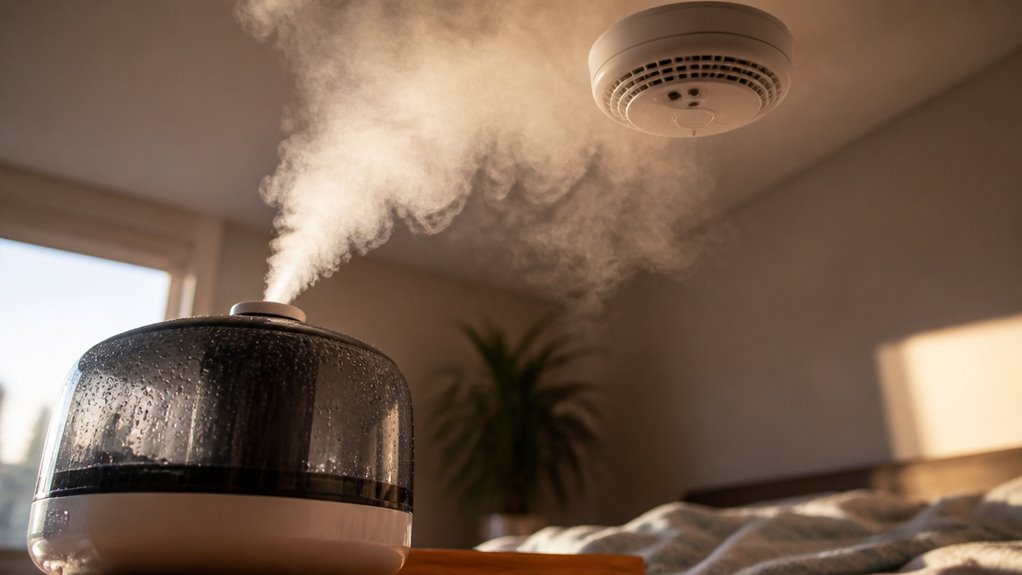

Yes, your humidifier can set off a smoke alarm if it produces dense, cool mist near the detector, especially in high humidity above 80%.
Ionization alarms are highly sensitive to water vapor, while photoelectric alarms may misinterpret mist as smoke due to light scattering.
Positioning your humidifier at least 5 feet from detectors and keeping humidity moderate helps reduce false alarms.
Knowing these factors will help you better manage your humidifier without triggering alarms.
Key Takeaways
- Humidifiers produce water vapor that can mimic smoke particles, potentially triggering smoke alarms.
- Ionization smoke detectors are highly sensitive to dense, cool mist from humidifiers.
- Photoelectric alarms may falsely trigger due to light scattering by water droplets in the air.
- Placing humidifiers at least 5 feet away from smoke detectors helps prevent false alarms.
- Keeping room humidity below 80% and ensuring good ventilation reduces smoke alarm false triggers.
Why Your Humidifier Sets Off Smoke Alarms?
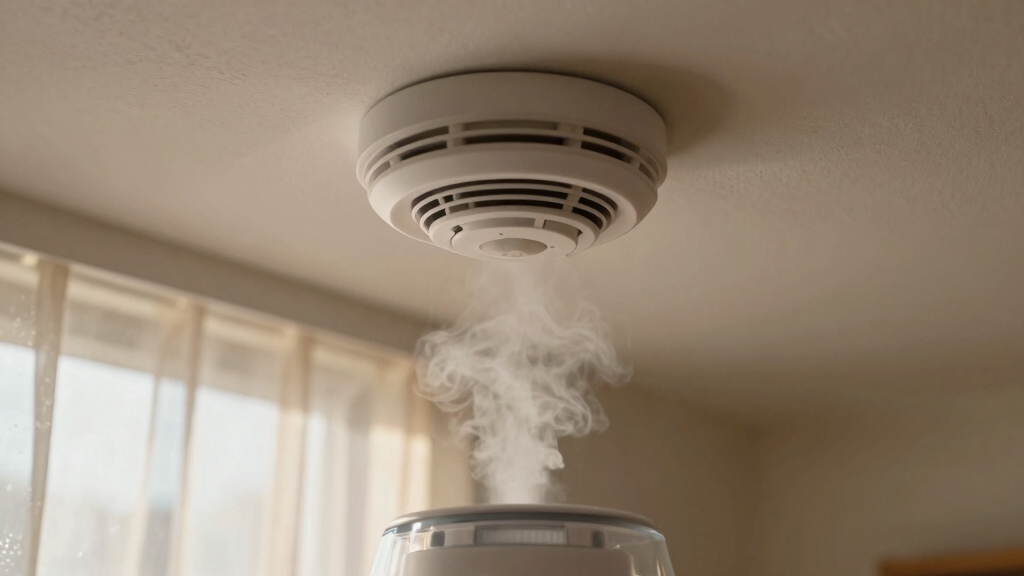
When your humidifier sets off a smoke alarm, it’s usually because the water vapor it emits closely mimics the particles smoke detectors are designed to sense.
Dense, cool mist from the humidifier increases water particle density in the air. This is interpreted similarly to ionized smoke particles by ionization sensors.
Photoelectric sensors can also mistake the mist’s light-scattering properties for smoke. This confusion arises because these detectors lack the capability to differentiate between actual combustion particles and water droplets or vapor.
High humidity, especially above 80%, exacerbates this effect, particularly in enclosed spaces. Malfunctioning or overly high-output humidifiers amplify the risk of false alarms.
You should be cautious with humidifier placement and operation to prevent these unintended activations and maintain the reliable performance of your smoke detection system.
Installing smoke alarms at least 10 feet away from humidifiers and other moisture sources helps minimize false alarms caused by humidity interference.
How Ionization and Photoelectric Smoke Alarms React to Humidity?
Understanding how ionization and photoelectric smoke alarms react to humidity is crucial for preventing false alarms caused by humidifiers.
Ionization detectors often mistake dense, cool water vapor for smoke particles, while photoelectric sensors react to scattered light from water droplets.
Both sensor types are sensitive to high humidity, especially above 80%, increasing false trigger risks.
| Detector Type | Sensitivity to Water Vapor | Typical False Alarm Cause |
|---|---|---|
| Ionization | High | Mist particles, ionized air |
| Photoelectric | Moderate | Light scattering by droplets |
| Smart Alarms | Adjustable | High humidity events |
| Location Impact | Critical | Proximity to humidifier |
| Humidity Level | Below 50% ideal | Minimal false alarms |
You should monitor humidity and understand detector responses to minimize false alarms. Professional monitoring systems with false alarm verification can further reduce unnecessary emergency responses.
Where to Place Your Humidifier to Avoid False Alarms?
Although humidifiers improve indoor air quality, placing them incorrectly can cause smoke alarms to trigger falsely. To avoid this, position your humidifier at least 5 feet (1.5 meters) away from any smoke detector.
Humidifiers enhance air quality but must be placed 5 feet away from smoke detectors to prevent false alarms.
Never place it directly beneath or adjacent to an alarm, as water vapor rises and can easily reach the sensor. Avoid corners and walls where moisture can accumulate and increase local humidity beyond 80%, a threshold that often triggers false alarms.
Install smoke detectors on ceilings while keeping humidifiers on stable, open surfaces to guarantee proper vapor dispersion. Also, refrain from running your humidifier on high settings in small, enclosed spaces, as this raises water vapor density.
Careful placement minimizes the risk of false alarms caused by mist mimicking smoke particles. Proper ventilation and maintaining good airflow further reduce the chance of false activations from humidifiers near detectors.
Practical Tips to Stop Your Humidifier From Triggering Smoke Alarms
To prevent your humidifier from setting off smoke alarms, you must control both its placement and operation carefully.
Keep your humidifier at least 5 feet away from any smoke detector. Avoid placing it near walls or corners where vapor can accumulate.
Operate the humidifier at moderate settings to maintain humidity below 80%. Use a hygrometer for monitoring.
Avoid running it continuously overnight. Instead, use timers to reduce excess moisture buildup. Proper ventilation in the room also helps dissipate water vapor, lowering the risk of false alarms.
Because photoelectric smoke alarms use light scattering to detect smoke particles, excessive steam or moisture can sometimes scatter light and cause false triggers, so managing humidity is crucial to avoid activating the Tyndall Effect-based sensors.
| Placement | Operation | Monitoring |
|---|---|---|
| 5+ feet from alarm | Moderate humidity settings | Use a hygrometer |
| Avoid corners/walls | Timed operation | Ventilate the room |
| Ceiling-mounted alarms | Prevent excessive steam | Keep humidity < 80% |
Choosing and Adjusting Smoke Alarms for High-Humidity Areas
When selecting smoke alarms for areas with high humidity, you should prioritize models that minimize false alarms caused by water vapor. Ionization smoke detectors are generally less sensitive to water vapor compared to photoelectric types, making them preferable in such environments.
Additionally, look for alarms with adjustable sensitivity settings to reduce false triggers. Smart alarms with humidity sensors can also offer improved reliability by distinguishing steam from smoke.
Here are three key considerations:
- Choose ionization or dual-sensor alarms with humidity resistance.
- Prefer models that allow sensitivity customization.
- Install alarms away from humidifier output and maintain proper ventilation.
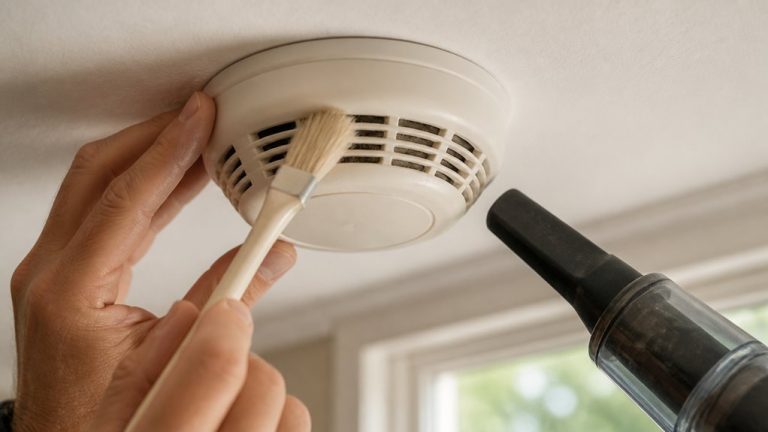
Regular maintenance and cleaning are essential to prevent residue buildup from moisture, which can degrade sensor sensitivity over time.
Frequently Asked Questions
Can Humidifiers Affect Carbon Monoxide Detectors?
Humidifiers generally don’t affect carbon monoxide detectors because these detectors sense gas molecules, not moisture.
However, excessive humidity or steam buildup near the sensor could potentially interfere with its electronic components or cause corrosion over time.
To guarantee reliable operation, keep your humidifier at least 5 feet away from CO detectors and maintain indoor humidity below 80%.
Regularly check and replace detectors according to manufacturer guidelines to avoid false readings or malfunctions.
Do Warm Mist Humidifiers Cause Fewer False Alarms?
Warm mist humidifiers cause fewer false alarms, produce less dense vapor, and emit warmer particles that dissipate faster.
You’ll find they’re less likely to trigger ionization or photoelectric smoke detectors because their steam isn’t as thick or cool as that from cool mist devices.
Still, you should maintain proper distance from alarms, avoid excessive humidity above 80%, and monitor room conditions to prevent any unintended activation due to moisture buildup.
How Does Outdoor Humidity Influence Indoor Smoke Alarms?
Outdoor humidity affects indoor smoke alarms by influencing indoor moisture levels. If outdoor humidity is high, it can raise indoor relative humidity, especially in poorly ventilated spaces.
This increases the risk of false alarms from smoke detectors sensitive to water vapor. You should monitor indoor humidity with a hygrometer and ventilate properly to keep levels below 80%.
This helps prevent false triggers caused by moisture mimicking smoke particles in sensitive detectors.
Are There Humidifiers Designed Specifically to Prevent False Alarms?
Think of these humidifiers as detectives trained to avoid false alarms; they do exist. You can find models with adjustable mist output and built-in humidity sensors that prevent excess vapor buildup, reducing smoke alarm triggers.
Some use ultrasonic technology optimized to emit fine mist without overwhelming air sensors. Still, you should place them carefully and monitor indoor humidity, ideally keeping it below 80% to minimize false alerts effectively.
Can Air Purifiers Reduce Humidifier-Triggered Smoke Alarms?
Yes, air purifiers can help reduce humidifier-triggered smoke alarms by lowering airborne particles and moisture concentration.
You’ll want to use purifiers with HEPA filters and dehumidifying functions to effectively remove excess water vapor and aerosols that mimic smoke particles.
However, air purifiers aren’t a guaranteed fix. You should still maintain proper humidifier placement, control humidity levels below 80%, and ensure adequate ventilation to minimize false alarms safely.
Final Thoughts: Can a Humidifier Set Off a Smoke Alarm?
When your humidifier releases a misty cloud, it can mimic smoke particles, causing alarms to blare unexpectedly.
To prevent this, place your humidifier away from smoke detectors, ensuring the steam doesn’t drift directly toward sensors.
Adjusting or choosing alarms designed for humid environments helps maintain safety without false alerts.
By managing placement and selecting appropriate devices, you can enjoy a comfortable, moisture-rich atmosphere without the sudden shriek of a smoke alarm cutting through the calm.