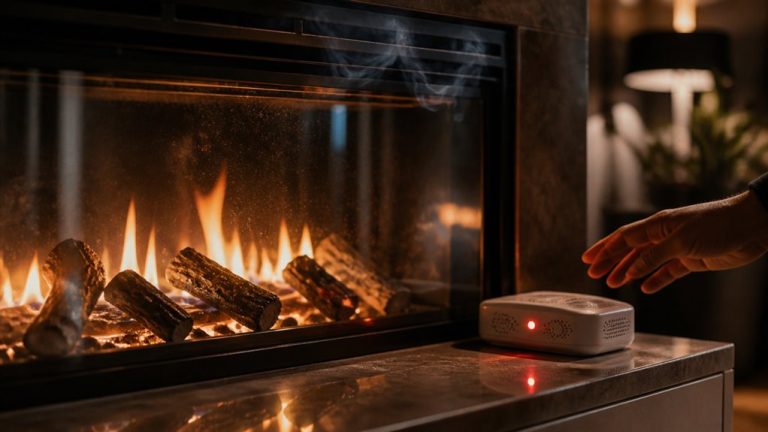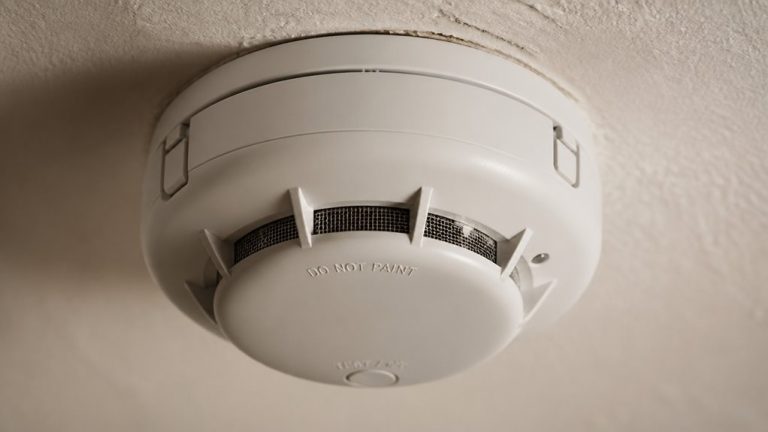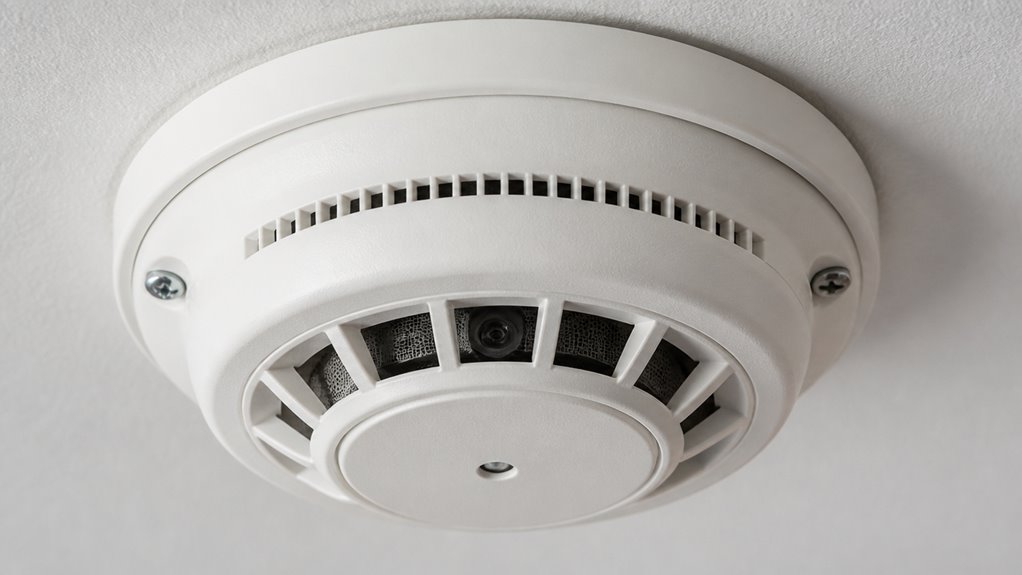

The sensor in your smoke detector is housed inside a dedicated sensing chamber within the device.
For photoelectric types, it detects smoke by measuring scattered light caused by smoke particles entering the chamber.
Ionization sensors sense smoke by monitoring changes in an electric current inside a sealed ionization chamber.
This chamber design protects the sensor from dust and interference, ensuring accurate detection.
Proper placement and airflow are vital for timely alerts. Explore these factors to improve your detector’s effectiveness.
Key Takeaways
- The sensor is located inside the smoke detector’s dedicated smoke-sensing chamber within the housing.
- It is placed in the light-sensing chamber where scattered light from smoke particles is detected (photoelectric type).
- The sensor is fully enclosed to protect it from dust, insects, and external interference.
- Smoke must physically enter this chamber to trigger the sensor and activate the alarm.
- The sensing chamber design minimizes false alarms by isolating the sensor from environmental disturbances.
Sensor Location Inside Smoke Detectors
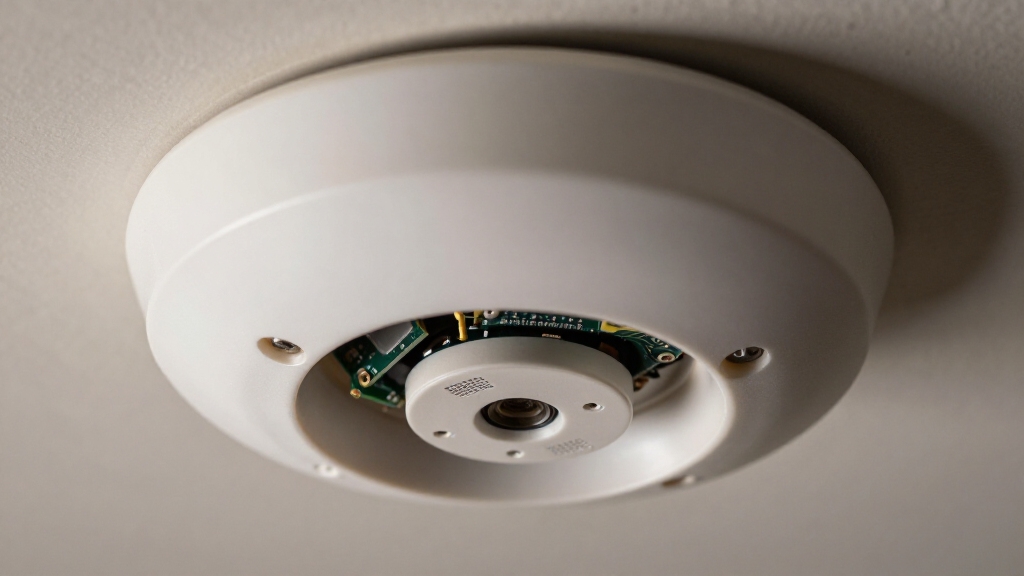
Although you see the smoke detector housing on your ceiling or wall, the actual sensor is located inside that housing, within a dedicated smoke-sensing chamber. This chamber is designed to allow smoke particles to enter while protecting the sensor from external interference.
In basic models, the sensor sits inside this chamber, ready to detect smoke presence. Many detectors employ a light source and sensor positioned at specific angles inside the chamber. This setup enables the sensor to detect smoke by changes in light behavior or electric current disruption.
These internal arrangements ensure that smoke must physically enter the chamber before triggering the alarm. Understanding this internal sensor placement is key to appreciating how smoke detectors effectively monitor air quality within a confined, controlled environment for reliable detection.
The sensor is typically either a photoelectric sensor or an ionization chamber containing americium-241, which plays a crucial role in detecting smoke particles.
How Photoelectric and Ionization Smoke Detector Sensors Work?
So, let’s break down how photoelectric and ionization smoke detectors work.
Photoelectric sensors are pretty cool because they detect smoke by measuring light that gets scattered inside their sensing chamber. It’s like they’re on the lookout for tiny particles blocking or reflecting light.
On the other hand, ionization sensors take a different approach. They keep an eye on changes in an electric current caused by smoke particles.
What’s interesting is that each type of sensor responds in its own way to different smoke characteristics. This means that depending on the situation, one might be faster or more accurate than the other.
Photoelectric detectors excel at detecting smoldering fires by sensing larger smoke particles that scatter light effectively.
Photoelectric Sensor Mechanism
Many smoke detectors rely on two primary sensor mechanisms: photoelectric and ionization to detect smoke particles effectively. The photoelectric sensor uses a light source inside the detector’s chamber aimed away from the sensor.
When smoke enters, it scatters the light toward the sensor, triggering the alarm. This mechanism excels at detecting larger smoke particles from smoldering fires.
| Feature | Photoelectric Sensor | Function |
|---|---|---|
| Sensor Location | Inside smoke-sensing chamber | Detects scattered light caused by smoke |
| Detection Method | Light scattering | Smoke particles deflect light beam |
| Best Fire Detection | Slow, smoldering fires | Early warning before flames appear |
You’ll find the sensor housed safely inside. This ensures smoke must enter the chamber for detection. The design helps minimize false alarms caused by optical interference such as dust or insect debris inside the chamber.
Ionization Sensor Function
Ionization smoke detectors detect fire by measuring changes in an electric current within a small chamber. Inside, the sensor creates a steady flow of ions between two electrodes, establishing a small electric current.
When smoke enters this chamber, particles attach to the ions, disrupting their flow and reducing the current. The sensor registers this decrease and triggers the alarm.
The sensor is housed within the detector’s smoke-sensing chamber, ensuring only smoke particles inside affect detection. Unlike photoelectric sensors that rely on light scattering, ionization sensors depend on the ionization process to identify smoke presence.
You’ll find the sensor fully enclosed to protect it from external interference. This design allows it to continuously monitor the air within the chamber for changes in ion current caused by combustion particles.
Ionization sensors, such as those used in models like the i12060A, are particularly responsive to fast-flaming fires, making them effective for early detection of rapidly spreading flames.
Smoke Detection Differences
Although both photoelectric and ionization smoke detectors serve the same purpose, they detect smoke using fundamentally different methods.
Photoelectric sensors use a light source inside the sensing chamber. When smoke particles scatter the light beam, the sensor detects the change and triggers the alarm.
Ionization sensors rely on a small ionized air current. Smoke particles disrupt this current, and the sensor registers the variation.
| Feature | Photoelectric Sensor | Ionization Sensor |
|---|---|---|
| Detection Method | Light scattering by smoke particles | Disruption of ionized air current |
| Best For | Smoldering fires with larger particles | Fast-flaming fires with smaller particles |
| Sensor Location | Inside light-sensing chamber | Inside ionization chamber |
| Response Time | Faster to smoky, smoldering fires | Faster to fast, flaming fires |
Understanding these differences helps you choose the right device for your environment. Modern smoke detectors often integrate multiple sensor types and advanced detection technologies to optimize safety across various fire scenarios.
Why Smoke Must Enter the Sensing Chamber?
Because smoke detectors rely on sensors inside a sealed chamber, smoke must physically enter this sensing chamber to trigger an alert.
The sensing chamber isolates the sensor from ambient air and dust, guaranteeing accurate detection.
In photoelectric detectors, smoke particles scatter a light beam inside the chamber, directing it toward the sensor.
In ionization detectors, smoke disrupts an ionized air current within the chamber, altering the electrical signal.
Without smoke entering this enclosed space, the sensor can’t detect these changes.
This design prevents false alarms from external disturbances and guarantees the detector responds only to actual smoke presence.
Consequently, the smoke’s physical entry into the sensing chamber is essential for the sensor to measure the characteristic changes that activate the alarm.
Proper placement on ceilings or high walls maximizes the chance that smoke reaches the sensing chamber early, enhancing early warnings and safety.
How Room Features Like Vents and Drafts Affect Smoke Detection?
When you install a smoke detector in a room with vents, drafts, or air currents, these features can markedly influence how quickly smoke reaches the sensor.
Installing smoke detectors near vents or drafts can significantly affect how quickly smoke is detected.
Airflow from HVAC vents may divert smoke away from the detector’s sensing chamber, delaying detection. Similarly, drafts caused by open windows or doors can disperse smoke unevenly, reducing its concentration near the sensor.
This can impair the photoelectric or ionization sensor’s ability to detect smoke particles promptly. To maintain reliable performance, you should avoid positioning detectors directly in the path of supply or return vents and away from strong drafts.
Proper installation considers how air movement impacts smoke travel, ensuring smoke enters the sensing chamber without obstruction or dilution caused by ventilation or drafts.
High humidity near detectors can also interfere with sensor accuracy by mimicking smoke particles and causing false alarms.
Best Ceiling and Wall Placement for Smoke Detector Sensors
When it comes to installing smoke detectors, it’s best to place them as close to the center of the ceiling as you can. Since smoke rises, this gives the detector a better chance of catching it quickly.
If mounting on the ceiling isn’t an option for you, don’t worry! You can install them on the wall, just make sure they’re 4 to 12 inches below the ceiling. And remember, always check that the device is specifically listed for wall use.
Oh, and here’s a tip: steer clear of putting detectors near vents, drafts, or any air currents. These can either delay the smoke reaching the sensor or, worse yet, trigger false alarms. Keeping your detectors in the right spots can make a real difference in how effectively they work!
For optimal safety, install detectors within 10 feet of bedrooms to ensure maximum alarm audibility and effectiveness.
Ideal Ceiling Positioning
Although smoke detectors can be mounted on walls, placing them as close to the center of the ceiling as possible provides the most effective smoke detection.
Smoke rises and disperses, so a central ceiling location guarantees quicker smoke entry into the sensing chamber.
Position your detector at least 4 inches away from walls or partitions to avoid dead air zones that delay smoke reaching the sensor.
For peaked ceilings, install the detector within 36 inches of the peak but not directly at the apex, where airflow may be turbulent.
Avoid placing detectors near HVAC vents, windows, or doors, as drafts can prevent smoke from reaching the sensor promptly.
Following these precise ceiling positioning guidelines maximizes your smoke detector’s responsiveness and reliability.
Additionally, maintaining the detector within the optimal temperature range of 40°F to 100°F (4°C–38°C) is crucial for reliable sensor function and early detection, especially by avoiding placement in garages or unheated spaces with temperature extremes.
Wall Mounting Guidelines
Since ceiling mounting isn’t always feasible, wall mounting serves as a practical alternative for smoke detector placement, provided the device is listed for such use.
When mounting on a wall, position the unit between 4 and 12 inches below the ceiling to guarantee smoke can enter the sensing chamber promptly.
Avoid placing the detector too low, as smoke naturally rises and may not reach the sensor quickly.
Select a central location on the wall to maximize the detector’s response time from any part of the room.
Maintain clearance from corners and edges to prevent delayed smoke entry into the sensor chamber.
Always verify the manufacturer’s listing and installation instructions to confirm the unit’s suitability for wall installation, as improper placement can compromise detection efficiency.
Additionally, ensure the smoke detector has a battery backup to maintain functionality during power outages and provide continuous protection.
Avoiding Airflow Obstructions
Wall-mounted smoke detectors require careful positioning to guarantee smoke reaches the sensor chamber without delay. You need to avoid airflow obstructions that can divert smoke away from the sensor, reducing detection speed and reliability.
To optimize placement:
- Position the detector 4 to 12 inches below the ceiling, steering clear of HVAC vents, windows, doors, and fans that create drafts.
- Keep the unit at least 4 inches away from walls or partitions to prevent trapped air pockets.
- Avoid mounting near ducts or vents where airflow can dilute smoke concentration or cause nuisance alarms.
Following these rules guarantees smoke flows freely into the sensing chamber, enabling prompt detection.
Proper placement balances sensor responsiveness and minimizes false alarms caused by air disturbances.
Ideal Installation Spots to Maximize Sensor Performance
To maximize sensor performance, you should install smoke detectors as close to the center of the ceiling as possible. This placement allows rising smoke to reach the sensing chamber quickly and uniformly.
Ceiling placement guarantees smoke disperses evenly, enhancing detection speed. If ceiling mounting isn’t feasible, mount the detector on the wall 4 to 12 inches below the ceiling. Be sure to maintain clearance from corners and vents.
Avoid areas near HVAC ducts, windows, or doors to prevent airflow interference. Here’s a quick guide:
| Location Type | Height from Floor | Notes |
|---|---|---|
| Center Ceiling | Ceiling height | Best for quick smoke entry |
| Wall Mount | 4–12 inches below ceiling | Use only if ceiling mount impossible |
| Near Stairways | Ceiling or wall | Covers smoke movement between levels |
Proper placement maximizes sensor response and reduces detection delays.
Troubleshooting Smoke Detector Sensors and Avoiding False Alarms
Smoke detector sensors frequently trigger false alarms due to environmental factors or improper installation. To troubleshoot and minimize these issues, focus on the following:
False alarms often stem from environmental issues or incorrect smoke detector installation.
1. Check placement: Ensure the detector is at least 20 feet from kitchens or HVAC vents to avoid smoke or dust interference.
Avoid drafts and direct airflow that can trigger the sensor falsely.
2. Inspect sensor chamber: Dust and insects inside the smoke-sensing chamber can disrupt the sensor’s operation.
Clean the chamber gently with compressed air or a vacuum to maintain sensor accuracy.
3. Verify proper mounting: Confirm the detector is installed on the ceiling near the room’s center or on the wall 4 to 12 inches below the ceiling, following manufacturer specifications.
Incorrect mounting can prevent smoke from reaching the sensor promptly, causing false alarms or delayed detection.
Summary of Key Points for Effective Smoke Detector Use
Effective smoke detector use relies on proper sensor placement, maintenance, and understanding how the device functions.
You should install detectors near the center of ceilings to optimize smoke entry into the sensing chamber, avoiding walls, vents, and drafts that interfere with detection.
Make sure alarms are on every level, inside bedrooms, and outside sleeping areas for maximum coverage.
Regularly test and maintain units to keep sensors responsive, replacing batteries as needed.
Remember, the sensor resides inside the housing and requires smoke to enter the chamber to activate.
Avoid placing detectors too close to cooking appliances to reduce false alarms.
Frequently Asked Questions
How Often Should the Sensor Inside a Smoke Detector Be Cleaned?
You should clean the sensor inside your smoke detector at least once every six months to ensure reliable performance.
Dust and debris can block the smoke-sensing chamber, impairing detection.
Use a vacuum with a soft brush attachment or compressed air to gently remove particles from vents and openings.
Avoid using water or cleaning solvents, as they can damage sensitive components.
Regular maintenance helps keep your smoke detector functioning properly and extends its lifespan.
Can Humidity Affect the Sensor’s Performance in a Smoke Detector?
You might think humidity doesn’t impact your smoke detector sensor, but it actually can. High humidity can cause condensation inside the sensing chamber, which interferes with the sensor’s ability to detect smoke particles accurately.
This can lead to false alarms or delayed alerts. To maintain reliable performance, keep detectors away from bathrooms or kitchens where moisture levels spike.
Make certain proper ventilation to minimize humidity’s effect on the sensor’s function.
Do Smoke Detector Sensors Require Battery Replacement or Calibration?
You don’t need to calibrate smoke detector sensors, as they’re factory-set for peak sensitivity.
However, you must replace the batteries regularly, typically every 6 to 12 months, to guarantee proper function.
Some detectors have sealed lithium batteries lasting up to 10 years, eliminating battery changes but requiring full unit replacement after that period.
Always follow manufacturer guidelines for battery maintenance to keep the sensor and alarm working reliably.
How Do Smoke Detector Sensors Respond to Different Types of Smoke?
Imagine your smoke detector playing a blindfolded game, sensing smoke by its type.
Photoelectric sensors excel at detecting smoldering, slow-burning smoke by picking up scattered light.
Ionization sensors respond quickly to fast-flaming fires, sensing changes in ionized air currents caused by tiny particles.
Depending on the smoke’s nature, your detector’s sensor activates differently, ensuring you get the earliest warning whether the fire smolders quietly or blazes fiercely.
Are There Smart Smoke Detectors With Sensors That Connect to Mobile Devices?
Yes, there are smart smoke detectors with sensors that connect to mobile devices.
These units use built-in Wi-Fi or Bluetooth to send real-time alerts to your smartphone or tablet when smoke is detected.
They often integrate with home automation systems and allow remote monitoring, testing, and silence functions.
You’ll benefit from enhanced safety and convenience by receiving instant notifications, even when you’re away from home.
Keep Your Smoke Detector Sensor Working Properly
Remember, “an ounce of prevention is worth a pound of cure.”
Knowing where the sensor is inside your smoke detector and placing it correctly guarantees it detects smoke promptly.
Proper installation away from vents and drafts maximizes sensor accuracy, reducing false alarms.
Regularly check and maintain your detector to keep it functioning reliably.
By understanding and optimizing sensor placement, you’re taking a vital step to protect your home and loved ones effectively.