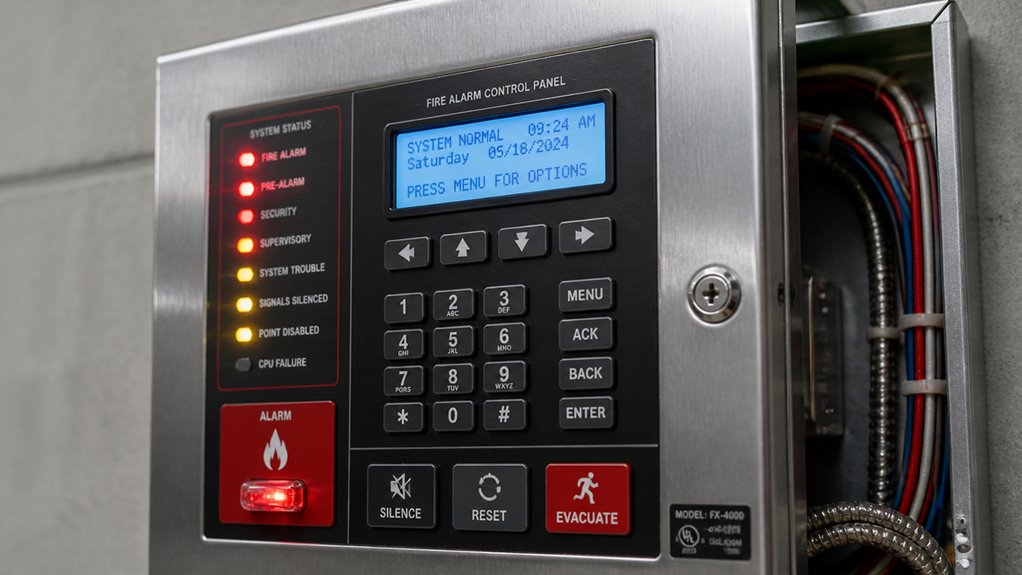

A fire alarm control panel centralizes detection and coordinates alarms by monitoring smoke detectors, heat sensors, and manual pull stations. It activates horns, strobes, fire doors, and suppression systems to guarantee quick, precise emergency responses.
With advanced models offering device-level identification and fault diagnostics, you can maintain system reliability and reduce false alarms. Proper installation and maintenance keep it fully operational, enhancing occupant safety.
Exploring further reveals how its components and communication improve building protection and compliance.
Key Takeaways
- A fire alarm control panel centralizes signal processing and coordinates detection, alarm notification, and fire protection equipment control.
- It monitors inputs from smoke detectors, heat sensors, and manual pull stations to detect fire conditions.
- The panel activates alarms like horns and strobes and controls fire doors, suppression systems, and smoke extraction.
- Addressable panels provide precise device identification and two-way communication for enhanced diagnostics and faster response.
- It ensures continuous operation with battery backup, fault detection, and compliance with safety standards for reliable emergency management.
Core Functions of a Fire Alarm Control Panel
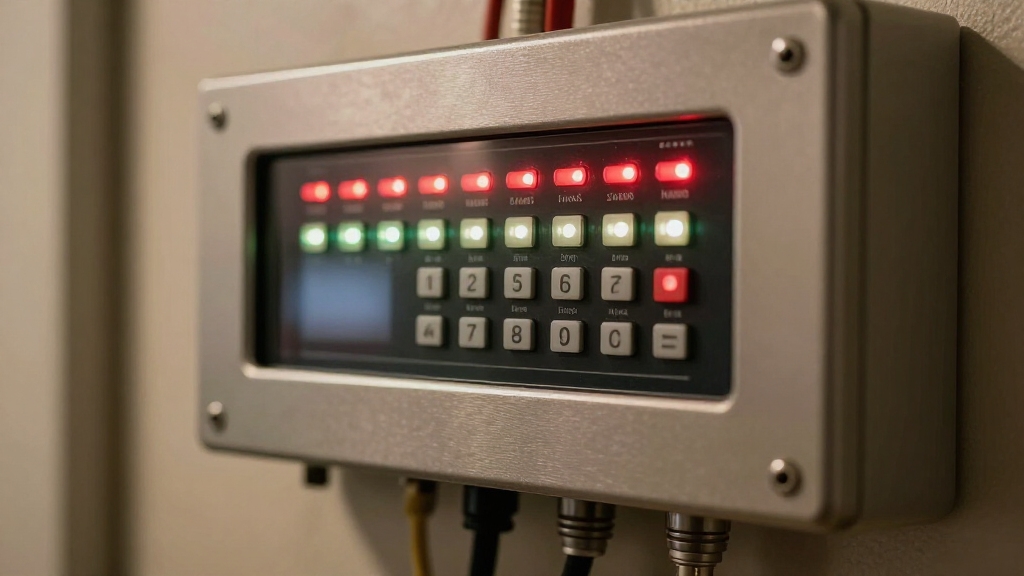
A fire alarm control panel actively monitors inputs from various initiating devices like smoke detectors, heat sensors, and manual pull stations to detect potential fire conditions.
When it identifies an alarm state, it promptly activates notification appliances such as horns, strobes, and sirens to alert occupants.
It also supervises system integrity by detecting faults like wiring issues, communication failures, or power supply problems, signaling trouble or supervisory conditions accordingly.
Beyond alarms, the panel controls fire protection equipment including smoke extraction, fire doors, and suppression systems, coordinating a thorough response.
It can transmit signals to remote monitoring stations or emergency responders as configured.
Understanding these core functions helps you appreciate the panel’s critical role as the command center in maintaining building safety and operational readiness.
Fire alarm control panels often interface with fire alarm annunciators to provide real-time status updates and alerts to building occupants and responders.
Key Components Inside a Fire Alarm Control Panel
While you interact with a fire alarm control panel, you’ll notice several key components work together to manage system operations.
The main board houses the microprocessor, which processes signals from initiating devices like smoke and heat detectors.
Input circuits receive these signals, categorizing them into alarm, supervisory, or trouble conditions.
Output circuits then activate notification appliances such as horns, strobes, or control modules for fire suppression.
A power supply section guarantees continuous operation, including battery backup to maintain function during outages.
The user interface, often a digital display with control buttons, provides status information and allows authorized personnel to acknowledge or reset alarms.
Communication modules enable signal transmission to remote monitoring stations.
Each component integrates precisely to guarantee reliable detection, notification, and control within the fire alarm system’s command center.
Before beginning any troubleshooting or testing, it is critical to contact authorities and place the system in test mode to ensure safety and compliance.
Differences Between Conventional and Addressable Fire Alarm Panels
Though both types serve the same fundamental purpose, conventional and addressable fire alarm panels differ markedly in how they identify and manage initiating devices.
Conventional panels group devices into zones, limiting precise location identification. Addressable panels assign unique addresses to each device, enabling pinpoint identification and advanced diagnostics.
| Feature | Conventional Panel |
|---|---|
| Device Identification | Zones (grouped devices) |
| Diagnostics | Limited |
| Scalability | Suitable for smaller systems |
| Feature | Addressable Panel |
| Device Identification | Unique device addresses |
| Diagnostics | Detailed device status and faults |
| Scalability | Supports large, complex systems |
This distinction impacts system management, troubleshooting, and response efficiency. Additionally, critical facilities often require panels that support Class A wiring to ensure continuous operation despite wiring faults.
Fire Detection and Response by Fire Alarm Panels
Fire alarm panels continuously monitor signals from detection devices like smoke and heat sensors, instantly interpreting these inputs to trigger appropriate system responses.
Fire alarm panels constantly analyze signals from smoke and heat detectors to activate timely safety measures.
When a detector senses abnormal conditions, the panel processes the signal according to programmed logic, distinguishing between alarm, supervisory, or trouble states.
Upon confirming an alarm, it immediately activates notification appliances such as sirens and strobes to alert occupants.
Simultaneously, the panel can initiate control functions, including releasing suppression systems or closing fire doors, coordinating a thorough response.
Addressable panels identify the exact device triggering the alarm, enhancing response precision.
Throughout, the panel supervises system integrity, alerting you to faults that could impair operation.
This continuous detection and response cycle guarantees rapid, reliable fire safety management within the protected premises.
Modern fire alarm panels also support remote diagnostics and predictive maintenance to improve system reliability and reduce false alarms.
Why Installation and Maintenance Matter for Fire Panels?
Because a fire alarm control panel serves as the central command for life-safety systems, proper installation and ongoing maintenance are critical to guaranteeing its reliable operation.
You must guarantee the panel is installed according to relevant standards, such as BS 5839-1:2017, by qualified personnel to ensure correct wiring, device addressing, and system configuration.
Regular maintenance is essential to verify the integrity of initiating devices, notification appliances, power supplies, and communication circuits.
You should conduct functional testing and address trouble signals promptly to prevent system failures.
Neglecting these tasks risks delayed alarms, false signals, or total system malfunction during emergencies.
By prioritizing precise installation and routine upkeep, you maintain continuous system readiness.
This guarantees the panel accurately monitors conditions and commands appropriate responses without interruption or error.
Regular functional testing of devices such as manual call points and sounders ensures audible alarm coverage throughout the premises and confirms system readiness.
How Fire Alarm Control Panels Enhance Building Safety?
You know, when it comes to fire safety, the fire alarm control panel plays a crucial role. It’s designed to trigger quick emergency responses by activating alarms and notifying responders almost instantly. That’s pretty impressive, right?
But it doesn’t stop there! This system also works in tandem with other safety controls, like fire doors and suppression systems. Together, they help contain hazards effectively.
The control panel continuously processes signals from various fire detectors to ensure early detection and prompt action.
Rapid Emergency Response
When a hazardous condition arises, the fire alarm control panel instantly processes signals from detection devices and triggers appropriate emergency responses. It identifies the exact location and type of alert: alarm, supervisory, or trouble, allowing you to act decisively.
The panel activates notification appliances like sirens and strobes to warn occupants immediately, reducing evacuation time. It also communicates with monitoring stations or fire brigades, ensuring prompt external intervention.
Continuous supervision of system integrity means faults are detected early, preventing false alarms or delayed responses. By centralizing signal processing and output control, the panel enhances coordination between detection and alarm notification.
This rapid, automated response is critical for minimizing risk, protecting occupants, and supporting efficient emergency management in your building’s fire safety infrastructure. In simpler systems, this control panel manages zone-based detection to streamline alerts and troubleshooting without device-level identification.
Integrated Safety Controls
As fire alarm control panels monitor and respond to hazards, they also integrate with other building safety systems to enhance overall protection.
You’ll find these panels coordinating with ventilation systems to control smoke extraction, managing fire doors to contain fire spread, and activating suppression systems when needed.
This integration guarantees a unified response, minimizing damage and improving occupant safety.
The panel’s ability to manage multiple safety functions simultaneously streamlines emergency procedures and reduces response time.
By linking alarm signals to control modules and notification appliances, you get precise, automated control over complex safety operations.
This centralized coordination not only meets stringent fire safety codes but also provides real-time monitoring and fault detection.
This helps you maintain system reliability and assure peak building safety at all times.
Additionally, the use of Signaling Line Circuits enables two-way communication between the panel and devices, improving system responsiveness and diagnostics.
Frequently Asked Questions
How Long Does a Fire Alarm Control Panel Typically Last?
A fire alarm control panel typically lasts 10 to 15 years with proper maintenance. You should guarantee regular testing, firmware updates, and prompt repairs to keep it reliable.
Environmental factors and usage intensity can affect lifespan. Monitoring trouble signals helps you address issues early. When your panel nears the end of its service life, upgrading guarantees continued compliance with safety standards and peak system performance for occupant protection.
Can Fire Alarm Panels Be Integrated With Smart Home Systems?
Yes, you can integrate fire alarm panels with smart home systems, especially modern addressable panels that support communication protocols like BACnet or Modbus.
This integration lets you monitor alarms, faults, and system status remotely through your smart home interface. It also enables automation, such as triggering HVAC shutdown or releasing doors during an alarm.
Make certain compatibility and compliance with safety standards when connecting your fire alarm panel to smart home platforms.
What Happens if the Fire Alarm Control Panel Loses Power?
If the fire alarm control panel loses power, its backup battery immediately kicks in to keep the system operational, ensuring continuous monitoring and alarm functions.
You should regularly check and maintain this battery to avoid failure during outages.
Without power or a functioning backup, the panel can’t detect or signal alarms, putting occupants at risk.
Supervisory trouble signals alert you to power issues, prompting timely maintenance or repairs to restore full system functionality.
Are Fire Alarm Control Panels Compatible With All Detector Brands?
You won’t find fire alarm control panels universally compatible with all detector brands. Compatibility depends on the panel’s design, communication protocol, and manufacturer specifications.
Addressable panels require detectors with matching protocols and unique addresses. Conventional panels can accept various detectors but may limit functionality.
Always verify compatibility through technical documentation or consult the panel manufacturer to make certain detectors will properly communicate and function within your fire alarm system.
How Do Fire Alarm Panels Communicate With Emergency Responders?
You might think fire alarm panels just sound alarms, but they actively communicate with emergency responders through dedicated phone lines, IP networks, or cellular connections.
When an alarm triggers, the panel sends detailed signals, including location and type of emergency, to monitoring stations or fire brigades.
This rapid, automated transmission guarantees responders get accurate info quickly, improving reaction times and coordinating emergency actions efficiently without relying solely on manual alerts.
Understand the Panel That Controls Fire Safety Alerts
Just like the captain of a ship piloting through stormy seas, your fire alarm control panel steers safety in emergencies.
By understanding its core functions, components, and differences, you guarantee it detects fires swiftly and responds effectively.
Remember, proper installation and upkeep aren’t just technical steps; they’re critical defenses that safeguard lives and property.
With a well-maintained panel, you’re not just complying with codes; you’re commanding an essential asset in your building’s safety strategy.