
When choosing between Class A and Class B fire alarm wiring, you’ll find Class A uses a four-wire loop for bidirectional signaling, providing redundancy and fault tolerance. Your system keeps working even if one wire breaks.
Class B uses a simpler two-wire linear path, which is cost-effective but vulnerable to single faults that disable downstream devices. Class A’s complexity suits critical sites needing high reliability, while Class B fits smaller buildings with budget limits.
Exploring their detailed differences reveals key design, code, and maintenance impacts.
Key Takeaways
- Class A fire alarm circuits use a looped four-wire topology allowing bidirectional signal flow and redundancy.
- Class B circuits use a two-wire linear topology with unidirectional signal flow and require an end-of-line resistor.
- Class A maintains operation despite a single open conductor by rerouting signals, while Class B loses all devices beyond a break.
- Class A is preferred for critical, large, or high-risk buildings due to higher reliability and fault tolerance.
- Class B is simpler and lower cost, suited for smaller or standard buildings but lacks redundancy and fault resilience.
Class A vs Class B Fire Alarm Comparison: Wiring, Safety, and Reliability
| Comparison Point | Class A Fire Alarm | Class B Fire Alarm | Best Fit |
|---|---|---|---|
| Wiring Design | Uses a looped four-wire circuit with a return p | Uses a linear two-wire circuit with one path | Class A for advanced protection |
| Signal Flow | Allows bidirectional signaling from both directions | Sends signals in one direction only | Class A for signal continuity |
| Fault Tolerance | Keeps devices working after a single open wire fault | Devices beyond the break may stop working | Class A for fault resilience |
| Redundancy | Includes a backup pathway to maintain operation | Has no redundant return path | Class A for critical systems |
| End-of-Line Resistor | Usually does not require an EOL resistor | Requires an end-of-line resistor for supervision | Class B for simple supervision |
| Installation Complexity | More complex due to extra wiring and loop design | Easier to install with a straightforward layout | Class B for simple projects |
| Cost Level | Higher cost because of more conductors and labor | Lower cost with fewer materials | Class B for budget control |
| Building Suitability | Best for large, high-risk, or critical buildings | Suitable for smaller or standard buildings | Depends on risk level |
| Overall Safety Value | Stronger reliability where continuous detection matters | Practical where code allows simpler wiring | Class A for maximum reliability |
Class A Fire Alarm Wiring Explained
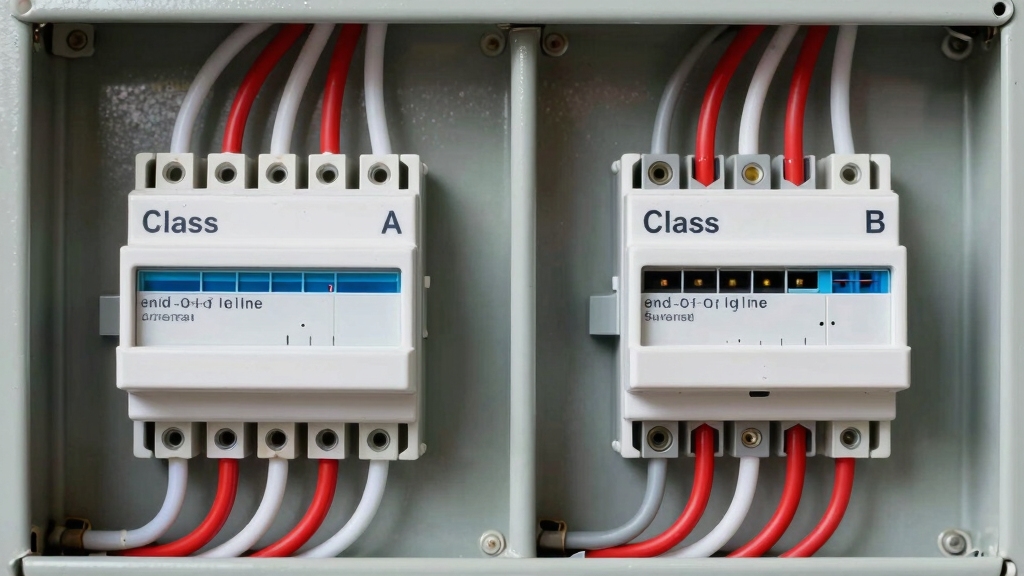
Although Class A fire alarm wiring demands more complex installation, it provides a critical advantage: a looped circuit that supplies power and signals from both directions.
You’ll appreciate that this configuration creates redundancy, allowing the system to maintain full functionality even if a single wire is compromised.
The wiring uses four conductors: two for the outgoing path and two for the return, forming a continuous loop back to the control panel.
This loop eliminates the need for an End of Line resistor since supervision occurs through the circuit’s closed path.
With this topology, you make certain that any open conductor triggers a trouble signal but doesn’t interrupt device operation.
Class A wiring is ideal for critical environments where uninterrupted fire detection and alarm communication are mandatory for safety and code compliance.
This looped configuration supports loop continuity monitoring, enhancing fault detection and system reliability.
Class B Fire Alarm Wiring Explained
Class B wiring features a straightforward two-wire configuration, complete with an end-of-line resistor for supervision. It’s pretty simple and cost-effective, which is great for smaller projects.
However, there’s a catch: it doesn’t offer redundancy. If there’s a break in the wire, it can disable all the devices downstream.
This setup tends to work well in smaller buildings and is often allowed by code in situations where full circuit continuity isn’t a big deal. So, if you’re working on a smaller scale, Class B wiring might just be the way to go!
Note that Class B wiring is commonly used in conventional fire alarm systems, which are typically more cost-effective and simpler to install for small buildings.
Wiring Configuration Basics
When wiring a Class B fire alarm system, you connect devices in a linear series extending from the control panel to the last device without creating a return loop.
This straightforward topology uses two wires feeding power from one direction, requiring an End of Line Resistor (EOLR) at the circuit’s terminus for supervision.
You’ll notice the absence of a redundant path, making circuit integrity dependent on continuous wiring.
Key points include:
- Devices link sequentially without a return path.
- The EOLR monitors circuit continuity.
- A single wire break disables all downstream devices.
- Signal and power flow in one direction only.
Understanding this wiring method guarantees you optimize installation for smaller or less critical buildings.
Backup batteries provide a fail-safe layer to ensure detector operation during power outages and maintain system reliability.
Limitations and Fault Impact
Since Class B fire alarm wiring employs a single linear path without a return loop, any break or fault in the wiring immediately disrupts communication and power to all devices downstream of the fault.
This lack of redundancy means a single open conductor isolates all subsequent devices, rendering them inoperative and undetectable by the control panel.
Additionally, a direct short typically disables the entire Class B circuit, requiring system shutdown until repairs are made.
Unlike Class A circuits, which use looped wiring to maintain operation despite faults, Class B systems provide no alternate signal path, resulting in complete loss of function beyond the fault point.
You must consider these limitations carefully, as any wiring fault critically impacts system reliability and compromises fire detection continuity in the affected zone.
For safety and compliance, it is essential to use only UL-listed devices approved for the specific wiring method employed.
Application and Code Use
Although Class B fire alarm wiring lacks the redundancy of Class A systems, it remains widely used due to its simplicity and cost-effectiveness.
You’ll find Class B favored in smaller buildings or those with lower risk profiles, where code permits and cost constraints matter.
However, you must consider potential downtime from a single wiring fault affecting all downstream devices.
Key application and code considerations include:
- Class B wiring suits smaller occupancies with less critical detection needs.
- NFPA 72 allows Class B but limits faults to a single zone to minimize impact.
- Authorities Having Jurisdiction (AHJ) may require Class A in high-risk or critical areas.
- Project specs might mandate Class A despite code allowances, prioritizing operational continuity.
When choosing between Class A and Class B wiring, understanding supervision and circuits is essential to ensure system integrity and compliance.
You should weigh these factors carefully to meet both safety and regulatory demands.
How Class A and Class B Wiring Differ in Circuit Design?
You’ll notice that Class A wiring uses a looped circuit topology. This design creates a continuous path for signals, allowing them to flow from both directions. Pretty neat, right?
On the other hand, Class B takes a different approach. It employs a linear series configuration, which means there’s just a single pathway. Plus, it has an end-of-line device to keep an eye on the circuit.
Understanding these fundamental differences in wiring configuration is key. It really highlights why Class A offers redundancy—if one part fails, signals can still get through. Meanwhile, Class B is simpler, but it’s not as fault-tolerant. So, while Class A might be a bit more complex, it definitely has its advantages when it comes to reliability!
Additionally, Class B wiring is commonly used in zone-based detection systems due to its straightforward installation and cost-effectiveness.
Circuit Topology Differences
When examining fire alarm system designs, understanding the fundamental circuit topology differences between Class A and Class B wiring is essential.
Class A wiring forms a continuous loop, providing a redundant return path to the control panel. Class B wiring, on the other hand, follows a linear, single-path design without a return loop. This distinction impacts system resilience and fault tolerance markedly.
Key differences include:
- Class A uses a looped circuit, allowing signals to travel bidirectionally, enhancing fault tolerance.
- Class B employs a radial circuit with a single pathway, lacking redundancy.
- Class A wiring typically involves four conductors to complete the loop; Class B uses two conductors in series.
- Class A sustains operation after a single open fault, while Class B loses function downstream of a fault.
This topology difference directly influences system reliability and operational continuity. Proper installation standards and adherence to safety protocols are critical to maximize system effectiveness.
Wiring Configuration Comparison
Several key distinctions define the wiring configurations of Class A and Class B fire alarm systems. These distinctions impact their circuit design and fault tolerance.
Class A uses a looped wiring design with four wires. This allows signals to travel in both directions, ensuring circuit redundancy and operational continuity even if a wire breaks.
Class B employs a linear, two-wire series without a return path. This makes it vulnerable to faults beyond the break.
| Feature | Class A | Class B |
|---|---|---|
| Wiring Type | Looped, 4-wire | Linear, 2-wire |
| Fault Tolerance | Maintains function if wire open | Devices beyond fault fail |
| End-of-Line Resistor | Not required | Required for supervision |
| Power Feed Direction | Both directions | Single direction |
You’ll notice Class A’s design prioritizes reliability, while Class B favors simplicity and cost. Fire alarm annunciators often monitor wiring faults and supervisory issues to provide system trouble alerts for prompt maintenance and response.
How Redundancy Boosts Reliability in Class A vs Class B Wiring?
Although both Class A and Class B fire alarm wiring systems provide critical supervision, redundancy fundamentally distinguishes their reliability.
Class A’s looped wiring creates a return path, enabling continuous operation even if a single conductor fails. In contrast, Class B’s linear wiring lacks this backup, causing device loss downstream from a fault.
Consider these points:
- Class A maintains full device operation after a single open conductor.
- Class B loses all devices beyond the break.
- Class A detects and isolates faults promptly, minimizing downtime.
- Class B circuits depend on end-of-line resistors for supervision but can’t reroute signals.
- Class A’s redundancy suits larger, critical facilities requiring high reliability.
- Class B fits smaller, lower-risk installations.
Redundancy in Class A wiring directly boosts system uptime and fault tolerance compared to Class B. Before troubleshooting any wiring faults, it is crucial to test fuses for continuity and confirm the presence of end-of-line resistors to ensure proper circuit supervision and compliance.
Wiring Configurations: Four-Wire vs Two-Wire Systems
Because wiring configuration directly impacts system resilience and supervision, understanding the distinction between four-wire Class A and two-wire Class B systems is essential.
Class A wiring uses four conductors forming a loop, allowing signals to travel in both directions. This provides a return path and continuous circuit supervision without requiring an End of Line resistor.
This looped topology guarantees the circuit remains operational despite a single open or fault.
Conversely, Class B wiring employs two conductors arranged in a linear series, with devices terminating at an End of Line resistor.
Without a return path, any break beyond the fault isolates downstream devices, causing loss of communication and alarming capability. This fundamental difference in wiring layout critically affects fault tolerance and system reliability under various wiring failure scenarios.
Performing a power cycle reset can help resolve transient wiring faults by fully rebooting the system and clearing temporary errors.
Why Class A Wiring Is Best for Large and High-Risk Buildings?
When it comes to large or high-risk buildings, Class A wiring is definitely the way to go.
Why? Well, its looped design ensures that you have continuous detection coverage, even if one of the wires happens to fail. That’s pretty crucial, right?
This enhanced redundancy doesn’t just sound good on paper; it actually meets important compliance requirements for critical areas. By choosing Class A wiring, you’re keeping the system up and running without any interruptions.
Plus, let’s be honest: nobody wants to deal with undetected events. Class A wiring helps minimize that risk, all while aligning with those stringent safety codes we’ve to follow. It’s a smart choice that prioritizes safety and reliability.
Enhanced System Redundancy
When designing fire alarm systems for large or high-risk buildings, you’ll find Class A wiring offers unmatched redundancy. It assures continuous operation even if a single conductor is compromised.
This is due to its looped configuration, enabling signal travel in both directions. This maintains circuit integrity and device functionality despite faults.
Key benefits of Class A enhanced redundancy include:
- Continuous operation during single open conductor faults.
- Immediate fault detection with trouble indication.
- Isolation of short circuits via fault isolators.
- Power supply from dual paths preventing total loss.
This redundancy assures fire alarm reliability, critical in environments where detection continuity is non-negotiable.
Class A wiring’s superior fault tolerance surpasses Class B’s linear topology, providing resilient fire protection for complex, high-risk structures.
Critical Area Compliance
Building on Class A wiring’s enhanced redundancy, its design directly supports compliance with critical area requirements in large and high-risk facilities.
You’ll find that Class A’s looped configuration provides a continuous circuit path, allowing signals to reroute if a single conductor fails.
This characteristic aligns precisely with stringent code mandates, which often require uninterrupted fire alarm coverage in critical zones such as healthcare or detention centers.
By contrast, Class B’s linear topology risks losing detection beyond a single fault point, which can be unacceptable in these environments.
When you choose Class A wiring, you guarantee that even if a wire breaks, the system maintains full operation and signals a trouble condition.
This fulfills the need for reliable supervision and minimizes the risk of undetected fires in sensitive, high-occupancy spaces.
Continuous Detection Coverage
Although fire alarm systems must maintain consistent operation, Class A wiring uniquely guarantees continuous detection coverage in large and high-risk buildings. Its looped configuration ensures signal redundancy, allowing the system to operate even if a single wire is compromised.
This level of reliability is vital where uninterrupted detection is non-negotiable. Consider these advantages of Class A wiring for continuous coverage:
- Signals travel bidirectionally, creating a redundant path back to the panel.
- Single open wires don’t disable downstream devices; all remain active.
- The system maintains full operation while signaling a trouble condition.
- Faults are isolated, preventing total circuit failure and ensuring ongoing protection.
When Class B Wiring Works for Smaller and Standard Buildings?
Class B wiring suits smaller and standard buildings by offering a straightforward and cost-effective fire alarm configuration. Its linear layout reduces installation complexity and material costs, making it ideal when budget and simplicity matter most. While it lacks redundancy, in buildings where fire risk is lower and code permits, Class B delivers reliable performance without unnecessary expense.
| Benefit | Consideration |
|---|---|
| Lower installation cost | Vulnerable to single faults |
| Simple wiring layout | Limited fault tolerance |
| Suitable for smaller spaces | No return path redundancy |
| Meets most standard codes | Potential zone outages |
You’ll appreciate that Class B balances efficiency with sufficient safety for many common building types. It provides practical fire alarm protection without the higher cost and complexity of Class A systems.
NFPA 72 Code Requirements for Class A and B Wiring
When you design fire alarm systems, NFPA 72 sets clear standards for wiring classifications based on pathway performance. It distinguishes Class A and Class B configurations by their fault tolerance and redundancy.
Class A wiring requires a redundant path, ensuring continuous operation despite a single conductor fault. Class B wiring, while simpler, must be arranged so that only one zone is affected by a fault, limiting impact.
NFPA 72 emphasizes supervision for both classes to detect faults promptly.
Key NFPA 72 requirements include:
- Class A circuits must form a complete loop providing bidirectional signaling.
- Class B circuits follow a single path with an end-of-line device.
- Fault isolation limits Class B circuit disruptions to one zone.
- Authorities may mandate Class A wiring for critical or high-risk areas.
Troubleshooting Faults in Class A and B Fire Alarm Systems
Understanding how to troubleshoot faults in fire alarm systems starts with recognizing the inherent differences in wiring topologies and fault tolerance between Class A and Class B circuits.
When you encounter a fault in a Class A loop, you’ll find that the system maintains operation despite a single open conductor. This allows you to isolate the fault using loop continuity tests and isolator status indicators.
Conversely, in Class B circuits, a single open wire disables devices beyond the break. Your troubleshooting focuses on locating the open section by segmenting the linear path and verifying signal loss.
For shorts, Class A circuits contain faults with isolators, while Class B circuits usually experience full circuit failure.
Employing precise voltage and resistance measurements along with device supervision signals enables efficient fault identification and resolution tailored to each class’s design.
Balancing Cost and Safety: Class A vs B Fire Alarm Wiring
Balancing cost against safety requires a careful evaluation of your building’s risk profile and operational priorities.
Class A wiring delivers enhanced redundancy and fault tolerance but comes with higher installation costs due to its looped configuration and additional wiring.
Class B offers a more economical solution with simpler linear wiring but lacks resilience against wire faults, potentially compromising detection continuity.
Consider these factors:
- Risk tolerance: Critical facilities demand Class A for uninterrupted operation.
- Budget constraints: Class B reduces upfront expenses but risks downtime.
- Building size: Larger complexes benefit from Class A’s redundancy.
- Code compliance: Some jurisdictions mandate Class A for specific occupancies.
You must weigh the trade-offs between enhanced safety and budget to select the most favorable wiring class.
Frequently Asked Questions
How Does Environmental Interference Affect Class a and Class B Wiring Performance?
Environmental interference hits Class B wiring harder because it runs on a single path. Any noise or disruption can knock out all devices downstream like dominoes falling.
You’ll find Class A wiring more resilient since its looped design offers a redundant return path. This allows signals to reroute around interference.
This redundancy minimizes data loss and maintains system integrity, making Class A better suited for environments prone to electromagnetic or physical disturbances.
Can Class a and Class B Systems Be Combined in One Building?
Yes, you can combine Class A and Class B systems in one building to optimize cost and reliability.
You’ll typically use Class A wiring in critical areas requiring redundancy and Class B in less critical zones to reduce complexity.
Just make certain each circuit meets code requirements and that the fire alarm control panel supports mixed topologies.
Proper design coordination and supervision are essential to maintain system integrity and fault detection across both classes.
What Are the Maintenance Differences Between Class a and Class B Wiring?
You’ll find maintaining Class A wiring like juggling flaming torches—complex but rewarding, thanks to its redundancy checks and loop integrity tests.
Class B’s maintenance feels simpler, focusing on single-path continuity and end-of-line resistor verification.
With Class A, you’ll constantly monitor for loop faults and isolate issues without downtime.
Class B demands swift response to breaks since any fault can disable downstream devices.
This requires rapid troubleshooting and replacement to restore full function.
How Do Power Failures Impact Class a Versus Class B Fire Alarm Circuits?
Power failures impact Class A and Class B circuits differently.
In Class A, you’re protected by the looped design, so if one path loses power, the return path maintains system operation.
This minimizes downtime.
In contrast, Class B circuits rely on a single path; a power failure there will disable all devices beyond the fault.
You’ll notice Class B systems are more vulnerable to outages, while Class A offers higher resilience and continuity during power issues.
Are There Specific Manufacturers Specializing in Class a or Class B Equipment?
Oh sure, you’ll find manufacturers specializing exclusively in Class A or Class B, as if the market demanded such strict segregation.
In reality, major players like Honeywell, Siemens, and Notifier design equipment compatible with both Class A and B circuits, ensuring versatility.
They engineer devices with flexible wiring options to meet diverse code requirements and building needs.
Final Verdict on Class A Vs Class B Fire Alarm
When choosing between Class A and Class B fire alarm wiring, consider that Class A systems reduce downtime by maintaining circuit integrity even if one wire fails. This is a critical factor since 70% of fire alarm failures stem from wiring faults.
While Class B wiring suits smaller buildings and lower budgets, Class A’s redundancy offers superior reliability. Balancing cost with safety and NFPA 72 compliance guarantees your system performs at its best under any conditions.