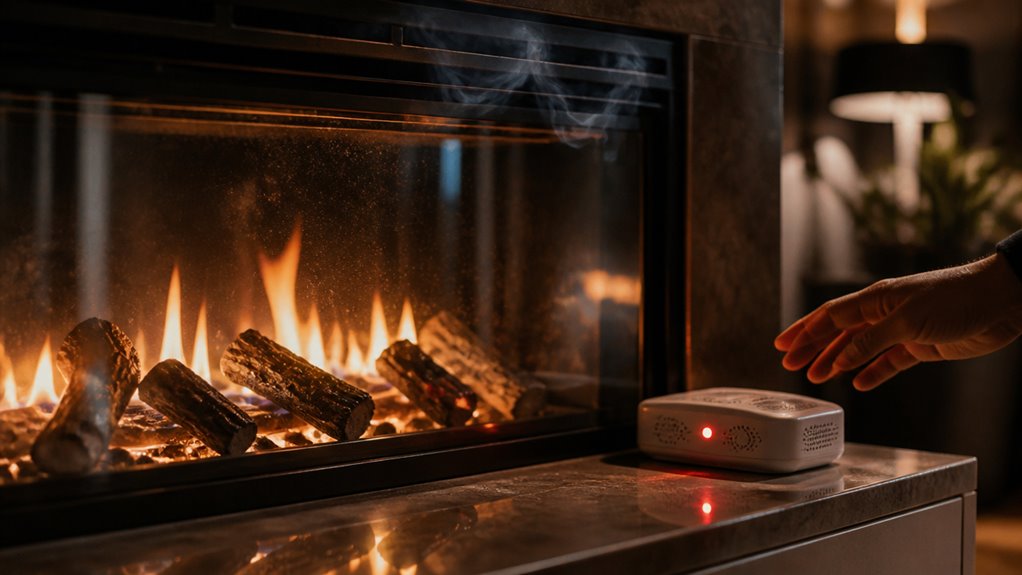

Your fireplace beeping usually means there’s a problem needing attention.
It could be low batteries in the remote or ignition system, pilot light or ignition failures, gas supply issues, or airflow and sensor faults.
Faulty control boards or necessary maintenance alerts also trigger beeps.
These signals help prevent unsafe conditions by notifying you of malfunctions.
Understanding the exact cause will help you address the issue efficiently and guarantee your fireplace runs safely and reliably.
Key Takeaways
- Fireplace beeping often signals low or weak batteries in the remote, ignition system, or wall switch, requiring battery replacement.
- Ignition failures or a pilot light outage trigger beeping, indicating failed ignition attempts or sensor malfunctions needing manual relight or reset.
- Gas supply issues like low pressure or partially closed valves cause beeping due to unsafe or insufficient combustion.
- Blocked airflow, dirty sensors, or overheating protections activate beeping alerts to prevent unsafe operation or combustion problems.
- Control board faults, loose electrical connections, or maintenance reminders can cause persistent beeping, often diagnosable via system fault codes.
How Low Batteries Cause Fireplace Beeping?
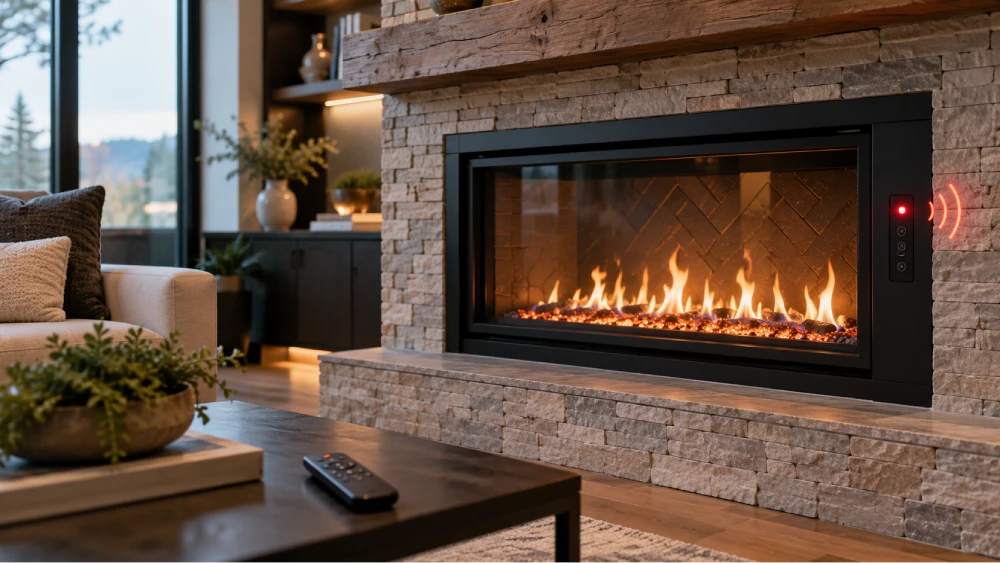
When your fireplace starts beeping, it’s often because the batteries in the remote, receiver, wall switch, or ignition system are running low.
A beeping fireplace usually signals low batteries in the remote, receiver, wall switch, or ignition system.
Weak batteries reduce voltage, which can prevent the gas valve from opening or the ignition system from activating properly.
This triggers a single beep or repeated alert signals from the control module, indicating insufficient power.
Many models use these beeps as an early warning before complete shutdown.
You should first replace all relevant batteries with fresh, manufacturer-recommended types to restore full function.
Checking battery contacts for corrosion and ensuring correct installation polarity is essential.
Ignoring low battery signals can lead to ignition failures or control lockouts.
Proactive replacement is a critical troubleshooting step when diagnosing fireplace beeping caused by power issues in control components.
Using low-power technology can help extend battery life and reduce the frequency of such alerts.
Pilot Light and Ignition Issues Causing Fireplace Beeping
Although your fireplace relies on multiple components to ignite, pilot light and ignition failures frequently cause beeping alerts. When the pilot light extinguishes, your fireplace can’t ignite on demand, triggering warning beeps.
Repeated failed ignition attempts engage a lockout mode that produces persistent beeping to alert you. Faulty thermocouple or thermopile sensors often disrupt pilot operation by failing to detect heat, causing the control system to shut off gas flow for safety.
To resolve these issues, you may need to manually relight the pilot or reset the ignition system according to the manufacturer’s instructions. Ignoring these beeping warnings can lead to prolonged lockout states or unsafe conditions. Prompt diagnosis and maintenance are essential for reliable ignition performance. Proper placement and regular maintenance of sensors help prevent false alarms similar to those caused by steam interference.
Gas Supply Problems Triggering Fireplace Beeping
If your fireplace starts beeping, it could indicate an issue with the gas supply, pressure, or valve function. Insufficient gas pressure often prevents proper combustion, triggering warning beeps from the control module.
Check that the shutoff valve is fully open. A partially closed valve restricts gas flow, causing ignition failures or flame instability. Interrupted gas delivery can also activate safety alerts, as the system detects unsafe combustion conditions.
Since gas-related faults pose significant safety risks, you should avoid attempting extensive repairs yourself. Instead, contact a licensed technician to inspect the regulator, gas lines, and valve operation.
Professional diagnostics ensure your fireplace runs safely and efficiently, resolving beeping caused by gas supply problems without compromising your home’s safety. Always remember to shut off the main gas valve and evacuate the area if you suspect a gas leak before contacting a professional.
Safety Sensors and Airflow Issues Causing Fireplace Beeping
Beyond gas supply concerns, safety sensors and airflow issues also frequently cause fireplace beeping. Your fireplace relies on sensors to monitor combustion and ventilation. If these detect abnormal airflow or venting problems, they trigger alerts.
Blocked air inlets or outlets restrict oxygen flow, prompting beeps to warn you of unsafe combustion conditions. Similarly, dirty or misaligned sensors may send false signals, causing your unit to beep unnecessarily.
Overheating protection features in some electric fireplaces also use beeping to indicate excessive temperature. When your fireplace beeps due to these issues, it might also shut down or show error codes.
Addressing airflow obstructions, cleaning sensors, and verifying proper venting usually resolve the problem. This ensures safe operation and prevents sensor-triggered alarms.
Keeping the damper open during operation and extinguishing helps maintain proper venting and airflow to avoid such issues.
Control Board Failures and Maintenance Alerts Causing Fireplace Beeping
When your fireplace starts beeping unexpectedly, control board failures often play a key role in signaling hardware issues. These electronic components manage ignition, safety sensors, and user commands. Faults here can trigger persistent alerts.
Unexpected fireplace beeping often indicates control board failures affecting ignition and safety systems.
Maintenance alerts also use beeping to remind you of necessary service or detect critical conditions.
Here are three common reasons related to control boards and maintenance alerts causing beeping:
- Faulty control boards or receivers may cause continuous or intermittent beeping due to hardware or wiring failures.
- Loose electrical connections can disrupt signals, triggering fault codes and warning sounds.
- Maintenance reminders or built-in alarms, like gas leaks or carbon monoxide detectors, emit beeps to prompt timely inspections or repairs.
Addressing these issues promptly guarantees safe and reliable fireplace operation. You can also troubleshoot persistent beeping by accessing the trouble menu on your system’s control panel to identify specific fault codes.
Frequently Asked Questions
Can External Weather Conditions Affect My Fireplace Beeping?
Yes, external weather conditions can affect your fireplace beeping. Cold or windy weather may disrupt airflow or venting, causing safety sensors to trigger alarms.
Moisture from rain or snow can affect electrical components or sensors, leading to false alerts.
Sudden temperature changes might also impact gas pressure or ignition efficiency, prompting beeps.
Regularly inspect vents and sensors during adverse weather to prevent beeping caused by environmental factors.
Does the Fireplace Beep When Connected to a Smart Home System?
About 40% of modern gas fireplaces integrated with smart home systems emit beeps as alert signals.
Yes, your fireplace can beep when connected to a smart home system, usually to notify you of status changes, safety alerts, or maintenance reminders.
These beeps often correspond with low battery warnings in remote controls or sensor alerts.
The smart system enhances monitoring but doesn’t eliminate traditional beeping functions tied to safety and performance.
Can Pets or Animals Trigger Fireplace Beeping Alarms?
Yes, pets or animals can trigger fireplace beeping alarms, especially if your unit has motion sensors or safety sensors that detect airflow or obstruction.
Pets brushing against wall switches, remote receivers, or sensor areas may cause false alarms or disrupt signals.
Additionally, pet hair and dander can accumulate near sensors, leading to malfunction or airflow issues, which prompt beeping.
Regular cleaning and sensor checks help prevent these animal-related triggers.
Is Fireplace Beeping Linked to Wi-Fi or Remote App Connectivity Issues?
Yes, fireplace beeping can be linked to Wi-Fi or remote app connectivity issues, especially in smart or Wi-Fi-enabled models.
If your remote app loses connection or encounters signal interference, the control module may emit warning beeps to alert you.
These beeps often indicate communication faults between the fireplace’s receiver and your device. This prompts you to check network settings, reboot the system, or reset the receiver to restore stable connectivity.
How Do I Distinguish Between Different Beep Patterns or Sounds?
You can gently differentiate beep patterns by attentively noting their rhythm, frequency, and duration.
For instance, a single, intermittent beep often hints at a low battery. A rapid, repetitive series might indicate a safety sensor alert or ignition failure.
Consult your fireplace’s manual to match specific beep codes with corresponding issues.
Using this methodical approach allows you to accurately interpret signals and respond with the appropriate troubleshooting measures.
Why Is My Fireplace Beeping? Final Troubleshooting Tips
When your fireplace beeps, it’s signaling low batteries, pilot light hiccups, gas supply interruptions, airflow blockages, or control board faults.
You’ll want to check batteries, inspect the ignition, verify gas flow, clear vents, and review control systems.
By addressing each factor with care and precision, you restore safety, guarantee warmth, maintain efficiency, and silence the alarm.
Your attentive maintenance transforms beeping chaos into steady comfort and reliable performance.