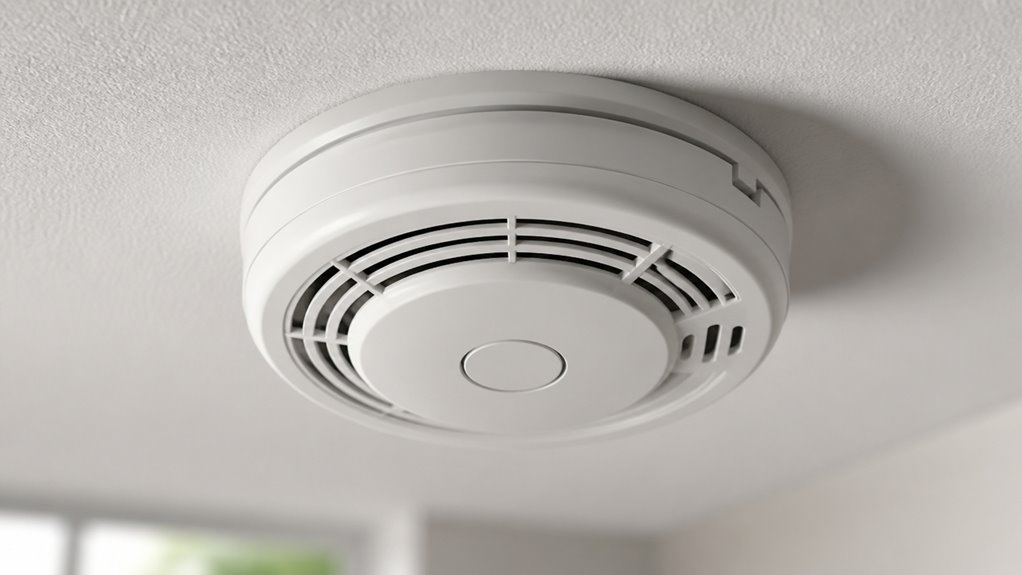

You’ll find Kidde hardwired smoke alarms reliable with continuous 120V AC power and battery backups lasting from 9V replaceables to sealed 10-year lithiums. This ensures detection during outages.
Models feature ionization or photoelectric sensors for fast flaming or smoldering fire detection. They support up to 24 interconnected devices for synchronized alerts.
Enhanced sensing reduces false alarms, and user-friendly installation steps simplify setup. Exploring the details reveals how these features work together for all-encompassing home safety.
Key Takeaways
- Kidde hardwired smoke alarms combine 120V AC power with battery backups for continuous, reliable detection during power outages.
- Models like i12060A use ionization sensing for fast-flaming fires, while 20SAR and 20SA10 use photoelectric sensors to reduce false alarms.
- Backup power options include 9V batteries, 2 AA batteries, and sealed 10-year lithium batteries depending on the model.
- Interconnected Kidde alarms link up to 24 devices for simultaneous alerts, improving home-wide fire detection and response.
- Maintenance includes annual battery replacement for replaceable batteries and monthly testing for optimal performance and safety.
How Kidde Hardwired Smoke Alarms Protect Your Home?
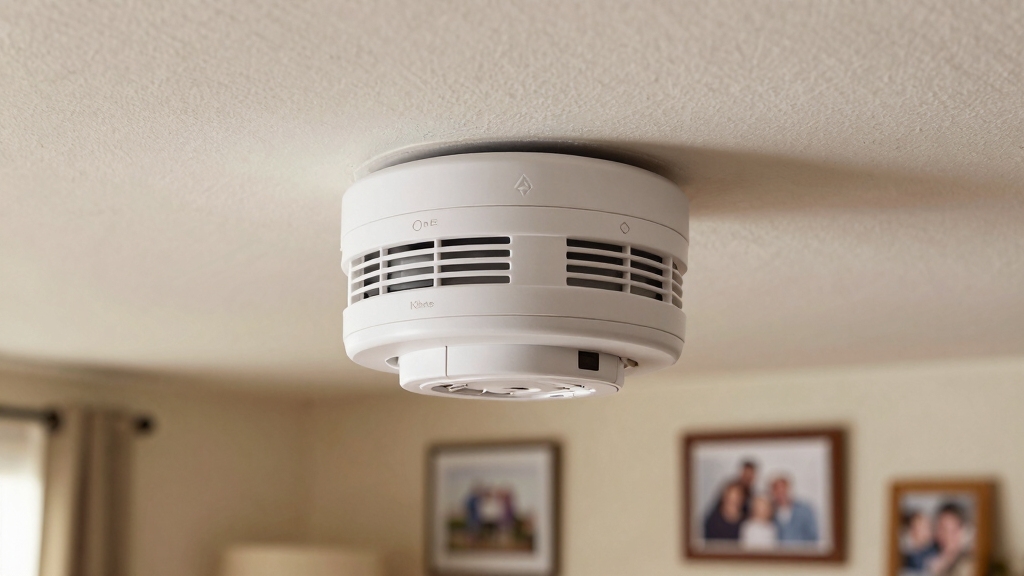
Kidde hardwired smoke alarms protect your home by delivering continuous, reliable fire detection through their 120V AC power sources combined with battery backups that guarantee functionality during power outages.
When you install these alarms, you ensure uninterrupted monitoring across multiple rooms with power supplied directly from your home’s electrical system.
Installing these alarms guarantees continuous protection in multiple rooms powered by your home’s electrical system.
The battery backup activates automatically during outages, maintaining alarm readiness.
You benefit from models featuring ionization or photoelectric sensors tailored to different fire detection needs, enhancing response accuracy.
Interconnected units communicate to alert all areas simultaneously, improving your overall safety.
Kidde designs these alarms with enhanced sensing technology to reduce false alarms, particularly those caused by cooking.
Their 10-year battery models reduce maintenance, ensuring long-term protection without frequent battery changes.
It is important to replace your Kidde smoke alarm every 10 years from manufacture date to guarantee reliable detection and safety.
Comparing Ionization vs. Photoelectric Sensing in Kidde Alarms
Although both ionization and photoelectric sensors aim to detect fire early, they operate using distinct principles that affect their sensitivity and response times.
Ionization sensors, like those in the Kidde i12060A, detect smoke particles using a small radioactive source that ionizes air. They trigger the alarm when combustion particles disrupt the ion flow. This makes ionization alarms more responsive to fast-flaming fires with small smoke particles.
Photoelectric sensors, found in models such as the Kidde 20SAR, use a light source and photodiode to detect smoke by sensing scattered light from larger particles. This improves detection of smoldering fires.
When choosing a Kidde hardwired alarm, consider the fire type risk and environment. Photoelectric sensors reduce nuisance alarms from cooking, while ionization units respond quicker to rapid fires.
Photoelectric technology also offers detection speed more than 25% faster than average alarms, enhancing early warning for smoldering fires.
How Kidde DETECT Alarms Reduce False Alarms?
Kidde DETECT alarms are pretty impressive! They use enhanced sensing technology to tell the difference between real fire threats and those pesky cooking emissions. This means you can say goodbye to those annoying nuisance alarms while still keeping safety a top priority.
Plus, they’re super quick to alert you when genuine smoke is detected. So, you can rest easy knowing you’ll get timely warnings when it really matters. The alarms also feature real-time push notifications to your smartphone via the Ring app, ensuring you’re alerted even when you’re away from home.
Enhanced Sensing Technology
When false alarms from cooking or steam trigger smoke detectors, they can lead to frustration and complacency. Kidde DETECT alarms incorporate enhanced sensing technology to address this issue with greater accuracy.
These alarms utilize advanced photoelectric sensors combined with optimized signal processing algorithms to differentiate between actual smoke particles and common non-hazardous aerosols. This reduces nuisance activations without compromising response time to genuine fires.
The technology also integrates adaptive sensitivity adjustments based on environmental conditions, improving reliability in diverse home settings. By refining detection thresholds and employing multi-criteria analysis, Kidde DETECT alarms maintain consistent performance while minimizing false alarms.
This precision allows you to trust your alarm system, ensuring timely alerts only occur during real fire events, thereby enhancing overall safety and user confidence. The use of a right-angle light path in the optical chamber design further enhances the sensor’s ability to detect smoke accurately while blocking stray light that could cause false alarms.
Cooking Nuisance Reduction
Building on enhanced sensing technology, Kidde DETECT alarms specifically target the common issue of cooking-related false alarms.
They utilize advanced photoelectric sensors combined with intelligent signal processing to distinguish between particles from smoke and harmless cooking aerosols like steam or light smoke.
This differentiation reduces the likelihood of nuisance alarms triggered by activities such as frying or boiling.
Additionally, the sensitivity thresholds are calibrated to ignore transient cooking byproducts while maintaining reliable fire detection.
By integrating these technical adjustments, the alarms minimize unnecessary disruptions without compromising safety.
When you install Kidde DETECT models, you benefit from a system engineered to reduce false alarms caused by routine kitchen events.
This ensures the alarm only activates for genuine fire threats, enhancing overall user experience and trust in the device’s performance.
Regular maintenance, such as cleaning the detector and testing it monthly, is recommended to sustain the device’s reliability and effectiveness.
Fast Alert Response
Fast alert response plays a critical role in how Kidde DETECT alarms effectively reduce false alarms.
These alarms use enhanced sensing technology combined with rapid signal processing to distinguish real fire events from common nuisance triggers like cooking smoke.
When smoke particles are detected, the alarm immediately evaluates the particle size and density, minimizing delayed or unnecessary alerts.
This precision reduces false activations without compromising safety.
You’ll also benefit from interconnected functionality; when one alarm detects a threat, all linked units sound simultaneously, ensuring timely awareness throughout your home.
The fast alert system shortens reaction time, giving you more opportunity to respond appropriately.
Additionally, Kidde alarms support battery backup to maintain operation during power outages, enhancing reliability and safety.
Backup Power Options in Kidde Hardwired Alarms
Did you know that Kidde hardwired smoke alarms come with different types of battery backups? Some use 9V batteries, while others rely on replaceable AA batteries. This is super important because it ensures that your alarm keeps working even during power outages. You want to know that you’re protected, right?
Having reliable backup options means you can reduce safety risks when AC power fails. It’s all about keeping you and your loved ones safe. So, when you’re choosing a smoke alarm, it’s a good idea to understand the backup power system for each model. This way, you can select the right one that offers dependable fire detection. How comforting is that?
Remember to regularly replace batteries annually or when the detector reaches its 10-year lifespan to maintain optimal performance.
Battery Backup Types
Kidde hardwired smoke alarms typically include battery backup systems that guarantee continuous operation during power outages. These battery backups come in different formats, ensuring you maintain fire detection even when AC power is unavailable. Understanding the battery types helps you select the right model for your needs and maintenance preferences.
Key battery backup types include:
9V replaceable batteries providing short-term emergency power.
2 AA replaceable batteries used in certain photoelectric models for outage coverage.
Sealed 10-year lithium batteries designed to last a decade without replacement.
Rechargeable backups integrated in some models for extended reliability.
Each type balances longevity, ease of replacement, and reliability to maintain alarm readiness throughout power interruptions. It is important to replace the 9V battery every 6 months or immediately upon low-battery chirp to ensure the backup remains effective.
Backup Power Benefits
Understanding the types of battery backups available lays the foundation for appreciating the benefits these systems provide in hardwired smoke alarms.
Kidde’s hardwired alarms use backup batteries to maintain continuous operation during power outages, ensuring uninterrupted fire detection.
Models like the i12060A rely on a 9V backup battery, while the 20SAR employs two replaceable AA batteries.
The 20SA10 offers a 10-year sealed backup battery, minimizing maintenance by eliminating battery replacements.
This backup power enhances reliability, especially in critical moments when AC power fails.
It also supports interconnected systems by keeping all units active, preserving the communication network.
By ensuring detection capability during outages, these battery backups markedly increase safety and reduce vulnerability to unnoticed fires.
This makes them an essential feature in Kidde’s hardwired smoke alarm lineup.
To maintain optimal performance, it is important to replace backup batteries with the specified battery type recommended by the manufacturer.
How Interconnection Enhances Safety With Kidde Smoke Alarms?
Although individual smoke alarms provide localized detection, interconnected Kidde smoke alarms enhance home safety by ensuring that when one unit detects smoke or fire, all alarms sound simultaneously.
This interconnected system markedly improves emergency awareness across your home, reducing the risk of missed alerts.
When using Kidde interconnected alarms, you benefit from:
- Immediate signaling across up to 24 devices, including smoke, CO, and heat alarms.
- Enhanced occupant response time due to simultaneous alerts throughout the property.
- Identification of the initiating alarm via a flashing red LED memory feature.
- Reduced chances of isolated alarms failing to notify occupants in distant rooms.
BRK smoke alarms similarly feature interconnectivity supporting up to 18 devices to provide comprehensive home coverage and synchronized alerts.
Reviewing Popular Kidde Models: i12060A, 20SAR, and 20SA10
Interconnected alarms provide all-encompassing coverage. Selecting the right model depends on your specific needs and installation requirements.
The Kidde i12060A features ionization sensing, supports up to 24 interconnected devices, and includes a 9V battery backup.
The 20SAR uses photoelectric technology with 2 AA batteries for backup, offering fast alerts and status LEDs.
The 20SA10 provides a worry-free 10-year sealed battery, eliminating battery changes during its lifespan.
Below is a comparison to help you decide:
| Model | Sensing Type | Backup Power |
|---|---|---|
| i12060A | Ionization | 9V Battery + 120V AC |
| 20SAR | Photoelectric | 2 AA Batteries |
| 20SA10 | Photoelectric | 10-Year Sealed Battery |
| Interconnection | Up to 24 devices | Yes, all models support interconnection |
| Battery Life | Varies by model | 1-10 years |
Customer Reviews on Kidde Hardwired Alarm Performance
Frequently, customers praise Kidde hardwired smoke alarms for their reliable detection and prompt alert systems, noting that these features enhance home safety.
Users appreciate the consistent alarm response times and effective interconnection capabilities that amplify warning signals throughout homes.
Reviews often highlight the following technical strengths:
- Stable 120V AC power operation with dependable battery backup for uninterrupted coverage.
- Efficient ionization or photoelectric sensing technologies tailored to specific fire detection needs.
- Interconnectivity allowing simultaneous alarms across multiple units for thorough alerts.
- Reduced nuisance alarms due to enhanced sensing algorithms, minimizing false triggers particularly from cooking smoke.
Installation Tips for Kidde Hardwired Smoke Alarms
When installing Kidde hardwired smoke alarms, you should first turn off the circuit power to guarantee safety.
Next, connect the wiring harness to the home’s electrical wiring, ensuring secure connections within the mounting bracket.
Attach the bracket firmly to the electrical box, then twist and lock the alarm into place.
For models with battery backup, pull the battery activation tab before restoring AC power to enable backup functionality.
After installation, test the unit using the hush/test button to confirm proper operation.
If installing interconnected units, verify that all devices communicate correctly by triggering one alarm and checking that all sound simultaneously.
Following these steps assures reliable power, backup readiness, and system interconnection essential for effective fire detection.
Frequently Asked Questions
What Is the Warranty Period on Kidde Hardwired Smoke Alarms?
You’ll find that Kidde hardwired smoke alarms typically come with a 10-year limited warranty. This warranty covers defects in materials and workmanship under normal use.
If the alarm fails within this period, Kidde will repair or replace it free of charge. It’s important to register your product and keep your purchase receipt to guarantee warranty service.
Always review the specific warranty details in your model’s manual for exact terms.
Are Kidde Hardwired Alarms Compatible With Smart Home Systems?
While you can’t always judge a book by its cover, Kidde hardwired alarms generally aren’t designed for direct smart home integration.
They focus on interconnection within their own systems, allowing up to 24 devices to communicate.
However, they don’t natively support Wi-Fi or smart assistant compatibility.
To connect with smart home setups, you’d need a compatible bridge or hub that can interface with traditional alarm signals and convert them for smart control.
Can I Install Kidde Hardwired Alarms Myself Without Professional Help?
Yes, you can install Kidde hardwired alarms yourself if you have basic electrical knowledge.
Make sure you turn off the circuit power before beginning. Connect the wiring harness to your home’s electrical system and secure the mounting bracket to the electrical box.
Twist the alarm into place. Don’t forget to pull the battery activation tab on battery-backed models.
Always test the unit with the hush/test button after installation to confirm proper function.
How Often Should I Replace the Batteries in Kidde Backup Systems?
You should replace the batteries in Kidde backup systems annually to guarantee continuous protection.
Some models, like the 20SA10, feature a 10-year sealed battery that doesn’t require replacement during its lifespan.
For alarms using replaceable batteries, check them regularly and swap out batteries immediately if the unit signals low power.
Always follow manufacturer guidelines to maintain peak performance and safety during power outages.
Do Kidde Hardwired Alarms Require Regular Maintenance or Cleaning?
Just like a knight regularly polishes his armor, you need to maintain your Kidde hardwired alarms. Yes, they require regular cleaning to assure peak performance.
You should vacuum or gently wipe the unit’s exterior and sensor openings every six months to remove dust and debris. Avoid harsh chemicals.
Also, test the alarm monthly using the test button to verify functionality. Proper upkeep helps prevent false alarms and guarantees reliable fire detection.
Why Homeowners Trust Kidde Hardwired Smoke Alarms for Everyday Safety
You rely on Kidde hardwired smoke alarms to detect smoke swiftly, reduce false alarms efficiently, and maintain power consistently.
You trust their interconnection to alert every corner of your home simultaneously, ensuring all-encompassing safety.
You expect easy installation and dependable performance, model after model.
By choosing Kidde, you equip your home with technology that senses accurately, communicates seamlessly, and safeguards persistently.
This provides you peace of mind through precision-engineered protection.