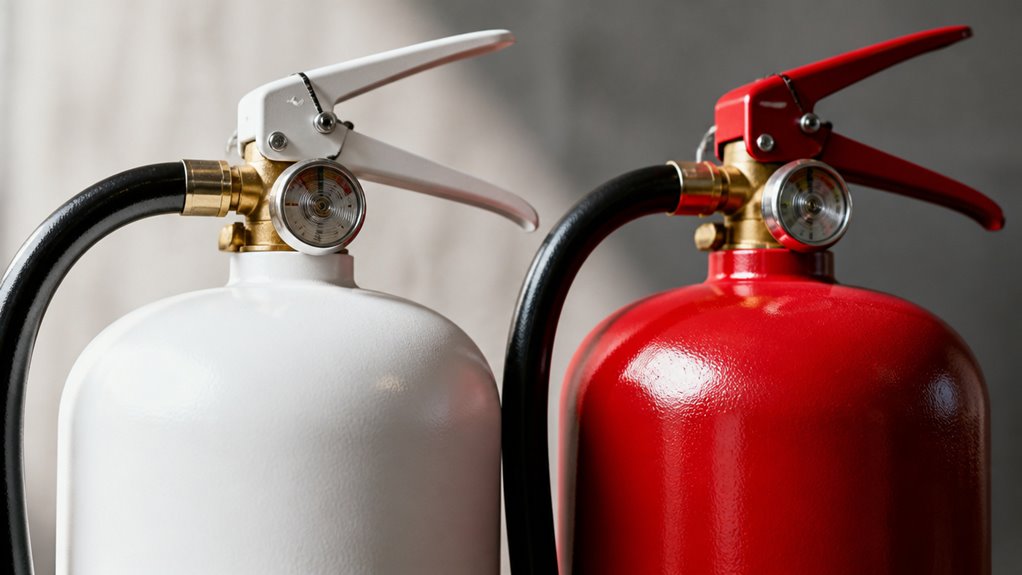

When choosing between white and red fire extinguishers, focus on fire class ratings and agent types rather than shell color.
Red units are the classic, general-purpose option for various fire classes.
White extinguishers often target kitchen fires with wet chemical agents suited for Class K.
Both colors can carry multipurpose ABC ratings using dry chemicals.
Prioritize selecting the right extinguisher for your specific fire hazards to guarantee effectiveness.
Understanding these details helps optimize your fire safety setup.
Key Takeaways
- Red extinguishers are traditional and widely recognized but color does not determine the extinguishing agent or fire class rating.
- White extinguishers are often used in kitchens for aesthetics and typically contain wet chemical agents for Class K fires.
- Both red and white extinguishers require checking labels for fire class ratings and agent types to ensure proper fire hazard compatibility.
- Red units commonly serve multipurpose ABC-rated use, while white units often focus on kitchen safety and Class K fire suppression.
- Selection should prioritize fire class and agent type over shell color to ensure effective fire suppression and safety.
White and Red Fire Extinguisher: Complete Side-by-Side Comparison
| Feature | White Fire Extinguisher | Red Fire Extinguisher |
|---|---|---|
| Primary Purpose | Often designed for kitchens and home interiors | General-purpose fire protection |
| Common Fire Class | Frequently Class K (cooking oils and grease) | Commonly Class A, B, and C |
| Appearance | Blends with kitchen and modern décor | Highly visible traditional design |
| Visibility During Emergencies | Moderate | Excellent |
| Typical Extinguishing Agent | Wet chemical or ABC dry chemical | Water, foam, dry chemical, CO₂, or wet chemical |
| Kitchen Fire Protection | Excellent | Depends on fire class rating |
| Multipurpose Use | Some models are ABC-rated | Commonly available as ABC-rated |
| Commercial Use | Less common | Widely used |
| Residential Use | Popular in kitchens and modern homes | Popular throughout homes and businesses |
| Fire Class Identification | Must check label and rating | Must check label and rating |
| Maintenance Requirements | Same as red extinguishers | Same as white extinguishers |
| PASS Method Compatibility | Yes | Yes |
| Color Determines Performance? | No | No |
| Best For | Kitchen environments and discreet placement | General fire safety and maximum visibility |
| Main Advantage | Aesthetic appearance and kitchen-focused options | Universal recognition and broad availability |
| Main Drawback | Less visible during emergencies | More noticeable in decorative spaces |
What Fire Classes Mean for Fire Extinguisher Choice?
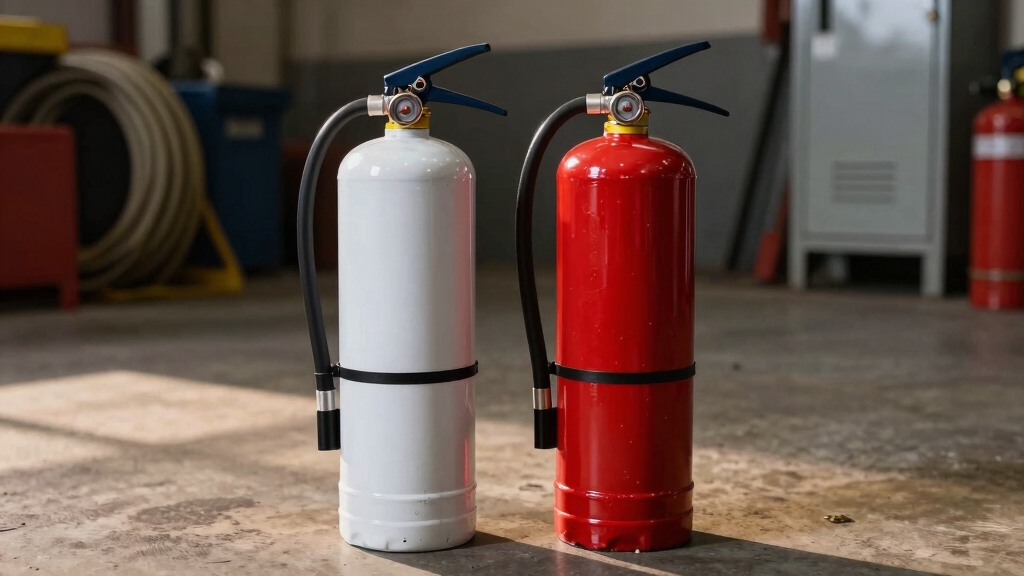
Because fire extinguishers are designed to combat specific types of fires, understanding fire classes is essential for selecting the right unit. You need to match the extinguisher to the fire class for effective suppression.
Matching fire extinguishers to fire classes is crucial for effective and safe fire suppression.
Class A fires involve ordinary combustibles like wood and paper; water or foam agents work best here. Class B fires stem from flammable liquids such as gasoline or oil, requiring foam, dry chemical, or CO2 agents.
Class C fires involve energized electrical equipment, so non-conductive agents like CO2 or dry chemical are necessary. Class K fires, common in kitchens, involve cooking oils and fats, best extinguished with wet chemical agents.
Using the wrong extinguisher can worsen the fire or create hazards. Always check the extinguisher’s class rating and agent type before use. ABC fire extinguishers use monoammonium phosphate powder, making them effective for multiple fire classes including A, B, and C.
What Fire Extinguisher Colors Mean?
You know, red fire extinguishers are the most common ones you’ll see. That bright color really just indicates a traditional design rather than what’s actually inside.
Now, when it comes to white extinguishers, they often pop up in kitchens or home settings. They blend in pretty well, but you still need to pay attention to the labeled rating to know how effective they are.
Just a quick reminder: the color of the extinguisher shell doesn’t dictate how you should use it. What really matters is the fire class and the type of agent inside. So, always check the labels!
For outdoor storage, it’s important to consider temperature guidelines to ensure extinguisher performance and durability.
Red Extinguisher Overview
Although the red color of fire extinguisher bodies is traditional and highly recognizable, it doesn’t determine the extinguisher’s performance or suitability for specific fire types.
You’ll find red extinguishers commonly used for general-purpose fire protection, but the critical information lies in the label color and class rating.
Red-labeled extinguishers may contain water, foam, dry chemical, CO2, or wet chemical agents, each designed for different fire classes: A, B, C, or K.
When selecting a red extinguisher, focus on its fire class rating rather than the shell color. This guarantees you have the correct suppression agent for the specific hazards you face.
Proper maintenance and regular inspection help ensure the extinguisher maintains consistent spray duration and effectiveness when needed.
White Extinguisher Purpose?
While red fire extinguishers dominate general-purpose fire protection, white extinguishers serve a distinct role, especially in kitchen and domestic environments.
You’ll find white-housed units designed to blend discreetly into these settings, often targeting Class K fires involving cooking oils and grease.
However, the white casing itself doesn’t define performance. You must check the extinguisher’s agent type and fire class rating to understand its suitability.
Many white extinguishers carry ABC ratings, making them multipurpose but still optimized for household use.
When selecting a white extinguisher, focus on the label’s classification and agent rather than shell color.
This guarantees you’ll have effective suppression tailored to specific fire risks typical in kitchens, rather than relying on appearance alone for fire safety decisions.
For specialized environments, agents like Purple K fire extinguishers provide superior performance on flammable liquid and electrical fires, highlighting the importance of choosing the right extinguisher type.
Color Versus Fire Class
How do fire extinguisher colors relate to their effectiveness against different fire classes? The color of the extinguisher body, red or white, doesn’t determine its fire suppression capability.
Instead, effectiveness depends on the extinguisher’s label, agent type, and fire class rating. Red extinguishers are traditional and often house water, foam, dry chemical, CO2, or wet chemical agents. Each of these targets specific classes (A, B, C, or K).
White extinguishers are frequently marketed for kitchens but still rely on their class rating for proper use. You must prioritize the fire class—A for combustibles, B for flammable liquids, C for electrical fires, and K for cooking oils—when selecting an extinguisher.
Ignoring class ratings in favor of color risks ineffective suppression and increased hazards during a fire emergency. For home safety, selecting a properly rated extinguisher with the recommended 5 lb ABC size ensures effective coverage against common residential fires.
Choosing Red vs White Fire Extinguishers
When you’re deciding between red and white fire extinguishers, it’s really important to focus on what matters most: the extinguisher’s fire class compatibility.
The color of the shell isn’t the main thing you should worry about.
Instead, your top priority should be picking the right agent type for the specific fire hazards you might encounter.
After all, you want to be prepared for whatever comes your way! Just keep in mind that while color is nice to consider, it’s really secondary to function and proper classification when it comes to effective fire suppression.
For ongoing safety, remember that fire extinguishers require regular inspection and maintenance by certified professionals to ensure reliability.
Color Versus Function
Although the color of a fire extinguisher’s casing—red or white—might catch your eye first, it doesn’t determine its effectiveness or appropriate use. The critical factors are the extinguisher’s agent type and rating, which directly influence fire suppression capability.
When choosing between red and white extinguishers, consider these points:
- Red casings are traditional and versatile, commonly housing various agent types for general use.
- White casings often target kitchen or domestic settings but still rely on agent ratings for performance.
- Labels and classifications provide precise information on suitability, regardless of shell color.
- Functionality depends on matching the extinguisher’s agent to the fire scenario, not on casing appearance.
Focus on the technical specifications rather than color for optimal fire safety. Regular inspection and maintenance ensure the extinguisher remains reliable when seconds count.
Fire Class Compatibility
Since fire extinguishers are designed to tackle specific types of fires, choosing between red and white models depends primarily on their compatibility with fire classes rather than shell color.
You should focus on the extinguisher’s class rating—A, B, C, or K—since each corresponds to different fire hazards.
Red extinguishers cover a range of agents, including water, foam, dry chemical, CO2, and wet chemical, suitable for general or specialized uses.
White extinguishers often target kitchen fires (Class K) but may also carry ABC ratings.
Selecting the right extinguisher means matching its agent and rating to potential fire types in your environment.
Ignoring these factors reduces effectiveness and increases risk.
Always check the label and agent type to make certain your extinguisher meets the specific fire class hazards you face.
For optimal safety, ensure extinguishers are placed along normal travel paths and near exits for quick accessibility in emergencies.
Why Red Fire Extinguishers Are the Classic Choice?
Red fire extinguishers frequently serve as the classic choice because their color signals a universally recognized standard for fire safety equipment.
When you select a red extinguisher, you’re opting for a widely accepted visual cue that indicates readiness and reliability.
Keep in mind, the red shell itself doesn’t determine performance; the agent type and class rating do.
Here’s why red extinguishers remain popular:
- They accommodate various agents such as water, foam, powder, CO2, and wet chemical.
- Their color aligns with traditional fire safety protocols and regulations.
- Labels on red bodies clearly identify the extinguishing agent and fire class.
- They offer versatile protection for general-purpose fire risks across multiple environments.
This combination of familiarity and functional clarity makes red extinguishers a dependable choice.
Regular inspection and servicing by licensed fire protection services ensure the extinguisher’s effectiveness and compliance with safety standards.
Using White Fire Extinguishers in Kitchens
Consider choosing a white fire extinguisher specifically designed for kitchen environments to blend functionality with aesthetics. These extinguishers often feature wet chemical agents suited for Class K fires involving cooking oils and grease.
While the white casing complements kitchen decor, focus on the rating and agent type for effectiveness. Proper placement near cooking areas guarantees quick access during emergencies. It is important to follow the PASS method when using these extinguishers to ensure safe and effective fire suppression.
| Feature | White Kitchen Extinguisher |
|---|---|
| Shell Color | White, blends into kitchen design |
| Fire Class Rating | Primarily Class K (kitchen fires) |
| Extinguishing Agent | Wet chemical |
| Visibility | Discreet but labeled clearly |
| Placement | Near stoves and cooking areas |
Always check the label for Class K certification to guarantee safe and effective fire suppression.
Common Fire Extinguisher Agents and Uses
Understanding the different agents inside fire extinguishers helps you select the right tool for specific fire hazards. Each agent tackles fires uniquely based on the fuel type and fire class.
Knowing fire extinguisher agents ensures you choose the best tool for each fire hazard type.
Here’s what you need to know:
- Water: Cools Class A fires involving wood, paper, and textiles. Not suitable for electrical or flammable liquid fires.
- Foam: Creates a barrier, smothering Class A and B fires by cutting off oxygen from flammable liquids and solids.
- Dry Chemical: Interrupts combustion chemically. It’s effective on Class A, B, and C fires, making it versatile for many hazards.
- CO2: Displaces oxygen around the fire. It’s ideal for electrical fires and flammable liquids without leaving residue.
Choosing the right agent guarantees peak fire suppression and safety during emergencies.
What ABC Ratings Tell You About Fire Extinguisher Use?
Many fire extinguishers feature an ABC rating, indicating their suitability for tackling common fire types involving ordinary combustibles, flammable liquids, and energized electrical equipment.
When you choose an ABC-rated extinguisher, you’re selecting a multipurpose unit primarily designed to combat Class A, B, and C fires.
These extinguishers most often contain dry chemical agents that interrupt combustion by forming a crust over the fuel.
However, you should know that an ABC rating doesn’t guarantee effectiveness against all fires.
For instance, kitchen grease fires (Class K) require specialized wet chemical extinguishers.
The extinguisher’s label and agent type provide more critical information than the shell color, so always verify the rating before use.
Understanding ABC ratings helps you select an extinguisher that matches the fire hazards in your environment for peak safety and fire suppression.
Fire Extinguisher Inspection and Maintenance
Knowing the correct extinguisher type and rating is only part of effective fire safety. Regular inspection and maintenance keep your extinguisher ready for action.
You must routinely verify pressure gauges, check the physical condition, and make certain the nozzle is unobstructed to guarantee functionality when needed.
Follow these four key steps:
- Inspect the pressure gauge monthly to confirm it’s in the operable range.
- Examine the cylinder for dents, corrosion, or leaks that could compromise integrity.
- Make certain the nozzle or hose is free of blockages and damage.
- Check the tamper seal and pull pin are intact to prevent unauthorized use.
Adhering to these practices extends your extinguisher’s service life and maintains compliance with safety standards.
Proper Fire Extinguisher Use With PASS
Mastering the PASS technique, Pull, Aim, Squeeze, and Sweep, is essential for using a fire extinguisher effectively during an emergency. First, pull the pin to break the tamper seal. Next, aim the nozzle at the base of the fire, not the flames. Then, squeeze the handle to release the extinguishing agent. Finally, sweep the nozzle side-to-side to cover the fire area thoroughly until the fire is out or the extinguisher empties.
| Step | Action |
|---|---|
| Pull | Remove pin to release extinguisher |
| Aim | Direct nozzle at fire base |
| Squeeze | Press handle to discharge agent |
Using PASS correctly maximizes suppression efficiency and minimizes risk in both red and white extinguisher models.
Frequently Asked Questions
How Long Do Red and White Fire Extinguishers Typically Last?
You can expect both red and white fire extinguishers to last about 5 to 15 years, depending on the manufacturer and maintenance.
The shell color doesn’t affect lifespan; instead, focus on regular inspections for pressure, corrosion, and damage.
Recharge or replace them after use or if they fail inspection.
Proper storage and handling also matter, so keep them accessible and maintained to guarantee reliability in emergencies.
Are White Fire Extinguishers More Expensive Than Red Ones?
Think of choosing between a sleek, modern gadget and a classic model.
White fire extinguishers often cost a bit more than red ones because they’re designed to blend discreetly into kitchens or homes.
They sometimes use specialized agents like wet chemical for grease fires.
However, the price difference isn’t huge.
What really affects cost is the extinguisher’s rating, agent type, and capacity, not just its shell color or appearance.
Can I Use a White Extinguisher Outdoors?
Yes, you can use a white extinguisher outdoors, provided it’s rated for the fire class you expect.
The casing color doesn’t limit where you use it; the agent type and rating matter most.
Just make sure it’s suitable for the fire hazards in that environment, like Class A, B, or C.
Also, check the extinguisher’s pressure and condition before relying on it outdoors. Exposure to elements might affect performance.
Do Red Extinguishers Require Special Mounting Brackets?
You don’t need a special mounting bracket just because your extinguisher is red! Red extinguishers use standard brackets designed to hold their size and weight securely.
What really matters is matching the bracket to the extinguisher’s dimensions and local safety codes. Proper mounting guarantees quick access and prevents damage.
Are There Regulations on Extinguisher Color in Commercial Buildings?
You won’t find strict regulations mandating extinguisher color in commercial buildings.
Codes focus more on extinguisher type, rating, and placement.
The National Fire Protection Association (NFPA) emphasizes correct classification and accessibility rather than color.
However, red is traditional and widely accepted for visibility.
Some jurisdictions or organizations may have preferences, but you should prioritize compliance with classification (e.g., ABC, K), agent type, proper mounting, and maintenance over color requirements.
Choose the Right Fire Extinguisher Based on Fire Type and Risk
When choosing between red and white fire extinguishers, understanding fire classes and extinguisher agents is key.
Red extinguishers are the tried-and-true option for general use, while white ones are specialized for kitchen fires.
Always check ABC ratings and maintain your extinguisher regularly to guarantee readiness.
Don’t let fire safety be a shot in the dark. Knowing the right extinguisher to use can make all the difference when seconds count.