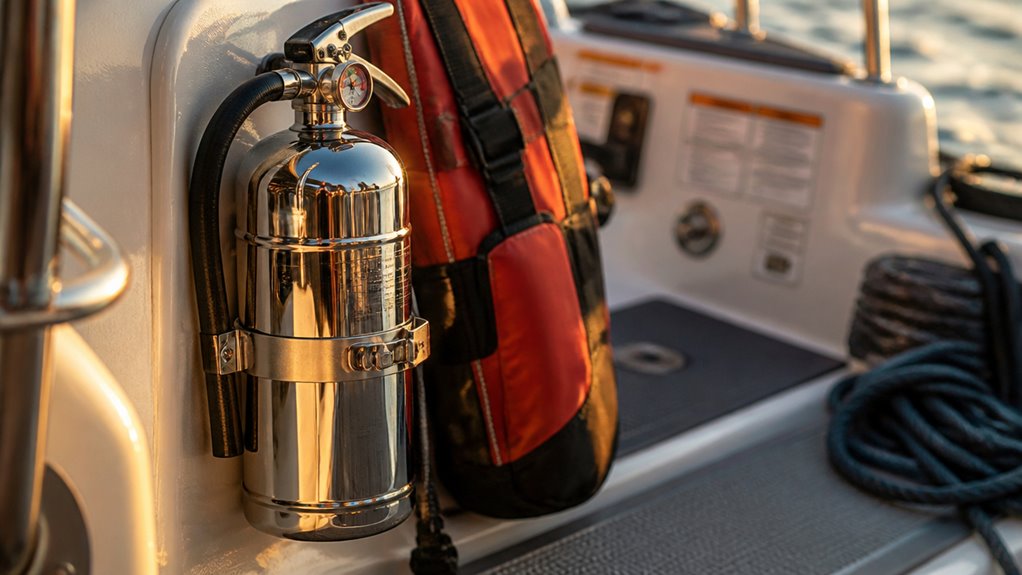

You must carry Coast Guard-approved fire extinguishers on your recreational boat if it has permanently installed fuel tanks, closed compartments, or enclosed living spaces where flammable vapors can build up.
Smaller outboard motorboats under 26 feet with open construction and portable fuel tanks might be exempt unless passengers for hire are aboard.
Extinguishers must have proper ratings, be in good condition, and readily accessible.
Understanding these rules guarantees your boat’s safety and compliance. Explore how vessel size and extinguisher type affect what you need.
Key Takeaways
- Coast Guard requires approved portable fire extinguishers on motorized recreational vessels under specific conditions.
- Extinguishers must have valid Coast Guard approval and appropriate UL rating, such as 5-B or 20-B.
- Quantity depends on vessel size: one 5-B extinguisher for boats under 26 feet, increasing with length and tonnage.
- Extinguishers must be in good working condition, accessible, and replaced if older than 12 years or damaged.
- Proper placement along normal travel paths and near exits is mandatory for quick access and effective emergency response.
When Does the Coast Guard Require Fire Extinguishers on Boats?
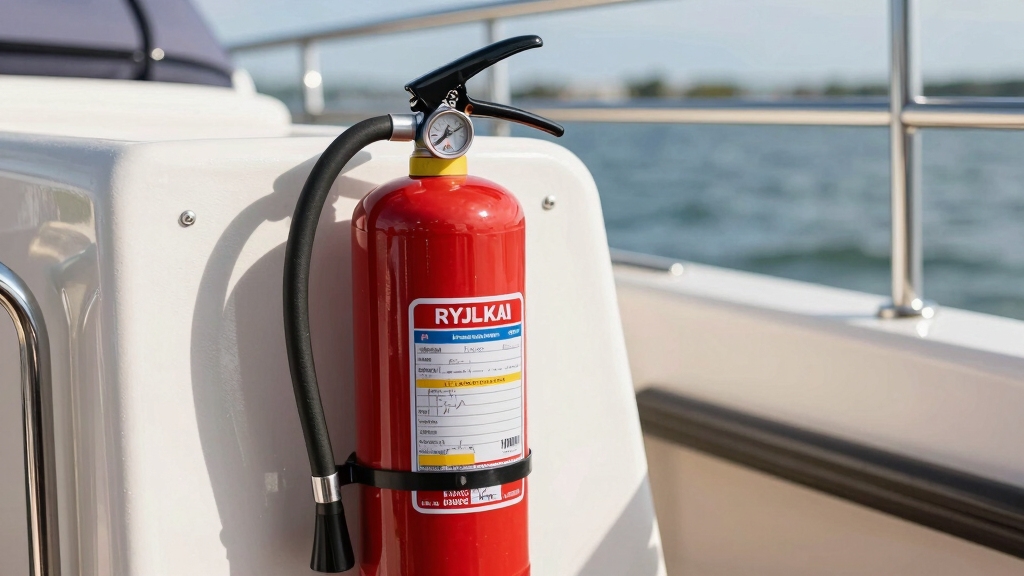
When do you need to carry a fire extinguisher on your boat? The Coast Guard requires approved portable fire extinguishers on recreational vessels propelled or controlled by machinery whenever specific conditions exist.
The Coast Guard mandates portable fire extinguishers on motorized recreational vessels under certain conditions for safety compliance.
If your boat has closed compartments under seats, permanently installed fuel tanks, closed living spaces, or storage areas for flammable materials, you must carry extinguishers.
Length also matters: boats under 26 feet generally need one 5-B extinguisher, while larger boats require more, depending on size and installed fixed systems.
Extinguishers must be onboard, readily accessible, approved, and in good working condition without expiration. If you have a fixed system, extinguisher requirements reduce accordingly.
Meeting these rules guarantees safety and compliance, protecting you and your passengers from fire hazards on the water.
It is important to ensure that your extinguisher has the proper UL certification to guarantee effectiveness and safety.
Which Boats Are Exempt From Carrying Fire Extinguishers?
You might be wondering about fire extinguisher requirements for boats. Well, if your boat fits certain criteria, you might just be exempt from carrying one!
For instance, if you have an open outboard motorboat that’s under 26 feet long and uses portable fuel tanks, you’re likely in the clear. These boats usually don’t have enclosed spaces where flammable vapors can accumulate, which is a good thing.
But, hold on! If your boat has closed compartments, permanently installed fuel tanks, or if you’re carrying passengers for hire, that exemption doesn’t apply anymore. So, it’s always best to double-check your boat’s specifics to stay safe on the water!
Additionally, ensuring you have the proper fire extinguisher rating is critical for safety and compliance when exemptions do not apply.
Exemption Criteria
Although most recreational vessels must carry Coast Guard–approved fire extinguishers, some boats qualify for exemptions based on specific criteria. You’re exempt if your boat is an outboard motorboat under 26 feet, has open construction, carries no passengers for hire, and uses portable fuel tanks.
However, if your boat has closed compartments under seats, double bottoms not sealed or filled, closed living spaces, closed storage for flammable materials, or permanently installed fuel tanks, you must carry extinguishers. These conditions increase fire risk by allowing flammable vapors to accumulate, negating exemption.
Always verify your vessel’s layout and fuel system against these criteria before assuming exemption. This guarantees compliance and safety without unnecessary equipment. Proper extinguisher placement along normal travel paths ensures readiness and rapid response in fire emergencies.
Boat Construction Types
Determining whether your boat is exempt from carrying fire extinguishers starts with understanding its construction type. Outboard motorboats under 26 feet with open construction typically don’t need extinguishers.
However, this exemption applies only if you don’t carry passengers for hire and your fuel is stored in portable tanks. Closed compartments under seats, double bottoms not fully sealed or filled with flotation, closed living spaces, or storage for flammables all require you to carry extinguishers regardless of length.
Boats with permanently installed fuel tanks also lose the exemption. If your vessel has any enclosed spaces where flammable vapors could accumulate, you must have approved, serviceable fire extinguishers on board and within easy reach to comply with Coast Guard regulations. ABC fire extinguishers use a monoammonium phosphate dry chemical agent effective on multiple fire classes and are commonly recommended for marine safety.
Fuel and Storage Conditions
When your boat stores fuel in portable tanks and features open construction, it may qualify for an exemption from carrying fire extinguishers, provided you don’t carry passengers for hire.
This exemption applies only if there are no closed compartments where flammable vapors can accumulate.
If your boat has closed storage, living spaces, or permanently installed fuel tanks, you must carry Coast Guard-approved extinguishers.
Additionally, double bottoms not sealed to the hull or not filled with flotation material also trigger the requirement.
Boats less than 26 feet with open designs and portable fuel tanks typically don’t need extinguishers unless they carry passengers for hire.
Always assess your boat’s fuel storage and compartment design carefully to determine if you meet exemption criteria or must comply with extinguisher requirements.
How Closed Compartments and Fuel Tanks Trigger Extinguisher Rules?
When you’re out on your boat and you’ve got closed compartments—like those areas under the seats or the thwarts—or if you have permanently installed fuel tanks, you need to pay attention. The Coast Guard has some rules that require you to carry approved fire extinguishers in these situations.
You see, those closed spaces can easily trap flammable vapors. This can definitely increase the risk of a fire, which is why the extinguisher rules kick in. By understanding these conditions, you can’t only stay compliant with the regulations but also keep everyone on board safe and sound. It’s all about being prepared!
It’s important to regularly check and maintain safety equipment to prevent false alarms caused by factors like moisture or dust, ensuring reliable protection in emergencies with regular maintenance.
Closed Compartments Defined
Closed compartments on your vessel can quickly trigger the Coast Guard’s fire extinguisher requirements.
These compartments include any enclosed spaces where flammable vapors might accumulate, such as storage lockers, under-seat compartments, or double bottoms that aren’t fully sealed or filled with flotation material.
If you have closed compartments designed to hold portable fuel tanks or combustible materials, you must carry approved portable fire extinguishers.
The presence of these spaces creates a higher fire risk, prompting stricter extinguisher rules to guarantee safety.
Open construction vessels without such compartments may be exempt, but once you introduce closed compartments, the Coast Guard mandates specific extinguisher types, quantities, and accessibility.
Understanding what qualifies as a closed compartment helps you comply and keep your vessel safe.
It is also important to note that fire extinguishers typically have a spray duration of around 21 seconds, which affects how you manage fire emergencies in these compartments.
Impact of Fuel Tanks
Handling fuel tanks properly plays a crucial role in determining your vessel’s fire extinguisher requirements. If your boat has permanently installed fuel tanks, you must carry portable fire extinguishers.
Similarly, closed compartments housing portable fuel tanks also trigger this requirement, as these spaces can accumulate flammable vapors. Double bottoms not sealed to the hull or not fully filled with flotation material add to the risk, requiring extinguishers.
Conversely, if your boat uses portable fuel tanks stored in open construction without enclosed compartments, you might be exempt. Understanding how your fuel storage setup interacts with Coast Guard rules guarantees you meet extinguisher obligations precisely. This keeps your vessel compliant and safe from fire hazards linked to fuel vapors in confined spaces.
Additionally, ensuring fire extinguishers meet the minimum rating of 2-A:20-B:C and are readily accessible within 30 feet is essential for effective fire protection during hot work and fuel handling operations.
Safety Implications Explained
Several key vessel features markedly increase fire risk, necessitating portable fire extinguishers under Coast Guard rules.
When your boat has closed compartments, like under seats or thwarts, flammable vapors can accumulate, creating a hazardous environment.
Permanently installed fuel tanks and double bottoms that aren’t sealed or fully filled with flotation material also raise fire potential.
These enclosed spaces trap vapors, increasing the chance of ignition from sparks or heat.
Because of this, the Coast Guard mandates you carry approved extinguishers and keep them readily accessible.
By understanding these safety implications, you’ll ensure your vessel meets regulations while protecting everyone on board from fire-related dangers.
Put simply, closed compartments and fuel tank configurations directly trigger extinguisher requirements to mitigate serious fire risks.
It is also important to store fire extinguishers in weatherproof enclosures to protect them from environmental damage and ensure they remain fully functional.
Approved Fire Extinguisher Types for Recreational Boats
When selecting fire extinguishers for your recreational boat, you must use only Coast Guard-approved types that meet the required 5-B or 20-B ratings.
These ratings indicate the extinguisher’s effectiveness against flammable liquid fires common on boats. Acceptable extinguishers are portable, designed for marine use, and clearly labeled with their rating and approval.
Older models marked B-I or B-II are no longer compliant for new vessels. You need extinguishers with a valid date stamp not exceeding 12 years in age, maintained in serviceable condition.
This means a clear nozzle, intact seal, and pressure gauge in range. Using non-approved or expired extinguishers compromises safety and violates regulations.
Always verify that your extinguisher matches these standards to guarantee proper protection and Coast Guard compliance on your boat. Additionally, proper signage such as “Do Not Block” signs should be mounted near extinguishers to ensure visibility and accessibility during emergencies.
Fire Extinguisher Requirements by Boat Length
Your boat’s length directly determines the number and type of fire extinguishers you’re required to carry.
The size of your boat dictates the essential fire extinguisher requirements for safety compliance.
For boats under 26 feet, one 5-B extinguisher typically suffices unless your vessel has closed compartments or permanently installed fuel tanks.
Between 26 and 40 feet, you need either two 5-B extinguishers or one 20-B.
Boats 40 to 65 feet require three 5-B extinguishers or a combination of one 5-B and one 20-B.
If your vessel is over 65 feet, requirements depend on gross tonnage and are more complex, often involving larger or additional extinguishers.
Always make sure your extinguishers are Coast Guard approved, accessible, and in good working order.
Extinguishers should be installed along normal travel paths and near exits for rapid retrieval during emergencies.
How Fixed Fire Suppression Systems Affect Extinguisher Requirements?
Understanding how fixed fire suppression systems impact your extinguisher requirements can help you optimize safety equipment on board.
If your vessel has a Coast Guard–approved fixed fire suppression system installed in the engine space, you can reduce the number of portable fire extinguishers required there by one unit.
For example, if the rules call for two 5-B extinguishers in the engine compartment, a fixed system lets you carry just one.
This reduction applies only to the engine space extinguisher count, not to other areas requiring portable extinguishers.
You still need to meet all other requirements, including type, accessibility, and maintenance standards.
Keep in mind that fixed systems don’t eliminate the need for portable extinguishers elsewhere on the vessel.
They simply allow you to adjust your extinguisher load for safer, more efficient compliance.
Fire Extinguisher Rules for Boats Over 65 Feet
Since vessels over 65 feet follow different regulations, you must adhere to extinguisher requirements based on gross tonnage rather than length alone.
For vessels exceeding 65 feet but under 300 gross tons, you’ll need 5-B or 20-B portable extinguishers. If your vessel surpasses 300 gross tons, a 160-B semi-portable extinguisher or a fixed system in machinery spaces is mandatory.
The minimum extinguisher count depends on gross tonnage, as detailed in Table 4 to § 175.320(b)(1).
| Gross Tonnage Range | Extinguisher Type | Minimum Number Required |
|---|---|---|
| 65 ft+ – 100 GT | 5-B or 20-B portable | 3 |
| 101 – 200 GT | 5-B or 20-B portable | 4 |
| 201 – 300 GT | 5-B or 20-B portable | 5 |
| Over 300 GT | 160-B semi-portable or fixed | 1 (machinery space) |
Follow this table precisely to stay compliant.
How to Check If Your Fire Extinguisher Is Serviceable and Compliant?
Before heading out on the water, make sure the fire extinguisher on board is both serviceable and compliant with Coast Guard regulations.
Check the pressure gauge to confirm it’s in the operable range.
Ensure the pressure gauge needle stays within the safe range for reliable fire extinguisher operation.
Guarantee the lock pin is firmly in place and the nozzle is clear of obstructions.
Inspect the extinguisher for any signs of corrosion, dents, or damage that could impair function.
Verify the extinguisher is an approved type, properly rated (5-B or 20-B as required), and not expired or previously discharged.
Confirm the label is legible and matches Coast Guard standards.
Keep the extinguisher readily accessible, mounted securely for quick use.
Regularly perform these checks to maintain compliance and assure safety during your vessel operations.
Why Model Year and Expiration Dates Matter for Fire Extinguishers?
Although fire extinguishers may look functional, their model year and expiration dates are critical indicators of their reliability and compliance with Coast Guard regulations.
You can’t just rely on appearance; an expired or outdated extinguisher might fail during an emergency. The Coast Guard requires extinguishers to be date stamped and not older than 12 years, especially for vessels from model year 2018 onward.
This guarantees the extinguisher’s chemicals and mechanisms remain effective.
Keep these points in mind:
Extinguishers older than 2018 must still be in good, serviceable condition. Date-stamped units past 12 years are non-compliant and unsafe.
Only approved 5-B or 20-B rated extinguishers meet current standards.
Following these rules keeps you compliant and ready to respond effectively.
Frequently Asked Questions
How Often Should Fire Extinguishers Be Professionally Inspected or Serviced?
You should have your fire extinguishers professionally inspected and serviced annually to make certain they’re in good, serviceable condition.
Check the pressure gauge regularly, verify the lock pin is firm, and look for corrosion or damage.
Replace or service extinguishers if they’re expired, used, or more than 12 years old.
Staying on top of maintenance keeps you compliant and ready to respond effectively in an emergency.
Can I Use a Fire Extinguisher Purchased From a Retail Store on My Boat?
Don’t just grab any fire extinguisher off the store shelf and toss it on your boat. That could be a disaster waiting to happen.
You need one that’s Coast Guard-approved, properly rated (like 5-B or 20-B), and suitable for marine use.
It must be in good working order, unexpired, and meet specific size and type requirements based on your vessel.
Are There Specific Storage Locations Required for Fire Extinguishers on Board?
Yes, you must store fire extinguishers on your boat so they’re readily accessible in an emergency.
Don’t tuck them away in hard-to-reach spots. Place them near potential fire hazards like the engine compartment or galley.
Make sure they’re secured to prevent movement but easy to grab quickly.
Proper storage guarantees you can respond immediately, keeping everyone safe and complying with Coast Guard guidelines.
What Penalties Exist for Not Complying With Coast Guard Fire Extinguisher Rules?
Back in the days of knights and castles, ignoring fire safety meant serious consequences, and today it’s no different.
If you don’t comply with Coast Guard fire extinguisher rules, you risk hefty fines, vessel detention, or even being barred from operating your boat.
The Coast Guard enforces these rules strictly to protect lives and property, so you’ll want to maintain approved extinguishers in good condition to avoid penalties.
How Do I Properly Dispose of an Expired or Used Fire Extinguisher?
To properly dispose of an expired or used fire extinguisher, first fully discharge it in a safe, open area away from people and flammables.
Then, remove the head to indicate it’s empty.
Contact your local fire department, hazardous waste facility, or recycling center to find disposal guidelines.
Never toss it in regular trash, as pressurized containers can be dangerous.
Following these steps guarantees safe, legal disposal and environmental protection.
Stay Compliant with Current Coast Guard Fire Extinguisher Regulations
You can’t cut corners when it comes to Coast Guard fire extinguisher requirements.
Carrying the correct, compliant extinguisher keeps you covered against combustible chaos.
Consider compartment configurations and fuel factors to avoid exemptions.
Whether your boat is big or small, fixed systems or not, staying sharp on service dates and approved types safeguards your safety.
Stay steady, stay safe, and stay smart. Proper preparedness prevents peril on the water.