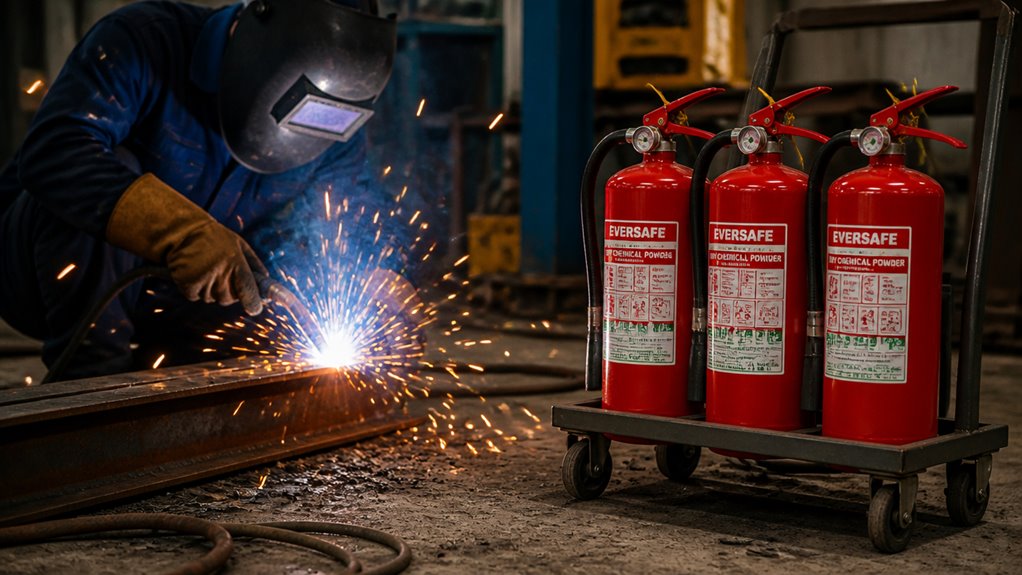

During hot work, you must keep fire extinguishers fully charged and within 30 feet of the work area for immediate access.
Use a minimum 2-A:20-B:C rated ABC extinguisher alongside a supplementary water extinguisher to cover all fire classes.
Position extinguishers unobstructed with a clear escape route behind the operator. Regularly inspect and maintain them per NFPA 51B and OSHA standards.
Proper training and fire watch duties guarantee readiness and rapid response. Next, you’ll understand how precise placement and protocols enhance safety.
Key Takeaways
- Fire extinguishers must be fully charged, operable, and positioned within 30 feet of the hot work area for immediate access.
- Maintain unobstructed access and visibility to extinguishers, ensuring a clear exit route behind the operator during use.
- Conduct daily inspections verifying pressure gauge in the green zone, intact seals, and no physical damage before hot work begins.
- Keep a dedicated fire watch on-site throughout hot work and at least 30–60 minutes afterward, ready to deploy extinguishers immediately.
- Use a dual-equipment strategy with ABC and water extinguishers to cover all fire classes common in welding and cutting operations.
What Fire Extinguisher Ratings Are Required During Hot Work?
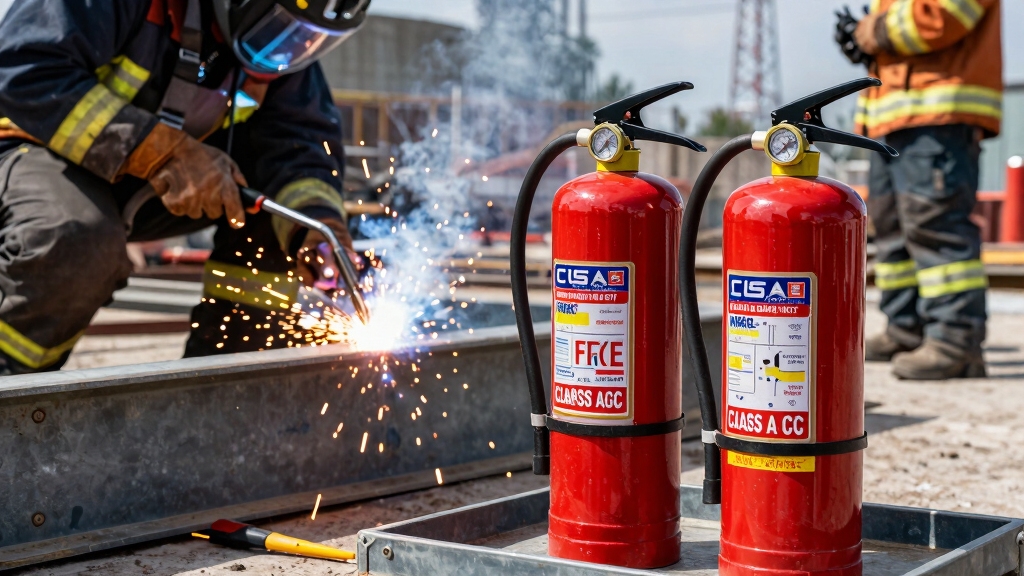
When performing hot work such as welding, brazing, or cutting, you must have fire extinguishers rated at a minimum of 2-A:20-B:C on hand.
This rating guarantees the extinguisher effectively combats Class A (ordinary combustibles), Class B (flammable liquids), and Class C (electrical) fires typically encountered during these operations.
Extinguishers with lower ratings fail to meet regulatory compliance and don’t provide adequate fire suppression capacity.
You must use equipment that complies with NFPA 51B standards to guarantee fire prevention during hot work.
Position these extinguishers within immediate reach, and make certain they’re maintained and fully charged before starting any hot work.
Adhering to these requirements is essential for regulatory compliance and maintaining a safe work environment during operations involving heat and sparks.
Regular inspection and maintenance of fire extinguishers are crucial to ensure their continued effectiveness and readiness in emergency situations.
Why Both ABC and Water Fire Extinguishers Are Required?
Although an ABC extinguisher provides versatile protection against Class A, B, and C fires common in hot work, you still need a water extinguisher on site to address specific fire scenarios that ABC units alone can’t efficiently handle.
While ABC extinguishers cover many fires, water extinguishers remain essential for certain scenarios on site.
The ABC extinguisher covers flammable liquids, electrical fires, and ordinary combustibles. However, water extinguishers excel at cooling and suppressing Class A fires involving wood, paper, and textiles.
NFPA 51B mandates this dual presence to guarantee all-encompassing fire suppression capability. You must deploy both types with a minimum 2-A:20-B:C rating for ABC units and maintain water extinguishers ready to combat fires where chemical agents may be less effective.
This dual-equipment strategy aligns with regulatory compliance and optimizes safety during welding, cutting, and brazing operations. Proper use of extinguishers targets a critical fire-triangle point to break the combustion cycle and stop fires effectively.
Where Are Fire Extinguishers Positioned for Easy Access?
Placing fire extinguishers within immediate reach is a key aspect of fire safety during hot work. You must position them no more than 30 feet from the hot work area, ensuring unobstructed access at all times.
Standard building extinguishers won’t meet this requirement. Only designated hot work extinguishers complying with NFPA 51B standards are acceptable. Whether indoors or outdoors, extinguishers should be strategically located based on hazard assessment and area layout.
| Location | Max Distance | Accessibility |
|---|---|---|
| Hot work zone | ≤ 30 feet | Unobstructed, visible |
| Adjacent areas | ≤ 30 feet | Clear path to device |
| Emergency exits | Easily reached | Immediate accessibility |
This setup guarantees rapid response capability during welding, brazing, or cutting operations. Regular inspections and maintenance ensure these extinguishers remain effective and ready for use, following NFPA 10 standards.
How to Maintain Fire Extinguishers for Readiness?
To keep your fire extinguishers ready for action, it’s important to conduct daily inspections. This means checking that they’re fully charged and free from any damage.
You definitely want to make sure they’re easily accessible and not blocked by anything in the hot work area.
And don’t forget, maintaining operational integrity is crucial! So, stick to these procedures before and during all hot work activities. It’s all about being prepared and ensuring safety.
Additionally, ensure extinguishers are mounted with the carrying handle between 3½ and 5 feet off the ground for effective reach and control.
Daily Inspection Procedures
Consistently performing daily inspections guarantees fire extinguishers remain fully operational and ready for immediate use during hot work. You must verify pressure gauges are in the operable range, confirm the extinguisher is free from physical damage, and confirm seals and tamper indicators are intact.
Check for clear labeling and accessibility. Record findings for compliance documentation.
Class D fire extinguishers require special attention due to their use with combustible metal fires, which pose unique challenges not addressed by standard extinguishers.
| Inspection Item | Required Condition | Action if Non-Compliant |
|---|---|---|
| Pressure Gauge | In green zone | Recharge or replace |
| Physical Condition | No dents, leaks, or rust | Tag out and service |
| Seal & Tamper Indicator | Unbroken | Investigate and reseal |
Follow this routine before every hot work operation to maintain readiness and adhere to NFPA 51B standards.
Ensuring Unobstructed Access
Although fire extinguishers must be positioned within 30 feet of hot work areas, maintaining unobstructed access is equally critical to guarantee immediate usability during emergencies.
You need to make certain that no equipment, materials, or debris block the path to the extinguisher.
Confirm that extinguisher mounting brackets or stands are secure and clearly visible.
Avoid placing extinguishers behind doors, curtains, or in corners where quick retrieval is hindered.
Regularly inspect the area for new obstructions caused by workflow changes.
Mark extinguisher locations with visible signage to facilitate rapid identification.
During hot work, keep access aisles clear at all times, complying with NFPA 51B requirements.
Ensure travel distances are measured along the shortest navigable walking path to maintain compliance with OSHA and NFPA standards.
Maintaining Operational Integrity
Clear and unobstructed access to fire extinguishers supports rapid response.
Maintaining their operational integrity guarantees they function effectively when needed.
You must verify extinguishers are fully charged, properly pressurized, and free of physical damage before each hot work operation.
Conduct routine inspections to confirm the pressure gauge is in the operable range and the nozzle is unobstructed.
Make certain tamper seals and pin devices are intact.
Replace or service extinguishers immediately if any deficiencies are detected.
Maintain documentation of inspection results and maintenance activities to comply with NFPA 51B standards.
Additionally, confirm compatibility with the required minimum rating of 2-A:20-B:C and the presence of supplementary water extinguishers.
This rigorous maintenance ensures readiness, compliance, and maximizes your ability to control fires during hot work.
Always ensure extinguishers undergo professional servicing and hydrostatic testing at recommended intervals to maintain structural integrity and operational effectiveness.
Who Should Be Trained to Use Fire Extinguishers During Hot Work?
Make sure that all personnel involved in hot work operations receive thorough training on the use of portable fire extinguishers. This includes welders, cutters, and fire watch personnel who must understand extinguisher types, operational procedures, and safety protocols.
Proper training guarantees rapid, effective fire response, minimizing risk and complying with NFPA 51B standards.
| Personnel Role | Training Focus | Responsibility |
|---|---|---|
| Welders | Extinguisher operation basics | Immediate fire suppression |
| Fire Watch | Equipment use and hazard recognition | Continuous monitoring |
| Supervisors | Safety protocols and compliance | Oversee training and readiness |
You must maintain this competency to guarantee fire extinguishers are used correctly, safeguarding personnel and property during hot work. Understanding the P.A.S.S. technique ensures personnel can operate extinguishers quickly and effectively in emergencies.
How Fire Watch Personnel Manage Fire Extinguishers During Hot Work?
Fire watch personnel must maintain immediate and unobstructed access to fire extinguishers throughout all hot work operations.
You’re responsible for ensuring extinguishers with a minimum rating of 2-A:20-B:C and a water extinguisher are positioned within 30 feet of the hot work site.
Keep these extinguishers free from obstruction and in a state of readiness, charged and operational at all times.
Prior to starting work, verify all equipment meets NFPA 51B standards and confirm functionality.
You must stay on-site during the entire hot work process and remain vigilant, ready to deploy extinguishers instantly if a fire occurs.
Never leave the work area unattended without a qualified relief.
Your role is critical to maintaining fire safety and regulatory compliance, preventing escalation of fire hazards during hot work activities.
Additionally, ensure that ABC fire extinguishers used are within the recommended temperature range of −65°F to 120°F to guarantee reliable operation during deployment.
Operational Protocols to Ensure Fire Extinguisher Effectiveness During Hot Work
Make sure there’s a trained fire watch on site for the entire duration of the hot work, plus at least 30 minutes afterward. This helps keep an eye out for any flare-ups that might occur.
Before you kick things off, it’s a good idea to check all your fire extinguishing equipment. You want to confirm that everything is fully charged and easy to get to.
If you do see any signs of ignition, don’t hesitate! Respond immediately, especially if it’s something that your extinguisher can handle. Quick action is key to preventing any escalation.
Always position the extinguisher with a clear exit behind you to ensure a safe escape route while operating.
Fire Watch Presence
Consistently maintaining a dedicated fire watch during hot work operations is critical to guaranteeing immediate response capability in case of fire.
You must guarantee the fire watch remains continuously present in the work area throughout the hot work process and for at least 30 to 60 minutes after completion.
Fire watch personnel shouldn’t leave for breaks or other reasons unless properly relieved.
Their role includes constant monitoring for fire hazards and readiness to deploy extinguishers rated at a minimum of 2-A:20-B:C.
You need to confirm fire watch personnel are trained in extinguisher use and have unobstructed access to the required equipment.
This presence guarantees rapid intervention, minimizing fire risk and complying with NFPA 51B and OSHA requirements for hot work safety.
Equipment Readiness Checks
Maintaining a vigilant fire watch is only part of assuring safety during hot work. Verifying equipment readiness before and throughout operations is equally important.
You must inspect all fire extinguishers to confirm they meet the minimum 2-A:20-B:C rating and NFPA 51B standards. Assure extinguishers, including the mandatory water extinguisher, are fully charged, operational, and free from obstructions within 30 feet of the work area.
Check pressure gauges, seals, and physical condition for damage or corrosion. Confirm sprinkler systems and hoses are functional as supplementary measures.
Perform these readiness checks before starting hot work and maintain vigilance during operations. Document all inspections to comply with safety protocols and regulatory requirements.
This systematic approach guarantees immediate availability and effective response capability, critical for fire prevention in hot work environments.
Immediate Fire Response
Fire watch personnel must remain vigilant in the hot work area throughout operations and for at least 30 to 60 minutes after completion to assure immediate fire detection and suppression.
You must make certain fire extinguishers are positioned within 30 feet and unobstructed for rapid access. Always verify equipment is fully charged and compliant with NFPA 51B standards before work begins.
During hot work, you should continuously monitor for sparks or embers that could ignite nearby combustibles.
Be prepared to deploy the extinguisher promptly without delay. Never leave the fire watch post unless properly relieved.
Strict adherence to these protocols guarantees extinguishers remain effective and fires are contained swiftly, minimizing risk to life and property.
How NFPA 51B and OSHA Affect Fire Extinguisher Use?
Although you may already have fire extinguishers on site, NFPA 51B and OSHA regulations specifically dictate the type, placement, and readiness of extinguishing equipment during hot work operations.
You must make certain a minimum 2-A:20-B:C rated extinguisher, such as a 10 lb ABC unit, is present, accompanied by a water extinguisher.
These standards guarantee capability against Class A, B, and C fires typical in welding, cutting, and brazing.
Extinguishers must be accessible within 30 feet of the hot work location and remain unobstructed and fully charged.
OSHA mandates trained personnel to operate extinguishers and conduct continuous fire watch during and after hot work.
Compliance includes pre-operation inspections and documented hot work permits verifying fire safety measures.
This aligns your procedures with regulatory requirements and industry best practices.
Frequently Asked Questions
Can Fire Extinguishers Be Shared Between Multiple Hot Work Sites?
You shouldn’t share fire extinguishers between multiple hot work sites.
Each site requires a dedicated extinguisher within 30 feet, ensuring instant accessibility and readiness.
Sharing can cause delays in emergencies and violates safety protocols.
To comply with NFPA 51B and OSHA standards, you must provide appropriately rated extinguishers at every hot work location.
These extinguishers should be maintained and unobstructed, guaranteeing rapid response and minimizing fire risks effectively.
What Specific Signage Should Accompany Fire Extinguisher Placement?
You should place clear, standardized signage identifying fire extinguishers at hot work sites.
The signs must be visible from a distance, using reflective materials and the red fire extinguisher symbol per NFPA guidelines.
Include directional arrows if the extinguisher isn’t immediately visible.
Make sure signage complies with OSHA and NFPA 51B standards, highlighting extinguisher type and rating.
Proper signage guarantees quick access during emergencies, enhancing overall site safety.
Are There Penalties for Non-Compliance With Extinguisher Regulations During Hot Work?
Ignoring extinguisher rules during hot work is like playing with fire. Yes, you face strict penalties for non-compliance.
OSHA can impose hefty fines, stop-work orders, or even legal action if you fail to maintain proper extinguisher readiness, placement, or ratings.
These measures guarantee safety and accountability. You must follow NFPA 51B and OSHA standards meticulously; otherwise, the financial and legal consequences can escalate quickly and severely.
How Often Must Fire Extinguishers Be Replaced or Upgraded?
You must replace or upgrade fire extinguishers based on their maintenance condition, inspection results, and manufacturer guidelines.
Regular monthly inspections and annual maintenance checks guarantee operational readiness.
Replace extinguishers if they fail pressure tests, show corrosion, or have expired service life, typically 5 to 15 years.
Stay compliant with NFPA 10 standards and OSHA regulations, which mandate prompt replacement or upgrade to maintain effectiveness during hot work operations.
Can Battery-Operated Fire Extinguishers Be Used During Hot Work?
You can’t use battery-operated fire extinguishers during hot work. Regulations and standards like NFPA 51B require extinguishers with a minimum 2-A:20-B:C rating, typically 10 lb ABC types, to handle Class A, B, and C fires effectively.
These extinguishers must be fully charged and operational, not reliant on batteries. Battery-operated units don’t meet these strict readiness and performance criteria essential for hot work safety compliance.
Protect Workers and Property With Effective Fire Safety Measures
During hot work, keeping fire extinguishers within 30 feet of the work area is vital for rapid response. Curiously, OSHA reports that having properly positioned and maintained extinguishers reduces fire incidents by up to 60%.
You must make certain ABC and water extinguishers are accessible, maintained, and that fire watch personnel are trained to operate them.
Following NFPA 51B and OSHA guidelines guarantees you’re prepared to control fires effectively and protect lives and property.