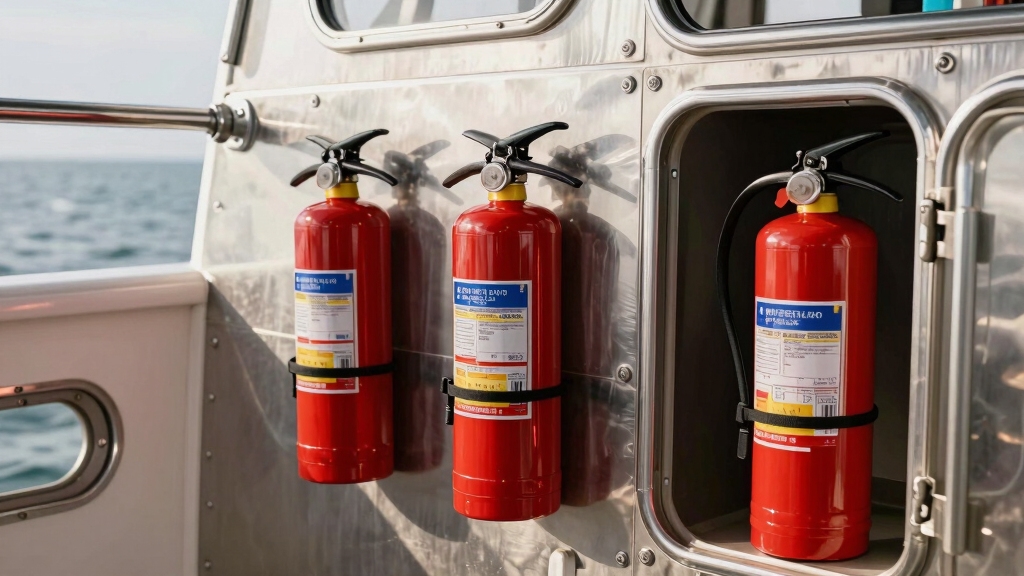

You should mount portable marine fire extinguishers along normal travel paths, ensuring no one travels more than 33 feet or half the vessel’s length to reach one.
Position them where they’re easily visible, out of fire-prone or obstructed areas, and within arm’s reach of high-risk zones like the galley; never inside.
Use marine-grade, corrosion-resistant brackets, mounting extinguishers no higher than 5 feet if under 40 pounds, or 3.5 feet if heavier.
Learn how proper placement and mounting meet safety standards and improve emergency response.
Key Takeaways
- Mount extinguishers along normal travel paths, within 33 feet or half the vessel’s length for quick accessibility during emergencies.
- Use marine-type, corrosion-resistant brackets with secure straps labeled “Marine Type USCG” to ensure stable and quick removal.
- Position extinguishers no higher than 5 feet if under 40 pounds, or 3.5 feet if heavier, for safe and easy retrieval.
- Avoid placing extinguishers inside galleys or engine compartments; mount opposite these areas with clear escape routes.
- Install extinguishers in well-lit, unobstructed locations within natural line of sight and away from fire-prone zones for maximum visibility.
Why Accessibility Matters Most for Fire Extinguishers?
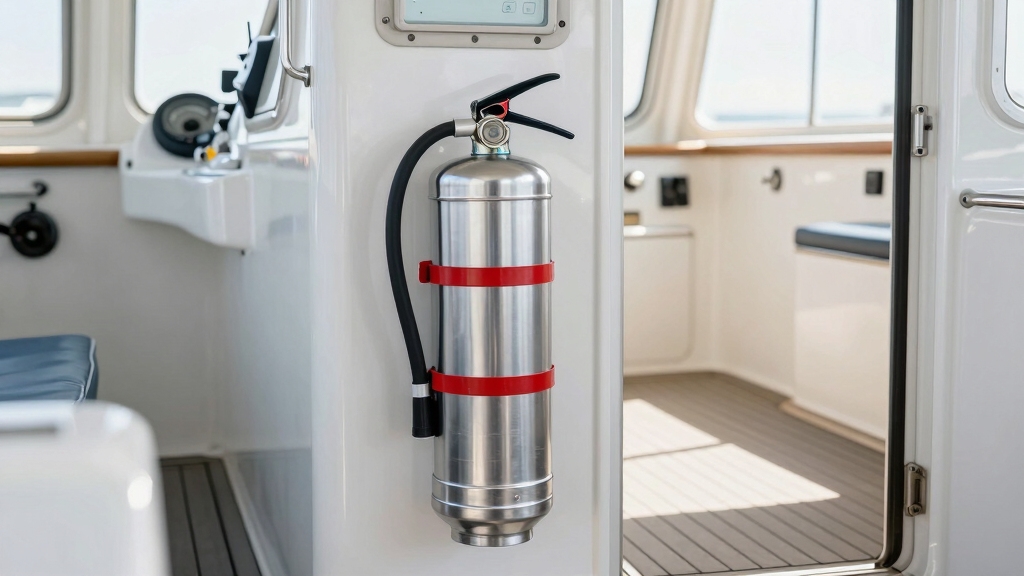
Because every second counts during a fire emergency, you need to have your marine fire extinguishers within easy reach at all times.
Fire extinguishers must be readily accessible and immediately available, positioned along normal travel paths where people spend most time on the vessel.
You can’t afford obstructions or hidden placements that delay response. Coast Guard regulations emphasize accessibility as the top priority, no exceptions.
You should place extinguishers so you can grab them quickly without detours, ensuring rapid deployment.
Accessibility outweighs other factors like proximity to fire-prone areas.
By maintaining clear, unobstructed access, you drastically improve your chances of extinguishing a fire before it spreads, protecting lives and property.
Your preparedness depends on keeping extinguishers within easy, immediate reach throughout the vessel’s inhabited spaces.
Regular inspections and maintenance are essential to ensure extinguishers remain fully functional and accessible at all times, as outlined in NFPA 10 standards.
How to Mount Fire Extinguishers for Easy Access?
Properly mounting your marine fire extinguishers is essential to guarantee you can grab them instantly during an emergency.
Use marine-type wall brackets or strap-type holders labeled “Marine Type USCG” to secure extinguishers firmly.
Mount extinguishers at a height no higher than 5 feet if under 40 pounds, and no more than 3.5 feet if heavier. This ensures quick reach without strain.
Position them along normal travel paths, free from obstructions, so anyone aboard can access them immediately.
Always attach extinguishers to their brackets; never leave them loose.
If visibility is limited, add high-visibility decals to mark locations clearly.
Following these precise mounting standards isn’t just best practice; it’s a Coast Guard requirement that maximizes safety and readiness when seconds count.
Regular inspection and maintenance of the extinguisher components ensures they function reliably when needed.
Best Locations to Avoid Fire-Prone Areas
You know, when it comes to fire safety, it’s really important to think about where you place your extinguishers.
Ideally, you want to mount them away from direct fire sources, like stoves or engine compartments. This way, they won’t get damaged and will keep you safe.
But here’s the thing: you still want them to be easily accessible.
So, it makes sense to position them near these areas. Just be careful not to put them right next to or directly above potential ignition points.
Finding that balance ensures your extinguishers are both protected and ready to grab when you need them most. It’s also crucial to keep a Class K extinguisher accessible in marine kitchens where grease fires may occur.
Away From Fire Sources
While fire extinguishers must be easily accessible, you should never mount them directly within fire-prone areas like the galley or engine compartment. Positioning extinguishers away from these high-risk zones reduces the chance they’ll be compromised or inaccessible during a fire.
Instead, place them where you can quickly grab them without stepping into danger. Consider these key points for ideal mounting locations:
Mount extinguishers opposite, not adjacent to, the galley or stove to avoid heat damage while ensuring quick access. Avoid storing extinguishers inside engine compartments; use dedicated fixed systems or specialized extinguishers there instead.
Choose areas along normal pathways where you spend time but safely removed from likely ignition points. This approach balances immediate availability with protection from fire hazards, keeping extinguishers functional when you need them most.
Remember to keep a dry chemical extinguisher on hand as backup for unexpected flare-ups to enhance safety in emergency situations.
Near But Not Adjacent
Locating fire extinguishers near, but not directly adjacent to, fire-prone areas helps guarantee quick access without exposing them to heat or damage.
You should install extinguishers opposite or close to locations like the galley or stove, making certain they remain reachable yet protected from potential ignition sources.
Avoid mounting extinguishers immediately next to the stove or inside the engine compartment, where excessive heat or flames could render them unusable.
Instead, place them along normal travel paths within 33 feet or less of these high-risk zones.
This approach balances safety and accessibility, meeting Coast Guard requirements for readiness while preventing premature extinguisher failure.
Storing extinguishers within the manufacturer’s specified temperature range is critical to avoid internal pressure risks that could compromise their safety and effectiveness.
How to Position Extinguishers Near the Galley and Stove Safely?
When it comes to positioning fire extinguishers near the galley, there are a few important things to keep in mind. You want them to be easily accessible, right? But at the same time, you need to make sure they’re safely away from the stove to prevent any heat damage.
Mounting the extinguisher opposite the stove is a smart move. This way, you can grab it quickly without putting yourself in harm’s way.
Just remember to keep it within arm’s reach, but not so close that it turns into a hazard during a fire. It’s all about finding that sweet spot! Always ensure the extinguisher is positioned with a clear exit behind you to assure quick escape.
Optimal Galley Extinguisher Placement
Placing a fire extinguisher near the galley demands careful attention to both safety and accessibility. You want the extinguisher within quick reach but not so close to the stove that heat or flames could damage it or hinder access.
Mount it on a sturdy wall bracket opposite the stove or just outside the cooking area to avoid fire-prone zones. Make sure it’s unobstructed and visible, so you can grab it instantly in an emergency.
Keep these points in mind:
- Use marine-rated brackets with secure straps to hold the extinguisher firmly.
- Position the extinguisher no higher than five feet for easy reach.
- Clearly mark the extinguisher location with decals if visibility is limited.
This setup balances immediate availability with protection from potential hazards. Ensure the extinguisher contains monoammonium phosphate powder for effective suppression of multiple fire types common in marine environments.
Safe Distance From Stove
When positioning fire extinguishers near the stove, maintaining a safe distance is vital to guarantee both accessibility and protection from heat damage.
You should mount extinguishers opposite the stove rather than directly adjacent or above it to avoid exposure to intense heat that can compromise their functionality.
Make certain the extinguisher is immediately accessible along normal travel paths, free from obstructions, so you can reach it quickly in an emergency.
Avoid placing it within the galley’s hottest zones but close enough to respond swiftly to a cooking fire.
Use marine-specific brackets with secure straps to keep the extinguisher stable.
Regular inspection and maintenance are essential to ensure the extinguisher’s effectiveness remains reliable in emergencies.
Recommended Marine-Grade Extinguisher Mounts
Making sure your portable marine fire extinguisher is securely mounted requires using marine-grade hardware specifically designed for the rigors of a vessel environment.
You need brackets or hangers labeled “Marine Type USCG” that resist corrosion and hold the extinguisher firmly in place even in rough seas. Strap-type brackets are your best choice. They secure the extinguisher tightly while allowing quick removal in emergencies.
When selecting mounting hardware, consider these essentials:
Use metallic components permanently attached to the extinguisher for secure installation.
Choose wall brackets or listed brackets designed specifically for marine use.
Confirm all mounting hardware meets NFPA 10 standards and Coast Guard requirements. Proper maintenance and inspection of mounted extinguishers also ensure they perform reliably when needed.
What Height Is Best for Mounting Portable Fire Extinguishers?
Mount your portable fire extinguisher at a height that balances quick accessibility with secure stability.
For extinguishers weighing less than 40 pounds, install them no higher than 5 feet from the floor.
Heavier units must be mounted no higher than 3.5 feet to guarantee you can grab them quickly during an emergency. This height range prevents difficulties in reaching or dislodging the extinguisher, especially in rough seas or tight spaces.
Use marine-grade brackets or straps to secure the unit firmly. Proper height placement also keeps the extinguisher visible and within your natural line of sight, speeding up response time.
Avoid mounting extinguishers too low where they could be obstructed or too high where stability becomes an issue. Following these standards guarantees your extinguisher is always ready when you need it most.
Regular inspections and maintenance ensure the extinguisher remains reliable and safe for use during emergencies.
How Far Should Passengers Travel to Reach an Extinguisher?
Proper height placement gets your extinguisher within easy reach, but you also need to take into account how far passengers must travel to access it. Limiting travel distance guarantees extinguishers are immediately available during emergencies, maximizing response time and safety.
You should mount extinguishers so no one travels more than half the vessel’s length or 33 feet, whichever is less. This distance standard supports rapid access without unnecessary delay.
Keep these points in mind:
- Position extinguishers along normal travel paths where passengers usually move.
- Avoid placing extinguishers in obstructed or fire-prone areas to maintain accessibility.
- Guarantee extinguishers are distributed evenly to cover all main sections of the vessel.
How to Make Fire Extinguishers Visible and Marked Clearly?
Fire extinguishers must always be placed where you can see them quickly, even in smoky or chaotic conditions.
Mount each extinguisher conspicuously on its designated marine-type bracket to prevent confusion during emergencies.
If visibility is limited by equipment or layout, use high-visibility decals or signage to mark the location clearly.
Assure labels are durable, reflective, and easy to read from a distance.
Position extinguishers in well-lit areas and keep the surrounding space free from obstructions.
Remember, clear marking isn’t just good practice; it’s essential for rapid response and safety.
How to Meet Coast Guard and ABYC Extinguisher Rules?
Making sure your vessel complies with Coast Guard and ABYC extinguisher regulations starts with understanding the specific requirements for extinguisher type, quantity, and placement.
Ensuring your vessel meets Coast Guard and ABYC extinguisher rules begins with knowing the required type, amount, and placement.
You must use Coast Guard–approved B-I or B-II extinguishers with marine-type mounting brackets. The number of extinguishers varies by vessel length and risk areas. They must be mounted for immediate accessibility along primary travel paths.
Focus on these key points to meet requirements:
Use listed marine-type brackets or strap mounts to secure extinguishers.
Mount extinguishers no higher than 5 feet for units under 40 pounds. Ensure no passenger travels over 33 feet to reach one.
Position extinguishers away from fire-prone areas but near high-risk spots like the galley.
Following these ensures safety and regulatory compliance without compromise.
Frequently Asked Questions
How Often Should Marine Fire Extinguishers Be Inspected and Serviced?
Imagine relying on a shield that’s rusty and empty when danger strikes.
You should inspect your marine fire extinguishers monthly, checking pressure gauges, seals, and physical condition.
Service them annually with a professional to maintain Coast Guard compliance and peak readiness.
Don’t wait for an emergency to discover a fault. Regular upkeep ensures your extinguisher performs flawlessly when seconds count, protecting lives and your vessel from devastating fire.
What Types of Fires Do Different Marine Extinguishers Combat?
You’ll find marine fire extinguishers classified mainly as Class A, B, or C.
Class A tackles ordinary combustibles like wood and paper.
Class B fights flammable liquids such as gasoline or oil.
Class C is designed for electrical fires.
Many marine extinguishers combine these classes, like B-I or B-II, covering multiple fire types.
Make sure you choose the correct extinguisher for your vessel’s specific fire risks to stay compliant and safe.
Can a Single Extinguisher Protect Multiple Fire Hazard Areas?
You might think one extinguisher can cover all fire hazards, but that’s risky.
While a single extinguisher can help initially, it often won’t provide adequate protection across multiple areas like the galley and engine compartment.
You need strategically placed extinguishers, each suitable for specific fire types and locations, ensuring quick, effective response.
Don’t rely on just one; multiple, accessible extinguishers save lives and comply with safety standards.
What Are the Signs That an Extinguisher Needs Replacing?
You need to replace a fire extinguisher if the pressure gauge shows it’s outside the green zone, indicating low pressure.
Look for physical damage, corrosion, or a clogged nozzle.
If the extinguisher is past its manufacturer’s expiration date or has been used, even partially, it must be replaced.
Regular maintenance checks are essential to guarantee readiness.
Don’t ignore any signs of wear or malfunction to keep safety intact.
Are There Specific Extinguisher Sizes Recommended for Different Vessel Types?
Yes, specific extinguisher sizes are recommended based on your vessel’s length.
For vessels under 26 feet, you need at least a 5-B, 10-B, or 20-B rated extinguisher.
Boats between 40 and 65 feet typically require four portable extinguishers per ABYC standards.
Always choose Coast Guard-approved sizes and ratings to guarantee compliance and effective fire protection tailored to your vessel type and size.
Visibility Meets Safety: The Perfect Spot for Your Extinguisher
You don’t want your marine fire extinguisher tucked away like a forgotten tool, nor do you want it hanging in a spot where smoke or flames block your reach.
Mount it where you can grab it instantly—near fire-prone areas but safely distanced, at a visible height, and within quick reach.
By balancing safety with accessibility, you make certain that when seconds count, your extinguisher is ready, not out of sight or out of reach.