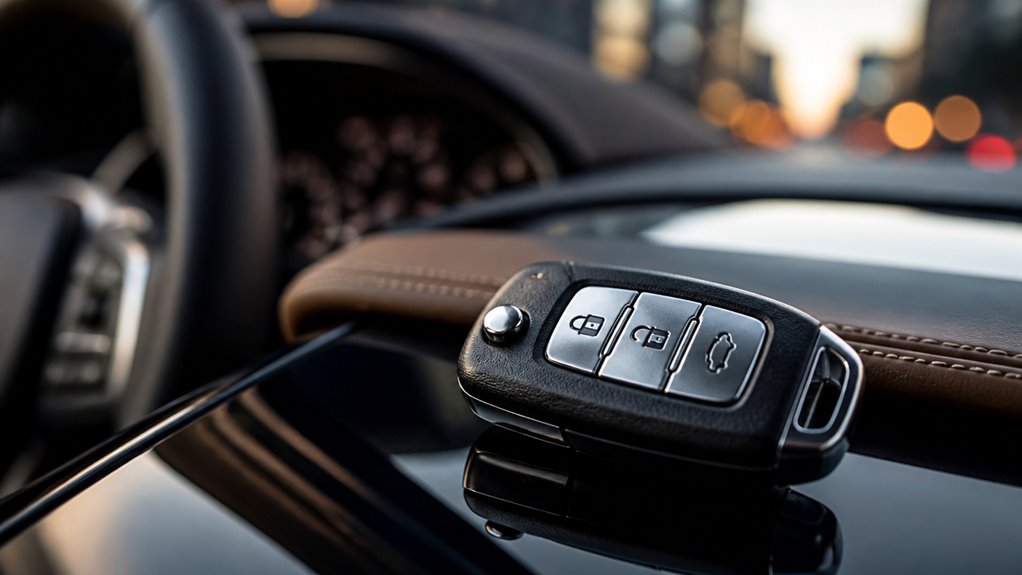

A smart key on your car replaces traditional metal keys with an electronic device that securely communicates using encrypted radio signals.
It lets you unseal doors and start the engine without physically inserting a key, relying on proximity detection within about one to two meters.
This system stores personalized driver settings and enhances convenience with push-button start and hands-free entry.
While offering advanced security, it also faces specific risks and protections that are important to understand for prime use.
Key Takeaways
- A smart key is an electronic device replacing traditional keys for keyless entry and push-button engine start using encrypted wireless signals.
- It enables automatic door unlocking and engine start when detected within about 1 to 2 meters of the vehicle.
- The key communicates continuously via encrypted radio signals with vehicle antennas for secure authentication and access.
- Smart keys store personalized driver settings, automatically adjusting seats, mirrors, and climate upon detection.
- Security features include encrypted communication, limited range, and protections against relay attacks and signal jamming.
What Is a Smart Key and How It Works?
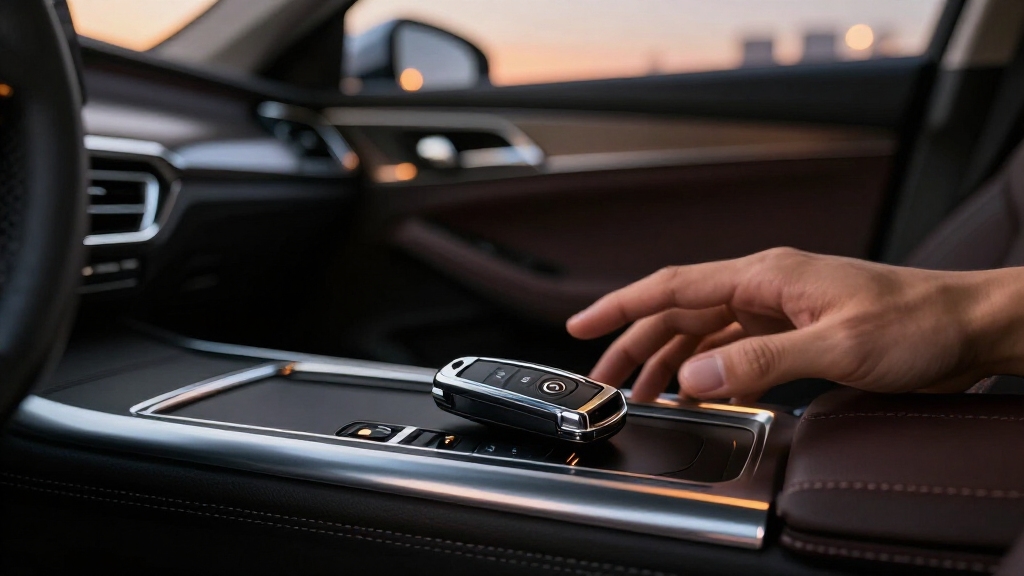
When you approach your car with a smart key, it automatically recognizes your presence through encrypted wireless signals. This allows you to release the doors without fumbling for a physical key.
This keyless system replaces traditional metal keys with an electronic device that communicates securely with your vehicle. It lets you lock, disengage, and start the engine using push-button ignition, provided the key fob is within a short range, typically about one to two meters.
You can keep the fob in your pocket or bag, enhancing convenience and speed. The smart key stores encrypted codes that the car’s system verifies before granting access. This ensures security while streamlining your daily routines with seamless entry and startup functions.
To maintain reliable operation, it is important to regularly replace or recharge the remote batteries used by the smart key.
How Smart Keys Communicate With Your Car?
Did you know that your smart key and car are always chatting? They constantly exchange encrypted radio signals to verify each other’s identity and grant access. Pretty neat, right?
This little back-and-forth usually happens within a close range—about one to two meters—so your car only responds when you’re nearby.
Getting a grip on how this wireless communication works is essential. It’s what keeps your vehicle both convenient and secure!
This secure connection often relies on rolling code technology to prevent unauthorized access and replay attacks.
Radio Signal Exchange
How does your car recognize your smart key without a physical connection?
It exchanges encrypted radio signals with your key fob through antennas placed around the vehicle. When you approach or interact with your car, these antennas send a coded request to the key.
If your smart key responds with the correct encrypted code, the car verifies your identity and grants access or enables ignition. This two-way radio communication happens within milliseconds, ensuring a seamless experience.
The system relies on strong encryption to prevent unauthorized interception or replication of signals. By continuously exchanging these coded signals, your car confirms the key’s authenticity, enabling functions like releasing doors or starting the engine without you inserting a physical key.
This radio signal exchange forms the backbone of keyless entry and push-button start systems. The remote’s reliable performance depends on using the correct battery size and voltage to maintain strong signal strength and longevity.
Proximity Detection Range
Exactly how close does your smart key need to be for your car to recognize it?
Typically, your vehicle detects the key within about 1 to 2 meters, depending on the system design.
This short-range proximity guarantees the car only opens or starts when the authorized key is genuinely near, enhancing security and convenience.
Antennas placed around the car continuously scan for the fob’s radio signals, activating door sensors or the push-button start only when the key is within this predefined zone.
If the key moves out of range, the system disables these functions automatically.
Understanding this detection range helps you anticipate when your car will respond, preventing accidental lockouts or false activations and assuring seamless interaction between you and your smart key system.
To further enhance protection, many smart key systems incorporate rolling code technology to prevent unauthorized access through signal interception or replay attacks.
Encrypted Communication Protocol
Many smart key systems rely on encrypted communication protocols to securely exchange information between the key fob and your vehicle. This encryption prevents unauthorized access by ensuring that only your car and key can understand each other’s signals.
When you approach, your smart key sends a coded radio signal, which your vehicle verifies before releasing the locks or enabling the engine start.
Key aspects of this encrypted communication include:
- Dynamic encryption keys that change with each interaction to prevent replay attacks.
- Mutual authentication, where both the key and vehicle confirm each other’s identity.
- Short-range radio frequency signals to restrict communication distance and reduce interception risk.
- Secure cryptographic algorithms implemented to protect data integrity and confidentiality during transmission.
These protocols form the foundation of your smart key’s security and convenience. Similar to a security camera’s use of a unique identifier, smart keys rely on device-specific credentials to maintain secure and trusted communication.
Core Features of Smart Key Systems
You know, smart keys really make life easier.
Forget about fumbling around with traditional keys; with smart keys, you can lock and unlock your car effortlessly. It’s all about that seamless experience!
And let me tell you, the push-button engine start is a game changer.
Once your authorized key is inside, you can power up your car in an instant. No more waiting around!
But it doesn’t stop there.
These systems also come with personalized driver settings. How cool is that? They automatically adjust your seats, mirrors, and climate to just the way you like it, making every ride super comfortable.
In addition, smart key systems often include advanced wireless transceivers to communicate securely with your vehicle for enhanced convenience and security.
Keyless Locking And Unlocking
When you approach your vehicle with a smart key, the system automatically senses the fob’s presence and releases the doors without any physical key use. This keyless locking and unfasten feature relies on encrypted wireless communication between the fob and the car’s antennas. It enhances convenience by eliminating the need to fumble for keys.
Here’s what you should know:
- The car detects the smart key within about 1 to 2 meters, enabling automatic unfasten.
- You can also unfasten doors by touching a sensor on the handle when the key is nearby.
- Locking the vehicle is just as seamless, often activated by pressing a button on the door handle.
- This system improves safety by ensuring only the authorized key can trigger these actions.
Keyless locking and unfasten define the smart key’s core convenience. Proper placement and shielding of the key’s internal sensors are essential to prevent interference and ensure reliable sensor accuracy.
Push-Button Engine Start
Alongside keyless locking and releasing, push-button engine start stands out as a defining feature of smart key systems. When you enter your vehicle with the authorized smart key inside, you simply press a button to start the engine. This eliminates the need to insert a physical key.
This system uses encrypted wireless communication to verify that the key fob is present, ensuring authorized access before ignition. You benefit from a seamless, efficient startup process that enhances convenience and security by reducing traditional mechanical vulnerabilities.
The push-button start also integrates smoothly with other vehicle systems, allowing quick activation without delay. Overall, this feature streamlines your driving experience by combining ease of use with advanced electronic authentication. It marks a significant evolution in vehicle access technology.
If the system experiences issues, performing an ignition cycling reset can often restore proper function without requiring physical key use.
Personalized Driver Settings
Smart key systems often store personalized driver settings, tailoring the vehicle environment to individual preferences automatically.
When you approach your car with the smart key, it recognizes you and adjusts controls without manual input.
This enhances comfort and efficiency, saving time and reducing distraction.
Key personalized settings include:
- Seat position adjustments to match your preferred posture.
- Side mirror angles optimized for your driving view.
- Climate control settings based on your temperature preferences.
- Audio system presets to your favorite stations or playlists.
Modern systems may also integrate with wireless sensor technology to enhance vehicle security alongside convenience.
Benefits of Smart Keys for Drivers
Frequently, drivers find that using a smart key markedly enhances convenience by allowing you to access and start your vehicle without removing the fob from your pocket or bag. This seamless interaction speeds up daily routines by eliminating the need to insert a physical key.
Smart keys boost convenience by letting you unlock and start your car without taking the fob out.
You’ll appreciate the hands-free access, especially when carrying items, reducing fumbling and delays. Smart keys also contribute to personalized comfort by recalling driver-specific settings, which minimizes setup time upon entry.
Additionally, these systems improve security by using encrypted wireless communication to verify the key’s identity, limiting unauthorized access. Overall, smart keys provide a blend of convenience, efficiency, and enhanced security that elevates your driving experience beyond traditional keys.
This technology streamlines vehicle use while supporting modern expectations for ease and protection. Proper preparation and verification, such as confirming battery compatibility, are essential for maintaining the reliability of smart key systems.
Additional Smart Key Features for Convenience
Beyond basic locking, releasing, and engine start functions, many smart key systems include additional features designed to enhance your convenience.
These features streamline your interaction with the vehicle, making daily use more efficient and personalized. You can expect functionalities that go beyond simple access and ignition.
Here are four notable additional features:
- Trunk or Hatch Release: Open your cargo area remotely or with a sensor touch, easing loading tasks.
- Driver Memory Settings: Automatically adjust seats, mirrors, climate, and audio based on which key fob is detected.
- Remote Window and Sunroof Control: Operate windows or sunroofs from a distance for ventilation before entering.
- Hands-Free Entry: Unseal doors by touching the handle when the key is in your pocket, useful when carrying items.
These features collectively improve your vehicle’s usability by anticipating your needs.
How Smart Keys Improve Vehicle Security?
Enhancing your vehicle’s security starts with the electronic verification methods built into keyless systems.
Your smart key communicates with your car through encrypted radio signals, ensuring only the authorized device can release and start the vehicle.
This electronic handshake replaces traditional mechanical keys, making it harder for thieves to use physical lock-picking or ignition tampering.
The vehicle’s antennas detect the presence of the correct smart key within a limited range, preventing unauthorized access from a distance.
Additionally, encryption protocols protect the wireless signals from straightforward interception or duplication.
By relying on these sophisticated authentication steps, your smart key system adds a robust security layer that combines convenience with protection.
It reduces common vulnerabilities associated with conventional keys while maintaining seamless access and control.
Common Risks and Vulnerabilities of Smart Keys
While smart keys boost convenience and security, they also introduce new vulnerabilities that you should be aware of. Because these systems rely on wireless signals, attackers can exploit certain weaknesses to gain unauthorized access or control.
Here are common risks you might encounter:
- Relay Attacks: Thieves can capture and extend the key fob’s signal to gain entry and start your car remotely.
- Signal Jamming: Interference can block your key’s communication, preventing locking or gaining entry.
- Key Cloning: Hackers can duplicate the electronic code if encryption is weak.
- Software Exploits: Flaws in the vehicle’s software might allow unauthorized access or disable security features.
Understanding these vulnerabilities helps you take precautions and choose vehicles with stronger smart key implementations.
Smart Keys vs. Traditional Keys: Key Differences
Although both smart keys and traditional keys serve the same basic purpose of securing and starting your vehicle, they operate through fundamentally different mechanisms.
Traditional keys rely on a physical metal key you insert and turn in the ignition, engaging mechanical components to open doors and start the engine.
Smart keys, however, use encrypted wireless signals to communicate with your car, allowing keyless entry and push-button start without physically inserting anything.
This wireless exchange enhances convenience, letting you keep the key fob in your pocket, while offering added security layers through coded authentication.
Unlike a traditional key’s mechanical nature, smart keys integrate personalized settings and remote functions, fundamentally shifting how you interact with your vehicle.
Understanding these differences helps you appreciate the technological advances smart keys bring over conventional keys.
Key Factors to Consider When Choosing a Smart Key System
Understanding how smart keys differ from traditional keys sets the stage for making an informed choice when selecting a smart key system. You’ll want to evaluate the following key factors carefully:
Knowing the differences between smart and traditional keys helps you choose the right smart key system.
- Security Features: Assess encryption strength and anti-relay protections to minimize hacking risks.
- Convenience Functions: Look for functionalities like proximity access, push-button start, and personalized driver settings.
- Compatibility and Integration: Make certain the system works seamlessly with your vehicle’s make and model, including any existing electronic systems.
- Battery Life and Maintenance: Consider how often you’ll need to replace batteries and the ease of doing so.
Frequently Asked Questions
How Do I Replace a Lost or Stolen Smart Key?
To replace a lost or stolen smart key, you’ll need to contact your car dealer or a professional locksmith authorized for your vehicle brand.
They’ll require proof of ownership and vehicle identification.
The replacement involves programming the new key to sync with your car’s system, ensuring security.
Because smart keys use encrypted signals, you can’t just copy them; professional reprogramming is essential for proper function and security.
Can Smart Keys Be Used With Multiple Vehicles?
Imagine carrying a master key that fits every lock in your kingdom. That’s not how smart keys work.
You can’t use one smart key across multiple vehicles because each key pairs specifically with its car via encrypted signals.
The system’s security depends on this unique pairing to prevent unauthorized access.
So, while it’s convenient, each smart key is designed to operate only the vehicle it’s programmed for.
This ensures safety and precise control.
What Is the Typical Battery Life of a Smart Key?
You can typically expect a smart key’s battery to last between one to two years, depending on usage and the type of battery inside.
If you use your key frequently for locking, unsealing, and starting, the battery may drain faster.
It’s smart to monitor its performance and replace the battery promptly when you notice reduced range or delayed responses.
This helps avoid inconvenience and maintains your vehicle’s seamless access and security functions.
Are Smart Keys Compatible With Aftermarket Car Alarms?
You want seamless security, easy integration, and reliable performance.
Smart keys can be compatible with aftermarket car alarms, but it depends on the system’s design and your vehicle’s electronics.
You’ll need to make certain the alarm supports keyless entry signals or offers a bypass module. Compatibility varies widely, so you should consult your alarm manufacturer or a professional installer to match features and avoid conflicts between the smart key system and the alarm’s functions.
How Do Weather Conditions Affect Smart Key Functionality?
Weather conditions can affect your smart key’s functionality by interfering with the wireless signals it uses.
Heavy rain, snow, or extreme cold might reduce the signal range or cause delays in releasing access or starting your car.
Moisture can also affect the fob’s electronics if it’s not waterproof.
To maintain reliability, keep your smart key dry and avoid exposing it to harsh weather for extended periods.
Final Thoughts on Smart Keys and Modern Vehicle Security
Smart keys have revolutionized vehicle access, with over 90% of new cars now featuring them for enhanced security and convenience.
By understanding how smart keys communicate with your car and their core features, you can appreciate their benefits, like keyless entry and theft reduction.
However, be aware of potential vulnerabilities. When choosing a smart key system, consider security, ease of use, and compatibility to guarantee you get the best protection and convenience for your vehicle.