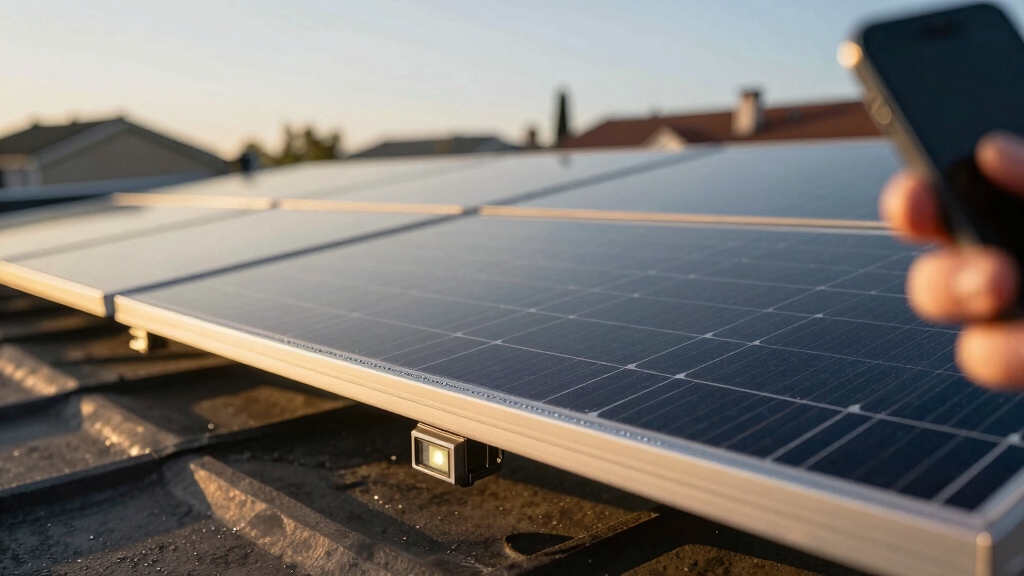

You can tell if your solar panel is working by monitoring its energy output against expected values like kWh per kWp and checking the performance ratio (PR), ideally above 80%.
Use real-time data from monitoring tools to track power output and detect faults instantly. Visual inspections help spot dirt, shading, or damage affecting efficiency.
Also, consider temperature effects and degradation trends to assess long-term health. Understanding these basics sets you up to optimize and troubleshoot your system effectively.
Key Takeaways
- Check your inverter’s display or monitoring dashboard for real-time power output and energy production data.
- Verify the performance ratio (PR) is near or above 80% to indicate strong system efficiency.
- Inspect solar panels for dirt, shading, cracks, or loose mounting hardware that reduce energy yield.
- Monitor for sudden drops or consistent declines in energy output that may signal faults or degradation.
- Use temperature-corrected analytics to assess performance accurately under varying environmental conditions.
What Energy Output Should Your Solar Panel Produce?
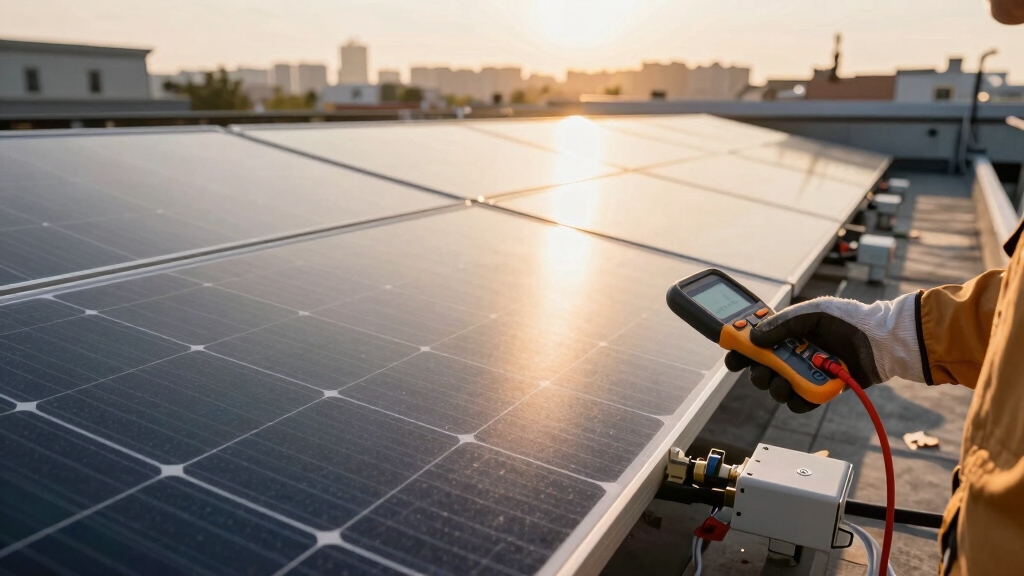
Understanding what energy output your solar panel should produce is essential for evaluating its performance accurately. You need to measure the energy production in kilowatt-hours (kWh) over specific timeframes and compare it against expected values based on your system’s size and location.
Standard test conditions provide a baseline power output in watts, which you can use to calculate the specific yield: kWh per kilowatt peak (kWp). Tracking this metric helps you identify deviations from peak performance.
Additionally, monitoring the inverter’s real-time DC to AC conversion data gives you insight into daily output efficiency. Proper maintenance and preparation, similar to how recycling air filters requires correct qualification and handling, can help ensure your solar panel system operates efficiently over time.
How to Visually Check If Your Solar Panel Is Working?
Sure! Here’s a more conversational version of your text:
First things first, take a look at your solar panels. Are the surfaces clean? If you spot any dirt, cracks, or discoloration, that could really affect how much sunlight they’re getting and how efficient they are.
Next up, check if all the panels are securely mounted. Loose connections or debris can cause problems, so it’s worth a quick inspection.
And don’t forget to consider shading from nearby trees or buildings—anything blocking the sunlight can really limit their performance.
Also, keep in mind that ambient light levels impact how well your panels generate electricity throughout the day.
Lastly, if everything looks consistent across the array, that’s a good sign! It usually means your panels are functioning well and aligned properly.
Panel Surface Inspection
When inspecting your solar panel surface, focus on identifying any dirt, dust, pollen, or bird droppings that could block sunlight and reduce efficiency.
Also, check for cracks or discoloration that may signal damage. Use a flashlight to spot subtle surface irregularities.
Regular cleaning or maintenance prevents performance loss caused by soiling.
Proper maintenance, including regular inspection and cleaning, is essential to avoid issues similar to those seen in appliances where blockages reduce efficiency and safety, such as dryer vent blockages.
| Issue Type | Visual Indicator |
|---|---|
| Soiling | Dust layers, pollen accumulation |
| Physical Damage | Cracks, chips, discoloration |
| Obstructions | Bird droppings, debris |
Mounting And Shading
After making sure your panels’ surfaces are clean and free from damage, turn your attention to the mounting and shading conditions. Proper mounting guarantees peak angle and stability, while shading can greatly reduce energy output.
Visually inspect your system for these key factors:
- Mounting Security – Check all brackets and fasteners for tightness and absence of corrosion or debris that could loosen panels.
- Alignment and Tilt – Verify panels maintain consistent tilt angles to maximize sun exposure throughout the day.
- Shading Obstructions – Identify any shadows cast by nearby trees, buildings, or objects that intermittently block sunlight on the panels.
Additionally, be aware that environmental factors such as moisture and corrosion can degrade wiring and connections, impacting overall system performance.
Addressing mounting and shading issues promptly ensures your solar array operates at peak efficiency and prevents long-term performance degradation.
How Temperature Affects Your Solar Panel’s Output?
Although solar panels convert sunlight into electricity efficiently, their output decreases as temperatures rise. You should understand that solar cells have a temperature coefficient, typically expressed as a percentage drop in power per degree Celsius above 25°C.
Solar panel output declines with rising temperatures due to the temperature coefficient above 25°C.
As ambient temperature climbs, the semiconductor materials’ efficiency declines, causing lower voltage output and reducing overall panel performance. High ambient temperatures can cause measurable production losses, especially in hot climates.
To accurately assess your system’s performance, consider applying temperature correction factors to your output data. Selecting panels with low temperature coefficients can help maintain better output under heat stress.
Monitoring temperature effects is essential to distinguish normal thermal losses from other issues such as shading or soiling that also degrade your solar panel’s productivity.
Additionally, indoor charging under artificial light yields far lower efficiency compared with direct sunlight due to reduced light intensity and spectrum, which can further impact your panel’s effective output when not exposed to optimal conditions like direct sunlight.
Using Efficiency Metrics to Evaluate Solar Panels
To kick things off, let’s talk about evaluating your solar panel’s efficiency. This basically measures how well your panels convert sunlight into energy. It’s all about the ratio of energy output to the sunlight input.
Once you have that down, the next step is calculating the performance ratio, or PR for short. This helps you compare how much energy your system actually produces against what it’s theoretically capable of. It’s a handy way to see how well your setup is working in real-world conditions.
And don’t forget about monitoring the degradation rate! This tells you how much power your panels lose each year. Typically, it’s around 0.5%, so keeping an eye on it’s important to ensure your system stays efficient over time.
Assessing Solar Panel Efficiency
To evaluate how well your solar panels are performing, you’ll want to investigate efficiency metrics that quantify their energy conversion capabilities. Efficiency is the ratio of electrical output to the solar energy input, typically expressed as a percentage. High-efficiency panels convert more sunlight into usable power, often exceeding 20%.
You can assess this by examining:
- Energy Output vs. Solar Irradiance – Compare the kilowatt-hours produced against the incident sunlight measured in kilowatt-hours per square meter.
- Specific Yield – Calculate kilowatt-hours generated per kilowatt peak (kWh/kWp) to measure actual performance relative to system size.
- Degradation Rate – Track annual power loss, usually around 0.5%, indicating how efficiency declines over time.
Calculating Performance Ratio
Building on the assessment of solar panel efficiency, calculating the performance ratio (PR) offers a standardized way to evaluate how effectively your system converts available sunlight into usable energy.
PR is the ratio of your system’s actual energy output to the theoretical maximum output under ideal conditions, expressed as a percentage.
To calculate it, divide the measured energy production (kWh) by the product of installed capacity (kWp) and the solar irradiance received (kWh/m²) during the same period.
This metric normalizes performance against environmental variables, helping you identify inefficiencies such as shading, soiling, or hardware faults.
A PR close to or above 80% indicates a well-performing system, while markedly lower values warrant inspection and maintenance to optimize energy yield.
Regular monitoring and pressure-based methods can help detect leaks or faults in system components that might reduce overall performance.
Monitoring Degradation Rate
Although solar panels are designed for long-term durability, their performance inevitably declines over time due to environmental and material factors.
Monitoring the degradation rate helps you quantify this decline using efficiency metrics. Typically, solar panels lose about 0.5% of their power output annually.
To evaluate this, you can:
- Calculate the performance ratio (PR) regularly to compare actual versus theoretical energy yield.
- Measure the energy performance index (EPI) by analyzing actual output against modeled expectations.
- Track efficiency percentage over time, noting if it drops below 20%, which indicates accelerated degradation.
How to Monitor Your Solar Panel Remotely and in Real Time?
Keeping tabs on your solar panel system in real time has become straightforward with advanced monitoring dashboards and remote tools.
You can access detailed performance data, including power output in kilowatts, energy production in kilowatt-hours, and efficiency metrics like performance ratio (PR) through these platforms.
Remote monitoring enables you to track specific yield (kWh/kWp), inverter-level outputs, and system availability instantly.
Many dashboards also provide temperature-adjusted analytics to account for environmental impacts on efficiency.
Additionally, you can remotely control system settings and receive immediate alerts for faults or deviations from expected performance.
By consistently reviewing key performance indicators such as cost per kWh and return on investment, you ensure your solar array operates at peak performance without needing physical inspections.
This approach saves time and prevents unnoticed performance drops.
Integrating your solar monitoring system with central monitoring stations can enhance real-time fault detection and automated responses.
Common Issues Indicating Solar Panel Maintenance Needs
Frequently, common issues arise that signal your solar panel system requires maintenance to maintain peak performance. You should regularly inspect for soiling or shading that lowers the performance ratio (PR). Sudden drops in energy production often indicate equipment faults or inverter malfunctions.
Additionally, a consistent annual performance decrease beyond the expected 0.5% degradation rate requires attention.
Key issues to watch for include:
- Low Performance Ratio (PR) – Caused by dirt accumulation, shading, or faulty components.
- Sudden Energy Output Drops – Indicative of inverter faults or wiring problems.
- Unexpected Annual Decline – If performance decreases more than 1%, it signals system deterioration or damage.
Addressing these issues promptly guarantees your system operates efficiently and prolongs its lifespan.
Frequently Asked Questions
How Often Should I Clean My Solar Panels for Optimal Performance?
You should clean your solar panels at least twice a year to maintain peak performance.
However, if you notice significant dirt, dust, pollen, or bird droppings blocking sunlight, increase cleaning frequency.
In dusty or polluted environments, quarterly cleanings work best.
Always inspect panels visually for grime or shading effects.
Regular cleaning prevents efficiency loss caused by soiling, helping you sustain consistent energy output and protect your investment over time.
Can Snow Cover Permanently Damage Solar Panels?
Snow cover itself won’t permanently damage your solar panels, but prolonged accumulation can cause issues.
Heavy, wet snow may stress mounting hardware or block sunlight, reducing output temporarily.
If snow melts unevenly, it might create ice dams, risking panel or roof damage.
You should carefully clear snow buildup to maintain efficiency and prevent physical strain.
What Warranties Typically Cover Solar Panel Repairs or Replacements?
Solar panel warranties usually cover manufacturing defects and performance degradation.
You’ll find two main types: product warranties, which protect against physical or workmanship defects for 10-25 years, and performance warranties, guaranteeing panels maintain a certain efficiency level (often 80-90%) over 25 years.
Some warranties also cover inverter repairs or replacements.
Always review terms carefully for exclusions like damage from extreme weather or improper installation, which often aren’t covered.
How Do Solar Panels Perform During Cloudy or Rainy Days?
You’ll find your solar panels can still produce about 10-25% of their usual output on cloudy or rainy days. This happens because panels capture diffuse sunlight, not just direct rays.
However, efficiency drops due to less irradiance and increased temperature effects. To get precise performance data, you can monitor your system’s specific yield and adjust expectations based on weather conditions.
This ensures accurate energy production analysis even in low-light scenarios.
Are There Any Safety Precautions When Inspecting Solar Panels?
Yes, when inspecting solar panels, you should always turn off the system to avoid electric shock.
Wear insulated gloves and non-slip shoes for safety. Avoid touching wiring or terminals directly and never inspect panels during wet conditions to prevent accidents.
Use a stable ladder if needed and make certain no debris or loose parts can cause injury.
Follow manufacturer guidelines strictly to maintain both personal safety and system integrity during inspections.
Silent Engine: Keeping Your Solar Panels at Peak Performance
You can think of your solar panel as a silent engine powering your energy needs. By checking its output, inspecting for visible damage, and understanding how temperature affects performance, you keep it humming efficiently.
Use remote monitoring tools and efficiency metrics as your dashboard indicators. They help you spot issues before they become problems.
With these steps, you make sure your solar panel doesn’t just sit in the sun; it transforms light into reliable power, day after day.