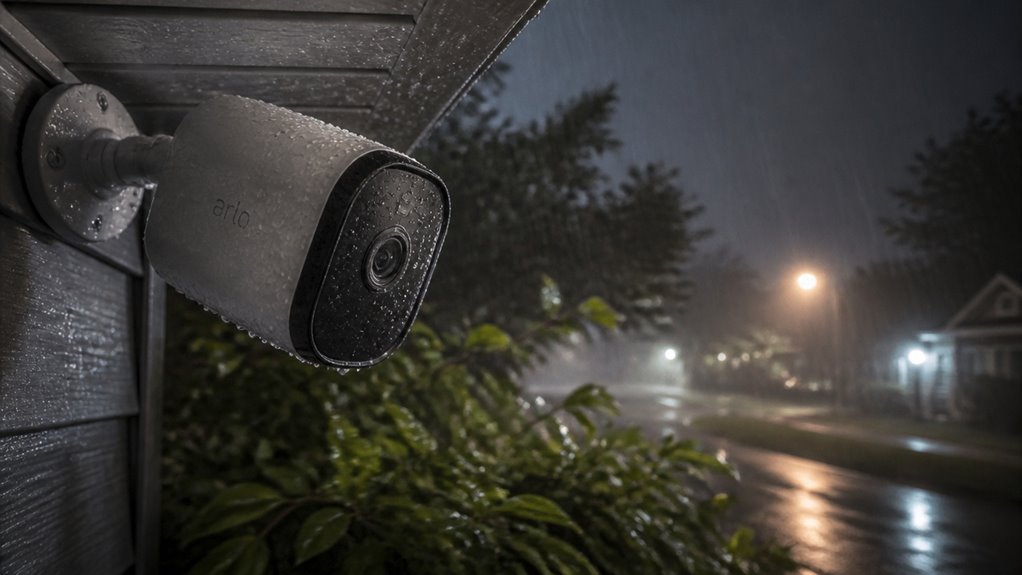

Yes, weather markedly impacts your security camera’s performance. Rain and moisture scatter light on the lens, causing blurred images and risking internal corrosion without proper sealing.
Extreme temperatures degrade battery life and image quality, while snow, ice, and wind obstruct view, stress components, and destabilize footage.
Humidity and fog reduce visibility by condensation and light scattering. Installing weatherproof cameras with protective features helps mitigate these effects.
Exploring these factors can optimize your camera’s reliability and longevity.
Key Takeaways
- Rain, fog, and humidity cause lens fogging and moisture buildup, reducing image clarity and visibility.
- Moisture infiltration damages internal sensors and electronics, leading to corrosion and malfunction.
- Extreme temperatures cause image distortion, sensor noise, and shorten camera component lifespan.
- Snow, ice, wind, and debris physically obscure lenses and destabilize camera mounting, affecting footage quality.
- Weatherproof features like IP ratings, heaters, and protective housings improve performance and durability in harsh conditions.
How Rain and Moisture Affect Camera Clarity and Durability?
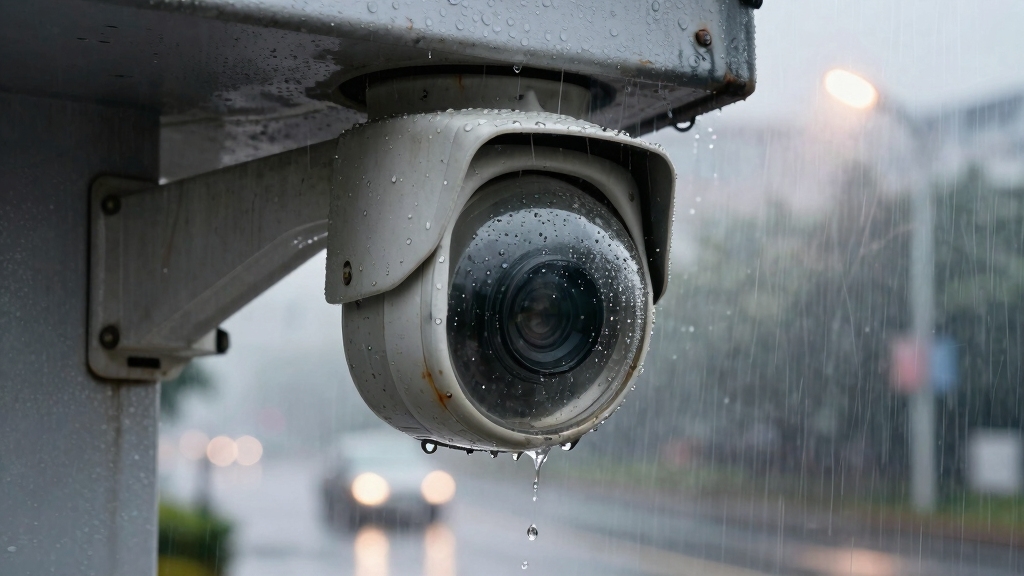
When rain and moisture come into play, your security camera’s clarity and durability can quickly degrade.
Water droplets on the lens scatter light, causing blurred images that reduce visibility and compromise footage quality.
Heavy rain further distorts the image and can obstruct key visual details.
If your camera lacks proper sealing, excess moisture penetrates internal components, leading to corrosion, electrical shorts, or malfunction.
Storm conditions worsen these effects as wind-induced vibrations misalign the camera, causing unstable footage.
To counter these issues, cameras with IP66 or IP67 ratings offer robust resistance against heavy rain and moisture ingress.
Ensuring your camera meets these standards helps maintain image clarity and protects internal electronics, preserving both operational reliability and the longevity of your surveillance system.
Regular lens cleaning and maintenance are also essential to prevent moisture degradation and ensure consistent image quality in harsh weather conditions.
How Extreme Temperatures Harm Security Camera Performance?
Although security cameras are designed to operate in various environments, extreme temperatures markedly impair their performance and longevity. Excessive heat overheats internal components, shortening lifespan. Extreme cold degrades battery efficiency and introduces digital noise.
Temperature swings cause condensation, fogging lenses and internal parts. This reduces image clarity and risks hardware damage.
| Temperature Range | Impact on Components | Visual Effect |
|---|---|---|
| > 50°C (122°F) | Overheating, failure | Blurred, distorted |
| < -20°C (-4°F) | Battery drain, noise | Grainy, low contrast |
| Fluctuations | Condensation, fogging | Reduced visibility |
You must choose cameras rated for wide operating ranges (e.g., -30°C to 60°C) and with protective features to guarantee reliable performance in extreme climates. Additionally, poor weatherproofing can lead to hardware damage over time, exacerbating performance issues in harsh conditions.
How Snow and Ice Obstruct and Damage Security Cameras?
Extremes in temperature don’t just affect internal components. They also create conditions that lead to the accumulation of snow and ice, which pose unique challenges to security cameras.
When snow builds up on the lens or housing, it obscures the field of view, markedly reducing image clarity. Frost forms below freezing temperatures, directly blocking visibility and causing glare due to snow’s reflectivity.
Ice accumulation mechanically stresses unshielded cameras, risking structural damage. It can freeze moving parts such as pan-tilt mechanisms, impairing functionality. These obstructions degrade footage quality and compromise surveillance reliability.
To maintain peak performance, you must consider protective measures like built-in heaters or proper housing. These can prevent snow and ice buildup and safeguard moving components from freezing or mechanical failure.
Mounting outdoor cameras under eaves or awnings provides additional weather protection and increases equipment longevity in snowy conditions.
How Wind and Storms Affect Security Camera Stability and Lens Quality?
Strong winds can really shake things up for your security camera. When that happens, you end up with unstable footage, which can seriously compromise the clarity of the images. It’s frustrating, right?
And then there are storms. They bring debris that can hit your camera lens, causing scratches or smudges. This not only affects the view but also degrades the overall visual quality.
Regular inspections and maintenance are essential to ensure your security equipment remains functional and clear despite environmental challenges, similar to best practices for maintaining fire extinguisher signage visibility.
Wind-Induced Camera Shaking
Wind frequently causes security cameras to shake, compromising both stability and image quality. When strong gusts hit, the resulting vibrations produce unstable footage, making it difficult to identify details.
You’ll notice frame blurring and misalignment caused by persistent movement. Over time, this constant shaking can loosen mounting brackets, further degrading stability.
Cameras installed on flexible poles or unsecured mounts are particularly vulnerable. To maintain lens precision, you must secure cameras with robust hardware and consider vibration-dampening mounts.
Additionally, protective enclosures designed to reduce wind exposure help maintain steady imaging. Without these measures, wind-induced shaking can distort surveillance footage, undermining its reliability and reducing the effectiveness of security monitoring during storms or high-wind conditions.
Improper mounting on metal surfaces can also introduce electrical interference, further degrading video quality during windy conditions.
Debris Impact On Lenses
Debris carried by storms can quickly degrade your security camera’s lens quality, obstructing clear imaging and compromising surveillance effectiveness.
Wind-driven particles like dust, leaves, and small twigs accumulate on the lens surface, scattering light and reducing image contrast.
Over time, abrasive debris erodes lens coatings, diminishing optical clarity and increasing glare.
Additionally, high-velocity impacts can cause micro-scratches or cracks, further impairing image fidelity.
Storm conditions also destabilize camera mounts, exacerbating misalignment and causing blurred or jittery footage.
To mitigate these effects, you should install protective enclosures with impact-resistant glass and position cameras away from direct exposure to prevailing winds.
Regular maintenance, including lens cleaning and inspection, is vital to preserve peak performance and guarantee reliable surveillance during and after adverse weather conditions.
Mounting cameras on solid surfaces or studs can also help maintain stability during strong winds and reduce the risk of misalignment.
How Humidity and Fog Reduce Security Camera Image Quality?
Have you ever noticed how high humidity can really mess with your security camera’s performance? It often leads to lens fogging, which blurs the image and makes everything look fuzzy.
When moisture builds up inside or on the lens, it just gets worse, degrading visibility even more. And let’s not forget—it can also cause long-term issues with the sensor.
Now, when it comes to foggy conditions, things get even trickier. The scattering of light can drastically limit how far your camera can see, making it tough to capture clear footage.
Maintaining lens cleanliness is essential to minimize the scattering of light and preserve image clarity in such conditions.
Lens Fogging Effects
Although security cameras are designed for outdoor use, high humidity and fog often cause lens fogging that markedly degrades image quality.
When moisture condenses on the lens surface, it scatters incoming light, reducing sharpness and contrast.
This leads to blurred, washed-out images that impair identification and monitoring tasks.
Fogging primarily occurs when warm, humid air contacts cooler lens surfaces, a common scenario during temperature fluctuations.
Cameras installed without adequate ventilation or protective housings are especially vulnerable.
The resulting image degradation compromises security effectiveness, particularly in marginal installations near water bodies or dense vegetation.
To mitigate fogging, consider cameras with built-in heaters or hydrophobic coatings that maintain optical clarity.
Proper placement under eaves and ensuring adequate airflow around the lens also help minimize condensation and preserve image fidelity in humid, foggy conditions.
Additionally, selecting cameras with appropriate weatherproof ratings can enhance durability and reduce performance issues caused by environmental factors like humidity and fog.
Moisture Buildup Issues
When humidity rises or fog settles, moisture tends to accumulate on and inside security cameras, directly impairing image quality.
You’ll notice lens surfaces fogging quickly, scattering light and reducing clarity.
This external condensation degrades sharpness and contrast, obstructing critical details.
Internally, if your camera lacks proper sealing or ventilation, moisture infiltrates sensitive electronics, causing short circuits or corrosion over time.
Condensation also distorts infrared illumination, compromising night vision effectiveness.
To maintain peak performance, you must guarantee cameras have appropriate IP ratings (IP65 or higher) and consider models with built-in heaters or ventilation systems.
Regular maintenance and strategic placement, such as under eaves, minimize exposure.
Addressing moisture buildup proactively is vital to preserving image integrity and extending your security system’s operational lifespan in humid or foggy environments.
Mounting cameras under eaves or soffits not only protects from weather but also helps prevent overheating and moisture issues.
Visibility Challenges in Fog
Since fog consists of tiny water droplets suspended in the air, it scatters infrared and visible light. This markedly reduces image sharpness and overall visibility for security cameras.
This scattering effect compromises contrast and detail, making object identification difficult. You need to understand key factors affecting performance:
- Lens fogging caused by high humidity creates blurred visuals.
- Light diffusion in fog lowers effective camera range.
- Condensation inside poorly ventilated cameras degrades sensor function.
- Infrared illumination becomes less effective as droplets absorb and scatter IR waves.
To maintain image clarity, consider cameras with built-in heaters or thermal imaging capabilities. Proper housing with IP65 or higher ratings prevents moisture ingress.
Strategic placement reduces exposure to dense fog, optimizing surveillance reliability under these challenging atmospheric conditions.
Additionally, using cameras equipped with Wide Dynamic Range (WDR) technology can help improve visibility by balancing lighting in foggy scenes.
Weatherproof Features That Protect and Improve Security Cameras
Incorporating weatherproof features markedly enhances the reliability and longevity of your security cameras under diverse environmental conditions.
Look for IP66 or IP67 ratings to guarantee resistance against heavy rain and dust ingress.
Built-in heaters prevent fogging and ice buildup on lenses, maintaining image clarity in cold climates.
Wide operating temperature ranges, such as -30°C to 60°C, protect internal components from thermal stress.
Additionally, rugged enclosures shield cameras from wind-induced vibration and debris.
| Feature | Purpose | Benefit |
|---|---|---|
| IP66/IP67 Rating | Water and dust resistance | Prevents moisture damage |
| Built-in Heater | Fog and ice prevention | Maintains clear visibility |
| Wide Temp Range | Thermal durability | Ensures consistent operation |
| Rugged Enclosure | Physical impact protection | Reduces vibration and debris |
Selecting these features improves performance and extends device lifecycle.
Frequently Asked Questions
Can Weather Conditions Trigger False Alarms in Security Camera Systems?
Yes, weather conditions can trigger false alarms in security camera systems. You’ll find that rain, wind, fog, and snow often cause motion sensors to misinterpret environmental changes as threats.
For instance, wind-blown debris or raindrops on the lens may activate alerts. To minimize false alarms, you should use AI-based motion detection and install cameras with weather-resistant ratings like IP65 or higher.
Additionally, position cameras strategically to reduce exposure.
How Does Camera Placement Influence Weather Resilience and Performance?
You enhance weather resilience by placing cameras under eaves or sheltered areas, minimizing direct rain, snow, and sunlight exposure.
Positioning cameras away from wind-prone spots reduces shake and debris impact, improving image stability.
Avoiding areas prone to fog or condensation helps maintain lens clarity.
Strategic placement also facilitates maintenance access, enabling timely cleaning or repairs.
Ultimately, careful positioning extends camera lifespan and guarantees consistent, high-quality performance across varied weather conditions.
Are Wireless Cameras More Vulnerable to Weather Than Wired Ones?
You might think wireless cameras struggle more in bad weather, and you’d be right.
Their batteries falter in extreme cold, reducing uptime.
Moisture can infiltrate unsealed compartments more easily.
Wired cameras, powered via PoE, maintain steady performance despite temperature swings and humidity.
Plus, wired models often have better sealing and fewer interference issues.
What Maintenance Is Required to Keep Cameras Operational After Severe Weather?
After severe weather, you should clean lenses to remove water droplets, snow, or debris that blur images.
Inspect seals and enclosures for moisture intrusion or damage, resealing if needed.
Check pan-tilt mechanisms for ice or wind misalignment, recalibrating if necessary.
Clear condensation inside cameras by drying or using heaters.
Verify power and network connections, especially in wireless models affected by cold.
Regularly test image clarity and motion detection to guarantee peak operation.
Do Weatherproof Cameras Require Additional Accessories for Extreme Climates?
You don’t need extra armor if your weatherproof camera’s already built for extremes, like a fortress with IP66 or IP67 ratings.
But in brutal cold, add built-in heaters to prevent fogging and ice buildup.
For scorching heat, guarantee proper ventilation or use PoE wired models to maintain power stability.
Strategic mounts under eaves shield against wind and rain.
Weatherproof Your Security for Uninterrupted Peace of Mind
Think of your security camera like a smartphone in a rainstorm. Without proper protection, performance drops fast.
Studies show moisture can reduce image clarity by up to 40%. Extreme temperatures can also shorten device lifespan.
Just as you’d use a waterproof case for your phone, investing in weatherproof features guarantees your camera stays sharp and reliable despite harsh conditions.
Don’t let weather blind your security. Fortify your setup for consistent, precise monitoring year-round.