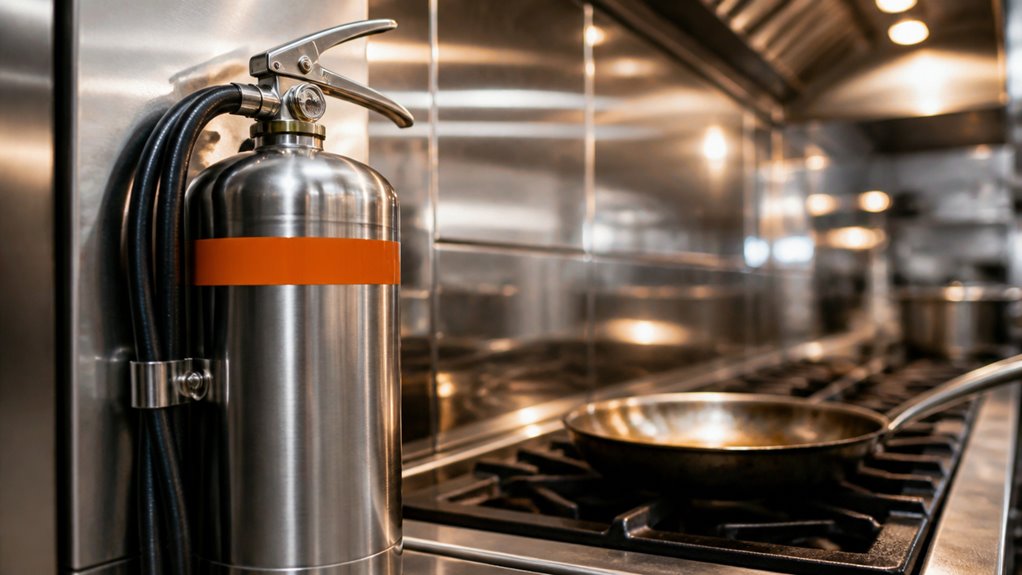

You rely on a Class K fire extinguisher to safely suppress high-temperature kitchen fires fueled by cooking oils, fats, and grease. These fires are common in commercial kitchens.
It uses a wet chemical agent that triggers saponification, turning burning oils into a soapy foam. This foam cools and smothers the fire, preventing re-ignition without spreading grease.
Unlike standard extinguishers, Class K units are specifically designed for these hazards. Understanding their operation and placement guarantees you’re prepared for kitchen emergencies.
Key Takeaways
- Class K fire extinguishers are designed specifically for kitchen fires fueled by combustible cooking oils and fats.
- They use a wet chemical agent that initiates saponification, turning hot grease into a cooling, soapy foam.
- The foam smothers flames and cools the grease, preventing reignition without spreading the fire.
- Conventional extinguishers can worsen grease fires, while Class K units provide effective suppression with chemical and cooling action.
- They are required within 30 feet of commercial cooking appliances and must be regularly inspected and maintained.
What Is a Class K Fire Extinguisher and Why Do You Need One?
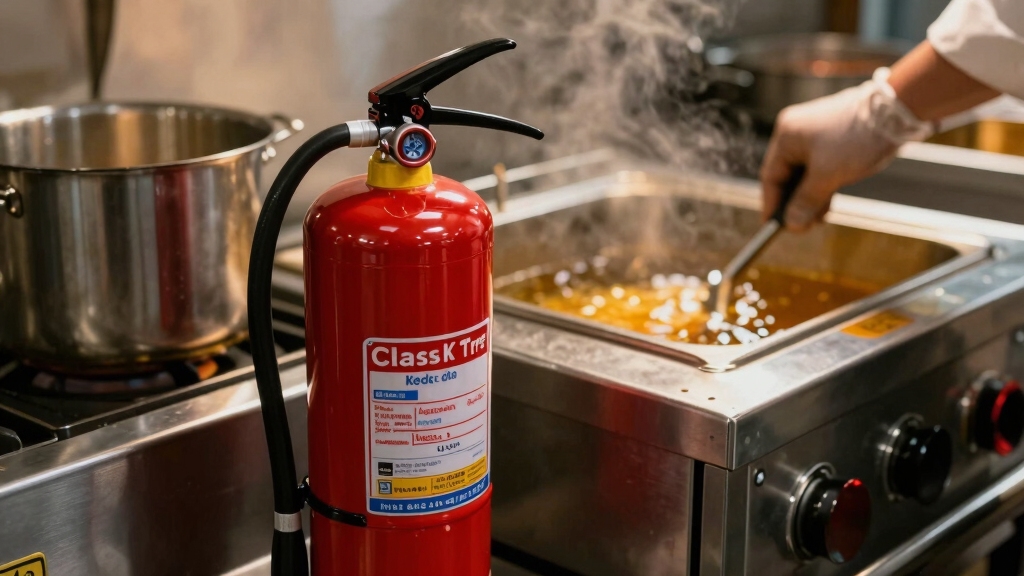
Although many fire extinguishers target general hazards, a Class K fire extinguisher specifically addresses fires fueled by combustible cooking media like vegetable oils, animal fats, and grease.
Class K fire extinguishers are designed for fires fueled by cooking oils, fats, and grease.
You need one because these fires burn at extremely high temperatures, often exceeding 1000°F. Traditional dry chemical or water-based extinguishers are ineffective and dangerous in these situations.
Class K extinguishers use a wet chemical agent that initiates saponification, turning hot oils into a thick, soapy foam. This foam smothers the fire and cools the fuel, preventing reignition.
These devices are essential in commercial kitchens, restaurants, and deep fryer stations where combustible cooking media present a persistent fire risk.
Compliance with NFPA 10 standards mandates their presence to guarantee safe and effective fire suppression in these high-risk environments.
Unlike BC or Class B extinguishers, which lack the wet chemical action needed to effectively cool and saponify burning oils, Class K extinguishers provide superior fire control for kitchen grease fires.
Why Do Traditional Extinguishers Fail on Kitchen Grease Fires?
Understanding why Class K extinguishers outperform traditional ones requires examining the limitations of common fire suppression methods on kitchen grease fires.
Traditional extinguishers, such as Class A, B, or dry chemical types, fail primarily because they can’t sufficiently cool or smother the high-temperature oils fueling these fires.
When you use water or standard agents, the burning grease often splashes or spreads, intensifying the hazard.
Dry chemicals lack the cooling capacity needed to reduce the oil temperature below its ignition point, causing rapid re-ignition.
Additionally, these agents don’t create a stable barrier to cut off oxygen from the fuel.
Without this, the fire continues burning beneath the surface.
That’s why relying on conventional extinguishers puts you at risk and underscores the need for specialized Class K solutions in kitchen environments.
Class K extinguishers use agents designed to form a stable barrier that effectively smothers grease fires and cools the oil to prevent re-ignition.
How Do Class K Extinguishers Work With Cooking Oil Fires?
When you grab a Class K extinguisher to tackle a cooking oil fire, there’s some fascinating chemistry at play. The wet chemical agent in the extinguisher kicks off a saponification reaction. What does that mean? Essentially, it transforms the burning grease into a soapy foam.
This foam isn’t just any ordinary foam; it smothers the fire by cutting off its oxygen supply. Plus, it cools down the hot surface, preventing any chance of reignition. So, understanding how this chemical and physical process works is really crucial if you want to effectively control those tricky kitchen grease fires. Class K extinguishers are specifically designed for cooking oils and fats and work much more safely and effectively than water or other common extinguishing agents.
Chemical Reaction Process
Class K fire extinguishers deploy a specialized wet chemical agent that reacts directly with burning cooking oils through a process called saponification.
When you discharge the extinguisher, the alkaline solution, often containing potassium acetate or carbonate, mixes with the hot fats. This triggers a chemical reaction that breaks down triglycerides in the grease.
This reaction converts the burning oils into a thick, soap-like foam that adheres tightly to the surface. You’ll notice this foam forms a stable, soapy layer that interrupts the combustion cycle by chemically neutralizing the fuel.
This saponification process is unique to Class K agents and essential for effectively tackling high-temperature kitchen fires involving vegetable oils and animal fats. It guarantees the fire’s fuel changes state, preventing ongoing combustion at the molecular level.
Class K extinguishers are also often certified for use with other fire classes such as Class A and electrical fires, making them versatile for kitchen environments with multiple fire risks.
Cooling And Smothering
Combining rapid cooling with effective smothering, Class K extinguishers quickly reduce the surface temperature of burning oils while forming a thick foam barrier.
When you discharge the wet chemical agent, it reacts with the hot cooking oil through saponification, producing a dense, soapy foam that blankets the fire.
This foam deprives the flames of oxygen, effectively smothering the fire, while simultaneously cooling the oil below its ignition point to prevent reignition.
The dual action guarantees that the fire is suppressed safely and efficiently without splashing or spreading burning grease.
It is important to note that ABC fire extinguishers are not recommended for kitchen grease fires, highlighting the necessity of using Class K extinguishers specifically designed for this hazard.
What Makes Class K Extinguishers Different From Other Types?
Although many fire extinguishers appear similar, Class K units are specifically engineered to tackle the unique challenges posed by cooking oil fires.
Unlike Class A or B extinguishers, Class K uses a wet chemical agent that reacts chemically with hot oils, creating a soapy foam that cools and smothers flames.
This saponification process prevents re-ignition and controls high-temperature grease fires, which dry chemical or CO2 extinguishers cannot safely manage.
Class K extinguishers are distinct because they require specialized dry powders different from the typical dry chemical agents used in other fire classes.
| Feature | Class K Extinguisher |
|---|---|
| Target Fire Type | Cooking oils and fats |
| Extinguishing Agent | Wet chemical (alkaline solution) |
| Fire Suppression | Saponification and cooling |
| Safety Advantage | Prevents grease re-ignition and splash |
You need Class K for kitchen-specific fire hazards.
Where Should You Place Class K Extinguishers in Commercial Kitchens?
When positioning extinguishers in commercial kitchens, you need to follow strict guidelines to guarantee quick and effective access during cooking oil fires.
Place Class K extinguishers within 30 feet of all major cooking appliances, including deep fat fryers, griddles, and ranges.
The IFC mandates one 6-liter unit for every four deep fat fryers, ensuring adequate coverage.
Mount extinguishers at a visible, unobstructed height, typically between 3.5 and 5 feet from the floor.
Avoid locating them too close to heat sources to prevent premature damage but close enough for rapid deployment.
If a fixed automatic system exists, install portable Class K units as secondary backup nearby.
Regularly inspect placement to confirm compliance with NFPA 10 standards, enabling personnel to respond immediately and contain high-temperature oil fires effectively.
Additionally, ensure that maintenance includes regular testing and inspection to prevent equipment failure and maintain readiness.
How Do Class K Extinguishers Stop Cooking Oil Fires?
When you grab a Class K extinguisher for a cooking oil fire, something interesting happens. The wet chemical agent inside triggers a saponification reaction. This means that the burning grease transforms into a soapy foam.
Now, why is that important? Well, this foam creates a cooling barrier that cuts off the oxygen supply. It smothers the flames and lowers the temperature, making it much harder for the fire to reignite. Unlike gasoline fires, Class K extinguishers use agents designed specifically for cooking oils rather than Class B extinguishers used on flammable liquids like gasoline.
Saponification Chemical Reaction
Because cooking oil fires burn at extremely high temperatures, Class K extinguishers use a specialized wet chemical agent that initiates a saponification reaction upon contact with the hot grease.
This chemical process converts the burning oil’s fatty acids into a thick, soapy foam that smothers flames by forming a barrier between the fuel and oxygen.
Additionally, saponification cools the surface, reducing the risk of reignition.
| Component | Role |
|---|---|
| Wet chemical agent | Contains potassium salts |
| Hot grease | Reactant initiating saponification |
| Soapy foam | Smothers fire by oxygen exclusion |
| Cooling effect | Lowers grease temperature |
| Foam barrier | Prevents re-ignition |
This precise chemical action makes Class K extinguishers uniquely effective against cooking oil fires. Unlike dry chemical agents such as Purple K fire extinguishers, Class K agents rely on a wet chemical formula to cool and chemically neutralize cooking oil fires.
Foam Cooling Barrier
The saponification reaction not only produces a soapy foam but also forms a physical barrier that plays a pivotal role in extinguishing cooking oil fires.
This foam blanket isolates the burning oil from oxygen, effectively smothering the flames and preventing re-ignition.
You’ll notice that the foam also has a significant cooling effect; it absorbs heat from the oil’s surface, reducing the temperature below the ignition point.
This dual function of oxygen exclusion and surface cooling makes the Class K extinguisher highly effective.
As you apply the wet chemical agent, the foam layer stabilizes quickly, sealing the hot grease beneath and disrupting the fire’s fuel-oxygen chain reaction.
Without this cooling barrier, the risk of flare-ups or reignition remains high, so its formation is pivotal for complete fire suppression in kitchen environments.
For comprehensive kitchen safety, it is also important to have properly installed smoke and carbon monoxide alarms nearby to ensure early detection of hazards.
How Do You Use a Class K Extinguisher Safely and Effectively?
Although kitchen fires can escalate rapidly, you can control them effectively by using a Class K extinguisher correctly. First, pull the pin to release the operating lever.
Aim the nozzle at the base of the fire, targeting the burning cooking media, not the flames. Squeeze the handle to discharge the wet chemical agent and sweep the spray side to side to cover the entire fire surface.
Aim the nozzle at the fire’s base, squeezing and sweeping the spray to fully cover burning cooking media.
This ensures the saponification process forms a thick foam barrier, smothering the fire and cooling hot oils. Maintain a safe distance as you operate and never use water or dry chemicals, which can cause dangerous splashing or re-flash.
Always follow your facility’s training protocols and confirm the extinguisher’s readiness before use for maximum safety and effectiveness.
How Do You Maintain Class K Extinguishers to Keep Them Ready?
Regularly inspecting and maintaining your Class K extinguisher guarantees it functions effectively during a kitchen fire emergency. You need to verify that the extinguisher’s pressure gauge shows adequate pressure, assuring the wet chemical agent is ready to deploy.
Check the discharge nozzle and misting system for blockages or damage that could impede operation. Also, confirm the extinguisher’s external condition, looking for corrosion or physical damage that might compromise integrity.
To keep your Class K extinguisher ready, you should:
Perform monthly visual inspections and document findings. Schedule annual professional maintenance to test agent concentration and mechanical components.
Replace or recharge the extinguisher immediately if the agent is depleted, contaminated, or if the unit shows signs of damage.
Adhering to these steps helps maintain compliance and assures reliable performance.
What Are the Fire Codes and Regulations for Class K Extinguishers?
When managing kitchen fire safety, you must comply with specific fire codes and regulations that govern Class K extinguishers. The NFPA 10 standard mandates that these extinguishers be listed and labeled specifically for cooking media fire protection.
According to the International Fire Code (IFC) 906.4.2, you’re required to install at least one 6-liter Class K extinguisher for every four deep fat fryers. Placement is critical; units should be within 30 feet of major cooking appliances to guarantee quick access.
Additionally, fixed extinguishing systems must activate before manual Class K extinguishers are deployed, serving as a primary defense. You also need to verify that extinguisher capacity meets commercial kitchen demands and that inspections comply with local jurisdiction requirements to maintain regulatory compliance and peak safety.
Frequently Asked Questions
Can Class K Extinguishers Be Used on Home Kitchen Fires?
Yes, you can use a Class K extinguisher on home kitchen fires, especially those involving cooking oils or grease.
Though designed for commercial kitchens, their wet chemical agents effectively saponify burning fats, controlling flames and preventing reignition.
However, make certain your extinguisher meets NFPA standards and you follow proper operation techniques.
Smaller residential models exist, but always prioritize safety and consider calling emergency services for large or uncontrollable fires.
How Long Does a Class K Extinguisher Last After Discharge?
A Class K fire extinguisher typically discharges for about 30 seconds, depending on its size and pressure.
After use, you shouldn’t attempt to reuse it, as the wet chemical solution will be depleted or contaminated.
You need to have it professionally recharged or replaced immediately to guarantee effectiveness.
Regular maintenance checks help confirm it’s ready when needed, so don’t skip inspections and follow manufacturer guidelines for proper care.
Are Class K Extinguishers Safe for Electrical Cooking Appliances?
Yes, Class K extinguishers are safe for electrical cooking appliances because their wet chemical agents use a low-conductivity, non-corrosive solution.
When you discharge a Class K extinguisher, the alkaline mixture forms a soapy foam that smothers grease fires without causing electrical shorts or shocks.
Still, always make sure the appliance is de-energized if possible to minimize risk. Proper maintenance guarantees the extinguisher’s effectiveness and safety during use.
What Is the Cost Range for Purchasing a Class K Extinguisher?
You’ll find Class K fire extinguishers typically cost between $120 and $300, depending on size and manufacturer.
For commercial kitchens, a 6-liter unit meeting NFPA 10 standards is standard and usually falls within this range.
Keep in mind, investing in a quality extinguisher is essential since cooking oil fires can reach over 1,000°F.
This demands specialized wet chemical agents for effective suppression and safety compliance.
Can Class K Extinguishers Be Refilled or Do They Require Replacement?
Yes, you can refill Class K extinguishers, but only through certified professionals who follow strict maintenance protocols.
After use or periodic inspection, the alkaline wet chemical solution must be checked for contamination or depletion.
If it’s compromised, refilling and recharging are necessary to restore functionality.
However, if the extinguisher shows physical damage or corrosion, replacement is recommended to guarantee reliable performance and compliance with safety standards.
Stay Prepared with the Right Class K Fire Extinguisher
When it comes to kitchen safety, a Class K fire extinguisher is your frontline defense against dangerous grease fires.
Traditional extinguishers often fall short, but Class K agents smother flames by cooling and sealing the oil’s surface.
This stops fires before they spread. Think of it as a surgeon’s scalpel: precise and effective.
Keep your extinguisher well-maintained and strategically placed in your commercial kitchen to guarantee it’s ready when you need it most.