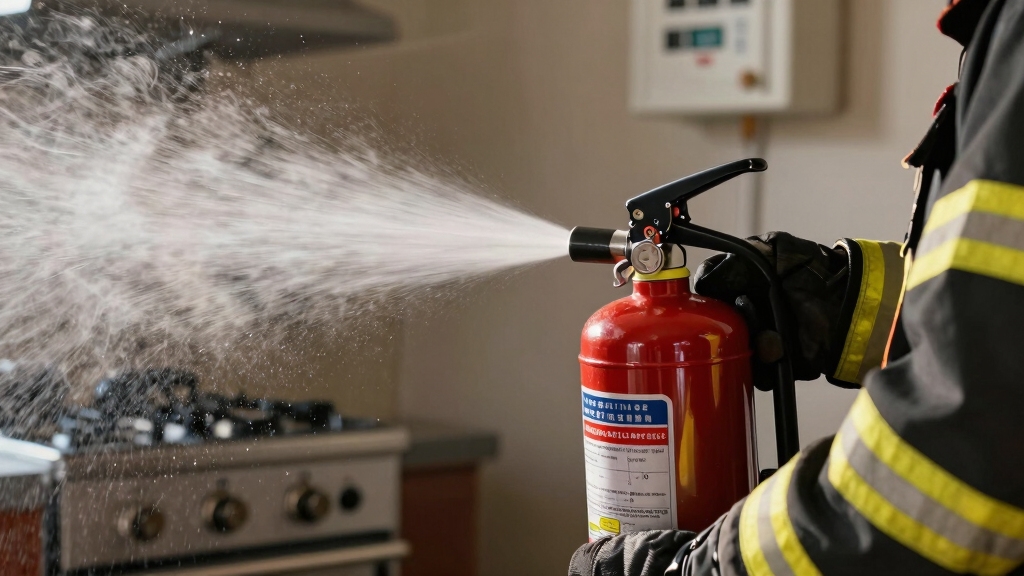

You use water mist fire extinguishers to tackle Class A solids, Class B flammable liquids, Class C gases, and certain Class F cooking oil fires with precision and minimal water damage.
They cool flames rapidly and generate steam to suffocate fires. They safely operate on energized electrical equipment up to 1000 volts when applied from at least one meter away.
Their fine mist reduces residue and risks to sensitive devices. Understanding their mechanisms and limitations guarantees peak, safe use in varied environments.
Key Takeaways
- Water mist fire extinguishers are used to safely extinguish Class A, B, C, and certified Class F cooking oil fires.
- They effectively cool fires by dispersing ultra-fine de-ionized water droplets that absorb heat and generate steam to suffocate flames.
- These extinguishers are safe for electrical fires up to 1000 V when used at a minimum distance of 1 meter.
- Ideal for sensitive environments like hospitals, offices, museums, and electronics-rich spaces due to minimal water damage and residue.
- Not suitable for Class D metal fires and require verification of certification for specific Class B and C fire applications.
What Fires Can Water Mist Extinguishers Put Out?
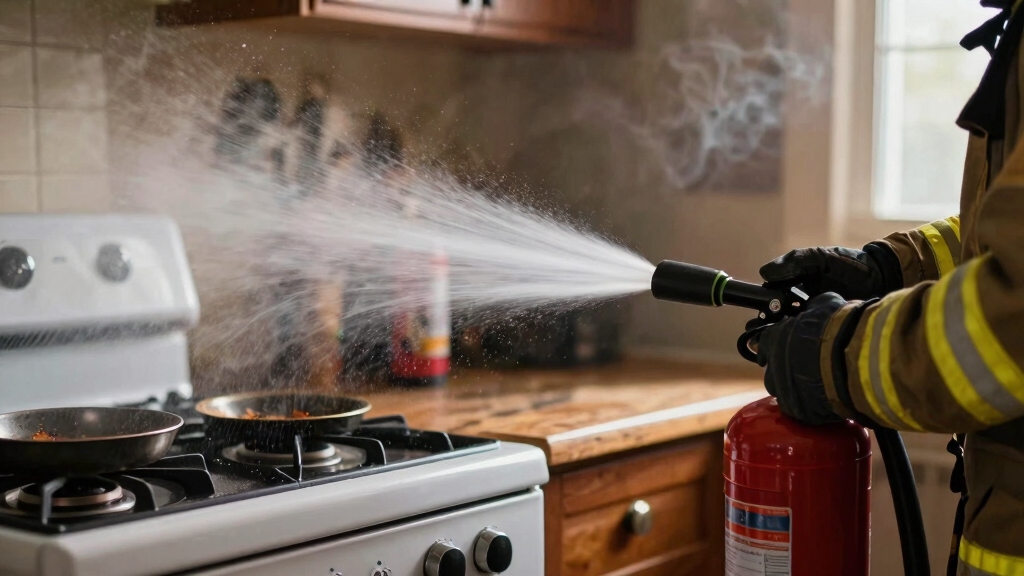
Although water mist extinguishers are primarily certified for Class A fires involving solids like wood and paper, they effectively tackle a broader range of fires. This includes Class B flammable liquids, Class C flammable gases, and even Class F cooking oil fires.
You can rely on their versatility when evaluating diverse fire risks in environments where multiple fire classes coexist. Their certification focuses on Class A, but their de-ionized water and fine mist technology allow safe application on flammable liquids and gases without spreading the fire.
Additionally, water mist extinguishers handle high-temperature cooking oil fires, a critical advantage in commercial kitchens. You should note, however, they aren’t suitable for Class D metal fires.
Understanding their fire class compatibility ensures you deploy them appropriately and safely in varied scenarios. Water mist extinguishers work primarily by cooling the fire, removing heat to lower the temperature below ignition point.
How Water Mist Extinguishers Fight Fires?
Utilizing a specialized nozzle, water mist extinguishers disperse ultra-fine water particles that penetrate the fire’s heat zone.
Water mist extinguishers release ultra-fine droplets that effectively reach and cool the fire’s core heat zone.
These microscopic droplets rapidly absorb heat, causing immediate evaporation. This phase change cools the combustion surface, reducing temperature below ignition levels.
Simultaneously, the mist displaces oxygen around the fire, lowering its concentration and hindering combustion.
Additionally, the water mist disrupts free radicals within the flame, breaking the chemical chain reaction essential for fire propagation.
This multi-pronged approach results in reliable and swift fire suppression.
Because the droplets are so fine, they maximize surface area coverage, enhancing cooling efficiency without dispersing burning materials.
Proper maintenance and full pressure ensure water mist extinguishers maintain typical discharge times close to manufacturer specifications for effective fire suppression.
Why Water Mist Extinguishers Are Safe for Electrical Fires?
You can count on water mist extinguishers for tackling electrical fires. Why? Well, they use de-ionized water, which is non-conductive. That makes them safe to use around live equipment. Pretty reassuring, right?
Each unit also goes through dielectric testing—up to 35,000 volts! This ensures they’ve high voltage resistance, so you know they’re reliable. Just remember to keep a one-meter distance from the electrical source when you’re using it. This helps prevent any conduction risks while you’re operating the extinguisher. Safety first!
Water mist extinguishers operate by releasing fine water droplets that effectively cool and smother fires without the risk of electrical conduction, making them ideal for energized electrical equipment fires.
Non-Conductive De-Ionized Water
Because water naturally conducts electricity, using standard water-based extinguishers on electrical fires poses substantial risks.
Water mist extinguishers, however, utilize de-ionized water, which is non-conductive due to the removal of dissolved salts and minerals that facilitate electrical conduction.
This absence of ions markedly reduces the risk of electrical shock to the user and prevents current flow through the extinguishing agent.
When you deploy a water mist extinguisher, the fine droplets not only cool the fire but also maintain electrical safety up to 1000V at a 1-meter distance.
The de-ionized water’s dielectric properties have been rigorously tested, ensuring safe application on electrical fires without compromising firefighting effectiveness or user safety.
This makes water mist extinguishers a reliable solution in environments with electrical hazards.
Additionally, the use of corrosion inhibitors in the water mist formulation helps protect equipment integrity during storage and use.
High Voltage Dielectric Testing
Building on the non-conductive nature of de-ionized water, water mist extinguishers undergo rigorous high voltage dielectric testing to confirm their safety around electrical equipment.
This testing assures the extinguisher can operate without conducting electricity, preventing shock hazards during use on electrical fires up to 1000V.
The process involves subjecting the water mist system to voltages as high as 35,000V to verify insulation integrity and operational safety.
You can rely on these key factors:
- Non-conductivity: De-ionized water resists electrical flow, critical for safe extinguishing on energized equipment.
- Dielectric testing at 35,000V: Confirms the extinguisher’s internal components and mist remain electrically isolated.
- Safe discharge distance: Assures the mist suppresses fire without creating electrical conduction paths.
This testing guarantees water mist extinguishers mitigate electrical fire risks safely and effectively. Additionally, unlike water, substances such as flour and baking powder can worsen fires, highlighting the importance of using appropriate extinguishing agents for different fire types.
Safe Distance Electrical Use
While addressing electrical fires demands caution, water mist extinguishers offer a safe solution when used at a minimum distance of one meter from energized equipment up to 1000 volts.
Their de-ionized water is non-conductive and di-electrically tested to 35,000V, ensuring user safety. The fine mist cools and displaces oxygen without creating electrical hazards.
| Feature | Benefit |
|---|---|
| Minimum 1m Distance | Prevents electrical conduction risks |
| De-ionized Water | Non-conductive, safe on energized parts |
| Fine Mist Particles | Rapid cooling, minimal residue |
You can confidently use water mist extinguishers near electrical fires, provided you maintain this safe distance. This combines effectiveness with electrical safety. Regular inspections and maintenance of the extinguisher’s valves and hoses ensure reliable performance and prevent leaks or failures.
How to Use a Water Mist Fire Extinguisher Safely?
When using a water mist fire extinguisher, it’s really important to keep a safe distance—at least one meter—especially if you’re dealing with electrical fires. This helps you stay out of harm’s way while still being effective.
Now, let’s talk about the PASS method. It’s super easy to remember: Pull the pin, Aim at the base of the fire, Squeeze the handle, and then Sweep side to side. This technique is key for putting out the flames effectively.
And don’t forget to always keep safety precautions in mind! They’re there to protect you and ensure that your extinguisher works at its best. Stay safe out there!
Water mist extinguishers are especially useful because their non-conductive agent allows safe use on energized electrical fires.
Proper Distance From Fire
Since water mist fire extinguishers use de-ionized water that’s safe around electricity, you must still maintain a minimum distance of 1 meter from the fire when operating them on electrical fires up to 1000 volts.
This safety margin guarantees you avoid electrical hazards while optimizing extinguishing performance.
When positioning yourself:
- Stand at least 1 meter away from electrical fires to prevent electrical shock and guarantee effective mist dispersion.
- Adjust your distance based on fire intensity—closer for smaller fires, but never less than 1 meter on electrical risks.
- Maintain a steady stance to control the extinguisher’s fine mist nozzle, allowing mist particles to absorb heat efficiently and disrupt combustion radicals.
Adhering to this protocol maximizes safety and efficiency when tackling fires involving electrical equipment or flammable materials. Always remember to aim at the base of the fire when using any extinguisher to ensure effective suppression.
Correct Extinguisher Operation
Mastering the correct operation of a water mist fire extinguisher hinges on following the standardized PASS method: Pull, Aim, Squeeze, Sweep.
First, pull the safety pin to release the extinguisher. Then, aim the nozzle at the base of the fire, ensuring a 1-meter distance for electrical hazards to maintain safety.
Next, squeeze the handle steadily to release a fine mist of de-ionized water, which rapidly cools and disrupts the fire’s chemical reactions.
Finally, sweep the nozzle side-to-side across the fire’s base to maximize coverage and extinguishment efficiency.
This precise technique leverages the extinguisher’s unique mist particle dispersion, ensuring rapid heat absorption and oxygen displacement without scattering burning materials.
Adhering to this method guarantees peak performance and fire suppression with minimal collateral damage.
Water mist extinguishers effectively target the fire triangle by simultaneously cooling and displacing oxygen, which helps to quickly break the combustion cycle for incipient fires through heat absorption and oxygen removal.
Safety Precautions For Use
Understanding the correct operation of a water mist fire extinguisher sets the foundation for its safe use. You must maintain a minimum 1-meter distance when tackling electrical fires up to 1000V to avoid electric shock.
Follow the PASS method: Pull, Aim, Squeeze, Sweep for precise deployment. Never use it on Class D metal fires, as it’s ineffective and potentially hazardous.
To ensure safety, remember these key precautions:
- Confirm the fire class compatibility before use, focusing on Class A, B, C, and F fires.
- Use de-ionized water refills to maintain non-conductivity and prevent damage.
- Avoid direct contact with flames; instead, apply mist to the base of the fire to maximize cooling and radical removal.
Adhering to these technical protocols guarantees effective and safe extinguishing performance. The effectiveness of water mist largely depends on its ability to produce steam that displaces oxygen, which helps suffocate flames and enhance fire suppression.
Where Water Mist Extinguishers Are Most Effective?
Water mist extinguishers frequently prove most effective in environments where sensitive equipment or valuable materials require protection from both fire and water damage.
You’ll find them ideal for spaces with electrical apparatus or delicate archival items, as their fine mist minimizes water exposure while extinguishing fires efficiently.
They excel on Class A fires involving solids and safely handle electrical fires up to 1000V at 1m distance.
| Environment | Fire Classes Handled | Key Benefit |
|---|---|---|
| Hospitals | A, Electrical | Protects sensitive medical gear |
| Offices | A, Electrical | Safe for electronics |
| Museums/Libraries | A | Preserves valuable materials |
| Telecommunications | A, Electrical | Prevents equipment damage |
This precision makes water mist extinguishers highly effective where fire suppression must avoid collateral damage.
Advantages of Water Mist Extinguishers Over Other Types
The ability of water mist extinguishers to protect sensitive equipment and valuable materials without causing water damage sets them apart from many traditional fire suppression options.
Water mist extinguishers safeguard delicate equipment and valuables without the risk of water damage.
When you choose a water mist extinguisher, you benefit from its precise mechanism of dispersing ultra-fine droplets (40-60 microns) that cool and suffocate fire efficiently while minimizing water use.
Here are three key advantages you’ll appreciate:
- Minimal Water Usage: Uses 70-90% less water than conventional sprinklers, reducing water damage risk.
- Electrical Safety: Employs de-ionized water, allowing safe use on live electrical fires up to 1000V at 1m distance.
- Versatility: Suitable for multiple fire classes including solids, flammable liquids, gases, and cooking oils, enhancing your risk management options.
This combination of features makes water mist extinguishers uniquely effective in sensitive and mixed-risk environments.
Limitations and Safety Precautions for Water Mist Extinguishers
Although water mist extinguishers offer broad fire protection capabilities, they come with specific limitations and safety precautions you must observe to guarantee effective use.
You should maintain a minimum 1-meter distance when tackling electrical fires. Avoid using them on Class D metal fires. De-ionized water refills may be sold separately, requiring attention to maintenance.
| Limitation | Safety Precaution | Notes |
|---|---|---|
| Not certified for Class B/C | Use only on Class A, F, C | Check certification before use |
| Requires 1m distance | Maintain safe distance | Prevents electrical hazards |
| De-ionized water separate | Assure proper refill | Avoids conductivity risks |
Choosing the Right Water Mist Extinguisher for Your Situation
When selecting a water mist extinguisher, you need to take into account the specific fire risks and environment in which it will be used. This guarantees compatibility with fire classes and safety requirements.
First, identify the predominant fire types: Class A, F, or electrically energized fires up to 1000V at 1m distance. Confirm the extinguisher’s certification covers these.
Second, assess environmental constraints. For clean rooms or electronics-rich spaces, prioritize models using de-ionized water to avoid conductivity and residue.
Third, consider operational factors such as nozzle design for peak mist particle size (40-60 microns) and user safety features like non-toxicity and the PASS method compatibility.
These criteria ensure you select a water mist extinguisher that delivers efficient, safe, and compliant fire suppression tailored to your specific needs.
Frequently Asked Questions
How Often Should Water Mist Extinguishers Be Serviced or Inspected?
Think of your water mist extinguisher like a well-oiled machine. It needs regular check-ups to function flawlessly.
You should inspect it monthly to spot any visible damage or pressure loss.
Have a professional service it annually. This includes checking seals, nozzle function, and refilling de-ionized water if needed.
Proper maintenance guarantees it’s ready to deploy effectively, especially given its specialized de-ionized water and sensitive components.
Can Water Mist Extinguishers Be Used in Outdoor Environments?
Yes, you can use water mist extinguishers outdoors, but you need to take into account environmental factors like wind. Wind may disperse the mist and reduce effectiveness.
They’re best applied in sheltered or semi-enclosed areas where mist can concentrate on the fire. Since they cool and suffocate fires rapidly, outdoor use is possible.
However, maintain the 1m safety distance for electrical hazards and ensure you have a clear line of sight for precise aiming.
What Is the Typical Lifespan of a Water Mist Fire Extinguisher?
You can expect a water mist fire extinguisher to have a dependable service life of around 10 to 15 years, provided you maintain it properly.
Regular inspections and timely refills are vital to preserve its peak functionality.
Keep in mind that environmental factors and usage frequency can influence its longevity.
Always follow manufacturer guidelines and conduct annual servicing to guarantee your extinguisher remains reliable when you need it most.
Are Water Mist Extinguishers Effective on Grease Fires in Commercial Kitchens?
Yes, you can rely on water mist extinguishers for grease fires in commercial kitchens.
They effectively tackle Class F fires, which involve cooking oils, by dispersing fine water mist that rapidly cools and suppresses flames without spreading hot oil.
Their non-conductive, residue-free nature guarantees safety around kitchen electronics.
However, always maintain a safe distance and follow proper operation steps to maximize effectiveness and avoid risks associated with direct water application on grease fires.
Can Water Mist Extinguishers Be Refilled or Recycled After Use?
Think of your water mist extinguisher as a trusty steed that can be saddled up again after a charge.
Yes, you can refill water mist extinguishers, often at a lower cost than replacing them.
The de-ionized water may need replenishing separately.
After use, proper recycling of components guarantees environmental compliance.
Always follow manufacturer guidelines and local regulations to maintain safety and functionality efficiently.
Master Fire Safety with the Power of Water Mist
When a fire sparks, imagine a fine, powerful mist swiftly blanketing flames, cutting oxygen and cooling heat instantly. Water mist extinguishers offer you precise control and safety, especially near electrical hazards.
By understanding their strengths and limits, you can confidently choose and use these advanced tools to protect your space. With the right extinguisher in hand, you’re ready to act decisively, minimizing damage while maximizing safety.