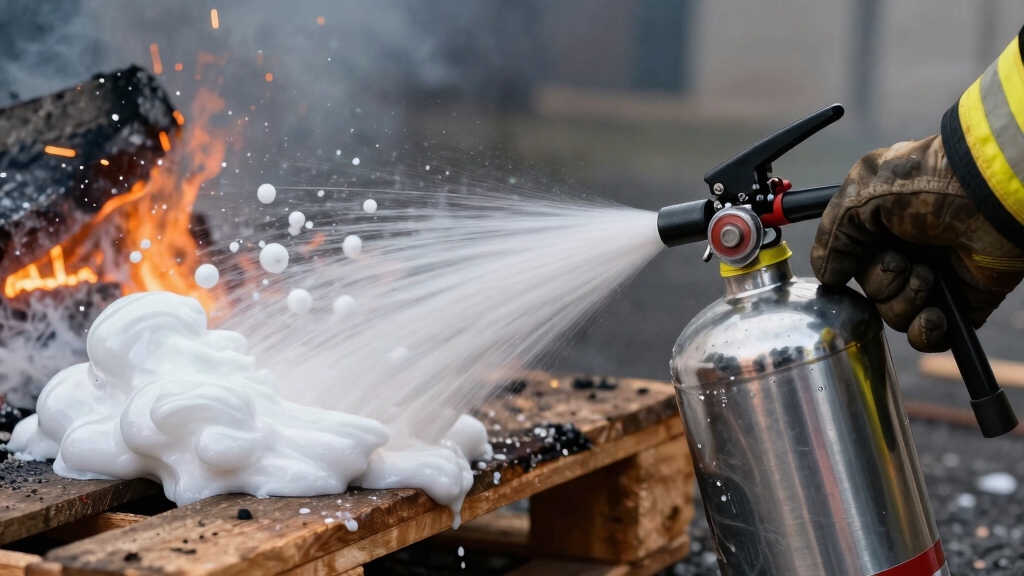

Fire extinguisher foam is made from an aqueous solution containing 20–60% foam agents like surfactants, with stabilizers such as lauryl alcohol and corrosion inhibitors.
These surfactants reduce surface tension, allowing rapid bubble formation to isolate fuel from oxygen and suppress vapors. Water acts as the heat-absorbing medium, while additives enhance foam stability and effectiveness.
You’ll find fluorinated foams excel in rapid coverage, whereas fluorine-free options focus on environmental safety. Exploring further reveals how the chemistry balances safety and performance.
Key Takeaways
- Fire extinguisher foam consists of an aqueous solution with 20–60% foam agent and 1–10% stabilizing additives like lauryl alcohol.
- Surfactants in foam lower surface tension, create bubbles, and form a film to isolate fuel from oxygen and suppress vapors.
- Foam concentrates are typically mixed with water, commonly at 3% concentrate to 97% water, to produce the usable foam premix.
- Fluorinated foams use fluorocarbon surfactants for rapid fuel coverage, while fluorine-free foams rely on hydrocarbon surfactants and protein derivatives.
- Additional components like corrosion inhibitors and organic solvents improve foam stability, viscosity, and resistance to solvents and re-ignition.
Main Ingredients in Fire Extinguisher Foam
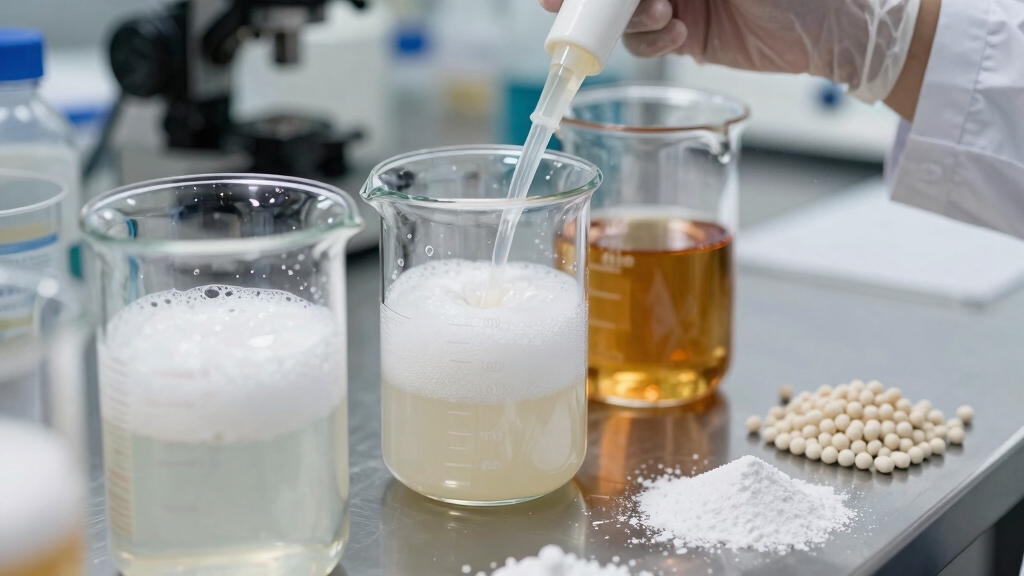
A fire extinguisher foam’s effectiveness hinges on its carefully balanced main ingredients, primarily aqueous solutions containing 20-60% foam agent, 1-10% stabilizing additives, and 1-10% compensating agents.
You mix these concentrates with water at specific ratios, commonly 3% concentrate to 97% water, to create the premix solution. When air expands this premix in generating equipment, it forms the foam blanket.
The foam agent mainly consists of surfactants that produce foam at concentrations below 1%. Stabilizers like lauryl alcohol enhance foam blanket stability, while compensating agents adjust properties such as viscosity and corrosion resistance.
Additional components may include organic solvents and corrosion inhibitors, ensuring the foam maintains performance under varying conditions. Understanding this composition lets you appreciate the precise chemical engineering behind effective fire suppression foams.
Differences Between Fluorinated and Fluorine-Free Foams
When comparing fluorinated and fluorine-free foams, you’ll notice distinct chemical compositions and fire suppression mechanisms that impact performance and environmental profiles.
Fluorinated foams, like AFFF and AR-AFFF, incorporate fluorocarbon surfactants that form aqueous films. These films spread rapidly over hydrocarbon fuels, enhancing suppression efficiency.
Fluorinated foams use fluorocarbon surfactants to create fast-spreading aqueous films for effective hydrocarbon fuel suppression.
These foams use C6 fluorosurfactants for lower toxicity but still contain perfluorohexanoic acid (PFHxA), a persistent compound.
In contrast, fluorine-free foams (FFF) rely on hydrocarbon surfactants, protein derivatives, and stabilizers to create bubble-rich blankets without fluorinated chemicals.
Though FFFs reduce PFAS accumulation risks and environmental toxicity, their film-forming capabilities and solvent resistance are generally inferior to fluorinated variants.
You’ll find that fluorinated foams excel in rapid fuel coverage, while fluorine-free alternatives prioritize ecological safety.
This requires tailored application strategies to optimize firefighting outcomes.
Proper foam stabilizers are essential to maintain bubble integrity for prolonged coverage and effectiveness in firefighting situations.
How Foam Agents Extinguish Fires?
Understanding how foam agents extinguish fires requires examining their chemical and physical actions on fuel surfaces.
When you apply foam, surfactants create a cohesive aqueous film that spreads across the fuel, isolating it from oxygen and interrupting combustion.
The foam blanket’s stable bubble matrix suppresses vapor release, reducing flammable gas concentration above the fuel.
In alcohol-resistant foams, polymer layers form, preventing solvent penetration and maintaining foam integrity on polar fuels.
The oleophobic nature of fluorocarbon surfactants further inhibits fuel re-ignition by repelling hydrocarbons.
Physically, foam expansion dilutes the fuel surface temperature and blocks oxygen access.
Chemically, surfactant molecules lower surface tension to maintain film coverage.
These combined actions rapidly interrupt the fire triangle: heat, fuel, and oxygen, effectively extinguishing the fire and preventing its recurrence.
Roles of Water, Surfactants, and Additives in Foam Performance
Although water forms the bulk of fire extinguisher foam solutions, its role extends beyond mere dilution. It acts as the continuous phase that facilitates foam expansion and heat absorption.
You rely on water to absorb heat rapidly, lowering temperature and preventing reignition. Surfactants, typically fluorocarbon and hydrocarbon-based, reduce surface tension and stabilize bubbles.
This enables the foam to spread evenly over fuel surfaces. These compounds are essential for forming aqueous films that suffocate fires by cutting oxygen access.
Additives like lauryl alcohol and solvents enhance foam stability and longevity, preventing premature collapse. Corrosion inhibitors protect equipment integrity, while compensating agents adjust viscosity for peak flow.
Understanding these components helps you optimize foam performance, ensuring effective suppression across various fire classes. This is done without compromising the foam’s structural integrity or heat transfer properties.
Balancing Safety and Performance in Modern Foam Formulations
Since fire extinguishing foam must meet stringent safety and environmental standards, you need formulations that deliver high performance without compromising health or ecosystem integrity.
Modern foams balance efficacy by using shorter-chain fluorosurfactants like C6 PFHxA and fluorine-free alternatives to reduce persistent environmental contaminants. You must consider foam stability, extinguishing speed, and toxicity simultaneously.
It is also important to understand that unlike fire extinguishers, foam formulations do not involve pressure relief valves that manage internal forces for safety.
| Parameter | Typical Values/Notes |
|---|---|
| Fluorosurfactants | C6 PFHxA replacing C8 compounds |
| Foam Concentration | 1-6% concentrate in water mixtures |
| Additives | Stabilizers, solvents, corrosion inhibitors |
| Expansion Ratio | <20 for low-expansion foams |
| Environmental Impact | Reduced PFAS, biodegradable options |
Frequently Asked Questions
How Is Fire Extinguisher Foam Tested for Environmental Impact?
You test fire extinguisher foam for environmental impact by analyzing its chemical composition, focusing on PFAS levels, especially PFHxA and PFOA.
You conduct biodegradability and toxicity assays on aquatic organisms to assess persistence and bioaccumulation.
Regulatory limits, like PFOA below 0.025 mg/kg, guide compliance.
You also evaluate fluorine-free alternatives for reduced environmental risks.
Thorough testing guarantees foam formulations meet environmental safety standards and minimize ecological harm.
What Equipment Is Needed to Generate Finished Foam From Concentrates?
You’ll need a foam proportioner or eductor to mix the concentrate with water at precise ratios, typically 1-6%.
Then, a foam generator or nozzle injects air into this premix to create finished foam.
Equipment like air-aspirating nozzles guarantees proper expansion, usually under 20 times volume for AFFF.
This system delivers a stable foam blanket by combining water, concentrate, and air efficiently, maximizing fire suppression effectiveness.
How Do Expansion Ratios Affect Foam Application and Effectiveness?
Expansion ratios directly impact foam application and effectiveness by controlling foam density and coverage.
Lower expansion foams (under 20) produce denser blankets that provide superior fuel suppression and oxygen barrier. They’re ideal for hydrocarbon fires.
Higher expansion foams create lighter, voluminous blankets that are better for large surface areas or difficult access. However, they offer less fuel smothering power.
You’ll select expansion ratios based on fire type and environment to optimize extinguishment and prevent reignition.
What Regulations Control the Use of PFAS in Firefighting Foams?
When a military base phased out C8 PFAS-based AFFF foams, they complied with EPA’s 2020 PFAS regulations limiting PFOA to below 0.025 mg/kg.
These rules restrict long-chain PFAS use, encouraging shifts to shorter-chain C6 PFHxA or fluorine-free alternatives.
You must monitor PFAS concentrations and maintain precise mixing ratios of 3% or 6% to meet environmental standards.
This ensures firefighting efficacy while minimizing persistent chemical accumulation.
Can Fire Extinguisher Foam Be Safely Used on Electrical Fires?
You can use certain fire extinguisher foams on electrical fires, but only those specifically rated for Class C hazards.
Most foam types contain water and conductive components, risking electrical shock.
Fluorinated foams like AFFF may be safe if designed for electrical use and applied cautiously.
Always check the foam’s classification and manufacturer guidelines to make certain it won’t conduct electricity.
This helps prevent injury and equipment damage during fire suppression on energized electrical sources.
From Flames to Safety: The Power of Firefighting Foam
When you use fire extinguisher foam, you’re relying on a carefully engineered cocktail of water, surfactants, and additives working in harmony.
Whether fluorinated or fluorine-free, each formulation targets fire suppression with precision. Think of foam as a shield, cutting off oxygen and cooling flames simultaneously.
By balancing safety and performance, modern foams guarantee effective fire control without compromising environmental or health standards.
They turn chaos into calm with scientific finesse.